Xolotl the Dog Guide
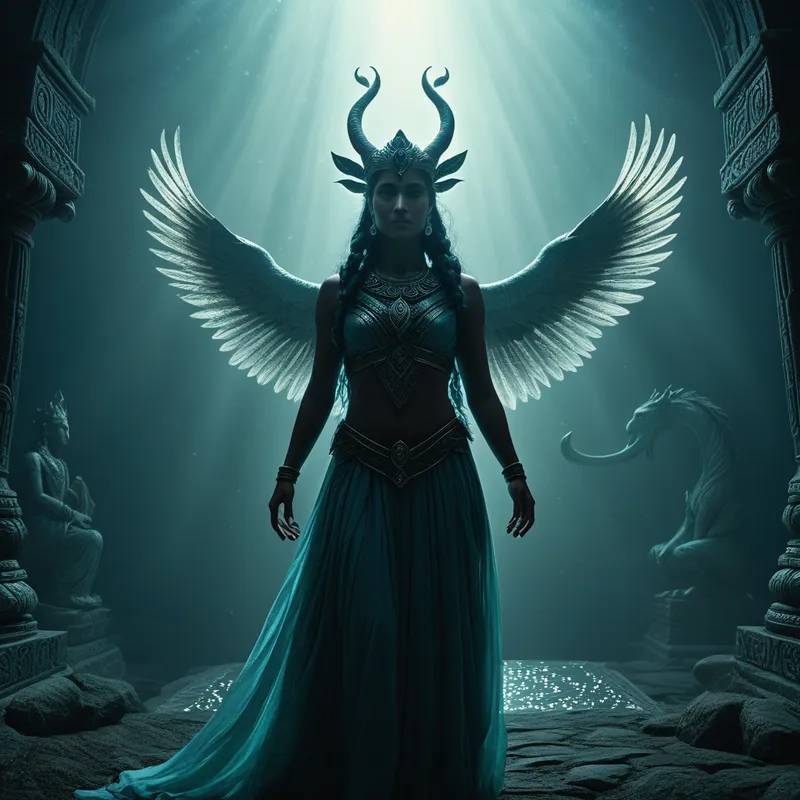
Xolotl, the Aztec dog-headed deity, served as a guide to the underworld while embodying lightning, monsters, and the evening star in a complex mythological role.
The Tale of Xolotl the Dog Guide
In the deep, star-scattered time of [the Fifth Sun](/myths/the-fifth-sun “Myth from Aztec culture.”/), the gods gathered at the sacred city of Teotihuacan. A great darkness had fallen; the Fourth Sun had perished, and [the world](/myths/the-world “Myth from Tarot culture.”/) lay still and lightless. To bring forth a new dawn, a supreme sacrifice was required: a god must cast themselves into the divine, cleansing fire to become the new sun. The proud and wealthy [Tezcatlipoca](/myths/tezcatlipoca “Myth from Mesoamerican culture.”/) and [Tlaloc](/myths/tlaloc “Myth from Aztec culture.”/) each tried, but the flames rejected them. Then, the humble and pustule-covered Nanahuatzin, filled with resolve, leapt into the pyre. He emerged, blazing, as [Tonatiuh](/myths/tonatiuh “Myth from Aztec culture.”/), the Sun. Yet a sun that moves across [the sky](/myths/the-sky “Myth from Persian culture.”/) alone is incomplete; it requires a companion to pull it through the perilous [underworld](/myths/underworld “Myth from Greek culture.”/) each night. This was the destiny of [Xolotl](/myths/xolotl “Myth from Aztec culture.”/).
Xolotl, the twin of the radiant Feathered Serpent [Quetzalcoatl](/myths/quetzalcoatl “Myth from Aztec culture.”/), was not made of light and feathers. He was shaped from shadow and bone, a deity with the head of a dog, ears ragged and alert, eyes that saw in the dark of Mictlan. When the newborn sun hesitated at the edge of the sky, afraid to begin its first perilous journey into the land of the dead, it was Xolotl who stepped forward. With a low growl of encouragement, he seized the sun and pulled it down into [the abyss](/myths/the-abyss “Myth from Kabbalistic culture.”/), beginning the eternal cycle of day and night. He became the nahualli, the animal-spirit guide, for the sun’s most dangerous passage.
But Xolotl’s tale is also one of profound reluctance and cunning evasion. When the other gods decided more sacrifices were needed to set the sun and moon in motion, Xolotl was filled with a terror of [death](/myths/death “Myth from Tarot culture.”/). He fled. Using his shapeshifting power, he transformed first into a young maize plant with two stalks (xolotl), hiding among the crops. When discovered, he dove into the [water](/myths/water “Myth from Chinese culture.”/) and became an amphibious creature, the axolotl. Found again, he transformed into the mexolotl, a maguey plant with twin leaves. Each form was a doubling, a reflection of his twin nature and his desperate bid for survival. Finally, cornered, he was captured and slain, his sacrifice completing the cosmic order. Yet, in his final transformation into the axolotl, he left a part of himself forever in the water, a being that never undergoes final metamorphosis, eternally suspended between forms.
Cultural Origins & Context
Xolotl’s roots dig deep into the Mesoamerican soil, where the dog was not merely a pet but a [psychopomp](/myths/psychopomp “Myth from Greek culture.”/), a guide for souls. Archaeological evidence shows dogs were commonly buried with their masters to aid them in the afterlife. Xolotl, as the dog-headed god, is the divine magnification of this belief. He belongs to the complex [pantheon](/myths/pantheon “Myth from Roman culture.”/) of the Aztec (Mexica) people, recorded in texts like the Historia de los Mexicanos por sus pinturas and the Florentine Codex.
His identity is woven from potent dualities. As the twin of Quetzalcoatl, he represents the dark, underworld counterpart to the celestial god of wisdom and life. Where Quetzalcoatl is [the morning star](/myths/the-morning-star “Myth from Astrological culture.”/) ([Venus](/myths/venus “Myth from Alchemical culture.”/)), Xolotl is the evening star, the same celestial body seen in its descent into darkness. He is associated with monstrous births, lightning that strikes [the earth](/myths/the-earth “Myth from Hindu culture.”/) (a fiery, downward force), and all things that are twisted, doubled, or inverted. In the Aztec cyclical view of time and destiny, where creation required sacrifice, Xolotl embodied the necessary, fearful aspect of that equation—the guide who must be sacrificed, the light-bringer born of shadow.
Symbolic Architecture
Xolotl’s form is a map of his function. The dog’s head signifies loyalty, [guidance](/symbols/guidance “Symbol: The act of receiving or seeking direction, advice, or leadership in a dream, often representing a need for clarity, support, or a higher purpose on one’s life path.”/), and an acute sense for paths unseen by [human](/symbols/human “Symbol: The symbol of a human represents individuality, complexity of emotions, and social relationships.”/) eyes. His ragged [appearance](/symbols/appearance “Symbol: Appearance in dreams relates to self-image, perception, and how you present yourself to the world.”/) speaks not of [poverty](/symbols/poverty “Symbol: A state of lacking material resources or essential needs, often symbolizing feelings of inadequacy, vulnerability, or spiritual emptiness in dreams.”/), but of one who travels through abrasive realms. His shapeshifting reveals a [psyche](/myths/psyche “Myth from Greek culture.”/)—and a [cosmos](/symbols/cosmos “Symbol: The entire universe as an ordered, harmonious system, often representing the totality of existence, spiritual connection, and the unknown.”/)—that is not fixed, but fluid, where [identity](/symbols/identity “Symbol: Identity represents the sense of self, encompassing personal beliefs, cultural background, and social roles.”/) is a garment that can be changed under duress.
He is the embodiment of the nagual, the animal-spirit double, representing the part of the self that can navigate non-ordinary reality, the subconscious terrain we call the underworld.
His most profound [symbol](/symbols/symbol “Symbol: A symbol can represent an idea, concept, or belief, serving as a powerful tool for communication and understanding.”/) is the act of guiding the sun. This is not a gentle escort, but a forceful pull, a necessary violence that ensures the cycle continues. It is the psychological [truth](/symbols/truth “Symbol: Truth represents authenticity, honesty, and the quest for knowledge beyond mere appearances.”/) that to move from one state of being to another—from waking to sleep, from [life](/symbols/life “Symbol: The symbol of ‘Life’ represents a journey of growth, interconnectedness, and existential meaning, encompassing both the joys and challenges that define human experience.”/) to [death](/symbols/death “Symbol: Symbolizes transformation, endings, and new beginnings; often associated with fear of the unknown.”/), from [innocence](/symbols/innocence “Symbol: A state of purity, naivety, and freedom from guilt or corruption, often associated with childhood and moral simplicity.”/) to [knowledge](/symbols/knowledge “Symbol: Knowledge symbolizes learning, understanding, and wisdom, embodying the acquisition of information and enlightenment.”/)—often requires a forceful, instinctual part of ourselves to drag our conscious, resistant self into the darkness where transformation occurs.
His [flight](/symbols/flight “Symbol: Flight symbolizes freedom, escape, and the pursuit of one’s aspirations, reflecting a desire to transcend limitations.”/) and transformations are equally rich. They are not mere cowardice, but a deep, existential protest against the very sacrificial [logic](/symbols/logic “Symbol: The principle of reasoning and rational thought, often representing order, structure, and intellectual clarity in dreams.”/) of the cosmos. In becoming the axolotl, he achieves a paradoxical victory: by refusing final form, he escapes final death, becoming a permanent symbol of potentiality.
The Dreamer’s Resonance
To encounter Xolotl in the inner landscape is to meet the part of the psyche tasked with leading us through our own darkest passages. He is the instinct that arises in crisis, the gut feeling that pulls us into a necessary depression, a period of grief, or a [dark night of the soul](/myths/dark-night-of-the-soul “Myth from Christian culture.”/), not to destroy us, but because something within us must die for renewal to happen. He is the guide who appears in dreams as a loyal but unsettling animal, leading the dreamer down unfamiliar paths.
His reluctance to be sacrificed mirrors our own resistance to painful but necessary endings. We, too, shapeshift—adopting new personas, hiding in work or distraction (our maize fields and deep lakes)—to avoid a confronting a profound truth. The axolotl aspect of Xolotl speaks to the modern condition of suspended animation, of feeling perpetually unfinished, avoiding the painful metamorphosis into adulthood or acceptance. Yet, his ultimate fate suggests that this suspension cannot last forever; the transformative journey must be completed.

Alchemical Translation
In the alchemy of the soul, Xolotl represents the [nigredo](/myths/nigredo “Myth from Alchemical culture.”/), the blackening, the initial descent into the primal matter of the psyche. He is the agent that facilitates the solve—the dissolution of the solar ego as it is pulled into [the underworld](/myths/the-underworld “Myth from Greek culture.”/). His lightning is not illumination from above, but a fiery spark from below that shatters old structures.
His entire myth is an alchemical process: the twin nature (coincidentia oppositorum), the descent (mortificatio), the fearful resistance (the volatile quality of mercury), and the final fixed state of the guide, who, through his own sacrifice, becomes the permanent vessel for the process itself.
Psychologically, integrating Xolotl means making peace with the guide who operates through fear and instinct, not reason. It is acknowledging that our most profound transformations are often not chosen, but are thrust upon us by a part of ourselves we barely recognize, a dog-headed shadow that knows [the way](/myths/the-way “Myth from Taoist culture.”/) through hell because it is made of it. To honor Xolotl is to consent to the journey, even as we fear the cost.
Associated Symbols
Explore related symbols from the CaleaDream lexicon:
- Guide — The essential force or figure that leads the conscious self through unknown, often terrifying, territories of experience and the psyche.
- Spirit Guide — A non-corporeal entity or archetypal form that offers protection and direction on spiritual or psychological journeys.
- Death — Not merely an ending, but the essential transition point that makes transformation and new cycles of being possible.
- Lightning — A sudden, violent, and illuminating force from the heavens that cleaves reality, often associated with divine power and instantaneous transformation.
- Trickster — A boundary-crossing figure who uses cunning and transformation to disrupt order, challenge norms, and facilitate unexpected change.
- Duality — The fundamental tension and interdependence between opposing forces, such as light/dark, life/death, and celestial/underworld.
- Transformation Cocoon — A state of suspended potential and latent change, where the old form has dissolved but the new has not yet fully emerged.
- Symbolic Axolotl — An emblem of neoteny, eternal potential, and the conscious refusal or delay of final metamorphosis.
- Journey — The fundamental process of moving from one state of being to another, especially through challenging or non-ordinary realms.
- Sacrifice — The voluntary or forced surrender of something of great value, which becomes the necessary fuel for cosmic or psychological renewal.
- Rebirth — The emergence of a new state of consciousness or being, made possible only by a prior descent, dissolution, or symbolic death.
- Shadow — The rejected, feared, or unseen aspects of [the self](/myths/the-self “Myth from Jungian culture.”/) that hold instinctual wisdom and the key to deeper wholeness.