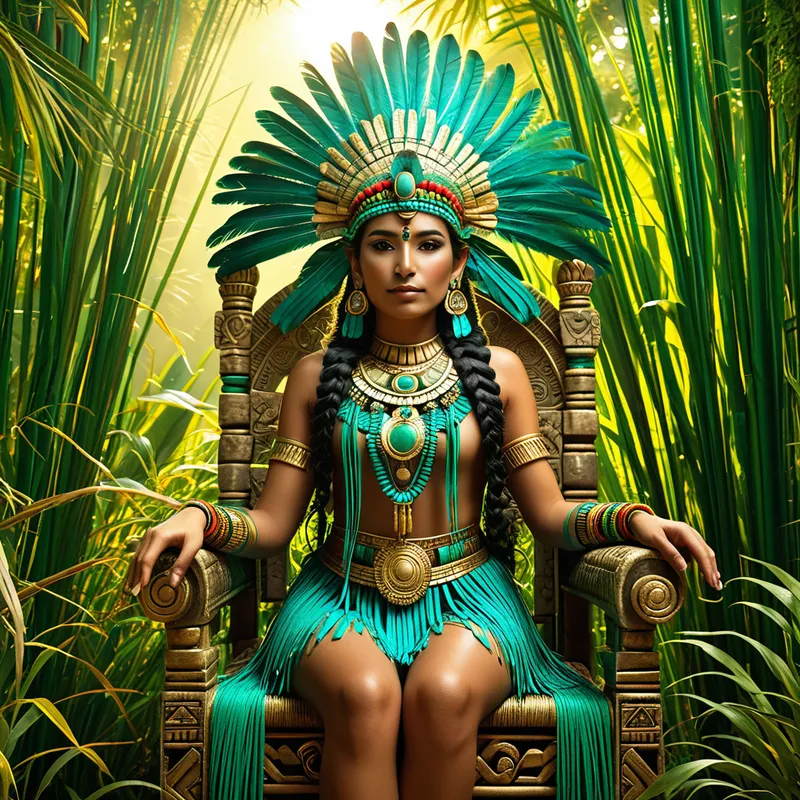
Xochiquetzal Myth Meaning & Symbolism
The myth of the Flower-Feather goddess, whose descent to the underworld reveals the sacred link between beauty, suffering, and creative rebirth.
The Tale of Xochiquetzal
In the time of the Fifth Sun, when the world was painted in the fierce hues of sacrifice and the sweet scent of corn, there lived a goddess whose very presence made the earth blush. She was Xochiquetzal, the Precious Flower, the Feather of Quetzal. Her home was Tamoanchan, the verdant, eternal garden at the apex of the world, where springs of nectar flowed and every breeze carried the perfume of a thousand blossoms. She was the patron of weavers, painters, singers, and lovers; her laughter was the sound of silver bells, and her footsteps caused jade-colored flowers to sprout from the stone.
But the gaze of the gods is often a jealous one. Tezcatlipoca, the Smoking Mirror, whose power is omnipresent and whose whims are law, beheld Xochiquetzal’s luminous joy. In his obsidian heart, a desire colder than the void between stars took root. He did not come as a suitor, but as a force of inevitable shadow. One moment, Xochiquetzal was plucking a gardenia, its white petals soft as dove’s down; the next, a chilling wind, smelling of flint and ashes, swept through Tamoanchan. The flowers bowed their heads. The springs ran still.
Tezcatlipoca, in a form both terrible and compelling, seized her. He tore her from her sun-drenched bower and dragged her, not across the earth, but downward, through the layers of the cosmos. The warm light of the upper worlds faded, replaced by the stagnant, cold air of Mictlan. The scent of flowers was swallowed by the odors of dust, damp clay, and forgotten bones. He brought her to the dark realm of Mictlantecuhtli and his consort, and there, in that palace of silence, he claimed her as his own. The goddess of life’s sweetest pleasures was made a captive in the land of the dead.
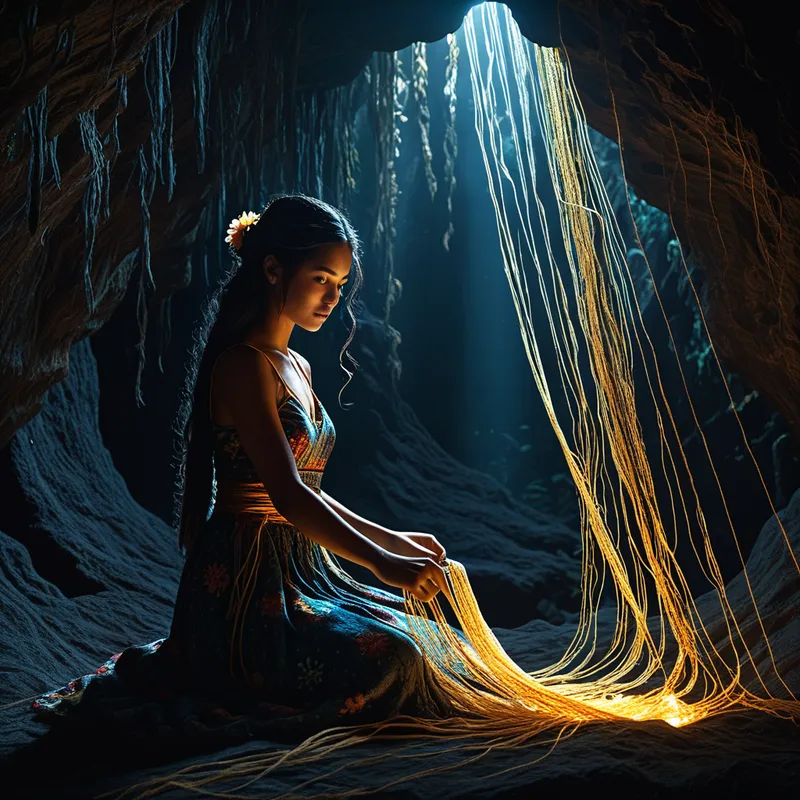
Yet, a flower does not cease to be a flower because it is placed in a tomb. In the profound darkness, Xochiquetzal did not wither. Her spirit, her essential flower-ness, could not be extinguished. The lords of Mictlan gave her a simple backstrap loom. There, in the gloom, surrounded by whispering shades, the goddess began to weave. But she did not weave the grey shrouds of the dead. From her fingertips flowed threads of impossible color—the crimson of a summer sunset, the azure of a tropical bird’s wing, the vibrant green of new growth. She wove visions of her lost garden: hummingbirds sipping from blossoms, butterflies dancing on the wind, lovers walking hand-in-hand under the ceiba tree. Her tapestry was a riot of life and memory in the heart of death, a defiant act of creation that illuminated the underworld itself. She became, even in captivity, the lady of the place, a beacon of art and sensuality where none should rightfully exist.
Cultural Origins & Context
The stories of Xochiquetzal were not mere entertainment; they were the sacred narratives that underpinned the Aztec understanding of life’s most potent and paradoxical forces. Her tales were preserved in the painted codices, like the Codex Borgia, and recited by the tlamatinime (the wise ones, or philosophers) and priests during festivals dedicated to the arts, fertility, and the veintena (20-day month) of Ochpaniztli.
As a deity of the Centzon Totochtin and a central figure of the paradisiacal Tamoanchan, she connected the people to the divine sources of creativity, pleasure, and procreation. Her worship was particularly vital for artisans, courtesans, and young women. Her myth served a crucial societal function: it acknowledged the terrifying fragility of beauty and joy in a cosmos ruled by the capricious forces of death (Tezcatlipoca) and the underworld, while simultaneously asserting the indomitable, transformative power of creative spirit. Even in the darkest circumstances, the act of creation—weaving, singing, loving—was a sacred resistance, a way to summon a fragment of paradise and assert one’s essential nature.
Symbolic Architecture
Xochiquetzal’s myth is a profound map of the soul’s relationship to Eros—not merely as sexual love, but as the life-force of connection, beauty, and artistic impulse. Her abduction represents the inevitable descent of this luminous energy into the shadow realms of the psyche.
The most radiant beauty is not born in the sun, but is forged in the confrontation with its absolute opposite. The flower must know the root in the dark earth.
Her captor, Tezcatlipoca, symbolizes the archetypal disruptor, the unconscious shadow, or the brutal realities of fate that shatter our innocent, paradisiacal states. He is the necessary antagonist that initiates the deepening of the soul. Xochiquetzal’s captivity in Mictlan is the embodiment of depression, creative block, trauma, or any experience where the vibrant self feels buried alive. Yet, her response is the key. The loom is her symbol of psychic integration. Weaving in the underworld is the act of taking the raw, often painful, threads of experience (the shadows) and consciously, artfully, weaving them into a new pattern of meaning.
She becomes the toltecatl (master artisan) of her own soul, transforming a victim narrative into a myth of sacred endurance. Her continued identity as the goddess of flowers and arts, even in the land of the dead, signifies that the core of one’s creative spirit is inviolable. It can be oppressed, hidden, or forced into exile, but it cannot be destroyed unless the individual consents to its annihilation.
The Dreamer's Resonance
When the pattern of Xochiquetzal stirs in the modern dreamer, it often manifests as a profound somatic and psychological process of reclamation. You may dream of being in a beautiful, safe garden that is suddenly invaded by a chilling, impersonal force. You may find yourself in a drab, bureaucratic office (a modern Mictlan) compulsively painting on the walls with brilliant colors. You might dream of weaving a tapestry, but the threads are your own hair or veins.
These dreams signal a “descent” phase where a vital part of the dreamer’s Eros—their capacity for joy, creativity, or sensual pleasure—has been captured by the “Tezcatlipoca” complexes of the psyche: perhaps by overwork (the grind), by internalized criticism (the inner judge), or by past trauma (the frozen moment). The body may respond with a feeling of being weighed down, a loss of libido, or a creative paralysis. The dream is not merely showing the captivity; it is highlighting the innate, god-given tool—the loom, the brush, the song—that remains at your disposal. The psychological process is one of moving from passive suffering to active making, even if that making is, at first, just the conscious feeling of the despair itself. To weave in the dream is to begin the work of integrating the shadow material, of finding beauty and pattern in the midst of the bleak.
Alchemical Translation
The alchemical journey modeled by Xochiquetzal is the transmutation of naive, solar beauty into a beauty that has known the depths—a beauty that is wise, resilient, and infinitely creative. This is the heart of individuation for the artist, the lover, or anyone seeking a soulful life.
The initial state (nigredo) is the brutal abduction: the loss of innocence, the plunge into depression or crisis, where all color seems to drain from the world. The captive goddess in the underworld represents the soul in this solve (dissolution) phase, where old identities are stripped away. The critical alchemical operation is not escape, but the work within the darkness. Her weaving is the coagula—the coagulation of a new substance. She does not reject the reality of Mictlan; she uses it as the backdrop against which her colors shine even brighter.
Individuation demands that we set up our loom in the very place we feel imprisoned, and begin to weave with whatever threads we have—especially the dark ones.
For the modern individual, this translates to a sacred practice: when in your personal “underworld,” you must consciously engage in your form of weaving. Write the poem from the heart of your grief. Cook a beautiful meal when you feel impoverished. Tend a single plant on your windowsill when your inner garden feels scorched. This is not positive thinking; it is alchemical doing. It is the assertion that your core creative principle is sovereign, even—especially—when external circumstances or internal states deny it. The triumph of Xochiquetzal is not a return to a naive Tamoanchan, but the establishment of a Tamoanchan-within, a cultivated inner paradise that has integrated the knowledge of Mictlan. She returns to the upper world not as a maiden, but as a queen whose authority is rooted in her mastery of both light and shadow, whose beauty is now unbreakable because it has been tempered in the dark.
Associated Symbols
Explore related symbols from the CaleaDream lexicon: