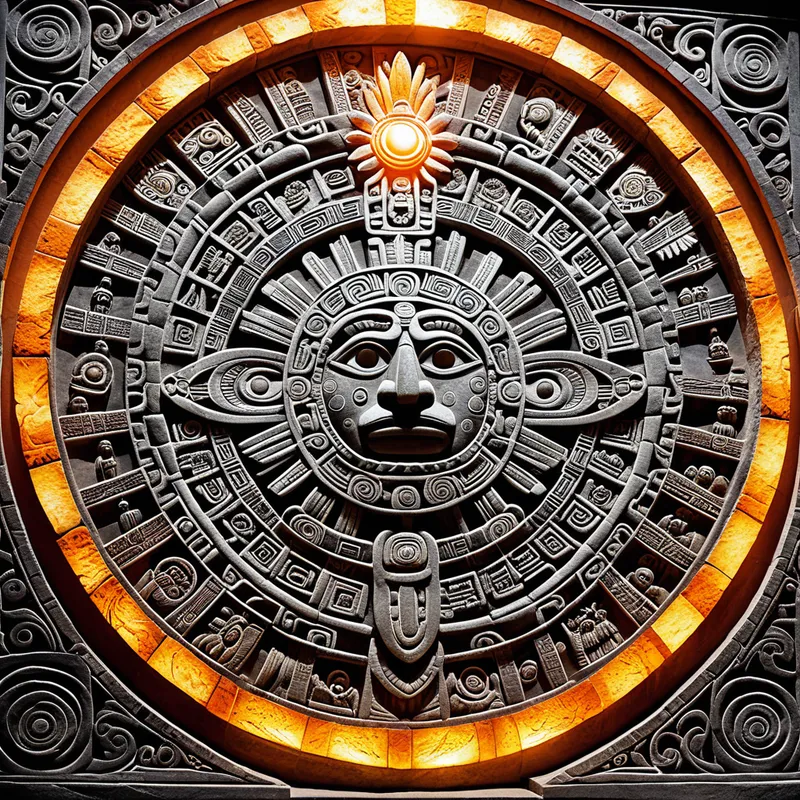
Xiuhpohualli Myth Meaning & Symbolism
The myth of the Xiuhpohualli is the story of cosmic fire, a divine struggle to bind the sun and measure time, ensuring the world's fragile renewal.
The Tale of Xiuhpohualli
Listen. Before the count of days, there was only the consuming fire and the devouring dark. [The world](/myths/the-world “Myth from Tarot culture.”/) was a raw, unfinished [thing](/myths/thing “Myth from Norse culture.”/), spinning through Teotl without rhythm or reason. The sun, a wounded god, staggered across [the sky](/myths/the-sky “Myth from Persian culture.”/) on a path of whim, its light guttering like a torch in a storm. Life sprouted and withered in chaotic gasps. There was no tomorrow, only an endless, terrifying now.
In the silent council of the gods at Tamoanchan, a dread took root. Without measure, without a binding circle of time, all creation would unravel back into the primordial maw. The aged [Xiuhtecuhtli](/myths/xiuhtecuhtli “Myth from Aztec culture.”/), Lord of the Year, whose body was volcanic stone and whose beard was smoke, spoke with a voice like grinding rock. “The sun runs wild. The world forgets its shape. We must capture the very breath of the cosmos and give it number.”
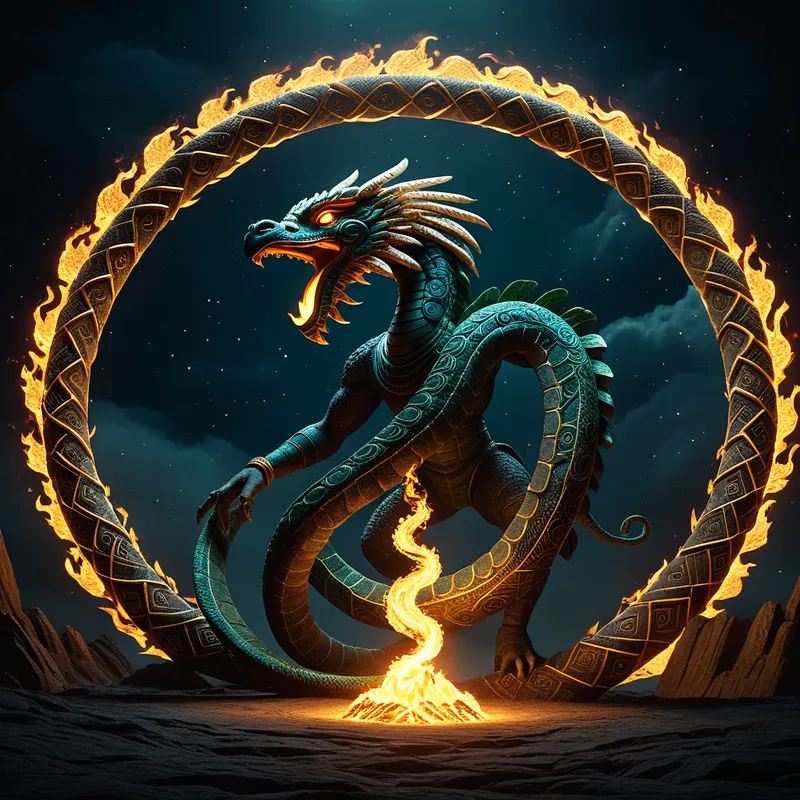
But what could contain such a force? Not stone, not [water](/myths/water “Myth from Chinese culture.”/). Only the essence of transformation itself: fire. Not the destructive blaze, but the sacred, sustaining flame—the heat at the heart of [the earth](/myths/the-earth “Myth from Hindu culture.”/), the spark of [the star](/myths/the-star “Myth from Tarot culture.”/). This fire was not a thing, but a being: [Xiuhcoatl](/myths/xiuhcoatl “Myth from Aztec culture.”/), the Turquoise Serpent. It was a cosmic dragon, a river of living embers coiling through the darkness, at once the sun’s heat and the drought’s terror.
The task fell to the shapers: the wise [Quetzalcoatl](/myths/quetzalcoatl “Myth from Aztec culture.”/) and the fierce [Huitzilopochtli](/myths/huitzilopochtli “Myth from Aztec culture.”/). They did not seek to slay the serpent, but to tame its infinite, linear rage into a perfect, returning circle. The struggle was not of blades, but of will. In [the shadow](/myths/the-shadow “Myth from Jungian culture.”/) of the great pyramid, they confronted the Xiuhcoatl. It was a spectacle of light and sound—a hiss of superheated air, the smell of ozone and scorched earth, the blinding glare of a thousand suns compressed into a scaled body.
Quetzalcoatl, with his breath of wind, cooled the serpent’s rage enough to grasp it. Huitzilopochtli, with his warrior’s resolve, provided the strength to bend it. Together, they wrestled the living river of fire, not onto an altar, but into a pattern. They pressed the Xiuhcoatl’s head to its own tail, forcing the endless line into a ring. As the circle closed, a deafening chime resonated through the five directions. The serpent’s body stiffened, not into death, but into sacred geometry. Its scales became 365 segments. Its fiery essence was partitioned into 18 periods of 20 days, with five nameless, potent days left over in the center—the Nemontemi.
The Xiuhpohualli was born. A wheel of fire. A binding contract with the cosmos. The sun, seeing its path now marked in this blazing ring, took its first measured step. Dawn followed dusk with newfound certainty. The maize knew when to grow. The rains knew when to fall. Time, the most elusive and terrifying of forces, had been given a house, and the world could begin its fragile, counted dance within it.
Cultural Origins & Context
The Xiuhpohualli was not merely a tool for agriculture or ritual, but the central organizing principle of the Mexica (Aztec) world. It was the “Year Count,” the 365-day solar calendar that interlocked with the 260-day sacred Tonalpohualli to create the 52-year Xiuhmolpilli, or “Bundle of Years.” This myth was the sacred charter for that entire temporal architecture.
It was knowledge held and performed by the Tlamatinime (wise ones) and the Tlacuilo. The story was encoded in the very design of the calendar stone, in ritual dramas, and in the rigorous education of the priestly class. Its societal function was profound: it explained why relentless, precise ritual and sacrifice were necessary. The sun’s journey was not guaranteed; it was a debt paid daily by the people, mirroring the gods’ original struggle to bind the fire-serpent of time. The calendar was the schedule for that eternal payment, ensuring the continuation of the cosmic order they called Teotl.
Symbolic Architecture
At its core, the myth of the Xiuhpohualli is about the [human](/symbols/human “Symbol: The symbol of a human represents individuality, complexity of emotions, and social relationships.”/) confrontation with [chaos](/symbols/chaos “Symbol: In Arts & Music, chaos represents raw creative potential, uncontrolled expression, and the breakdown of order to forge new artistic forms.”/)—specifically, the chaos of unmediated existence, of [life](/symbols/life “Symbol: The symbol of ‘Life’ represents a journey of growth, interconnectedness, and existential meaning, encompassing both the joys and challenges that define human experience.”/) without [structure](/symbols/structure “Symbol: Structure in dreams often symbolizes stability, organization, and the framework of one’s life, reflecting how one perceives their environment and personal life.”/), [pattern](/symbols/pattern “Symbol: A ‘Pattern’ in dreams often signifies the underlying structure of experiences and thoughts, representing both order and the repetitiveness of life’s situations.”/), or meaning. The wild Xiuhcoatl represents raw, undifferentiated [life](/symbols/life “Symbol: The symbol of ‘Life’ represents a journey of growth, interconnectedness, and existential meaning, encompassing both the joys and challenges that define human experience.”/) force and the terrifying linearity of time heading only toward [entropy](/symbols/entropy “Symbol: In arts and music, entropy represents the inevitable decay of order into chaos, often symbolizing creative destruction, impermanence, and the natural progression toward disorder.”/) and [dissolution](/symbols/dissolution “Symbol: The process of breaking down, dispersing, or losing form, often representing transformation, release, or the end of a state of being.”/).
The circle is not a cage, but a covenant. It transforms the arrow of fate into the wheel of destiny.
The heroic act of the gods is one of conscious creation. They do not destroy the fiery force; they inform it. They give the infinite a finite shape. The 365-day ring is a [symbol](/symbols/symbol “Symbol: A symbol can represent an idea, concept, or belief, serving as a powerful tool for communication and understanding.”/) of the [psyche](/myths/psyche “Myth from Greek culture.”/)‘s need to create order from the raw [material](/symbols/material “Symbol: Material signifies the tangible aspects of life, often representing physical resources, desires, and the physical world’s influence on our existence.”/) of experience. Each of the 18 twenty-day [Veintena](/myths/veintena “Myth from Aztec culture.”/) festivals represents a different facet of communal and psychological life—from cleansing to [abundance](/symbols/abundance “Symbol: A state of plentifulness or overflowing resources, often representing fulfillment, prosperity, or spiritual richness beyond material needs.”/) to remembrance—mapping the human [journey](/symbols/journey “Symbol: A journey in dreams typically signifies adventure, growth, or a significant life transition.”/) onto the celestial one. The five Nemontemi days are the symbolic “crack in the [cosmos](/symbols/cosmos “Symbol: The entire universe as an ordered, harmonious system, often representing the totality of existence, spiritual connection, and the unknown.”/),” the recognition that no [system](/symbols/system “Symbol: A system represents structure, organization, and interrelated components functioning together, often reflecting personal or social order.”/) is perfect, that a little chaos must be allowed to remain, contained, at the center of all order, lest the structure become rigid and die.
The Dreamer’s Resonance
When this myth stirs in the modern unconscious, it often manifests in dreams of being lost in vast, unstructured spaces, or of trying to contain something wild and elemental—a rushing river, a spreading fire, a panicked animal. The dreamer may be trying to build a wall, tie a knot, or complete a circle that keeps fracturing.
Somatically, this can correlate with feelings of anxiety, of life “getting away from you,” or a diffuse sense of panic that has no single source—the psychic equivalent of the wild Xiuhcoatl. The psychological process is one of containment. [The ego](/myths/the-ego “Myth from Jungian culture.”/) is being called to perform the god’s task: to take the overwhelming, formless energy of the unconscious (drives, emotions, traumas) and begin to give it form. This is not repression, but the first act of consciousness: drawing a boundary, creating a ritual, naming [the thing](/myths/the-thing “Myth from Norse culture.”/). The dream is an impetus to build one’s own Xiuhpohualli—a personal structure of meaning, routine, or creative practice that can hold the heat of one’s own life without being consumed by it.
Alchemical Translation
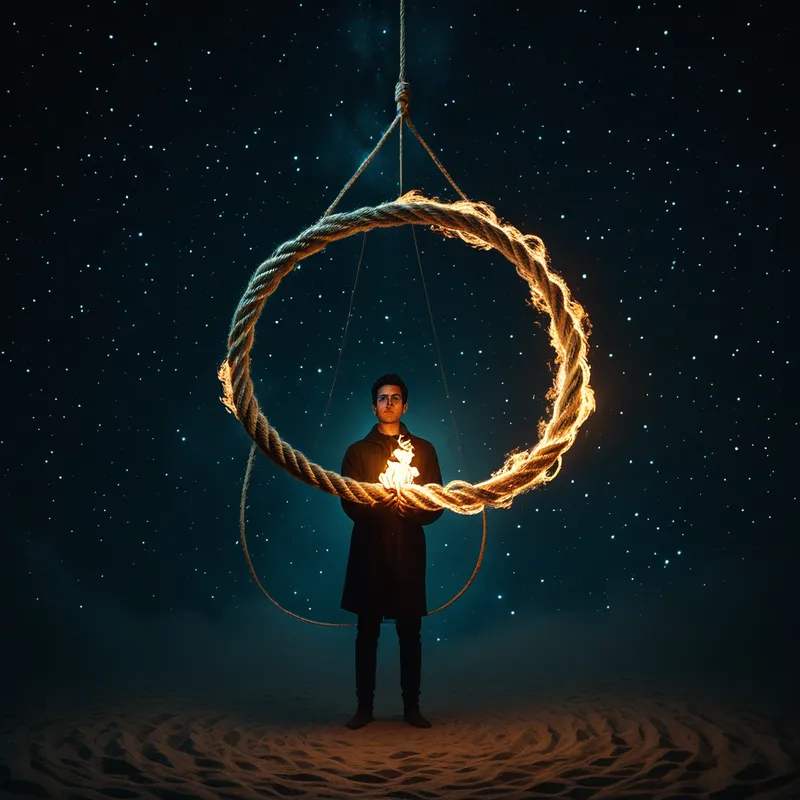
The alchemical journey of individuation mirrors the myth precisely. The [prima materia](/myths/prima-materia “Myth from Alchemical culture.”/), the lead of the soul, is the chaotic, fiery, and often painful raw material of our unexamined lives—our impulses, our history, our passions. This is the Xiuhcoatl within.
The first major work, the [Nigredo](/myths/nigredo “Myth from Alchemical culture.”/), is the confrontation and recognition of this chaos. The conscious mind (Quetzalcoatl, the spirit of reflection) and the will (Huitzilopochtli, the spirit of action) must engage this inner fire. The struggle is the analysis, the shadow-work, the difficult process of facing what we have allowed to run wild.
The calendar is the psyche’s attempt to remember itself, to inscribe its own history upon the void, and in doing so, to create a future worth inhabiting.
The binding into a circle is the Albedo and [Rubedo](/myths/rubedo “Myth from Alchemical culture.”/)—the whitening and reddening. It is the integration of this material into a coherent Self. The circle symbolizes wholeness. The 365 segments are the days of a life, each one a conscious unit of lived experience, no longer bleeding meaninglessly into the next. The established “year” of [the Self](/myths/the-self “Myth from Jungian culture.”/) allows for predictable inner seasons: times for work (Tozoztontli), times for celebration (Huey Tozoztli), and times for the sacred, dangerous emptiness of the Nemontemi—the necessary periods of fallow introspection, where the structure is dissolved slightly to be renewed.
Ultimately, the myth teaches that time is not our enemy, but the very medium of our soul’s creation. To live an unconscious life is to be chased by the fire-serpent. To live an individuated life is to have the courage to turn and, with great effort and wisdom, convince that fire to burn in a hearth of our own conscious making.
Associated Symbols
Explore related symbols from the CaleaDream lexicon: