
Xiong Jing Myth Meaning & Symbolism
A mythic tale of a primordial bear spirit embodying raw instinct, territorial power, and the deep, untamed wilderness of the human psyche.
The Tale of Xiong Jing
Listen, and let the mists of the high mountains part. Before the first emperors carved their names into bronze, before the fields were tamed by plow, the land belonged to the deep, silent ones. In the heart of the untamed wilderness, where the pines whispered secrets older than language and the rivers sang of forgotten sources, there dwelled Xiong Jing.
He was not merely a beast, but the soul of the mountain given fur and claw. His breath was the morning fog that clung to the valleys. His heartbeat was the slow, tectonic pulse deep within the earth. His territory was a sacred precinct of sheer cliffs, hidden caves, and ancient groves where no human fire had ever smoked. He was the perfect, unthinking law of the wild: to hunt, to roam, to protect, to be.
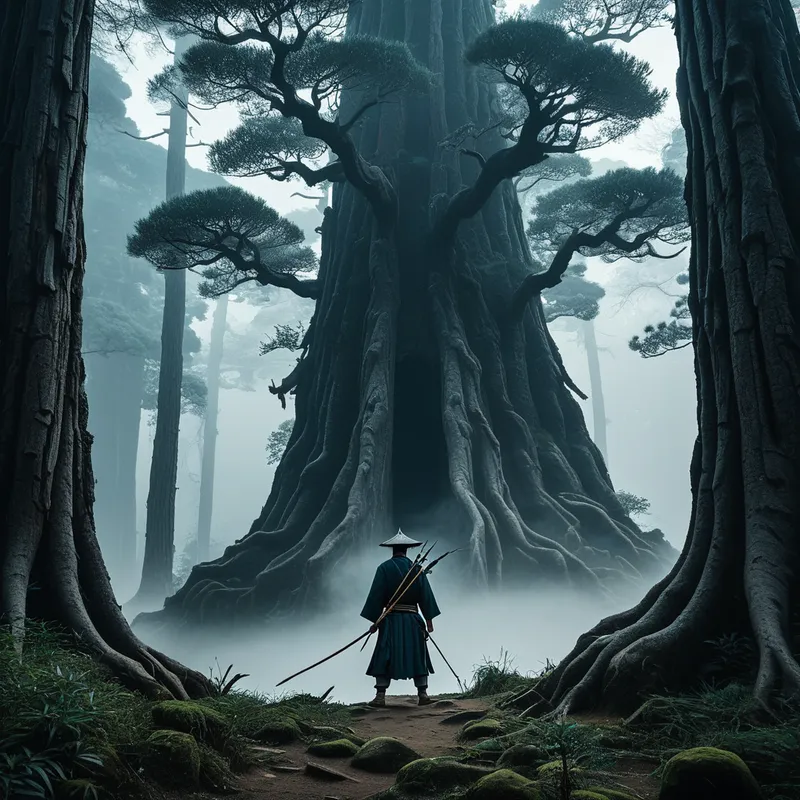
Then came the encroachment. The scent of smoke, the sound of axes biting into heartwood, the strange, two-legged creatures who cleared the forest’s edge. They were the people of the fledgling villages, driven by hunger and the need for space. Their champion was a hunter named Kang, whose skill was unmatched, yet whose heart was troubled by the diminishing game. The elders spoke of the mountain lord in hushed tones, a spirit to be appeased, not confronted. But Kang, seeing his people’s need, took up his strongest spear and ventured into the sacred precinct.
For three days and three nights, Kang moved like a ghost, following signs too subtle for ordinary men: a claw mark on stone older than the rain, a tuft of fur on a thorn that hummed with power. The forest grew silent, holding its breath. On the fourth dawn, in a clearing where a single shaft of sunlight pierced the canopy like a spear of heaven, he found him.
Xiong Jing rose from his bed of ferns, a mountain waking up. He stood on his hind legs, a shaggy monument of muscle and primal authority. His eyes were not the eyes of a simple animal; they were pools of ancient knowing, reflecting the forest, the sky, and the small, defiant man before him. There was no roar, only a deep, rumbling vibration that Kang felt in his bones—the sound of the earth itself issuing a challenge.
Kang did not throw his spear. The gesture felt suddenly petty, an insult to the majesty before him. Instead, he planted its butt in the soil and bowed his head, not in submission, but in recognition. He spoke not with his voice, but with the stillness of his own spirit, projecting his people’s plight, their fear, their need for sustenance.
The bear spirit regarded him. The air crackled with unspoken dialogue. Then, Xiong Jing slowly lowered himself, turned, and with a single, deliberate swipe of a paw, stripped the bark from a great, dead pine, revealing the pale wood beneath. He looked back at Kang, then lumbered into the depths of the forest, leaving the hunter alone with the revealed tree and the profound silence.
Kang returned to his village. He told of the encounter, not as a battle, but as a treaty. He showed them the clearing, the marked tree. “Here,” he said, “is the boundary. We may hunt up to this line, and gather from this side. The land beyond belongs to Xiong Jing. We take only what we need, and we give our respect.” From that day, the village prospered, and the deep woods remained untouched, a testament to a pact made not with words, but with mutual recognition.
Cultural Origins & Context
The myth of Xiong Jing is not found in the canonical classics like the Shan Hai Jing or Classic of Mountains and Seas, but in the rich, localized oral traditions of ancient China’s frontier and mountainous regions. It is a story told by hunter-gatherer societies and early agricultural communities living in intimate, precarious dialogue with the untamed world. Shamans and village elders were its custodians, using it not just as entertainment, but as a foundational charter.
Its societal function was multifaceted. Primarily, it was an ecological and ethical narrative, establishing the concept of the sacred grove or forbidden mountain—a taboo territory where human activity was restricted to ensure the balance of nature and the continued favor of the local spirits. It encoded the law of sustainable taking. Secondly, it served as an initiatory story for young hunters and warriors. The journey into the territory of the Xiong Jing was a metaphor for facing the ultimate power of the wild, and returning not necessarily with a trophy, but with a treaty—a mark of maturity and diplomatic wisdom over brute conquest.
Symbolic Architecture
At its core, Xiong Jing is an archetypal representation of the raw, instinctual psyche—the Shadow in its most primordial, non-personal form. He is not evil, but utterly other, governed by laws of territory, survival, and cyclical power that exist outside human morality.
The bear does not hate the hunter; it embodies the boundary that the hunter must recognize, both in the forest and within himself.
The bear’s mountain domain symbolizes the unconscious itself: vast, autonomous, and teeming with life and danger. Kang, the human ego, ventures into this domain driven by necessity (hunger, expansion). The critical moment is not combat, but the face-to-face encounter and the ensuing non-verbal communication. This symbolizes the ego’s confrontation with a powerful unconscious content—not to slay it, but to relate to it, to establish boundaries and terms of engagement.
The marked tree is the powerful symbol of this hard-won relationship. It is the temenos, the sacred boundary stone. It represents the conscious differentiation of a space for the ego (the village, cultivated land) and a space that must remain inviolate for the instinctual/archetypal psyche (the deep wilderness, the unconscious). The health of the whole system—the village and the forest—depends on respecting this line.

The Dreamer’s Resonance
When the pattern of the Xiong Jing myth stirs in modern dreams, it often signals a profound encounter with one’s own instinctual and territorial foundations. To dream of a massive, powerful bear in a wild setting is to feel the pressure of a primal part of the self demanding recognition.
Somatically, this might manifest as a felt sense of being “cornered” by life’s demands, a raw, inarticulate anger, or a deep, bodily yearning for solitude and space. Psychologically, the dreamer may be in a situation where their personal boundaries are being chronically violated (at work, in a relationship) or where they themselves are over-civilizing their nature, ignoring deep needs for rest, aggression, or solitude. The bear is the psyche’s immune response, a massive, instinctual force rising to reclaim its territory. The dream is an invitation to turn and face this power, not with panic, but with the respectful attention of Kang.

Alchemical Translation
The individuation process modeled here is not one of heroic conquest, but of sacred negotiation. The modern individual is perpetually Kang, living in the “village” of persona, duty, and conscious identity. The call to adventure is the growing sense of unease, of being cut off from one’s own vital, instinctual power—a chronic fatigue of the spirit.
Individuation is not about killing the bear, but about learning its language and establishing an eternal treaty at the edge of the clearing.
The journey into the woods is the courageous descent into self-reflection, therapy, or any practice that brings one into contact with the unconscious. Confronting the Xiong Jing is the terrifying yet awe-inspiring moment of truly seeing one’s repressed anger, wild creativity, or fierce need for autonomy without judgment. The alchemical transmutation occurs in the stillness of that gaze. The ego’s weapon (the spear of judgment, the will to control) is lowered.
The new consciousness forged is the “marked tree”—a clear, internal boundary. It is the conscious agreement that says, “This part of my life belongs to the world’s demands, but this deep, inner territory—my creative time, my solitude, my raw emotional truth—is sacred and non-negotiable.” The pact ensures the vitality of both realms: the conscious personality gains energy and authenticity from its connection to the instinctual base, and the unconscious is honored and given its necessary space, preventing it from erupting in destructive, “possessive” ways. One becomes, like the reconciled landscape, a whole ecosystem where civilization and wilderness coexist in dynamic, respectful balance.
Associated Symbols
Explore related symbols from the CaleaDream lexicon: