
Xenia Myth Meaning & Symbolism
The sacred, unwritten law of hospitality, where a stranger at the door is a god in disguise, demanding respect and reciprocity.
The Tale of Xenia
Listen. [The wind](/myths/the-wind “Myth from Various culture.”/) carries more than dust from the road. It carries a plea, a test, a divine whisper. In the time when gods walked [the earth](/myths/the-earth “Myth from Hindu culture.”/) cloaked in mortal flesh, the most sacred law was not carved in temple stone, but lived on [the threshold](/myths/the-threshold “Myth from Folklore culture.”/) of every home. It was called Xenia.
The sun was a dying ember on [the horizon](/myths/the-horizon “Myth from Various culture.”/), painting the hills of Phocis in blood and gold. In a humble stone house by the road, an old man, Baucis, and his wife, Philemon, prepared their meager supper. The air was thick with the smell of herbs and woodsmoke. Their world was small, bounded by [the hearth](/myths/the-hearth “Myth from Norse culture.”/) and the field.
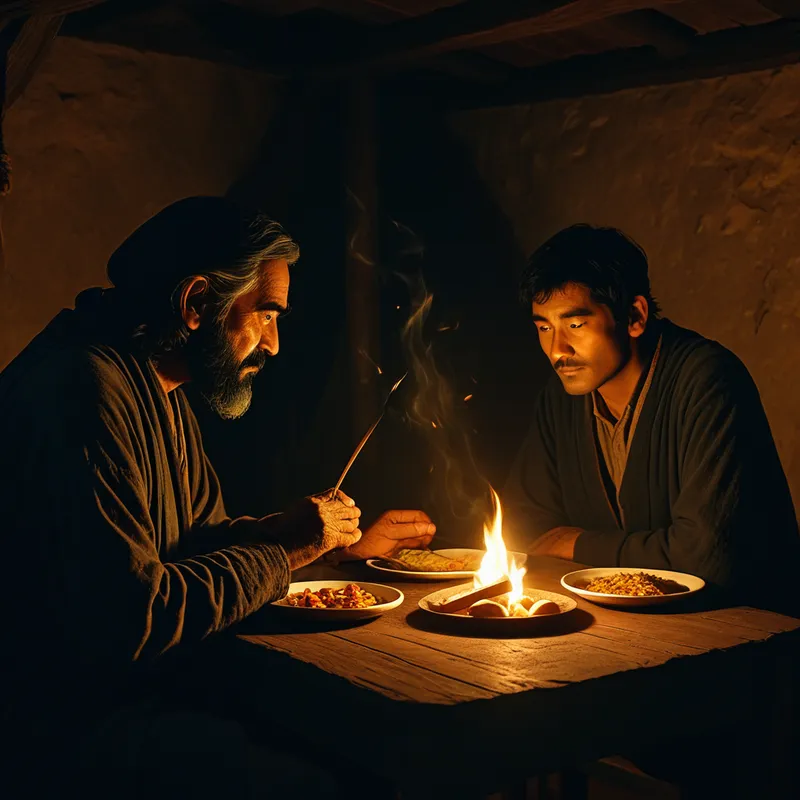
A knock, soft but insistent, broke the evening quiet. Not the knock of a neighbor. This was the knock of the unknown. On their threshold stood two travelers, men of weary step and dust-cloaked shoulders. Their eyes, however, held a strange, unsettling depth, like pools reflecting a sky no mortal could see. These were no ordinary men. They were Zeus and [Hermes](/myths/hermes “Myth from Global/Universal culture.”/), gods who had wandered the land disguised, testing the hearts of mortals.
They had been turned away from a hundred homes, doors slammed by the rich and the fearful. But here, at this poorest of dwellings, the door swung open. No questions were asked. Baucis and Philemon did not see beggars; they saw guests, and a guest is sacred. With trembling, work-worn hands, they ushered the strangers in. Philemon stirred the fire to a brighter blaze. Baucis brought a stool, wiping it clean with his sleeve. They offered the last of their wine, the last of their bread, the last slice of salted pork they had been saving for a festival.
As the old couple hurried to serve, a miracle unfolded. The wine pitcher, nearly empty, refilled itself. The loaf of bread grew whole again. The gods exchanged a glance, a silent acknowledgment. The test was passed. Then Zeus spoke, his voice filling the small room not with thunder, but with a terrible, gentle gravity. “Come,” he said. “Follow us to the high hill.”
Terrified and awed, Baucis and Philemon obeyed. As they climbed, a great roaring rose behind them. They turned and looked back. Where their valley had been, a vast, placid lake now shimmered in the moonlight. Every house, every neighbor who had denied the gods, was swallowed beneath the dark [water](/myths/water “Myth from Chinese culture.”/). Only their own tiny cottage remained, but it was transforming, its stones glowing, its roof rising, its walls expanding into the colonnades and gilded beams of a glorious temple.
“You have given the gods the gift of your hearth,” Zeus declared. “Ask of us any boon.” The old couple, hand in hand, made a single, simple wish. “Let us serve as your priests in this temple. And when the time comes for us to die, let it be together, so neither must see the other’s grave.” The gods consented. For years beyond count, they kept [the temple](/myths/the-temple “Myth from Jewish culture.”/). And when their time came, standing before the sacred steps, they did not fall. Instead, they slowly transformed, she into a linden tree, he into an oak, their branches intertwining for eternity, a living monument to the bond forged on a threshold at dusk.
Cultural Origins & Context
The myth of Baucis and Philemon, preserved for us by the Roman poet Ovid, is the purest distillation of the ancient Greek concept of Xenia. This was not mere etiquette; it was a foundational religious and social institution, a sacred covenant between host and guest enforced by Zeus himself, in his aspect as Zeus Xenios.
In a world of difficult travel, few inns, and constant peril, survival could depend on the kindness of strangers. Xenia created a temporary, ritualized bond of fictive kinship. The guest-friend (xenos) was brought from the chaotic, dangerous outside (the wild) into the ordered, safe inside (the oikos, or household). The ritual was precise: offering a seat, washing the feet, providing food and drink before asking any questions. This sequence symbolically stripped [the stranger](/myths/the-stranger “Myth from Biblical culture.”/) of their potential threat and reconstituted them as a sacred charge. The relationship often became hereditary, binding families for generations. To violate Xenia was to invite divine vengeance, as [the drowned](/myths/the-drowned “Myth from Norse culture.”/) village in the myth starkly illustrates. It was a primary way the Greeks mediated the relationship between Self and Other, between the known community and the vast, unknown world.
Symbolic Architecture
At its core, Xenia is a myth about the sacredness of the threshold—the liminal [space](/symbols/space “Symbol: Dreaming of ‘Space’ often symbolizes the vastness of potential, personal freedom, or feelings of isolation and exploration in one’s life.”/) where the unknown knocks and [the self](/myths/the-self “Myth from Jungian culture.”/) must decide. The [stranger](/symbols/stranger “Symbol: A stranger in dreams can represent unfamiliar aspects of the self or new experiences.”/) is the ultimate [symbol](/symbols/symbol “Symbol: A symbol can represent an idea, concept, or belief, serving as a powerful tool for communication and understanding.”/) of the unconscious, the part of the [psyche](/myths/psyche “Myth from Greek culture.”/) that is foreign, unexpected, and potentially divine.
The god is always disguised as that which you are most tempted to reject.
The dusty [traveler](/symbols/traveler “Symbol: A person on a journey, representing movement, transition, and the search for new experiences or self-discovery.”/) represents the unintegrated [aspect](/symbols/aspect “Symbol: A distinct feature, quality, or perspective of something, often representing a partial view of a larger whole.”/) of the self, the “[shadow](/symbols/shadow “Symbol: The ‘shadow’ embodies the unconscious, repressed aspects of the self and often represents fears or hidden emotions.”/)” in Jungian terms, or a numinous [archetype](/symbols/archetype “Symbol: A universal, primordial pattern or prototype in the collective unconscious that shapes human experience, behavior, and creative expression.”/) arriving from the [collective unconscious](/symbols/collective-unconscious “Symbol: The Collective Unconscious refers to the part of the unconscious mind shared among beings of the same species, embodying universal experiences and archetypes.”/). The [host](/symbols/host “Symbol: The symbol of a ‘host’ often represents nurturing, hospitality, or the willingness to offer support and guidance to others.”/)‘s hearth represents the conscious ego, the familiar territory of the known [personality](/symbols/personality “Symbol: Personality in dreams often symbolizes the traits and characteristics of the dreamer, reflecting how they perceive themselves and how they believe they are perceived by others.”/). The act of hospitality is not naive altruism; it is a courageous psychological act of admitting the unknown into the sanctum of the self. The shared [meal](/symbols/meal “Symbol: A meal often symbolizes nourishment, not just physically but emotionally and spiritually, representing the aspects of sharing and community.”/) is the symbol of communion, where two distinct entities partake of the same substance and are thereby transformed.
The reciprocal [nature](/symbols/nature “Symbol: Nature symbolizes growth, connectivity, and the primal forces of existence.”/) of Xenia—the [guest](/symbols/guest “Symbol: A guest in a dream can symbolize new experiences, unexpected situations, or aspects of oneself that are being revealed.”/) brings a blessing or a [curse](/symbols/curse “Symbol: A supernatural invocation of harm or misfortune, often representing deep-seated fears, guilt, or perceived external malevolence.”/) depending on [reception](/symbols/reception “Symbol: The symbol of ‘reception’ often signifies the act of welcoming or accepting new ideas, experiences, or people into one’s life.”/)—mirrors the psyche’s law of compensation. What we refuse to acknowledge and host within ourselves becomes a destructive flood (the drowning [lake](/symbols/lake “Symbol: A lake often symbolizes a place of reflection, emotional depth, and the subconscious mind, representing both tranquility and potential turmoil.”/)). What we welcome, honor, and nourish transforms our very [structure](/symbols/structure “Symbol: Structure in dreams often symbolizes stability, organization, and the framework of one’s life, reflecting how one perceives their environment and personal life.”/), turning a simple hut of [the ego](/myths/the-ego “Myth from Jungian culture.”/) into a [temple](/symbols/temple “Symbol: A temple often symbolizes spirituality, sanctuary, and a deep connection to the sacred aspects of life.”/) of the Self.
The Dreamer’s Resonance
When the pattern of Xenia stirs in the modern dreamer, it often manifests around themes of unexpected visitors, locked or opening doors, and the preparation or sharing of food. To dream of a mysterious figure arriving at your door signifies an emergent content from the unconscious seeking recognition. Anxiety in the dream—fumbling with locks, offering spoiled food, feeling the house is too messy—points to the ego’s resistance to this new psychic material.
The somatic experience can be one of palpable tension in the chest or gut, a literal feeling of something “knocking” from within. This is the psyche’s innate drive toward wholeness presenting itself. The dream is asking: What part of yourself have you left out in the cold? What talent, memory, emotion, or insight are you refusing to “host” because it seems inconvenient, shameful, or too powerful? The figure at the door may appear as an old enemy, a forgotten childhood self, or an intimidating authority—all guises of the disowned self, the potential god in disguise.

Alchemical Translation
The alchemical process modeled by Xenia is the coniunctio oppositorum—[the sacred marriage](/myths/the-sacred-marriage “Myth from Various culture.”/) of opposites. The conscious host (the known, the familiar, the ego) and the unconscious guest (the unknown, the strange, the Self) engage in a ritual of reciprocal transformation.
The goal is not to become the guest, nor to make the guest a permanent resident, but to achieve a lasting bond of sacred friendship between the two.
[The first stage](/myths/the-first-stage “Myth from Alchemical culture.”/) is mortificatio: the humbling of the ego. Baucis and Philemon are poor; they have nothing to lose but their last scraps. Psychologically, this is the necessary dissolution of ego-inflation, the recognition that our conscious [persona](/myths/persona “Myth from Greek culture.”/) is a “poor hut” compared to the vastness of the psyche. Only from this humility can true hospitality arise.
The shared meal is the [solutio](/myths/solutio “Myth from Alchemical culture.”/) and coagulatio: the dissolving of rigid boundaries and the reconstitution of a new, more complex whole. The miraculous replenishment signifies that when the ego serves the deeper Self, the resources of the unconscious become endlessly available.
The final transformation into intertwined trees is the ultimate symbol of individuation. They do not become gods; they become their own complete, natural selves, rooted in the earth (instinct, body) yet reaching for [the sky](/myths/the-sky “Myth from Persian culture.”/) (spirit, consciousness), forever connected in a living, growing bond. For the modern individual, the practice of Xenia means developing an inner hospitality—a willingness to pause at the threshold of a new feeling, a disturbing thought, or a forgotten memory, and to say, “Come in. Be my guest. Let me see what divinity you carry.” It is the daily alchemy of turning fear of the Other into curiosity, and turning the stranger within into the most sacred friend.
Associated Symbols
Explore related symbols from the CaleaDream lexicon: