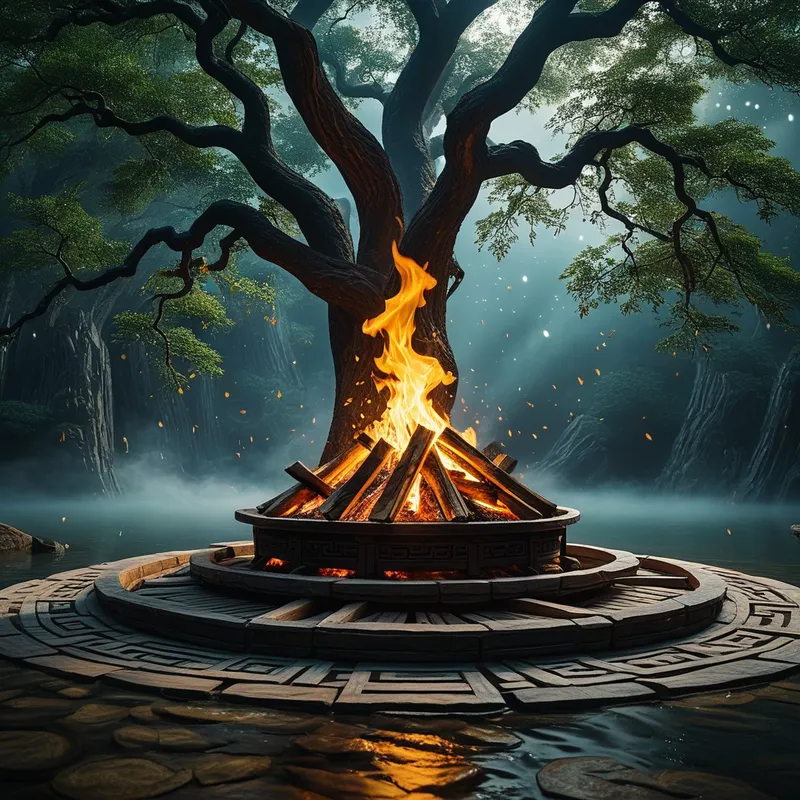
Wu Xing Myth Meaning & Symbolism
The eternal dance of five elemental phases, a cosmic law of transformation governing all existence, from the heavens to the human heart.
The Tale of Wu Xing
In the time before time, when the Taiji first stirred, there was not one thing, but a great, silent potential. Then, from the breath of the Dao, a rhythm was born. It was not a sound, but a pulse, a deep, resonant thrumming that echoed in the void.
First came the green whisper. It was the sigh of sap rising, the crack of a seed breaking its shell in the silent dark. This was Mu, the force of Spring. It pushed upward, tender yet inexorable, reaching for a light not yet born. Its energy was the straight trunk of the bamboo, the unfurling of the first leaf on a barren world.
But growth, unchecked, yearns for expression. From the heart of the green whisper, a spark was kindled. It was a flash of crimson warmth, a sudden, joyful heat. This was Huo, the blaze of Summer. It danced and leapt, consuming the Wood, not out of malice, but out of a sacred necessity. It was the cook-fire, the forge’s heart, the brilliant light of consciousness igniting in the long night.
The dance of Fire is glorious, but finite. Its brilliant light must fade, and from its passionate expenditure, something new settles. A soft, golden dust drifts down—the ashes of ambition, the residue of experience. This was Tu, the rich soil of Late Summer. It was the fertile plain, the nurturing mother, the still point at the center of the turning wheel. It received all that was spent and held it, patient and deep.
Within that nurturing stillness, pressure built. A gathering, a condensing. From the soft Earth, a hard clarity emerged, ringing like a bell. This was Jin, the harvest of Autumn. It was the gleam of the plowshare shaped from ore, the sharp edge of the sword, the unyielding pillar and the precious coin. It drew boundaries, gave form, and discerned value from the formless soil.
And form, in its perfection, weeps. The hard Metal, touched by the chill air, began to sweat, to condense. A bead formed, then a trickle, then a stream. This was Shui, the descent of Winter. It was the hidden aquifer, the flowing river that carves canyons, the deep, dark well of potential and memory. It flowed downward, seeking the lowest point, gathering in the silent dark.
And there, in the profound darkness where Water pooled, it touched the roots of a sleeping seed. The moisture seeped in, and the green whisper stirred once more. The cycle was complete, and yet it had never begun, for it was eternal. This was the law. This was the dance. Not a story with a beginning and an end, but the very pattern of the story itself, written in the stars, the seasons, and the human soul.
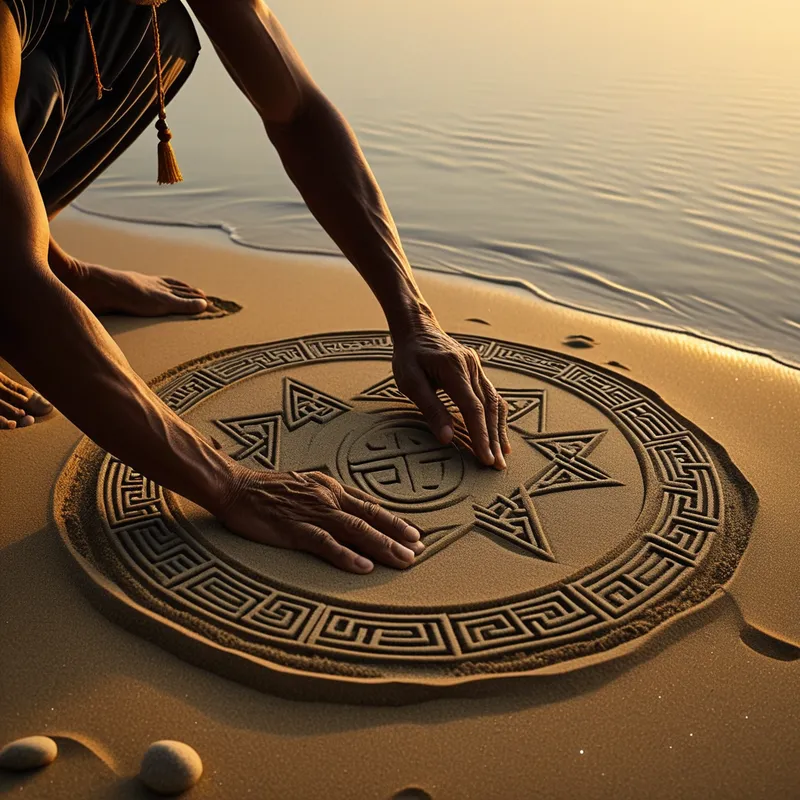
Cultural Origins & Context
The mythos of the Wu Xing is not a single narrative penned by one hand, but a cosmological framework that crystallized over centuries of observation. Its roots intertwine with the earliest Chinese agricultural societies, whose survival depended on reading the cycles of nature—the planting (Wood), the growth under the sun (Fire), the harvest (Earth/Metal), and the dormant, watery winter (Water). Philosophers of the Warring States period, particularly those associated with the Daoist and Yin-Yang schools, systematized these observations.
It was passed down not merely as lore, but as a fundamental operating system for understanding reality. Emperors used it to guide statecraft and rituals. Doctors of TCM used it to diagnose illness, mapping the phases to organs, emotions, and seasons. Generals used it to strategize. Its societal function was omnipresent: to teach humanity its place within a vast, intelligent, and cyclical cosmos, and to provide a symbolic language for maintaining harmony between heaven, earth, and humankind.
Symbolic Architecture
The Wu Xing is a map of process, not a catalog of static things. Its core genius lies in its two interactive cycles: the Creative (or Generating) Cycle and the Controlling (or Destructive) Cycle. In the Creative Cycle, each phase nourishes and gives birth to the next: Wood fuels Fire, Fire creates Earth (ash), Earth bears Metal, Metal collects Water, Water nourishes Wood. This is the myth of endless becoming, of life begetting life.
The universe does not create finished objects, but ongoing conversations. We are not nouns, but verbs in a grammatical sentence written by the cosmos.
Yet, harmony requires not just support, but also boundary. The Controlling Cycle ensures no single phase dominates utterly: Wood parts Earth (roots), Earth dams Water, Water quenches Fire, Fire melts Metal, Metal chops Wood. This is not “evil” destruction, but necessary limitation—the pruning that allows for healthy growth, the challenge that builds resilience.
Psychologically, each phase represents a mode of being. Wood is our initiative and vision. Fire is our enthusiasm and expressive joy. Earth is our empathy and ability to integrate. Metal is our discernment and principle. Water is our introspection and adaptive wisdom. The myth teaches that a whole psyche must honor all five, allowing each its season, and understanding that each naturally transitions into the next.
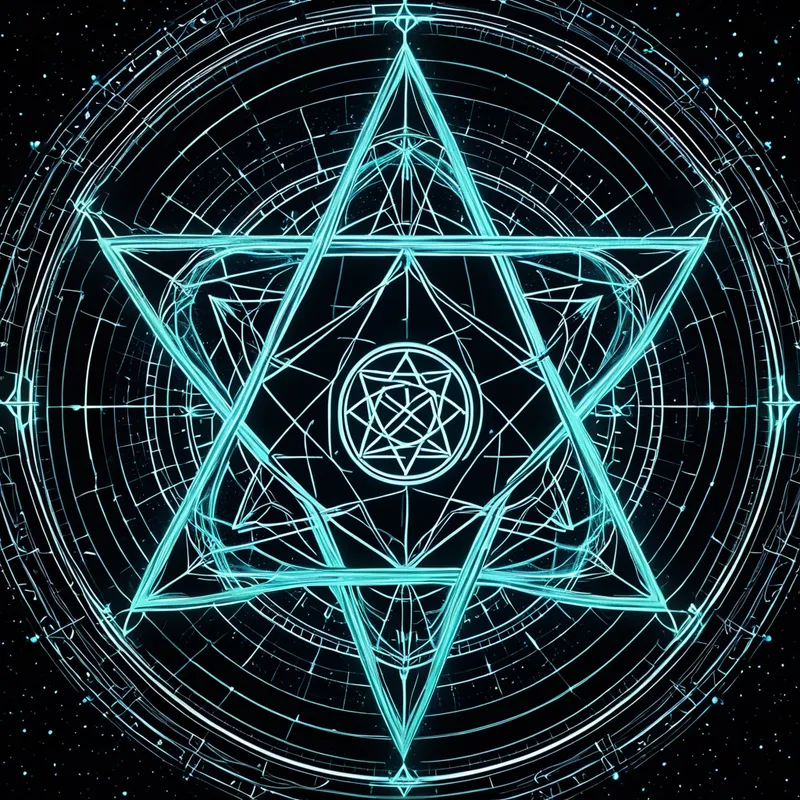
The Dreamer’s Resonance
When the Wu Xing appears in modern dreams, it rarely manifests as literal symbols. Instead, one dreams of its processes. A dream of uncontrollable wildfires (excessive Fire) may speak to a psyche where passion has burned away nourishment, leaving only ash (deficient Earth). A dream of being trapped in a frozen, icy landscape (stagnant Water) may reflect a deep emotional freeze, where the fluidity of feeling and adaptation has been lost, unable to nourish new growth (Wood).
Somatically, this might feel like a specific, recurring tension—a rigid stiffness in the shoulders (Metal’s boundary become armor) or a churning, anxious digestion (Earth’s center unable to stabilize). The dream is diagnosing a blockage in the inner ecosystem. It points to which “phase” or psychological function is over-expressed, under-nourished, or failing to transform into its necessary successor. The dreamwork becomes an act of internal feng shui, seeking to restore the flow of psychic Qi along these elemental pathways.
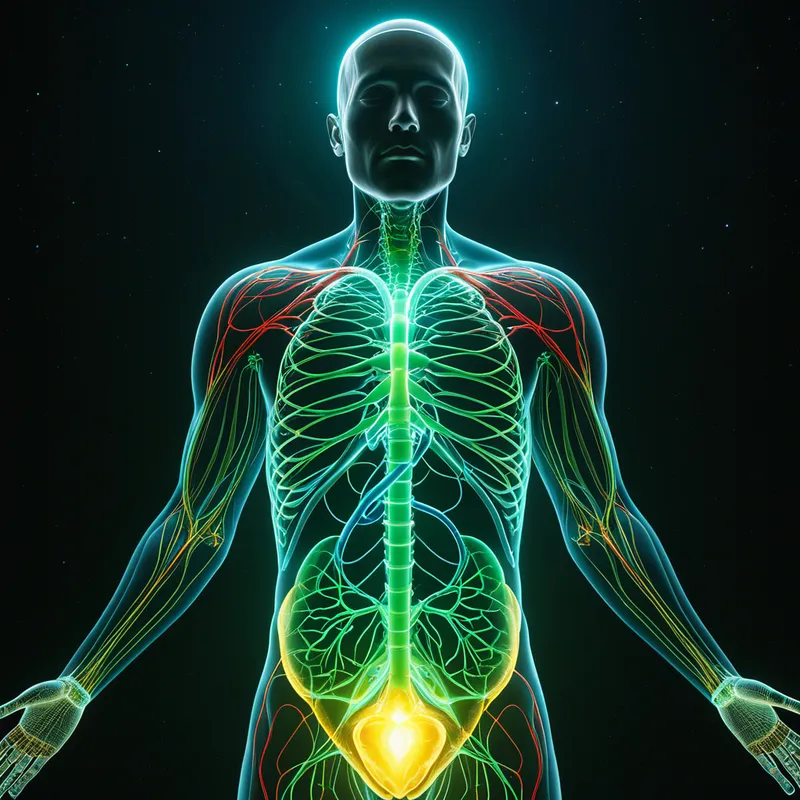
Alchemical Translation
The individuation process, the journey toward psychic wholeness, is perfectly modeled by the Wu Xing cycle. It is not a linear path to a fixed goal, but an eternal alchemy of the self.
We begin in Water—the unconscious, undifferentiated potential of the psyche. Our task is to give it form, to let a sapling of intention (Wood) rise from those depths. This is the birth of the ego, a “I will” pushing toward the light. That intention, if true, must catch fire (Fire)—it must be energized with passion, libido, and conscious engagement with the world. We burn brightly for our purpose.
Individuation is the self learning to be both the dancer and the dance, the phase and the cycle that contains it.
But the fire of identification cannot burn forever. It must submit to the humbling ash, to the phase of Earth. Here, we integrate our experiences, nurture what we’ve created, and find our grounded center. From this fertile soil of the integrated self, we then extract our true Metal—our core values, our unshakeable principles, the refined essence of our character. We define our boundaries and our worth.
Finally, we must let that structured self dissolve back into the wisdom of Water—not as a regression, but as a return to the source with conscious understanding. The rigid ego softens into adaptive flow, holding its shape but knowing when to yield. And from that deeper, wiser pool, a new, more authentic intention (Wood) is born, beginning the cycle again at a higher level of integration. The triumph is not in escaping the cycle, but in mastering its rhythm, becoming a conscious participant in the soul’s own perpetual, transformative seasons.
Associated Symbols
Explore related symbols from the CaleaDream lexicon: