Wu Daozi Myth Meaning & Symbolism
A legendary Tang Dynasty painter completes his life's work, a mural of paradise, and then walks into the painting, vanishing forever into his own creation.
The Tale of Wu Daozi
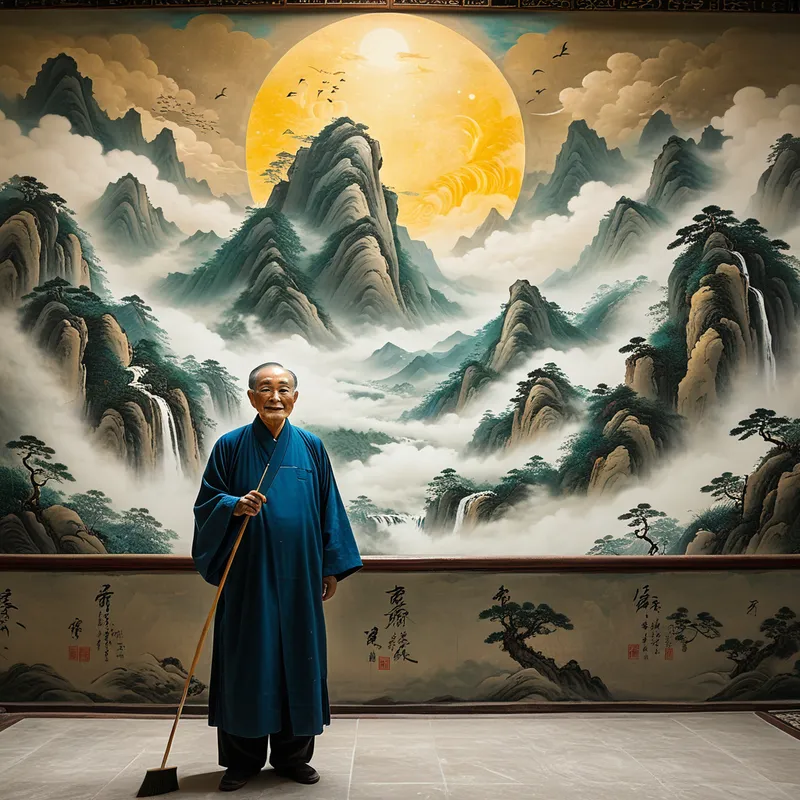
Listen, and let the incense of memory carry you back to the glorious days of the Tang Dynasty. In the court of the Emperor Xuanzong, there lived a man whose name was whispered with reverence: Wu Daozi. He was not merely a painter; his brush was a conduit for the Qi of the cosmos itself. Dragons coiled in the steam of his tea, and phoenixes took flight in the shadows cast by his lantern.
For years, the Emperor had harbored a desire. He commissioned Wu Daozi to create the ultimate masterpiece upon the vast wall of a palace hall: a mural depicting the Jade Void, the celestial paradise where sages dwelled among mist-wrapped peaks and crystalline waterfalls. The master accepted in silence. He withdrew from the court's glittering chatter, entering a solitude so profound it was itself a kind of art. Seasons turned outside his studio. He was seen less and less, but the whispers grew: they said his brushstrokes echoed with thunder, that the pigments he ground held crushed jewels and dawn light.
Finally, the day arrived. The Emperor, his courtiers, and esteemed scholars gathered in the hushed hall. A great silk cloth was draped over the wall. With a solemn grace, Wu Daozi approached and drew the cloth away.
A collective gasp sucked the air from the room. There it was—not a painting, but a world. The paradise was breathtaking in its complexity and vitality. Pine trees ancient and gnarled clung to impossible cliffs. A mighty river, born from clouds, cascaded down into a deep gorge, its spray almost cool on the face. Winding paths led to tiny pavilions where one could almost see immortals sipping wine. The depth was illusion, yet it felt more real than the stone floor beneath their feet. The Emperor wept at its beauty.
But Wu Daozi stood calmly before his creation. He turned to the dazzled Emperor and pointed to a specific part of the mural, near the base of the central mountain. "Your Majesty," he said, his voice like dry leaves, "the heart of this paradise lies within this cave, behind this waterfall. Its wonders are beyond mortal description."
The Emperor leaned closer, squinting. "Show me," he breathed.
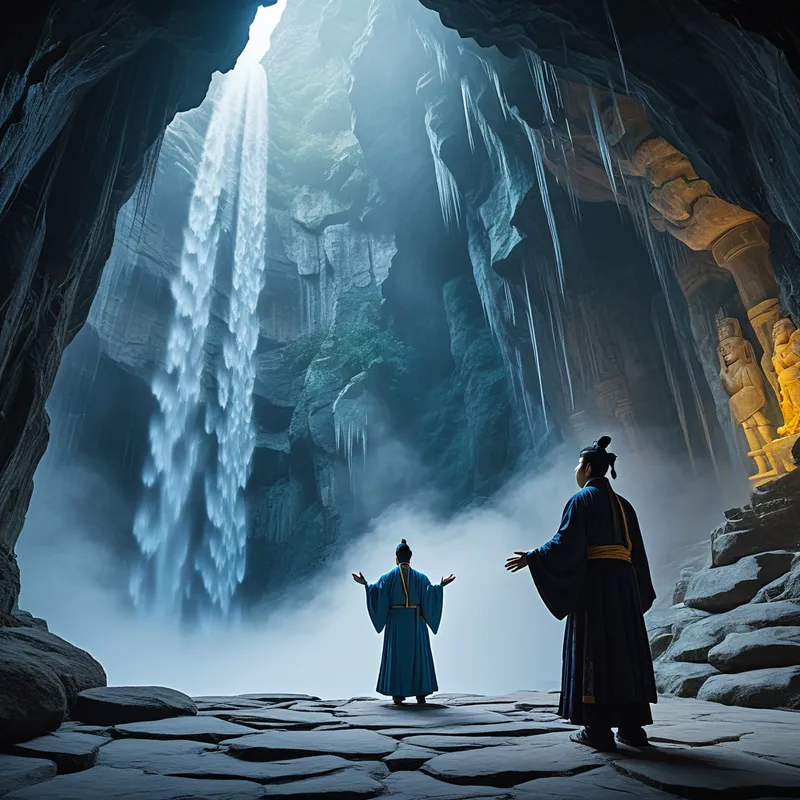
Wu Daozi nodded. He turned back to the wall, raised his hand, and with a final, gentle stroke of his sleeve against the painted rock face, he parted the waterfall. The sound of rushing water seemed to fill the hall. A dark cave entrance was revealed, swirling with ethereal mist. Without a backward glance, the painter stepped forward, his body passing through the plane of the wall as if through a curtain of silk. He walked into the cave, into the heart of his own creation.
For a moment, the court stood paralyzed. Then, as if waking from a dream, they surged forward. But the painting was just a painting again. The waterfall was solid pigment; the cave, a clever shadow. Wu Daozi was gone. He had vanished from the mortal realm, having completed his final and most perfect stroke: the transference of his own spirit from the world of form into the world of essence he had conjured. The masterpiece remained, but its creator had become one with its deepest mystery.
Cultural Origins & Context
The story of Wu Daozi is a pinnacle of Chinese artistic lore, emerging from the rich soil of the Tang Dynasty, a period that defined Chinese aesthetic and spiritual ideals for millennia. While a historical painter named Wu Daozi (circa 680-760 CE) did exist and was renowned as the "Sage of Painting," the myth of his disappearance is a later cultural crystallization. It is not a religious scripture but a parabolic tale passed down among scholars, poets, and artists.
It functioned as the ultimate expression of the Daoist-infused artistic principle of qiyun shengdong (spirit resonance, life-movement). The tale was told to illustrate that true art is not representation, but manifestation. It served to elevate the artist from craftsman to a sage-alchemist, one who could manipulate the very fabric of reality through profound alignment with the Dao. The myth also reinforced a classic theme: the incompatibility of ultimate spiritual attainment with worldly service, even to an emperor. The artist’s final act is one of supreme autonomy, leaving the patron with the artifact but not the essence.
Symbolic Architecture
At its core, the myth of Wu Daozi is a map of the creative act pushed to its spiritual extreme. The mural of the paradise is not just a scene; it is the Self fully realized—a complete, harmonious, and dynamic psychic landscape. Wu Daozi’s years of solitude represent the necessary nigredo, the dark, isolating work of gathering and refining one’s inner raw materials.
The masterpiece is not the object left behind, but the moment the creator becomes indistinguishable from the creation.
The cave behind the waterfall is the ultimate symbol. In global mythology, the cave represents the temenos, the sacred enclosed space of transformation, the womb of the world, and the gateway to the unconscious. It is the hidden center, the final mystery that cannot be shown, only entered. The waterfall, a dynamic veil between worlds, symbolizes the threshold of consciousness itself. Wu Daozi does not destroy his work to find the mystery; he reveals that the mystery is its foundational layer, and then he crosses the threshold permanently.
His disappearance signifies the ultimate sacrifice of the ego. The individual personality (the ego) is dissolved into the greater pattern it has served. He becomes the Senex who does not guide from without, but inhabits the wisdom from within.
The Dreamer's Resonance
When this myth stirs in the modern psyche, it often surfaces in dreams of profound completion and disconcerting departure. One might dream of finally finishing a lifelong project—a book, a garden, a business—only to find a hidden door within it. The dreamer stands at this threshold, feeling a powerful pull to step through, accompanied by equal parts terror and longing.
Somatically, this can feel like a hollowing out in the chest—not of loss, but of lightness. It is the psychological process of de-identification. The dream-ego, which has so tightly identified with the role of "the one who builds," "the one who strives," or "the one who creates," is being invited to let that identity go. The conflict is not with an external force, but with the attachment to one’s own historical narrative. The dream poses the terrifying question: What are you, once the thing that defined you is complete? The myth answers: You are what remains when you walk into the answer.
Alchemical Translation
For the modern individual, Wu Daozi’s journey is a radical model of individuation. Our lives are spent painting our mural—building careers, crafting identities, nurturing relationships, creating legacies. This is the necessary and beautiful opus of the first half of life. The alchemical crisis arrives at the moment of completion, or more often, at the moment we realize completion is possible.
The temptation is to stand back like Emperor Xuanzong, to admire our creation and seek admiration for it, to freeze it as a monument to our ego. The alchemical translation demands the Wu Daozi move: to turn away from the admiring crowd, to locate the hidden cave in our own masterpiece (the flaw, the unresolved pain, the silent passion we kept secret), and to have the courage to part the veil.
Individuation’s final stage is not a better adaptation to the world, but a conscious departure from the world you spent your life adapting to.
This "walking into the painting" is the transmutation of personality into essence. It is the retiree who stops being "the former executive" and discovers a nameless joy in volunteering. It is the artist who, after critical acclaim, begins creating work only for themselves, unconcerned with exhibition. It is the act of internalizing one’s own authority so completely that the external validation—even from an Emperor—becomes irrelevant. One vanishes from the old frame of reference because one has become part of a deeper, self-sustaining reality. The mural remains for others to see, but the living truth is that the painter is now in the landscape, a permanent part of the paradise he once only dreamed of depicting. The creation and the creator become one, in a silence more eloquent than any applause.
Associated Symbols
Explore related symbols from the CaleaDream lexicon: