World Tree Canopy Myth Meaning & Symbolism
A universal myth of a celestial canopy atop the World Tree, representing the soul's perilous ascent to achieve cosmic unity and wisdom.
The Tale of World Tree Canopy
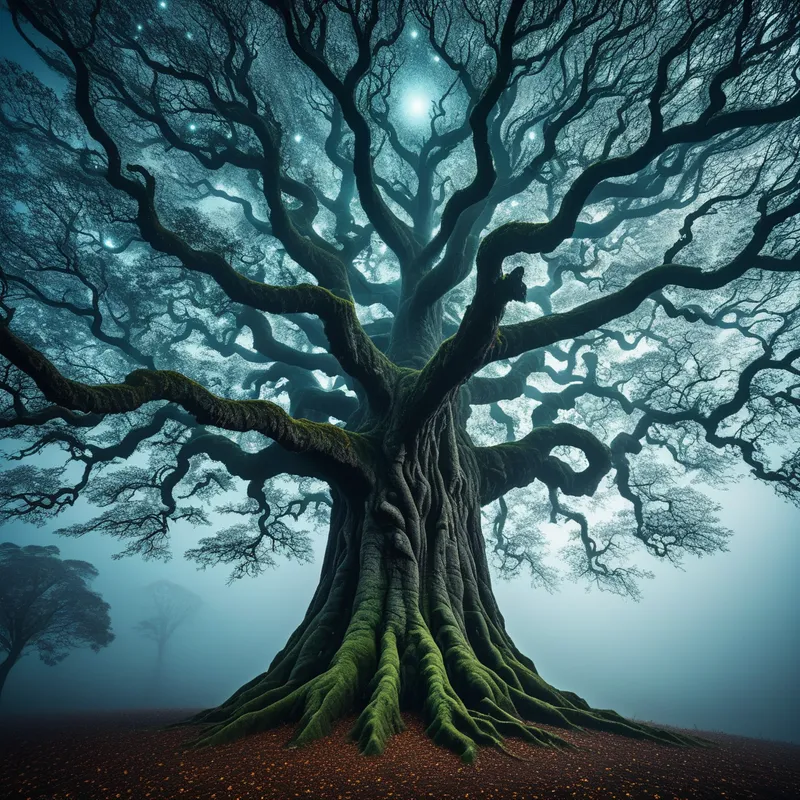
Listen. [The world](/myths/the-world “Myth from Tarot culture.”/) is not as flat as it seems, nor [the sky](/myths/the-sky “Myth from Persian culture.”/) as empty. In the time before time, when the breath of creation was still warm on the clay, there stood the [World Tree](/myths/world-tree “Myth from Global culture.”/). Its roots plunged into the churning waters of the deep, past the bones of ancestors and the whispers of forgotten things. Its trunk was the axis of all lands, around which the sun and moon danced their eternal chase. But its crown… its crown was a mystery veiled in cloud and light.
It was said that the highest branches did not simply bear leaves, but wove themselves into a Canopy</abīr>. This was no mere cluster of foliage. It was a living tapestry, a vault of woven starlight, shimmering sap, and the breath of winds that had never touched [the earth](/myths/the-earth “Myth from Hindu culture.”/). To look up was to see not a ceiling, but a second, inverted world—a realm of pure pattern, connection, and silent music. It was the source of all order, the loom on which fate’s threads were spun, and the repository of all wisdom that had not yet fallen to the ground as seed or story.
Yet a sickness came. A great forgetting. The patterns in the Canopy grew faint, its light dimmed. Discord rustled in the lower branches. The creatures of the root, the trunk, and the middle boughs squabbled, each believing their fragment of the Tree was the whole. The world was coming apart, its unifying vision lost.
From among the people came one whose ears were tuned to a different frequency. Perhaps a shaman with eyes the color of a storm-coming sky, or a child who spoke with the voice of an ancient river. They felt the ache of the disconnect in their own bones, a longing for a wholeness they had never known. Without a command from any king, driven by a pull they could not name, they approached the base of the World Tree.
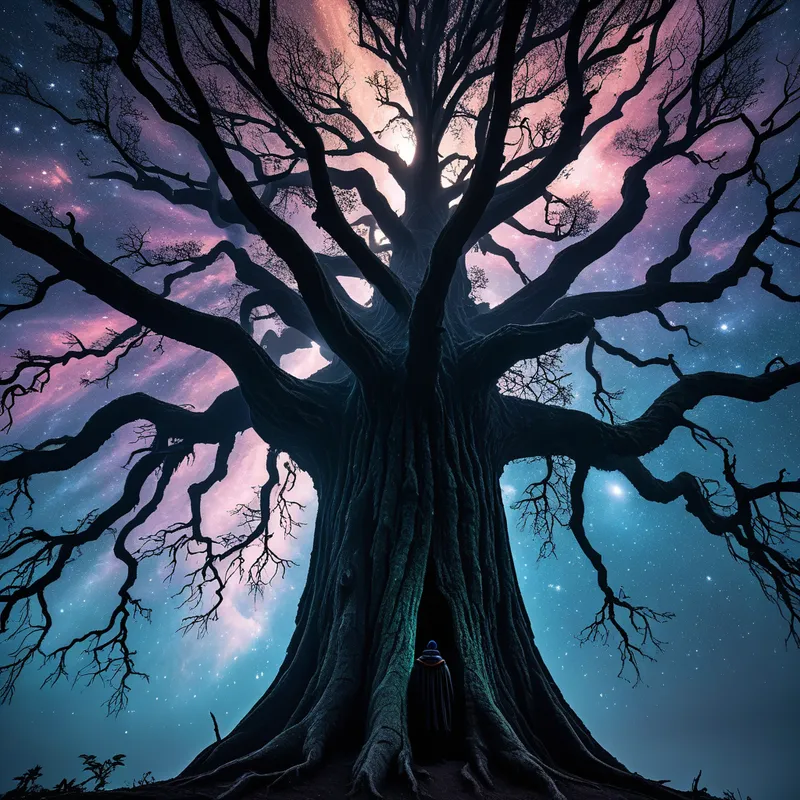
The ascent was the first ordeal. The lower bark was rough and welcoming, but as they climbed, the Tree changed. The handholds vanished; the bark became smooth as polished bone, cold as a mirror. They climbed by will alone, pressed against the immense column, hearing only the thunder of their own heart and the distant, fading cries of the world below. Days blurred into nights. They passed through veils of mist that carried visions—tempting glimpses of home, terrifying voids, the faces of loved ones pleading for their return.
Just as despair threatened to unclench their fingers, they broke through. Not to open sky, but into the Canopy itself.
It was not a place to walk, but to perceive. They did not stand upon branches, but floated within a nexus of luminous strands. Each leaf was a lens, showing not a reflection, but a connection: the root of a mountain here was the tear of a god there; the flight of a sparrow was the same pattern as the orbit of a distant star; their own breath was the rhythm of the tide in a sea they had never seen. The hero did not find wisdom; they became the point of awareness where all connections intersected. The sickness of separation was healed not by a potion, but by this overwhelming, ecstatic understanding of unity.
They did not stay. The vision was not for hoarding. With the pattern etched upon their soul, they began the perilous return, carrying not a physical trophy, but a realigned consciousness. As they descended, it is said, a single, luminous dewdrop—a distillation of the Canopy’s insight—fell from them and soaked into the Tree’s core, spreading slowly through the sap to all realms, beginning the long, slow healing of the world’s forgetfulness.
Cultural Origins & Context
The motif of the World Tree with a celestial or specially significant crown is not the property of a single culture, but a psychic archetype emerging globally. We see it in the Norse [Yggdrasil](/myths/yggdrasil “Myth from Global/Universal culture.”/), whose branches extend over [the nine worlds](/myths/the-nine-worlds “Myth from Norse culture.”/). We glimpse it in the Mesoamerican Wacah Chan, the “Raised-Up Sky,” often depicted as a great ceiba tree. It is present in the Siberian shamanic traditions, where the tree’s top reaches the dwelling place of the high gods. In Hindu cosmology, the inverted Ashvattha tree embodies a similar principle.
This myth was not entertainment; it was a functional cosmology and a psychological map. It was told by shamans, elders, and poets during rites of passage, in healing ceremonies, and in times of collective crisis. Its function was to provide a vertical axis of meaning in a horizontal world, to remind the community that their lives were part of a vast, interconnected system. The story of the ascent validated [the shaman](/myths/the-shaman “Myth from Siberian culture.”/)’s ecstatic journey and provided a mythical template for anyone seeking meaning beyond the mundane.
Symbolic Architecture
The Canopy is the symbolic [culmination](/symbols/culmination “Symbol: A point of completion or climax in a process, often marking the end of a cycle and the achievement of a goal.”/) of the World [Tree](/symbols/tree “Symbol: In dreams, the tree often symbolizes growth, stability, and the interconnectedness of life.”/). If the [Tree](/symbols/tree “Symbol: In dreams, the tree often symbolizes growth, stability, and the interconnectedness of life.”/) represents the [structure](/symbols/structure “Symbol: Structure in dreams often symbolizes stability, organization, and the framework of one’s life, reflecting how one perceives their environment and personal life.”/) of [reality](/symbols/reality “Symbol: Reality signifies the state of existence and perception, often reflecting one’s understanding of truth and life experiences.”/) and the [psyche](/myths/psyche “Myth from Greek culture.”/)—with the roots as the unconscious, the [trunk](/symbols/trunk “Symbol: The trunk in dreams typically denotes the core structure or foundation of one’s identity, values, or beliefs.”/) as [the ego](/myths/the-ego “Myth from Jungian culture.”/)/conscious self, and the branches as the reach of [spirit](/symbols/spirit “Symbol: Spirit symbolizes the essence of life, vitality, and the spiritual journey of the individual.”/)—then the Canopy is the [unus mundus](/myths/unus-mundus “Myth from Alchemical culture.”/), the unified world.
It represents the transcendent function, the psychic organ that perceives the underlying unity behind opposing forces.
The smooth, mirror-like bark of the upper trunk signifies the [dissolution](/symbols/dissolution “Symbol: The process of breaking down, dispersing, or losing form, often representing transformation, release, or the end of a state of being.”/) of the ego. All familiar tools and identities fail. One must confront the sheer, unadorned Self. The Canopy itself is not a “[thing](/myths/thing “Myth from Norse culture.”/)” but a state of [consciousness](/symbols/consciousness “Symbol: Consciousness represents the state of awareness and perception, encompassing thoughts, feelings, and experiences.”/)—the realization of the Self where all inner conflicts (the squabbling creatures) are seen as necessary parts of a grand, beautiful, and intelligent [pattern](/symbols/pattern “Symbol: A ‘Pattern’ in dreams often signifies the underlying structure of experiences and thoughts, representing both order and the repetitiveness of life’s situations.”/). The [hero](/symbols/hero “Symbol: A hero embodies strength, courage, and the ability to overcome significant challenges.”/)’s [journey](/symbols/journey “Symbol: A journey in dreams typically signifies adventure, growth, or a significant life transition.”/) is not one of conquest, but of receptive [integration](/symbols/integration “Symbol: The process of unifying disparate parts of the self or experience into a cohesive whole, often representing psychological wholeness or resolution of internal conflict.”/). They do not seize; they perceive. They do not defeat an [enemy](/symbols/enemy “Symbol: An enemy in dreams often symbolizes an internal conflict, self-doubt, or an aspect of oneself that one struggles to accept.”/); they understand a [relationship](/symbols/relationship “Symbol: A representation of connections we have with others in our lives, often reflecting our emotional state.”/).
The Dreamer’s Resonance
When this myth stirs in the modern dreamer, it often manifests not as a literal tree, but as a profound urge for verticality. One might dream of finally reaching the top floor of an endless skyscraper to find a serene observatory. They might dream of climbing a sheer cliff face to find a plateau with a stunning, panoramic view of interconnected landscapes. The somatic feeling is one of breathless ascent, followed by a dizzying expansion.
Psychologically, this dream pattern emerges during a crisis of meaning or a feeling of fragmentation. The dreamer is processing the arduous work of moving beyond a personal, ego-centric view of their life (the lower branches) toward a transpersonal perspective. The terrifying smoothness of the trunk mirrors the resistance encountered when old coping mechanisms and narratives fail. The final breakthrough into the “Canopy” state in a dream is often wordless—a profound feeling of peace, interconnectedness, and cosmic belonging that defies description upon waking. It marks a moment of synthesis, where previously compartmentalized aspects of [the self](/myths/the-self “Myth from Jungian culture.”/) or one’s life are suddenly seen as part of a coherent, if complex, whole.
Alchemical Translation
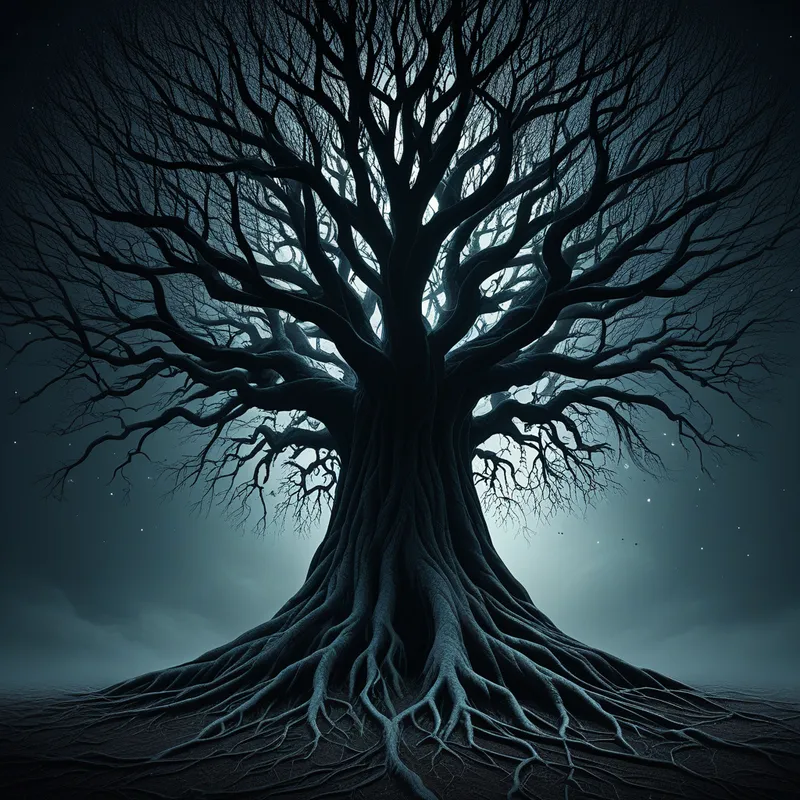
The myth of the Canopy is a perfect allegory for the alchemical opus and Jung’s process of individuation. The initial [nigredo](/myths/nigredo “Myth from Alchemical culture.”/), or blackening, is the “sickness” of separation and the despair of the climb. The albedo, or whitening, is represented by the smooth, mirror-like bark—the confrontation with the purified, stripped-down essence of the self, reflecting nothing but the truth of the climber’s solitude and purpose.
The ascent to the Canopy is the citrinitas, the yellowing or dawning of the spiritual sun, where one begins to see by a new light.
The arrival in the Canopy itself is the [rubedo](/myths/rubedo “Myth from Alchemical culture.”/), the reddening, the culmination. This is not an explosion of passion, but the deep, glowing realization of the Self’s place in the cosmic order. The hero achieves the Philosopher’s Stone—not a physical object, but the lapis as the integrated psyche. The “dewdrop” they bring back is the tinctura, the healing influence of this integrated state that begins to color and transform their ordinary life.
For the modern individual, this myth models the journey from a life lived on the horizontal plane of social roles, achievements, and problems (the world of the lower branches) to a life informed by the vertical connection to something transcendent. It teaches that the goal is not to escape the world, but to return to it, like the hero, with a transformed vision that can slowly, drip by drip, heal the fragmentation within and, by extension, in one’s corner of the world. The struggle is the ascent of consciousness itself.
Associated Symbols
Explore related symbols from the CaleaDream lexicon: