World Serpent Myth Meaning & Symbolism
A primordial serpent encircling the world, embodying chaos and potential, whose binding or slaying is a foundational act of cosmic and psychological order.
The Tale of the World Serpent
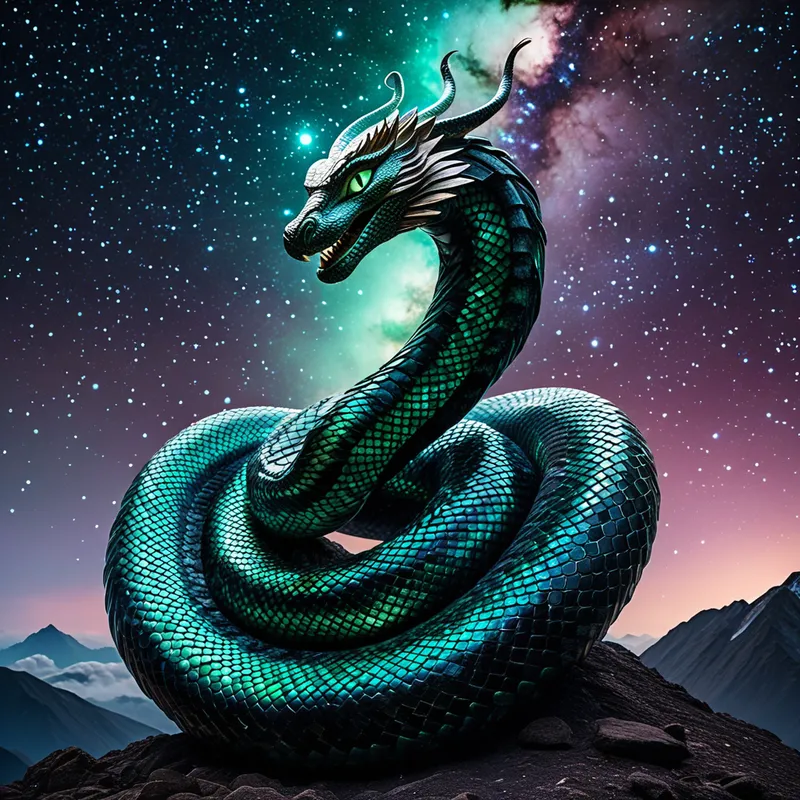
Listen, and I will tell you of the time before time, when the world was a raw and formless thing. In the deep, silent dark beneath the roots of mountains, it stirred. Not born, but simply being, from the very first. It was the World Serpent, a creature of scales that mirrored the abyss and eyes that held the cold fire of unborn stars. Its body was the measure of the earth, so vast that to see its head was to forget its tail, and to glimpse its tail was to doubt its beginning. It slept in the ocean’s trench, coiled around the foundations of the world.
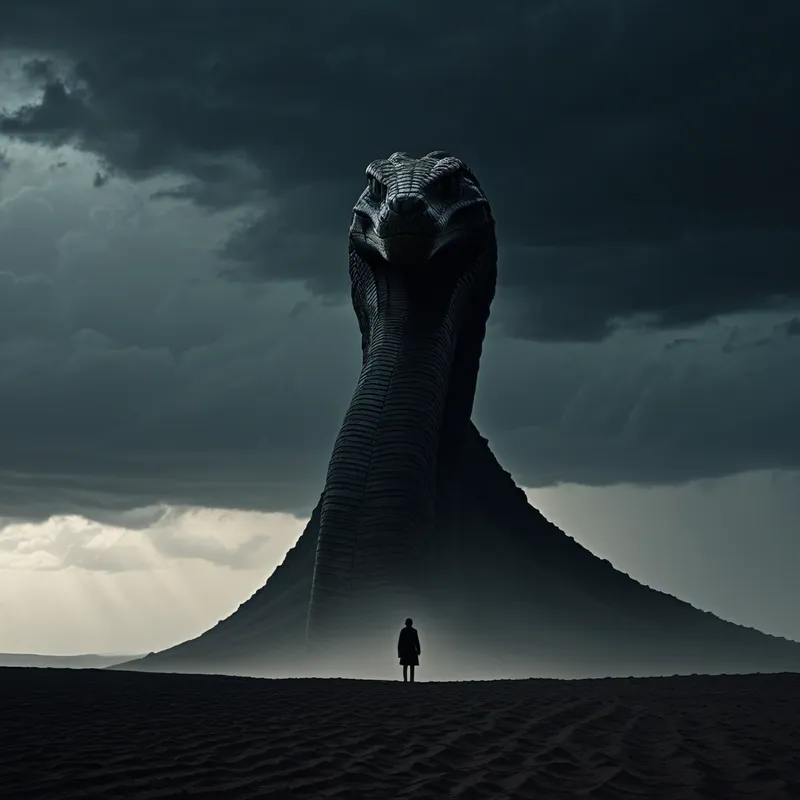
But its sleep was not peace. It was a gathering. With each turn of its dreaming form, the lands trembled. Tides were its breath, earthquakes the shifting of its scales. The people of the surface world lived in the shadow of its potential, knowing their ordered fields and sturdy homes were but a crust over an unimaginable power. They whispered that if it ever fully awoke, it would shrug, and the world would be unmade, returned to the primal soup from which it came.
Then came the one who would face it. Not always a warrior with a shining blade. Sometimes a cunning god, a trickster with words sharper than any spear. Sometimes a king whose duty was a heavier crown than gold. They descended, not into a simple cave, but into the underworld itself, where the air was thick with the smell of deep earth and salt, and the only light was the serpent’s own baleful glow. The confrontation was not mere battle. It was a dialogue of forces. The serpent would rise, a wave of muscle and scale, its hiss the sound of a continent cracking. It spoke of the void that existed before names, of the freedom of chaos, of the lie of permanence.
The hero stood, a point of will against the encircling deep. The struggle was cosmic—a test of whether consciousness could impose a pattern upon the infinite, whether a story could be told against the backdrop of the eternal silence. There was no final death blow, for such a being cannot truly die. Instead, there was a binding, a containment, a pact. The serpent was pinned beneath the world-mountain, its coils harnessed to hold the land together. Its restless energy was channeled; its chaos became the necessary tension that keeps the cosmic wheel turning. The world was saved, not by destruction, but by a terrible, necessary integration. The serpent slept again, but now its dreams were the deep, rhythmic pulse of the world itself.
Cultural Origins & Context
The image of the World Serpent is a true archetype, emerging independently from the human psyche in cultures separated by vast oceans. We find it as Jörmungandr in the frozen Norse sagas, where skalds chanted of its feud with Thor. It appears as the Tiamat in the baked clay tablets of Babylon. It is the Shesha, upon whose coils the god Vishnu rests, in the ancient texts of India. It is the Rainbow Serpent of Australian Aboriginal Dreamtime, a creator and destroyer.
This myth was not mere entertainment. It was a foundational narrative told by elders and priests, often during rituals or at the turning of seasons. Its function was ontological: it explained why the ground is stable yet sometimes shakes, why the sea is fertile yet dangerously boundless. It served as a societal anchor, reinforcing the idea that cultural order—laws, agriculture, civilization—is a hard-won achievement against an ever-present, chthonic force. The myth taught that existence is a dynamic, precarious balance, not a given state.
Symbolic Architecture
Psychologically, the World Serpent represents the totality of the unconscious, specifically its impersonal, archaic, and potentially overwhelming aspects—what Carl Jung termed the non-ego, the objective psyche. It is the chaos of unlived life, the raw instinctual energy, and the forgotten knowledge that lies beneath the ordered surface of the conscious personality.
The serpent is not the enemy to be destroyed, but the untamed force to be related to. Its binding is the ego’s necessary act of self-preservation, but its integration is the soul’s path to wholeness.
The hero’s journey to confront it symbolizes the ego’s descent into the unconscious, a perilous but essential voyage for anyone seeking psychological maturity. The serpent’s encirclement of the world mirrors how the unconscious surrounds and undergirds consciousness. The struggle is the ego’s terrifying encounter with its own insignificance in the face of psychic totality. The resolution—binding, not slaying—is the critical insight. It represents the establishment of a relationship between consciousness and the unconscious, where the immense power of the latter is acknowledged, contained, and ultimately harnessed as the foundational energy of the psyche.
The Dreamer’s Resonance
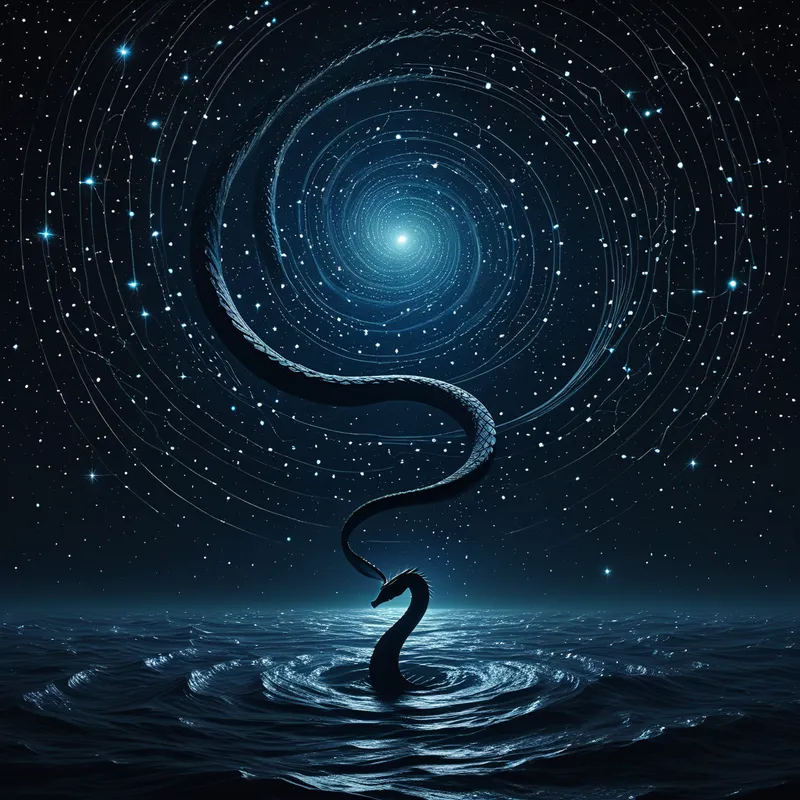
When the World Serpent surfaces in modern dreams, it rarely appears as a literal monster. Its presence is more atmospheric and somatic. One might dream of being in a house that is suddenly undermined by a vast, subterranean movement, or of watching the ocean rear up in one impossible, coiling wave. The dreamer often feels a profound, earth-shattering dread, a sense of a foundational reality giving way.
This dream signals that the dreamer’s psychological foundations are being shaken. It often occurs during life crises—the end of a career, the collapse of a long-held belief, a profound loss. The serpent’ stirring represents the uprising of repressed contents from the personal and collective unconscious: old wounds, ignored instincts, or a tidal wave of emotion that the conscious attitude can no longer dam. The somatic feeling of dread is the body’s recognition of this psychic earthquake. The dream is an urgent missive from the deep self, indicating that the old order of the personality is untenable and must engage with a more powerful, more chaotic, and ultimately more vital layer of being.
Alchemical Translation
The myth of the World Serpent is a perfect map for the alchemical process of individuation. The initial state is nigredo, the blackening: the chaotic, undifferentiated state of the psyche where the serpent rules unchallenged. The hero’s conscious decision to descend is the beginning of the work.
The crucible of transformation is not the light of consciousness alone, but the tension between that light and the profound darkness that gives it contrast and meaning.
The confrontation in the abyss is the stage of separatio and coniunctio. The ego (the hero) must first separate itself from identifying with the chaos (recognize the serpent as other), then endure the terrifying engagement with it. The binding is the coagulatio—the solidification of a new psychic structure. The serpent, once a threat of dissolution, becomes the stabilizing force at the center. Its immense energy is transmuted from a force of random destruction into the dynamic tension that holds the self together.
For the modern individual, this translates to the courage to face one’s own inner chaos—the depression, rage, irrational fears, or boundless desires we try to exile. The goal is not to eliminate these forces, which is impossible, but to “bind” them: to acknowledge their power, hear their message, and integrate their energy into the personality in a constructive way. The result is not a sterile peace, but a vibrant, resilient wholeness. One becomes like the stabilized world, with a conscious life built upon, and in dynamic relationship with, the vast, powerful, and eternal dark of the inner World Serpent.
Associated Symbols
Explore related symbols from the CaleaDream lexicon: