
Winepress Myth Meaning & Symbolism
A sacred vessel of crushing, where the blood of the grape becomes the wine of covenant, embodying the terrible beauty of divine judgment and transformative suffering.
The Tale of the Winepress
Hear now, a tale not of men, but of the harvest of heaven and earth. The sun hangs low, a bronze disc in a sky bleached white with heat. The vineyards of the [Promised Land](/myths/promised-land “Myth from Biblical culture.”/) are heavy, clusters of grapes dark as a bruise, sweet as a promise. But this is not a story of the harvest feast. This is the story of the press.
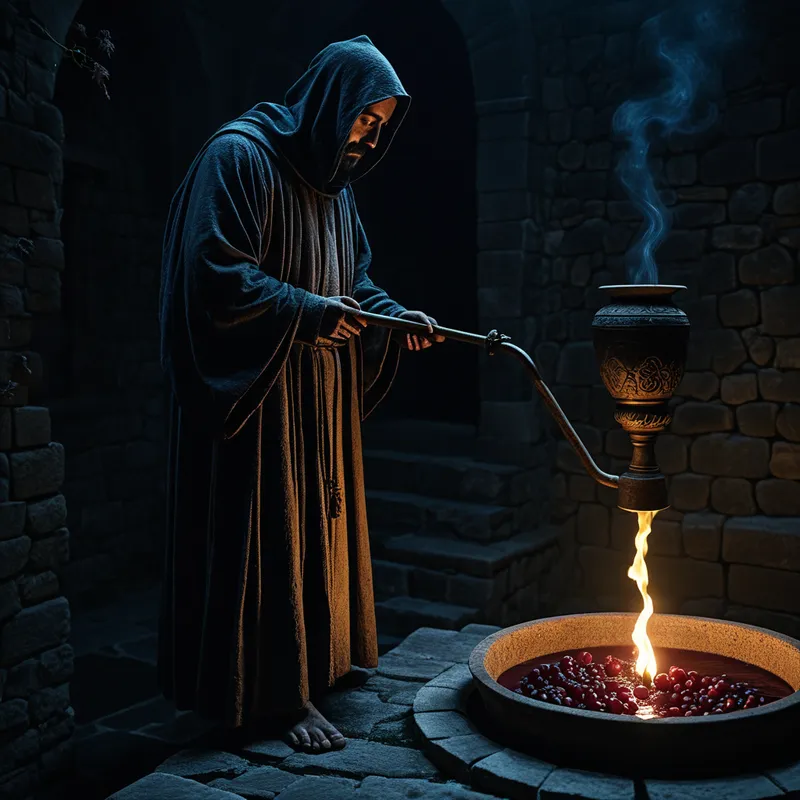
The air is thick with the scent of dust and impending must. The winepress, hewn from the living rock of a hillside, waits—a silent, stony mouth. It is not a gentle vessel. It is a place of weight, of pressure, of a necessary, brutal intimacy. The grapes are gathered, not by joyous hands, but with a solemn inevitability. They are poured into the trough, this sacred hollow, until they mound like a purple sacrifice.
Then comes the treader. Sometimes a figure of prophecy, robed and resolute; sometimes a presence felt more than seen, vast and inexorable. There is no machine here, only the slow, crushing rhythm of feet. The sound is not of celebration, but of a deep, groaning work. The skins split. The sweet flesh is rent. From the violence, a flow begins—first a trickle, then a stream, then a torrent.
It is not juice that runs, but lifeblood. It stains the stone a permanent crimson, rushing through the carved channel into the waiting vat below. The air fills with a metallic, fertile scent, the perfume of release. The treader works on, until the harvest is utterly spent, until every drop is yielded. What remains in the press is not fruit, but pulp and broken skin—the husk of what was, having given up its essence. The wine, now separate, rests in the darkness of the vat, a potent, sleeping spirit born from the crush. The work is terrible. The result is sacred.
Cultural Origins & Context
The image of the winepress is woven deep into the fabric of Biblical literature, from the Torah to [the prophets](/myths/the-prophets “Myth from Biblical culture.”/) and into the New Testament. It was not a mere agricultural metaphor but a visceral, cultural touchstone. Every village understood the process; its sights, sounds, and smells were part of the annual rhythm. Prophets like [Isaiah](/myths/isaiah “Myth from Abrahamic culture.”/) and Joel seized upon this universal understanding to convey messages of staggering theological weight.
They spoke of the winepress as an instrument of Yahweh’s wrath. Nations, or the faithless among Israel, were the grapes; divine judgment was the treading. This was not arbitrary violence, but the necessary processing of corruption to produce purity. The metaphor functioned as a severe warning and a theodicy—an explanation of suffering within a framework of divine [justice](/myths/justice “Myth from Tarot culture.”/) and ultimate purpose. It was passed down in temple readings and prophetic oracles, a stark reminder that blessing (wine) and covenant were preceded by a demanding, often painful, selectivity.
Symbolic Architecture
At its core, the winepress symbolizes the necessary container for transformative pressure. It is the archetypal [crucible](/symbols/crucible “Symbol: A vessel for intense transformation through heat and pressure, symbolizing spiritual purification, testing, and alchemical change.”/) where raw, complex potential (the grape) is subjected to a force that breaks its individual form to release a unified, potent essence (the [wine](/symbols/wine “Symbol: Wine often symbolizes celebration, indulgence, and the deepening of personal connections, but it can also represent excess and escape.”/)).
The self cannot be integrated without first being crushed. The ego, like the skin of the grape, must be ruptured for the spirit to flow.
The treader represents an unavoidable, transcendent force—be it [fate](/symbols/fate “Symbol: Fate represents the belief in predetermined outcomes, suggesting that some aspects of life are beyond human control.”/), divine will, or the demands of one’s own [destiny](/symbols/destiny “Symbol: A predetermined course of events or ultimate purpose, often linked to spiritual forces or cosmic order, representing life’s inherent direction.”/). This force is impersonal in its [operation](/symbols/operation “Symbol: An operation signifies a process of change or transformation that often requires deliberate effort and planning.”/); it does not hate the grape, but requires its submission to fulfill a greater [purpose](/symbols/purpose “Symbol: Purpose signifies direction, meaning, and intention in life, often reflecting personal ambitions and core values.”/). The grape symbolizes the individual [soul](/symbols/soul “Symbol: The soul represents the essence of a person, encompassing their spirit, identity, and connection to the universe.”/), a [community](/symbols/community “Symbol: Community in dreams symbolizes connection, support, and the need for belonging.”/), or a state of being that is whole yet unfulfilled, containing a [sweetness](/symbols/sweetness “Symbol: Represents pleasure, reward, and positive experiences, often linked to emotional satisfaction and life’s enjoyable moments.”/) locked within a fragile form.
The [blood](/symbols/blood “Symbol: Blood often symbolizes life force, vitality, and deep emotional connections, but it can also evoke themes of sacrifice, trauma, and mortality.”/)-red juice is the most potent [symbol](/symbols/symbol “Symbol: A symbol can represent an idea, concept, or belief, serving as a powerful tool for communication and understanding.”/). It is [life](/symbols/life “Symbol: The symbol of ‘Life’ represents a journey of growth, interconnectedness, and existential meaning, encompassing both the joys and challenges that define human experience.”/) itself being poured out, representing sacrifice, [covenant](/symbols/covenant “Symbol: A binding agreement or sacred promise between parties, often carrying deep moral, spiritual, or social obligations and consequences.”/), and [passion](/symbols/passion “Symbol: Intense emotional or physical desire, often linked to love, creativity, or purpose. Represents life force and deep engagement.”/). In the [Christian](/symbols/christian “Symbol: The symbol represents the faith, teachings, and cultural values associated with Christianity, including themes of love, salvation, and morality.”/) [alchemy](/symbols/alchemy “Symbol: A transformative process of purification and creation, often symbolizing personal or spiritual evolution through difficult stages.”/) of the [symbol](/symbols/symbol “Symbol: A symbol can represent an idea, concept, or belief, serving as a powerful tool for communication and understanding.”/), this becomes explicitly the [blood](/symbols/blood “Symbol: Blood often symbolizes life force, vitality, and deep emotional connections, but it can also evoke themes of sacrifice, trauma, and mortality.”/) of Christ, pressed out on the cross, the ultimate winepress of sacrifice that produces the wine of a new [covenant](/symbols/covenant “Symbol: A binding agreement or sacred promise between parties, often carrying deep moral, spiritual, or social obligations and consequences.”/). Psychologically, it is the vital emotional and psychic [energy](/symbols/energy “Symbol: Energy symbolizes vitality, motivation, and the drive that fuels actions and ambitions.”/) released only through profound struggle—the “[blood](/symbols/blood “Symbol: Blood often symbolizes life force, vitality, and deep emotional connections, but it can also evoke themes of sacrifice, trauma, and mortality.”/), sweat, and tears” that [water](/symbols/water “Symbol: Water symbolizes the subconscious mind, emotions, and the flow of life, representing both cleansing and creation.”/) the soul’s growth.

The Dreamer’s Resonance
When the winepress appears in a modern dream, it rarely speaks of literal viticulture. It announces a season of immense psychological pressure. The dreamer may find themselves inside the press, feeling crushed by life circumstances—a job, a relationship, an internal crisis. They may be the treader, apprehensive about causing necessary pain or enacting a difficult decision. Or they may simply behold the press, a monolithic, ancient structure in a dream landscape, evoking awe and dread.
Somatically, this dream pattern correlates with feelings of constriction, weight on the chest, or a sense of being squeezed dry. Psychologically, it marks the liminal phase of a transformation. The old identity (the intact grape) is being deconstructed. The dream is not a prophecy of doom, but a symbolic mapping of the process. The crucial question it poses is: What is the wine? The dream asks the dreamer to identify the potential essence, the clarified purpose or spirit, that this crushing pressure is meant to release. The terror of the dream is in the crushing; its hope is in the vat waiting below.

Alchemical Translation
The myth of the winepress provides a stark, powerful model for the individuation process. In psychological alchemy, the [prima materia](/myths/prima-materia “Myth from Alchemical culture.”/)—the base, unconscious stuff of [the self](/myths/the-self “Myth from Jungian culture.”/)—must be dissolved and coagulated to create [the philosopher’s stone](/myths/the-philosophers-stone “Myth from Alchemical culture.”/) of the integrated personality.
The winepress is [the vessel](/myths/the-vessel “Myth from Alchemical culture.”/) for the [nigredo](/myths/nigredo “Myth from Alchemical culture.”/), the blackening, the stage of mortification and despair. Our comfortable illusions, our inflated self-images, our unprocessed complexes—these are the clusters of grapes. Life, in the form of crisis, loss, or deep introspection, becomes the treader.
The goal of the press is not destruction, but distillation. Suffering, consciously endured, becomes the alembic that separates the spirit from the dross.
We are invited not to flee the press, but to consciously consent to its work. This is the sacred sacrifice: the offering of our ego’s defenses to a process larger than itself. The “wine” that results is the transformed attitude—a deepened compassion, a hard-won wisdom, a sober joy, or a creative spirit that could not have existed without the breaking. It is the aqua vitae, the [water](/myths/water “Myth from Chinese culture.”/) of life, born from the blood of experience. The individual emerges not simply bruised, but fermented, their essence potentiated and ready to be poured out as a libation to their own authentic life. The myth assures us that the crushing has a purpose, and the vat of meaning awaits the flow.
Associated Symbols
Explore related symbols from the CaleaDream lexicon: