Willow Tree Myth Meaning & Symbolism
A myth of a goddess's grief becoming a sacred tree, weaving sorrow with lunar light to create a vessel for prophecy and healing.
The Tale of Willow Tree
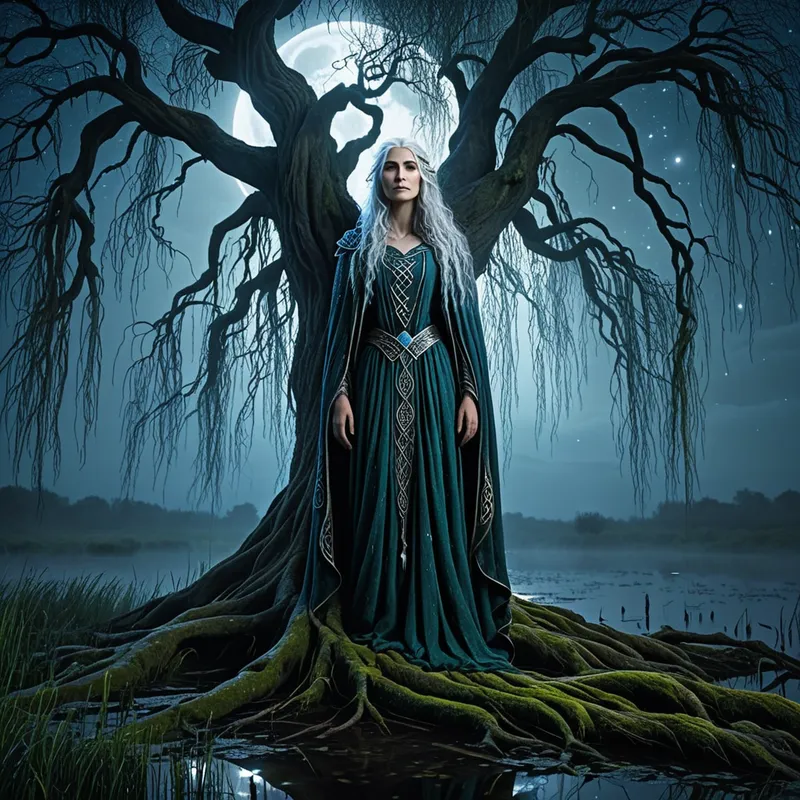
Listen, and hear the whisper of [the wind](/myths/the-wind “Myth from Various culture.”/) through the leaves that weep. In the time before memory, when [the world](/myths/the-world “Myth from Tarot culture.”/) was young and [the veil](/myths/the-veil “Myth from Various culture.”/) between the worlds was thin as mist, there lived a goddess of [the moon](/myths/the-moon “Myth from Tarot culture.”/) and the deep waters. Her name was lost to the sighing of the reeds, but her nature was known: she was the keeper of secrets, the weaver of dreams, and the witness to all sorrows that flowed unseen.
She dwelt where the land grew soft, in the liminal places where solid earth surrendered to the dark, reflective pools of the bog. Here, the silver light of the moon lay upon the [water](/myths/water “Myth from Chinese culture.”/) like a second sky, and here, the goddess would walk, her feet leaving no print upon the sodden moss. She was a solace to the lost, a listener to the heart’s silent cries. But her own heart was a vessel that filled with the grief of the world—every tear shed in loneliness, every pang of unspoken love, every sigh of the dying day flowed into her, a silent, ceaseless river.
One fateful twilight, as the first star pierced the violet sky, a great mourning arose from the mortal world below. A chieftain, beloved and brave, had fallen in a meaningless skirmish. His people’s lament was not a roar, but a deep, resonant keening that vibrated through the very roots of the hills and into the waters of the goddess’s domain. This sorrow was too vast, too pure in its desolation. It entered her not as another stream, but as a flood tide, filling her until she felt she would dissolve from the weight of it.
She could not contain it. Fleeing to the edge of her most sacred pool, she fell to her knees, and for the first time, the Keeper of Sorrows wept her own tears. They were not water, but liquid moonlight, falling in heavy, luminous drops onto the black peat. Where each tear fell, the ground stirred. A tender, silver-green shoot pushed through, thirsting not for sunlight, but for the lunar grief that nourished it.
The goddess wept until she had no form left to weep with. Her silvery robes melted into a smooth, pale bark. Her outstretched arms, raised in a final gesture of release, became pliant, sweeping branches. Her long hair, flowing in the spectral breeze, transformed into a cascade of slender, pointed leaves that brushed the dark water of the pool. Where she had knelt, a great and graceful tree now stood, its roots drinking deeply from the well of sorrow, its branches weaving a canopy of soft, sighing lament.
But this was not an end. The people, drawn by a strange comfort on the air, found the tree. They sat in its dappled shade and found their own grief met, not dismissed, but held. They heard secrets in the rustle of its leaves—whispers of what was, what is, and what might yet be. The tree, born of a goddess’s ultimate empathy, had become a bridge. Its roots in [the underworld](/myths/the-underworld “Myth from Greek culture.”/) of feeling, its trunk in the mortal world, and its crown brushing the realm of prophecy. It did not take away the pain; it transformed it into a shelter, a teacher, a connection to the deeper, flowing truth of all things.

Cultural Origins & Context
[The willow](/myths/the-willow “Myth from Celtic culture.”/), or Saille, holds a firm place in the Celtic world-view, particularly within the tradition of the [Ogham](/myths/ogham “Myth from Celtic culture.”/) alphabet. As the fifth consonant, Saille is linked to the month approximating April, a time of fluidity, growth, and the waxing moon. This mythic understanding was not preserved in a single, canonical text—the ancient Celts transmitted their wisdom orally, through the revered class of the Druids and the filid, or poets.
Its societal function was multifaceted. Practically, willow (Salix) was coppiced for weaving baskets, fences, and coracles—literally creating containers and vessels from its flexible wood. Mythologically, this physical property mirrored its spiritual role: the willow was seen as a container for non-ordinary states. It grew in the “in-between” places—riverbanks, lake edges, bogs—zones considered thresholds to the [Otherworld](/myths/otherworld “Myth from Celtic culture.”/). Therefore, it was intimately associated with the goddesses of these liminal realms, like the aforementioned lunar water deity, or figures such as Boann. The myth served to explain and sanctify the tree’s observed qualities: its connection to water, its melancholic beauty, and its use in rituals of divination and healing. It taught that profound sensitivity, even to the point of overwhelming grief, was not a weakness but a sacred, generative force when properly surrendered to the cyclical nature of life.
Symbolic Architecture
The Willow myth is a profound map of the [psyche](/myths/psyche “Myth from Greek culture.”/)’s [relationship](/symbols/relationship “Symbol: A representation of connections we have with others in our lives, often reflecting our emotional state.”/) with the deep waters of [emotion](/symbols/emotion “Symbol: Emotion symbolizes our inner feelings and responses to experiences, often guiding our actions and choices.”/). The [goddess](/symbols/goddess “Symbol: The goddess symbolizes feminine power, divinity, and the nurturing aspects of life, embodying creation and wisdom.”/) represents the [aspect](/symbols/aspect “Symbol: A distinct feature, quality, or perspective of something, often representing a partial view of a larger whole.”/) of [consciousness](/symbols/consciousness “Symbol: Consciousness represents the state of awareness and perception, encompassing thoughts, feelings, and experiences.”/) that receives and holds all feeling without filter—the ultimate empath. Her transformation is not a [punishment](/symbols/punishment “Symbol: A dream symbol representing consequences for actions, often tied to guilt, societal rules, or internal moral conflicts.”/), but a necessary evolution.
To be dissolved into one’s own sorrow is to become a vessel for the sorrow of the world. The personal tear becomes the root of the universal tree.
The [tree](/symbols/tree “Symbol: In dreams, the tree often symbolizes growth, stability, and the interconnectedness of life.”/) itself is the [symbol](/symbols/symbol “Symbol: A symbol can represent an idea, concept, or belief, serving as a powerful tool for communication and understanding.”/) of this [alchemical process](/symbols/alchemical-process “Symbol: A symbolic transformation of base materials into spiritual gold, representing inner purification, integration, and the journey toward wholeness.”/). Its roots, drinking from the dark pool, symbolize [connection](/symbols/connection “Symbol: Connection symbolizes relationships, communication, and bonds among individuals.”/) to the unconscious, the [shadow](/symbols/shadow “Symbol: The ‘shadow’ embodies the unconscious, repressed aspects of the self and often represents fears or hidden emotions.”/), and the ancestral past. Its flexible, non-resistant branches represent the adaptive, resilient psyche that can bend with emotional storms without breaking. The leaves touching the [water](/symbols/water “Symbol: Water symbolizes the subconscious mind, emotions, and the flow of life, representing both cleansing and creation.”/) create a perfect circuit: feeling is drawn up from the [depths](/symbols/depths “Symbol: Represents the subconscious, hidden emotions, or foundational aspects of the self, often linked to primal fears or profound truths.”/), given form and voice in the [rustling leaves](/symbols/rustling-leaves “Symbol: Rustling leaves symbolize change, communication from nature, and the subtle whispers of fate or intuition guiding one’s journey.”/) (conscious [expression](/symbols/expression “Symbol: Expression represents the act of conveying thoughts, emotions, and individuality, emphasizing personal communication and creativity.”/)), and then returns to the [source](/symbols/source “Symbol: The origin point of something, often representing beginnings, nourishment, or the fundamental cause behind phenomena.”/), refined. The willow is thus the [archetype](/symbols/archetype “Symbol: A universal, primordial pattern or prototype in the collective unconscious that shapes human experience, behavior, and creative expression.”/) of the [Psychopomp](/myths/psychopomp “Myth from Greek culture.”/) of the emotional [realm](/symbols/realm “Symbol: The symbol of ‘Realm’ often signifies the boundaries of one’s consciousness, experiences, or emotional states, suggesting aspects of reality that are either explored or ignored.”/), guiding raw, potentially drowning affect into structured wisdom and prophetic [insight](/symbols/insight “Symbol: A sudden, deep understanding of a complex situation or truth, often arriving unexpectedly and illuminating hidden connections.”/). It symbolizes the intelligence of the [heart](/symbols/heart “Symbol: The heart symbolizes love, emotion, and the core of one’s existence, representing deep connections with others and self.”/), which knows through feeling, not [logic](/symbols/logic “Symbol: The principle of reasoning and rational thought, often representing order, structure, and intellectual clarity in dreams.”/).
The Dreamer’s Resonance
When the Willow pattern emerges in modern dreams, it signals a profound somatic and psychological process of emotional assimilation. To dream of standing beneath a weeping willow, of weaving with its branches, or of being within its trunk, points to an encounter with the deep, often melancholic waters of the unconscious.
The dreamer may be processing a grief that feels ancestral or too vast for their personal identity to hold—the loss of a relationship, a career, an old self, or an unnamable nostalgia for something never possessed. The somatic sensation is often one of heaviness, liquidity, or a gentle, pulling sadness. The willow in the dream does not offer a solution, but a space. It suggests the psyche is attempting to build a structure around the feeling, to create a sacred container—much like the goddess became the tree—where this emotion can be held, witnessed, and slowly metabolized. It is a call to develop what psychologists might call emotional tolerance, or what the myth calls sacred witnessing. The dream warns against brittle resistance (which breaks) and advocates for conscious, pliant surrender (which bends and ultimately transforms).

Alchemical Translation
The myth of the Willow models the individuation process of integrating the shadow, specifically [the shadow](/myths/the-shadow “Myth from Jungian culture.”/) of vulnerability and profound feeling. In our modern, hyper-rational culture, deep sensitivity is often pathologized or hidden. The alchemical journey here begins with the [prima materia](/myths/prima-materia “Myth from Alchemical culture.”/) of overwhelming emotion—the “flood tide” of grief.
The goddess’s kneeling and weeping is the crucial mortificatio or dissolution. [The ego](/myths/the-ego “Myth from Jungian culture.”/)-consciousness that tries to “manage” or “stay strong” must surrender and be dissolved in its own affective waters. This is not a defeat, but the necessary death of an old, rigid way of being.
The transmutation occurs not by overcoming the water, but by becoming the vessel that is born from it.
From this dissolution arises the lapis, the philosophical tree. The new psychic structure is flexible, rooted in reality (the dark earth/water of the unconscious), and oriented toward meaning (the branches seeking light and air). The individual who undergoes this willow-process moves from being a victim of their emotions to becoming a host to them. They gain the willow’s gifts: intuition (listening to the leaves), resilience (bending in the wind), and the ability to create sacred containers—through art, relationship, or therapeutic practice—that can hold and transform the sorrows of themselves and others. They complete the circuit, finding that their deepest vulnerability, once fully embraced, becomes their point of greatest connection and wisdom.
Associated Symbols
Explore related symbols from the CaleaDream lexicon: