Widow's Cruse Myth Meaning & Symbolism
A destitute widow's last jar of oil multiplies miraculously, saving her sons from slavery and revealing a hidden, inexhaustible source of grace.
The Tale of Widow’s Cruse
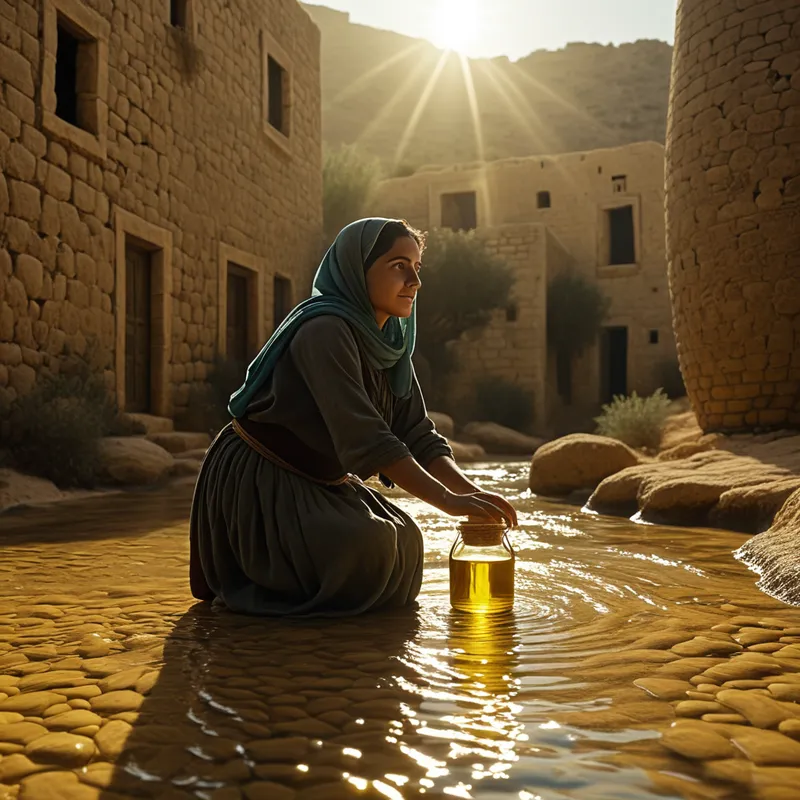
The sun was a merciless coin of brass, hammering the dust of Zarephath into a pale, breathless powder. The wind carried not the scent of rain, but the ghost of it—a cruel memory. In a house where silence had grown thick as the cobwebs in the corners, a widow moved with the slow certainty of despair. Her name is lost to us, but her shape is eternal: the slope of shoulders bearing a debt heavier than stone, the hands that had smoothed the hair of her two sons now clenched in quiet terror.
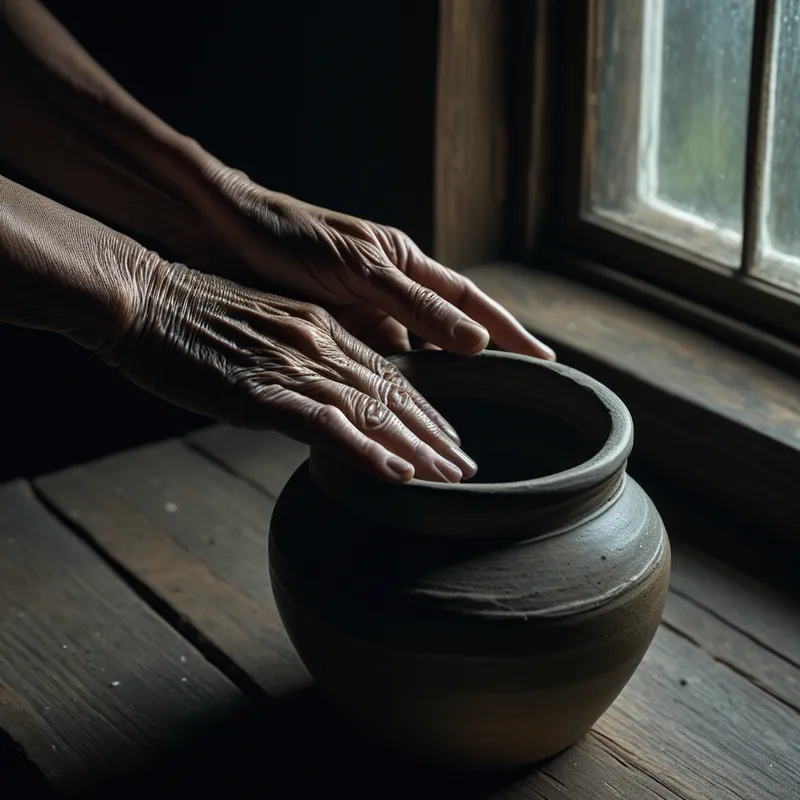
A creditor was coming. The law was a cold, sharp sickle, and it would harvest her boys for the debt their father left behind. They would become slaves, their laughter swallowed by a stranger’s field. All she possessed was a final, cruel hope: a single jar, a cruse, with only a film of oil clinging to its clay belly. Enough for one last cake of bread upon the fire. Then, she and her sons would eat that final meal and wait for the hunger to take what the debt-collector would not.
But a voice had entered her drought. It belonged to a man of God, Elijah, who was himself a fugitive from the king’s wrath, sustained by ravens in the wilderness. He asked her for water, and then for bread. She told him of her nothingness, the finality of her handful of meal and her drop of oil. The prophet’s eyes held not pity, but a fierce, unshakable knowing. “Fear not,” he said, and his words were like a key turning in a lock she did not know she possessed. “First make me a little cake, and bring it to me. Then make for yourself and your son. For thus says the LORD, the God of Israel: ‘The jar of meal shall not be spent, and the cruse of oil shall not fail, until the day that the LORD sends rain upon the earth.’”
The air in the room changed. It grew still, charged. The widow looked from the prophet’s face to her empty vessels, from her certain end to this impossible promise. Faith is not the absence of fear, but the action taken in its very teeth. With trembling hands, she poured the last of her oil. It made a thin, pathetic sound against the clay. She mixed the last of her meal. She took a portion—her portion, her sons’ portion—and gave it to the stranger.
Then, she returned to the jar. She tilted it again over her own bowl. And a drop fell. Then another. Then a slow, steady stream, golden and fragrant, welling up from the seemingly hollow depths. She gasped. She ran to the meal bin—a handful remained, and as she scooped it, more shifted beneath, as if from an invisible source. That day, they ate. The next day, she returned, and the oil flowed, the meal was replenished. The creditor pounded at the gate, but inside, a miracle hummed. The cruse did not fail. The jar was not spent. Day after parched day, in the shadow of a looming doom, a secret spring of abundance flowed, not from the earth, but from the keeping of a sacred word.
Cultural Origins & Context
This story is preserved in the First Book of Kings (Chapter 17), a text that chronicles the turbulent history of the divided kingdoms of Israel and Judah. It is set during the reign of the notoriously wicked King Ahab and a devastating, divinely-ordained drought—a direct confrontation between the LORD and the Canaanite fertility god Baal.
The tale functions on multiple cultural levels. Firstly, it is a prophet legend, showcasing Elijah as a true man of God whose word carries creative, sustaining power. Secondly, it is a story of social justice and divine compassion, highlighting God’s particular care for the most vulnerable: the widow, the orphan, and the stranger. In a patriarchal society where a widow with no male protector was economically and legally imperiled, this narrative subverts expected power dynamics. The sustainer of the great prophet is not a king, but a destitute foreign woman. Passed down orally and then scribally, it served as a powerful theological assertion: true provision comes not from royal storehouses or the cycles of nature worshipped as Baal, but from faithful obedience to the covenant God, even in the face of absolute scarcity.
Symbolic Architecture
At its heart, the Widow’s Cruse is an archetypal drama of the vessel and its hidden, infinite content. The widow represents the human ego in a state of existential depletion. She has given all, inherited only obligation, and faces the dissolution of her most precious attachments—her sons, her future. The empty jar and bin are symbols of a life felt to be drained of meaning, resource, and hope.
The miracle does not arrive as a sudden windfall from the outside, but as a mysterious upwelling from within the very container of lack.
The prophet Elijah symbolizes the activating principle of the Self, the inner or outer voice that demands a paradoxical, faith-filled action. His command to “give first” is the critical alchemical instruction. The act of giving from her perceived nothingness is the ritual that breaks the spell of scarcity consciousness. It is an investment in a hidden order of reality. The oil and meal—staples of life, light, and sustenance—symbolize the psychic energy (libido) and the nourishing substance of the soul that are discovered to be self-replenishing when aligned with a transpersonal purpose. The cruse that does not fail is the symbol of the indestructible core of the psyche, the wellspring of the unconscious that feeds consciousness when the ego surrenders its frantic hoarding.

The Dreamer’s Resonance
When this myth stirs in the modern dreamer, it often manifests in periods of profound burnout, financial anxiety, or emotional exhaustion—a feeling of being spiritually “dried up.” One might dream of a beloved house with empty, echoing rooms; of a bank account with a balance of zero; or of a desert landscape where a single, stunted tree holds one last fruit.
The somatic sensation is one of constriction in the chest, a hollow feeling in the gut—the physiology of scarcity. The psychological process is the confrontation with the Shadow of dependency and helplessness. The dream-ego, like the widow, is faced with a terrifying obligation (a debt, a demand, a looming deadline) that threatens to enslave its vital potential (the sons). The miracle in the dream may appear subtly: the empty cup refills as you drink, the single coin in your pocket multiplies, a trusted figure (the Elijah archetype) offers an irrational piece of advice that, upon waking, feels like a key. The dream is initiating the psyche into a new relationship with its own resources, hinting that the solution lies not in acquiring more from the outer world, but in performing the inner act of trust and generosity from the place of felt emptiness.

Alchemical Translation
The alchemical journey modeled here is the solutio—not by water, but by oil: a gentle, penetrating dissolution of the rigid ego’s calculus of lack. The widow’s initial state is the nigredo, the blackening of despair. The prophet’s word is the albedo, the illuminating insight that introduces a higher order.
The core operation is sacrifice, the sacrificium. The ego must sacrifice its last claim to security—its final “meal”—to the transpersonal demand (the Self, the divine, the deeper calling). This is not a loss, but the essential first step in a psychic transaction.
The act of giving what you believe you cannot spare is the precise gesture that opens the conduit to the infinite.
The multiplying oil is the lapis, the philosopher’s stone, in one of its most humble forms: the discovery that one’s true substance is inexhaustible. For the modern individual, the “widow’s cruse” is that inner faculty—perhaps creativity, compassion, resilience, or insight—that we fear is spent. The myth instructs us to use it, to give from it, even and especially when it feels empty. In doing so, we shift from an ego-economy of scarcity to a soul-economy of circulation and grace. The miracle is not that the jar is always full, but that in the faithful act of pouring out, it is never finally empty. This is the alchemy of sustained life: abundance revealed not as a possession, but as a faithful process.
Associated Symbols
Explore related symbols from the CaleaDream lexicon: