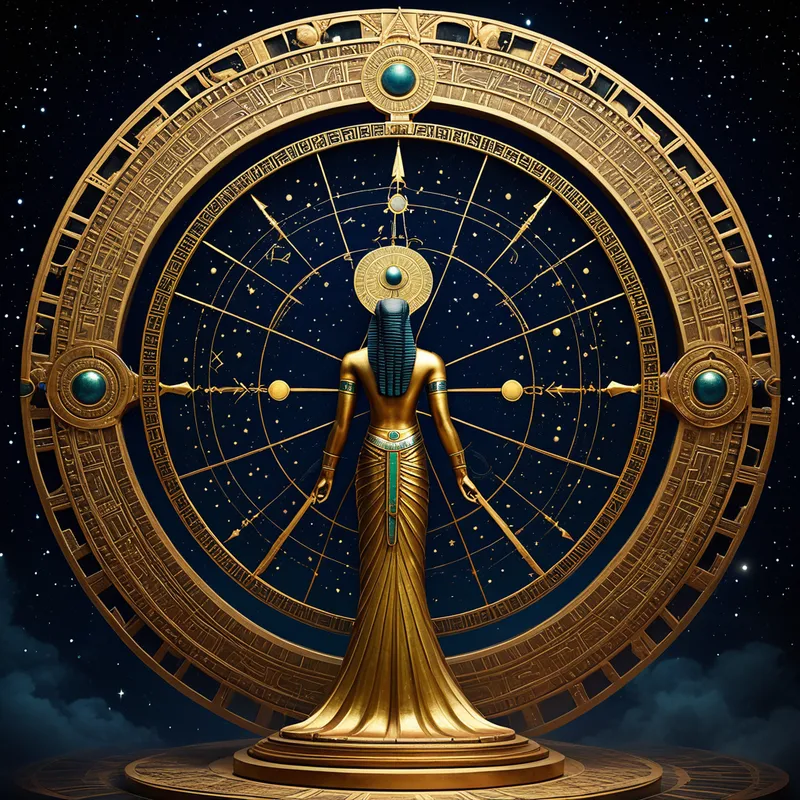
Wheel of Fortune Myth Meaning & Symbolism
A cosmic wheel, spun by fate, lifts souls to glory and casts them into shadow, teaching the eternal dance of ascent, zenith, and return.
The Tale of Wheel of Fortune
Listen. Beyond the veil of your steady world, in the chamber where time is not a river but a turning sphere, there is a sound. It is the groan of ancient timber, the sigh of straining rope, the hum of a stone grinding upon a stone. It is the Wheel.
It turns in a place that is no place, suspended in the breath between breaths. Its rim is gold and iron, crusted with the salt of forgotten tears and polished by the touch of a million hopeful hands. Upon its vast circumference, four figures are bound to the endless revolution.
At the zenith, clinging to a throne lashed to the rim, is a figure crowned in light. He wears the face of a king, his robes are rich, his eyes are wide with the awe of the summit. He holds a scepter, but it is the Wheel that holds him. This is the Ascent.
To his right, rising with the turning, is a creature of riddles and sun-bleached stone—the Sphinx</ab title>. Its claws are sunk deep into the wood, its gaze is serene and terrible, knowing the climb and the fall are one. It carries a sword, not to fight, but to cut the threads of illusion.
Now follow the turn. The king’s throne tips. The glorious zenith passes. He becomes the figure on the left, the one who is falling. The crown slips, the robes tear, and the face that was regal is now a mask of despair. This is the Descent.
And at the nadir, in the deep shadow beneath the turning world, is the fourth figure. Here lies the form of a man, but his head is that of a jackal—Anubis, the watcher in the dark. He does not cling, but stands upon the shifting sands below, his eyes luminous pools observing the fall. In one hand he holds the scales, waiting to weigh what the soul has learned in its plummet.
And coiled around the very axle of the Wheel, feeling every tremor, is the Serpent. It is the spirit of the cycle itself, descending into the earth and ascending again, its body the path of fate.
The king rises. The king falls. The Sphinx watches the rise. Anubis receives the fall. The Serpent feels it all. There is no conflict but the turning itself, no resolution but the next revolution. The sound is everything—the creak of destiny, the whisper of what goes up, and the thunderous, gentle certainty of what must come down. This is the tale that is not a tale, but the rhythm of existence. The Wheel turns. It has always turned. It will turn after the last story is told.
Cultural Origins & Context
The image of the Wheel of Fortune first emerged in the 15th century, within the vibrant visual culture of Renaissance Italy. It was not born from a single sacred text, but woven from threads of classical philosophy, medieval morality plays, and Hermetic thought circulating among scholars and artists. Early Tarot decks, like the Visconti-Sforza, were painted for noble families, serving as both a luxurious game and a repository of symbolic wisdom.
The card’s iconography is a direct heir to the medieval concept of Rota Fortunae—the Wheel of Fortune—a potent allegory popularized by philosophers like Boethius. This was not a “myth” told by bards around a fire, but a philosophical diagram enacted in cathedral sculptures and illuminated manuscripts. Its tellers were the artists and theologians who used it to illustrate a core, sobering truth of medieval life: earthly power, health, and wealth were transient gifts of a fickle goddess, Fortuna. The card’s societal function was memento mori—a reminder of mortality and the vanity of worldly attachment, urging a focus on the eternal soul rather than temporal station.
Symbolic Architecture
The Wheel is the ultimate symbol of dynamic equilibrium. It represents not chaos, but a complex, intelligent order—the cyclical pattern underlying all apparent randomness.
The Wheel does not ask for your belief; it asks for your perception of its pattern. To see the cycle is to step outside of its blind spot.
The four figures are not random passengers but a complete map of consciousness in relation to fate. The Rising Human (often labeled Regnabo, “I shall reign”) embodies the ego in its phase of expansion, effort, and achieved success. The Sphinx (Regno, “I reign”) represents the stabilizing, often enigmatic, principle of law, structure, and conscious understanding that accompanies the peak. The Falling Human (Regnavi, “I have reigned”) is the ego in dissolution, experiencing loss, defeat, and the stripping away of identity. Anubis (Sum sine regno, “I am without a kingdom”) is the deep Self, the psychopomp who receives the shattered ego into the underworld of the unconscious for renewal and re-evaluation.
The Wheel itself is the process of psychic life—the inevitable rotation of expansion and contraction, conscious dominance and unconscious renewal. The Serpent (Typhon) descending signifies the involution of spirit into matter, into the depths of experience, while its ascent is the evolution back towards integration. The letters on the Wheel’s spokes—T-A-R-O, or R-O-T-A—spell both “Tarot” and “Wheel,” revealing the deck itself as a tool for navigating these turns.
The Dreamer’s Resonance
When the Wheel of Fortune spins in the modern dreamscape, it rarely appears as a medieval illustration. Instead, it manifests as the feeling of profound, impersonal momentum. One may dream of being on a rollercoaster with no end, of elevators that rise to penthouses only to plummet to sub-basements, or of being a spectator at a game where the rules change inexplicably.
Somatically, this can correspond to sensations of vertigo, sudden drops in the stomach, or the dizzying rush of acceleration. Psychologically, the dreamer is encountering an autonomous complex—a bundle of thoughts, feelings, and memories—that has taken on a life of its own and is now dictating the rhythm of their experience. This could be a cycle of professional boom and bust, the repetitive pattern of a relationship, or the oscillation between manic confidence and depressive withdrawal.
The dream is not a warning, but an announcement: you are in a cyclical process. The ego is no longer in the driver’s seat but is a passenger on a larger vehicle. The work is to identify which wheel one is on—is it the wheel of ambition, of addiction, of an old familial pattern?—and to begin the difficult task of differentiating oneself from its relentless spin.
Alchemical Translation
The alchemical journey is one of transmutation: leaden consciousness into golden awareness. The Wheel of Fortune is the apparatus in which this occurs. It is the Vas Hermeticum, the sealed vessel where the elements of the psyche are separated, dissolved, and recombined by the fire of experience.
Individuation is not an escape from the Wheel, but the discovery of its still, silent axis within the self. The goal is not to stop the turning, but to find the center that turns with it, unmoved.
The “Ascent” phase (Regnabo) corresponds to the alchemical stage of Albedo, the whitening, where material is purified and elevated. The ego feels enlightened, successful. The “Zenith” (Regno, the Sphinx) is the precarious Citrinitas, the yellowing, a stage of intellectual illumination that can become rigid dogma if not surrendered. The inevitable “Descent” (Regnavi) is the crucial Nigredo, the blackening, the descent into the primal matter, the dark night of the soul where all previous structures break down. Finally, the “Nadir” (Sum sine regno, Anubis) is the beginning of Rubedo, the reddening. Here, in the humble darkness, the essence of the experience is weighed and integrated. The ego, having died to its old form, is reconstituted at a deeper level.
For the modern individual, this models the process of weathering life’s great transitions—not as random misfortunes or lucky breaks, but as phases of a necessary psychic operation. The triumph is not in staying at the top, but in consciously enduring the full rotation, extracting meaning from both the glory and the ruin, and returning to the world bearing the wisdom of the wheel’s whole turn. One learns to say, “This, too, is part of the turn,” and in that acceptance, finds a profound and unshakeable freedom.
Associated Symbols
Explore related symbols from the CaleaDream lexicon: