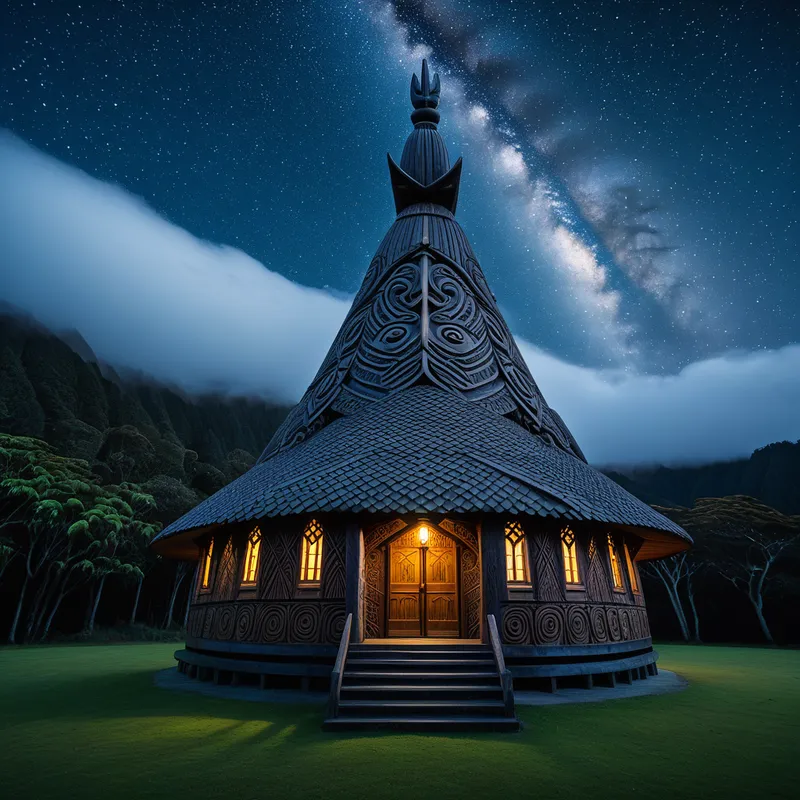
Wharenui Myth Meaning & Symbolism
The myth of the first carved meeting house, a sacred structure embodying the cosmos, ancestral lineage, and the ordered human world born from primal chaos.
The Tale of Wharenui
Listen. In the time before time, when the world was a formless, sighing mist of Te Kore, the people lived beneath the open sky. They huddled around fires, their backs to the whispering dark of Te Wao Nui. The winds, the children of Tāwhirimātea, stole their words. The rain, the tears of Ranginui, washed away their stories. They were a people adrift, their voices scattered, their ancestors silent in the long night.
Then came the vision. It came not to a warrior, but to a master of the adze, a carver named Tohunga Whakairo. In a dream, he stood on the chest of Papatūānuku and saw a great being. It was not a man, not a bird, but a structure of immense life. Its backbone was a ridgepole, straight and true as the path of the sun. Its arms were bargeboards, outstretched in a welcome that was also an embrace. Upon its head sat a fierce guardian, a tekoteko, with eyes of gleaming paua that held the light of the stars. From its sides, carved figures peered out—ancestors with curling koru upon their brows, their mouths open in the silent chant of the ages.
The carver awoke with the image burning in his hands. He went to the elders. “We must give this vision a body,” he said. “We must build a wharenui, a house that is a person, a person that is a world.”
The people were divided. Some feared to enclose the sacred, to trap the ancestral mana within walls. But the carver persisted. He led them to the heart of the forest, to a mighty Tāne Mahuta. With chants and offerings, they asked the tree, the child of the forest god, for its body. The tree consented with a sigh, and when it fell, it did not crash, but lay itself down upon the earth like a willing ancestor.
The work began. The carver’s adze sang, and with every chip of wood that flew, a story was released. The central post, the poutokomanawa, was carved from the heartwood. “This is the heart of our people,” he declared. The wall slabs, the poupou, took shape—each a remembered chief, a storied heroine, their faces marked by the trials and triumphs of the lineage. The ridgepole, the tāhuhu, was raised with ropes of woven flax and the synchronized power of a hundred voices chanting. It stretched from the front post, Ranginui, to the rear post, Papatūānuku, spanning the primal parents and holding the sky aloft.
Finally, the tekoteko was placed atop the roof, facing the rising sun. As the first light struck its paua-shell eyes, a profound silence fell. Then, a sound emerged—not from a person, but from the house itself. It was a low, resonant hum, the sound of the forest remembering itself, the sound of the wind given a home for its song. The people entered, not into a building, but into the embrace of a living ancestor. The chaos of the outside world was ordered. The whispers of the past became clear speech. The Wharenui was born, and the people were no longer adrift. They were held within the ribs of history, sheltered beneath the brow of heaven.
Cultural Origins & Context
The Wharenui is not merely a building in Māori culture; it is the primary vessel of tribal identity, history, and cosmology. The myth of its origin is embedded in the practical and sacred knowledge of the tohunga and master carvers. This knowledge was—and is—transmitted orally and through direct apprenticeship, a sacred trust (taonga) passed down generations.
The telling of this myth was not casual entertainment. It was recited during the consecration of a new meeting house, its narrative mirroring the physical act of construction. Each step in the story validated and sanctified the real-world work: the selection of the tree, the carving of ancestors, the raising of the ridgepole. The myth served a critical societal function: it encoded architectural principles, spiritual protocols, and social law. It explained why the house faces a certain way, why specific carvings are placed where they are, and, most importantly, it rooted the community’s present existence in a cosmological drama. The Wharenui became the physical anchor of the tribe’s tapu and their connection to the whenua. It was school, parliament, cathedral, and living genealogy all in one.
Symbolic Architecture
The Wharenui is a master symbol of psychic and cosmic integration. It is a map of reality, translating the vast, unordered cosmos into a comprehensible, human-scale order.
The house is a body, the body is a cosmos, and the cosmos finds its voice in the communal heart.
The ridgepole (tāhuhu) is the axis mundi, the world pillar connecting the earthly realm with the heavens. Psychologically, it represents the spine of consciousness, the central principle around which a coherent identity is structured. The carved wall panels (poupou) are the assembled ancestors, the internalized figures of one’s personal and collective past. They are not dead history but active constituents of the present self, each holding a piece of the story, a lesson, a wound, or a strength. The heart post (poutokomanawa) is the core of emotional and spiritual life, the central support without which the entire structure—the psyche—collapses.
The myth narrates the journey from Te Kore (the void of potential, the unformed self) to Te Ao Mārama (the world of light, the conscious, ordered self). The construction of the house is the act of building a conscious ego-structure capable of containing the powerful, often chaotic, forces of the ancestral unconscious (the forest, the winds, the ancestors). It is the creation of a temenos—a sacred, bounded space—where the raw material of life can be shaped into meaningful narrative.
The Dreamer’s Resonance
When the motif of the Wharenui appears in modern dreams, it signals a profound process of psychic reorganization. To dream of building such a house suggests the dreamer is actively engaged in constructing a stable, authentic identity, perhaps after a period of dissolution or crisis (“the formless mist”). They are seeking to integrate their personal history (their “ancestors”) into a coherent life-story.
To dream of entering a Wharenui, especially one that feels ancient and alive, often indicates a readiness to confront and commune with deep, perhaps neglected, aspects of the self. The carved figures (poupou) may represent specific complexes, inherited family patterns, or archetypal forces that hold power over the dreamer’s life. The somatic feeling is often one of both awe and profound containment—a sense of being smaller than the structure, yet safely held within it. Conversely, dreaming of a dilapidated or broken Wharenui can reflect a perceived collapse of one’s foundational beliefs, family support, or cultural identity, pointing to a need for repair at the soul’s core.
Alchemical Translation
The alchemical process mirrored in the Wharenui myth is that of coagulatio—the making solid, the bringing into form. It is the antidote to the perpetual solutio (dissolution) of modern life, where identity is fragmented, ancestry is forgotten, and meaning feels fluid and elusive.
Individuation is not a journey out into the world, but the sacred construction of a home for the world within.
The modern individual begins in their own Te Kore: a state of potential, confusion, or existential drift. The “master carver” is the emerging Self, the organizing principle of the psyche that receives the vision of wholeness. The “forest” is the rich, wild, and often untamed material of the personal and collective unconscious. The arduous work of felling the tree, carving, and raising the posts is the disciplined work of introspection, therapy, art, or ritual—the slow shaping of raw experience into conscious form.
Each “ancestor” carved into the walls is a reconciled aspect of the self: the integrated shadow, the acknowledged anima/animus, the accepted child and the wise elder. The raising of the ridgepole is the moment of synthesis, where a central, guiding principle of one’s life is consciously erected and aligned. The final act, the humming life of the completed house, symbolizes the achieved state where the personality is no longer a battleground of conflicting impulses but a resonant vessel. It is a vessel that can shelter the individual’s vulnerability, host the communion of their inner figures, and provide a stable orientation—a true north—from which to engage the outer world. One becomes, like the Wharenui, both a unique creation and a perfect expression of a universal, cosmic pattern.
Associated Symbols
Explore related symbols from the CaleaDream lexicon: