Weighing of the Heart Ceremony Myth Meaning & Symbolism
A soul's final judgment in the Hall of Two Truths, where the heart is weighed against a feather to determine eternal fate.
The Tale of Weighing of the Heart Ceremony
The final breath has been drawn. [The world](/myths/the-world “Myth from Tarot culture.”/) of sun and river, of stone and sand, recedes like a fading dream. You are no longer flesh, but essence—a ba, untethered, drawn through the silent dark toward a door that is not a door. A chill, deeper than the tomb’s heart, precedes it. You stand at [the threshold](/myths/the-threshold “Myth from Folklore culture.”/) of the Hall of Two Truths.
The air is thick with the scent of sacred incense and the silence of eternity. Pillars, carved from a stone that drinks light, rise into a darkness where stars seem to be frozen in mid-fall. At the hall’s far end, seated upon a throne that is a mountain of lapis lazuli, is [Osiris](/myths/osiris “Myth from Global/Universal culture.”/), the Green God. His skin is the black of fertile silt, his regalia the white of bleached bone. His eyes are pools of still [water](/myths/water “Myth from Chinese culture.”/), seeing everything that ever was within you.
But it is not to him you go first.
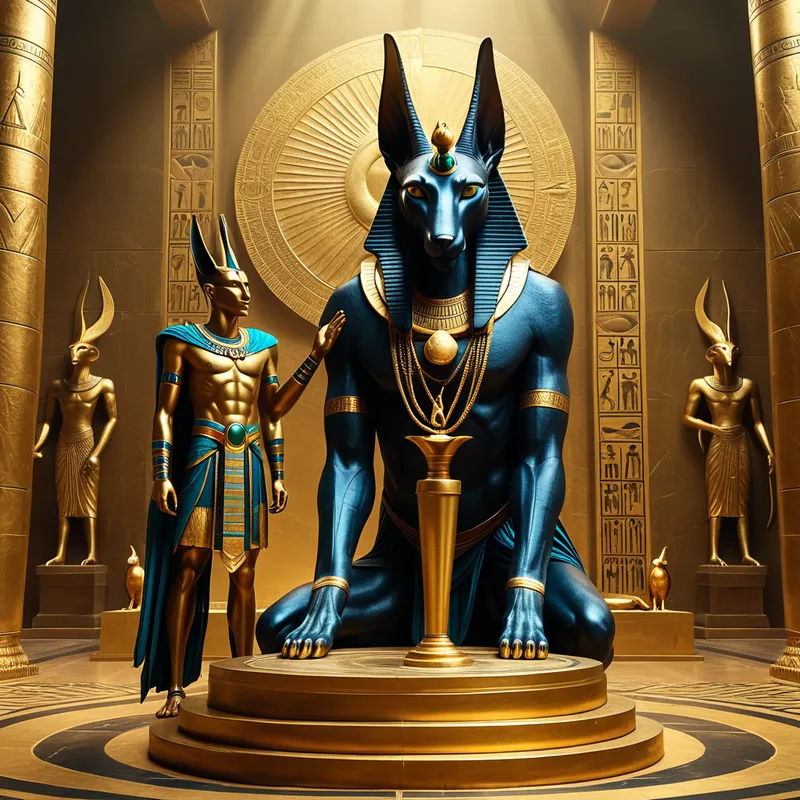
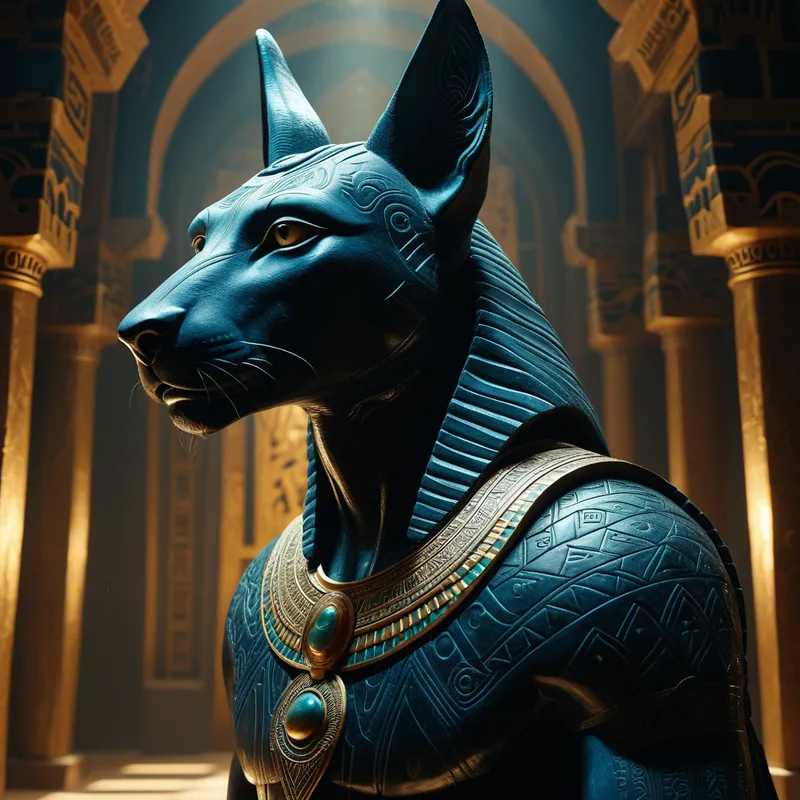
From the shadows, a figure emerges—sleek, silent, with the head of a desert jackal and the bearing of a king. This is Anubis. His touch is neither warm nor cold as he takes your hand, not in greeting, but in guidance. His voice is the whisper of sand shifting in a forgotten corridor. “Come.” He leads you to the center of the hall, where the true trial awaits.
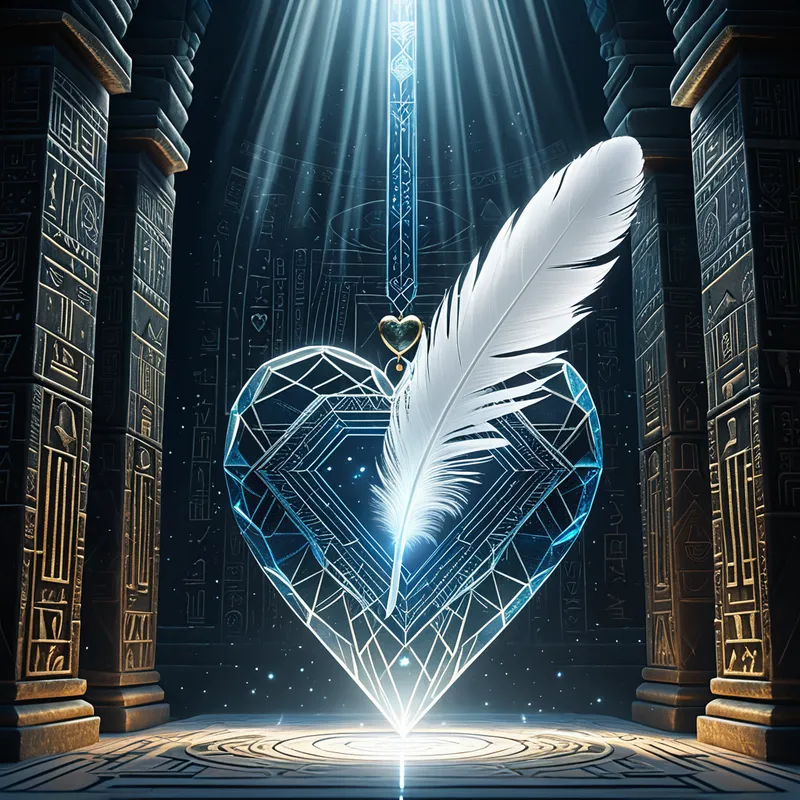
There, gleaming under a light with no source, stands the Scales of Truth. One golden pan sits empty. In the other rests a single, perfect feather—the Feather of Ma’at. It is so light it seems to tremble on the edge of non-existence. Your gaze is drawn downward. Anubis’s hands are at your chest. There is no pain, only a profound, hollow pulling. He holds it now, the sum of your life: your heart, ib. It glows with a soft, [inner light](/myths/inner-light “Myth from Buddhist culture.”/), but within its pulse, shadows flit like frightened birds.
With infinite care, Anubis places your heart upon the empty scale.
The world holds its breath. The great balance arm shudders, then begins its slow, agonizing dance. Up and down, the pans oscillate. Your heart seems to swell and shrink with each remembered kindness, each secret cruelty, every moment of courage and every instance of cowardice. The feather remains impossibly still, the absolute standard.
Watching, recording, is [Thoth](/myths/thoth “Myth from Global/Universal culture.”/), his ibis head bent over a [papyrus](/myths/papyrus “Myth from Egyptian culture.”/) scroll. His reed pen is poised. And lurking in the deeper shadows, a creature of nightmare waits: Ammit, part lion, part hippopotamus, part crocodile, her jaws slack with eternal hunger. Her purpose is singular.
The scales slow… and settle. The arm becomes perfectly, terrifyingly level. Your heart and the feather are in equilibrium. A truth has been proven. Thoth’s pen scratches a single, decisive mark. “True of voice,” he intones. The words echo like a struck bell.
Only then may you approach Osiris. He speaks, and his voice is the sound of the Nile’s source. “You have been found righteous. Your heart is not heavy with wrongdoing. You know the names of the gods and the spells of the Book of the Dead. You may pass into the Field of Reeds.” The hall, once a place of dread, now feels like a womb. The journey is complete. But for those whose heart sinks the scale, there is no speech from Osiris, only a final, merciful darkness as Ammit advances.
Cultural Origins & Context
This was not merely a story told for wonder; it was the central operating manual for the soul, codified in texts like the Book of the Dead. From the Middle Kingdom onward, its spells and vignettes were inscribed on coffin interiors and papyri placed with the deceased, providing a literal guidebook for the afterlife journey. The myth functioned as societal bedrock. It presented a cosmic moral calculus where one’s eternal fate depended not on faith or divine grace, but on the empirical evidence of a life lived in harmony with ma’at.
This concept permeated every level of society, from [the pharaoh](/myths/the-pharaoh “Myth from Egyptian culture.”/), who was its chief earthly upholder, to the humblest farmer. The ceremony democratized the afterlife—while wealth could buy a more elaborate copy of the guidebook, it could not buy a lighter heart. The myth was performed ritually in funerary rites and internalized through a lifetime of ethical instruction, creating a culture deeply concerned with the ledger of the soul.
Symbolic Architecture
The [ceremony](/symbols/ceremony “Symbol: Ceremonies in dreams often symbolize transitions, rituals of passage, or significant life events.”/) is a profound map of the [psyche](/myths/psyche “Myth from Greek culture.”/)’s final reckoning. The [heart](/symbols/heart “Symbol: The heart symbolizes love, emotion, and the core of one’s existence, representing deep connections with others and self.”/) (ib) is not the emotional [organ](/symbols/organ “Symbol: An organ symbolizes vital aspects of life and health, often representing one’s emotional or physical state.”/) of later traditions, but the total archive of [the self](/myths/the-self “Myth from Jungian culture.”/): mind, [memory](/symbols/memory “Symbol: Memory symbolizes the past, lessons learned, and the narratives we construct about our identities.”/), conscience, and will. It is the seat of one’s true [character](/symbols/character “Symbol: Characters in dreams often signify different aspects of the dreamer’s personality or influences in their life.”/), weighted with every [action](/symbols/action “Symbol: Action in dreams represents the drive for agency, motivation, and the ability to take control of situations in waking life.”/) and [intention](/symbols/intention “Symbol: Intention represents the clarity of purpose and direction in one’s life and can symbolize motivation and commitment within a dream context.”/).
The feather is the ultimate symbol of existential weightlessness. It represents a state of being unburdened by the density of deceit, greed, and violence.
The scale is the [instrument](/symbols/instrument “Symbol: An instrument symbolizes creativity, communication, and the means by which one expresses oneself or influences the world.”/) of objective [reality](/symbols/reality “Symbol: Reality signifies the state of existence and perception, often reflecting one’s understanding of truth and life experiences.”/), where the subjective self is measured against an immutable, cosmic standard. Anubis, as the guide and operator, represents the necessary, neutral function of the unconscious that leads us to our own [moment](/symbols/moment “Symbol: The symbol of a ‘moment’ embodies the significance of transient experiences that encapsulate emotional depth or pivotal transformations in life.”/) of judgment. Thoth is the archetypal scribe, [the principle](/symbols/the-principle “Symbol: A fundamental truth, law, or doctrine that serves as a foundation for a system of belief, behavior, or reasoning, often representing moral or ethical standards.”/) of [consciousness](/symbols/consciousness “Symbol: Consciousness represents the state of awareness and perception, encompassing thoughts, feelings, and experiences.”/) that observes, records, and makes the irrational rational through [language](/symbols/language “Symbol: Language symbolizes communication, understanding, and the complexities of expressing thoughts and emotions.”/) and law. Ammit is not evil, but the embodiment of the ultimate consequence of psychic [disintegration](/symbols/disintegration “Symbol: A symbol of breakdown, loss of form, or fragmentation, often reflecting anxiety about personal identity, control, or stability.”/)—the total annihilation of the individual [consciousness](/symbols/consciousness “Symbol: Consciousness represents the state of awareness and perception, encompassing thoughts, feelings, and experiences.”/) that fails to cohere. Osiris, the final judge, represents the transcendent, integrated Self that one can only approach after this brutal, necessary audit has been passed.
The Dreamer’s Resonance
When this myth stirs in modern dreams, it rarely appears in its full Egyptian regalia. Instead, the dreamer encounters its architecture. They may dream of standing before a council of faceless authorities, of their body being scanned by a mysterious machine, or of trying to balance two irreconcilable objects. The somatic feeling is one of profound exposure and vulnerability—the “heart” of their being laid bare.
This dream pattern signals a critical phase of psychological self-assessment. The psyche is conducting its own Hall of Two Truths. The “feather” may manifest as a forgotten ideal, a core value, or a simple feeling of rightness. The “heart” is the accumulated mass of one’s actions, compromises, secrets, and unintegrated shadows. The anxiety of the dream is the oscillation of the scale. Such dreams often precede or accompany major life transitions, where one’s current identity must be judged against a deeper, often unconscious, sense of authentic purpose.

Alchemical Translation
For the modern individual, the Weighing is not a post-mortem event but the continuous, often unconscious, process of individuation—the forging of a coherent Self. The alchemical laboratory is daily life; [the prima materia](/myths/the-prima-materia “Myth from Alchemical culture.”/) is our raw experience.
The goal is not to create a heart of feather-light purity, but to consciously integrate the lead of our shadow until its weight matches the golden standard of our own essential truth.
The first operation is mortificatio, guided by our inner Anubis: the honest confrontation with what we have done and who we have been. We must “remove” the heart for inspection through ruthless self-honesty and journaling (the work of Thoth). The second is the weighing itself—holding our actions against our professed values, feeling the tension of the imbalance. The lurking Ammit represents the terror of this process: the fear that we will be consumed by our own failings, that we are fundamentally unworthy.
The [triumph](/myths/triumph “Myth from Roman culture.”/) comes when we can look at the full record, accept responsibility without annihilation, and through atonement (at-one-ment) and amended living, bring the scales toward balance. This is the albedo, the whitening. We achieve a state of “True of Voice,” where our inner speech aligns with our outer actions. Only then do we earn an audience with the inner Osiris—the serene, enduring center of the psyche that exists beyond the conflict of opposites, offering passage into a more authentic, fertile, and peaceful state of being: [the Field of Reeds](/myths/the-field-of-reeds “Myth from Egyptian culture.”/) within.
Associated Symbols
Explore related symbols from the CaleaDream lexicon: