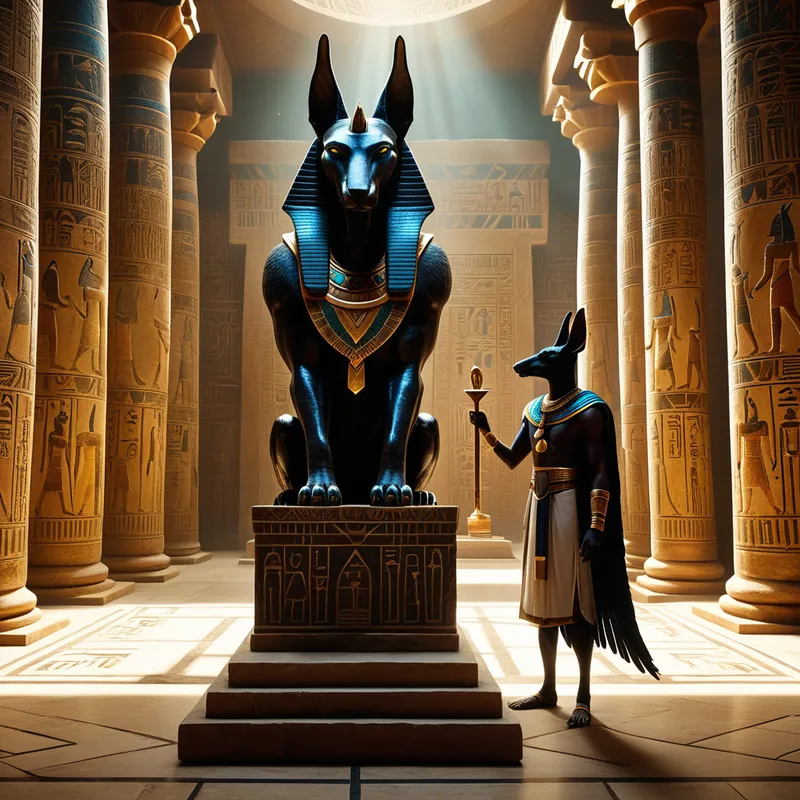
Weighing of the Heart Myth Meaning & Symbolism
The soul's final journey to the Hall of Ma'at, where the heart is weighed against the Feather of Truth to determine eternal fate.
The Tale of Weighing of the Heart
The great river of life has run its course. The sun-baked body lies still in its chamber, but the Ba has taken flight. It descends through darkness, through corridors of whispering stone, drawn by a gravity beyond [the earth](/myths/the-earth “Myth from Hindu culture.”/). The air grows cold and thick with the scent of incense and deep soil.
Before you, gates of black basalt swing open without a sound. You stand in the Hall of [Ma’at](/myths/maat “Myth from Egyptian culture.”/). It is a cavern without end, its ceiling lost in starless gloom. Forty-two silent figures, judges of the dead, line the hall, their eyes holding the stillness of deep wells. At the center, upon a dais of alabaster, stands the instrument of your eternity: a scale of perfect gold.
Anubis approaches. His movements are fluid, precise, devoid of malice. He is the master of ceremonies, the weigher of truth. With hands that have prepared a thousand kings for this moment, he guides you. You feel no fear from him, only the immense, solemn focus of a cosmic functionary. His dark eyes reflect the flickering torchlight as he gestures to the left plate of the scale. From your chest, he does not cut, but invites your Ib forth. It manifests—not a bloody muscle, but a glowing, pulsing essence, the condensed record of every laugh, every tear, every secret thought, every act of kindness and cruelty committed under the sun.
Onto the empty right plate, the goddess Ma’at herself, or perhaps her priestess, places a single feather. The Shu-feather. It is whiter than the first light of dawn, lighter than a breath, yet it holds the weight of the cosmos in balance. It is the measure of all things.
Anubis adjusts [the plumb](/myths/the-plumb “Myth from Masonic/Esoteric culture.”/) line. [The world](/myths/the-world “Myth from Tarot culture.”/) holds its breath. The golden beam trembles. Your heart, heavy with a lifetime, sinks. The feather, impossibly, rises. The beam dips, rises, dips again—a agonizing dance. You see the scales of your own being teetering between two eternities. To one side of the dais, [Thoth](/myths/thoth “Myth from Global/Universal culture.”/), scribe of the gods, waits with palette and reed. His duty is to record, not to judge. The judgment is written in the tilt of the gold.
And in the deepest shadow, a shape stirs. It has the head of a crocodile, the forequarters of a lion, and the hindquarters of a hippopotamus. Ammit, the Eater of Hearts, waits. She is not evil; she is entropy, the final dissolution for that which cannot join the ordered stars. Her silence is more terrible than any roar.
The beam slows. It steadies. It finds, at last, a perfect, horizontal balance. Heart and feather are equal. A sound like a sigh passes through the forty-two judges. Thoth’s reed scratches the verdict onto a scroll of celestial [papyrus](/myths/papyrus “Myth from Egyptian culture.”/). Anubis nods, a minute gesture of completion. The glowing heart is returned to you, now justified, now true. Ammit settles back into the shadows, unsatisfied. You are led onward, past the scales, toward the radiant presence of [Osiris](/myths/osiris “Myth from Global/Universal culture.”/), enthroned in green fertility, who grants you passage into [the Field of Reeds](/myths/the-field-of-reeds “Myth from Egyptian culture.”/). The trial is over. The soul has passed.

Cultural Origins & Context
This myth was not mere story, but the central operating manual for the Egyptian soul. Its most complete rendition is found in the <abbr title=""
A collection of funerary spells, hymns, and illustrations intended to guide the deceased through [the underworld](/myths/the-underworld “Myth from Greek culture.”/)“>Book of the Dead (known to them as “The Book of Coming Forth by Day”), a customized papyrus scroll placed in the tomb. This was a democratization of immortality; originally spells for [the pharaoh](/myths/the-pharaoh “Myth from Egyptian culture.”/) alone, by the New Kingdom, any who could afford the scribe’s fee could carry this guide.
The myth functioned on multiple societal levels. For the state, it underpinned the [Pharaoh](/myths/pharaoh “Myth from Egyptian culture.”/)’s role as the living guarantor of Ma’at on earth. For the individual, it provided a precise, ethical architecture for life. The famous “Negative Confession”—where the deceased declared “I have not stolen, I have not lied, I have not caused pain”—listed before the forty-two judges was both a magical spell to bypass guilt and a profound moral checklist. The myth was enacted in temple rituals, visualized in tomb paintings, and internalized through a culture that saw life as a continuous preparation for this ultimate, personal audit.
Symbolic Architecture
The Hall of Judgment is not a place, but a state of [consciousness](/symbols/consciousness “Symbol: Consciousness represents the state of awareness and perception, encompassing thoughts, feelings, and experiences.”/)—the ultimate [moment](/symbols/moment “Symbol: The symbol of a ‘moment’ embodies the significance of transient experiences that encapsulate emotional depth or pivotal transformations in life.”/) of self-confrontation. The [heart](/symbols/heart “Symbol: The heart symbolizes love, emotion, and the core of one’s existence, representing deep connections with others and self.”/) (Ib) is the entirety of the lived self: [memory](/symbols/memory “Symbol: Memory symbolizes the past, lessons learned, and the narratives we construct about our identities.”/), desire, conscience, and [shadow](/symbols/shadow “Symbol: The ‘shadow’ embodies the unconscious, repressed aspects of the self and often represents fears or hidden emotions.”/). It is not the perfect, idealized self, but the authentic self, with all its flaws and virtues.
The Feather is the paradox of the highest standard: it is the weight of integrity, which is simultaneously the lightest burden and the heaviest responsibility.
The scale is [the principle](/symbols/the-principle “Symbol: A fundamental truth, law, or doctrine that serves as a foundation for a system of belief, behavior, or reasoning, often representing moral or ethical standards.”/) of dynamic [equilibrium](/symbols/equilibrium “Symbol: A state of balance, stability, or harmony between opposing forces, often representing inner peace or external order.”/). It does not seek sinless perfection, but balance. A heart heavy with malice and deceit sinks; a heart unnaturally light, devoid of the substance of lived experience and genuine [emotion](/symbols/emotion “Symbol: Emotion symbolizes our inner feelings and responses to experiences, often guiding our actions and choices.”/), would also fail. The goal is a heart weighed with [life](/symbols/life “Symbol: The symbol of ‘Life’ represents a journey of growth, interconnectedness, and existential meaning, encompassing both the joys and challenges that define human experience.”/), yet aligned to [truth](/symbols/truth “Symbol: Truth represents authenticity, honesty, and the quest for knowledge beyond mere appearances.”/). Anubis represents the neutral, psychopompic function of the unconscious that guides us to this self-facing. Thoth is the observing ego, the part that records and witnesses without interference. Ammit is the terrifying but necessary force of psychic [dissolution](/symbols/dissolution “Symbol: The process of breaking down, dispersing, or losing form, often representing transformation, release, or the end of a state of being.”/)—the total annihilation of the [persona](/symbols/persona “Symbol: The social mask or outward identity one presents to the world, often concealing the true self.”/) that refuses [integration](/symbols/integration “Symbol: The process of unifying disparate parts of the self or experience into a cohesive whole, often representing psychological wholeness or resolution of internal conflict.”/), condemning it to non-existence.
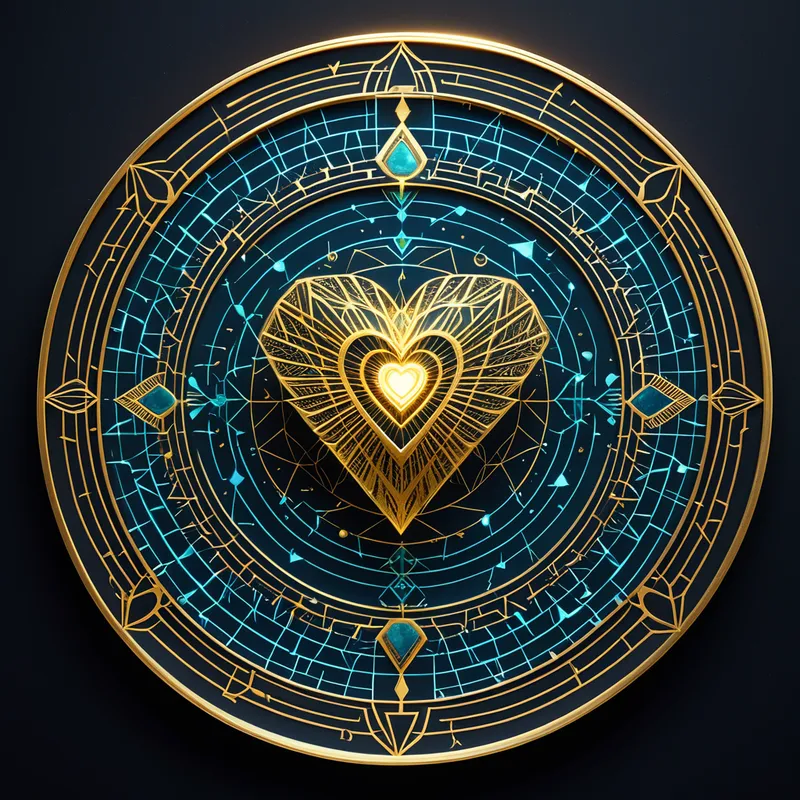
The Dreamer’s Resonance
When this myth stirs in modern dreams, it signals a profound interior trial. You may dream of being in a vast, official building (a courthouse, a grand hotel, a university hall) where you are to be evaluated. There is a test you haven’t studied for, or a ledger of your actions is being reviewed.
Somatically, this can feel like a pressure in the chest—anxiety, guilt, or the palpable weight of a secret. The dream is an expression of the [psyche](/myths/psyche “Myth from Greek culture.”/)‘s innate drive toward truth-telling. It is [the Self](/myths/the-self “Myth from Jungian culture.”/) organizing a tribunal to judge the compromises, falsehoods, or un-lived potentials held by [the ego](/myths/the-ego “Myth from Jungian culture.”/). The “forty-two judges” may appear as a committee, a panel of ancestors, or simply as an overwhelming sense of being seen. The dream is not necessarily punitive; like Anubis, it is procedural. Its terror is the terror of authenticity. To dream of passing the test, of the scales balancing, brings an immense, liberating relief—a somatic unburdening, as if a physical weight has been lifted from the heart-space.
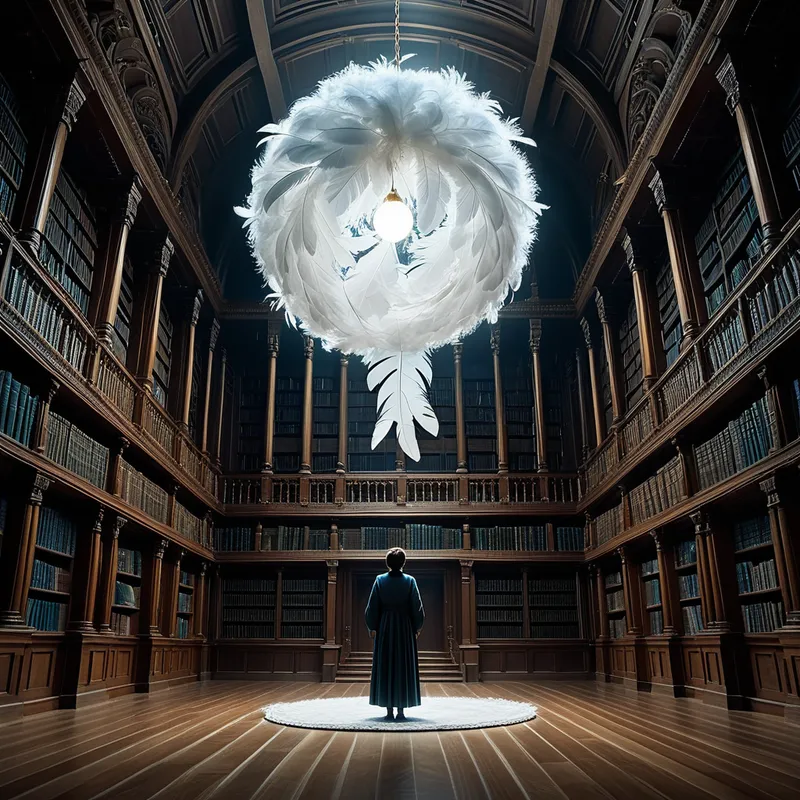
Alchemical Translation
The alchemical process mirrored here is mortificatio and [separatio](/myths/separatio “Myth from Alchemical culture.”/)—the dying of the old, false self and the separation of the essential from the dross, followed by sublimatio, the ascension of the purified spirit.
The modern individual’s “[Hall of Ma’at](/myths/hall-of-maat “Myth from Egyptian culture.”/)” is any moment of ruthless self-honesty: in therapy, in meditation, in the quiet after a great failure or loss. The “weighing” is the inner work of holding a thought, a feeling, or a life choice against the “feather” of one’s own core values. Is this action in alignment with my truth? Does this relationship bring balance or drag me into chaos? Does this career path feed my soul or only my [persona](/myths/persona “Myth from Greek culture.”/)?
Individuation is the lifelong process of making the heart congruent with the feather, of shaping a life so authentic that, in the final accounting, no part of the self needs to be devoured by the shadow.
Ammit represents the fate of unintegrated aspects—the repressed angers, the denied talents, the unlived loves. If we refuse to acknowledge and weigh them, they are not transformed; they are rendered monstrous and consigned to [the void](/myths/the-void “Myth from Buddhist culture.”/) of the unconscious, where they devour our vitality from within. The triumphant outcome is not becoming feather-light and detached, but becoming dense with integrity. The justified heart, returned to the Osiris-self, is a heart that has assimilated its own shadow, that carries its full weight consciously, and is therefore fit to enter the “Field of Reeds”—the Jungian state of wholeness, where the contradictions of the self are harmonized within a fertile, enduring peace.
Associated Symbols
Explore related symbols from the CaleaDream lexicon: