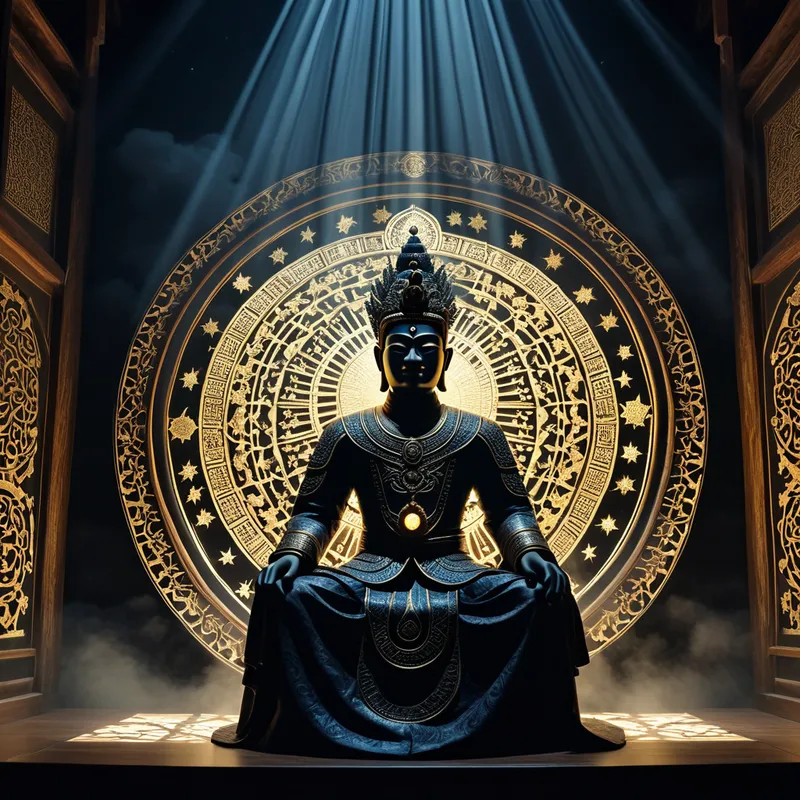
Wayang Kulit Origin Myth Meaning & Symbolism
A myth where the god Sang Hyang Tunggal creates shadow puppetry to console grieving humanity, revealing the divine play behind reality.
The Tale of Wayang Kulit Origin
Listen. In the time before memory, when the world was young and the hearts of humanity were raw and close to the bone, a great silence fell. It was the silence of a profound forgetting. The people of Java had lost their way. The stories of the ancestors, the laws of dharma, the very rhythm of life and duty—all had faded into a murmuring confusion. Grief, thick as monsoon mist, clung to the villages. Men and women moved as shadows themselves, hollowed by a longing they could not name.
In the highest realm, Sang Hyang Tunggal, the Singular Divine, observed this sorrow. His heart, the heart of the cosmos, was stirred. He saw not just disobedience, but a deep, aching dislocation. The connection between the divine realm of the gods (kahyangan) and the mortal world (marcapada) had grown thin, frayed by human distraction. A teaching was needed, but not a stern commandment from a distant sky. The lesson had to enter through the eyes, lodge in the heart, and unfold in the soul’s own theater.
So, Sang Hyang Tunggal descended, not in thunderous glory, but in the quiet potency of an idea. He took up a sheet of the finest buffalo hide, supple and strong. With a divine blade, he began to cut. Not random shapes, but a form both comic and profound: the figure of Semar, with his vast belly, his humble posture, and his ancient, knowing eyes. Here was a god choosing the guise of a servant, wisdom wrapped in simplicity.
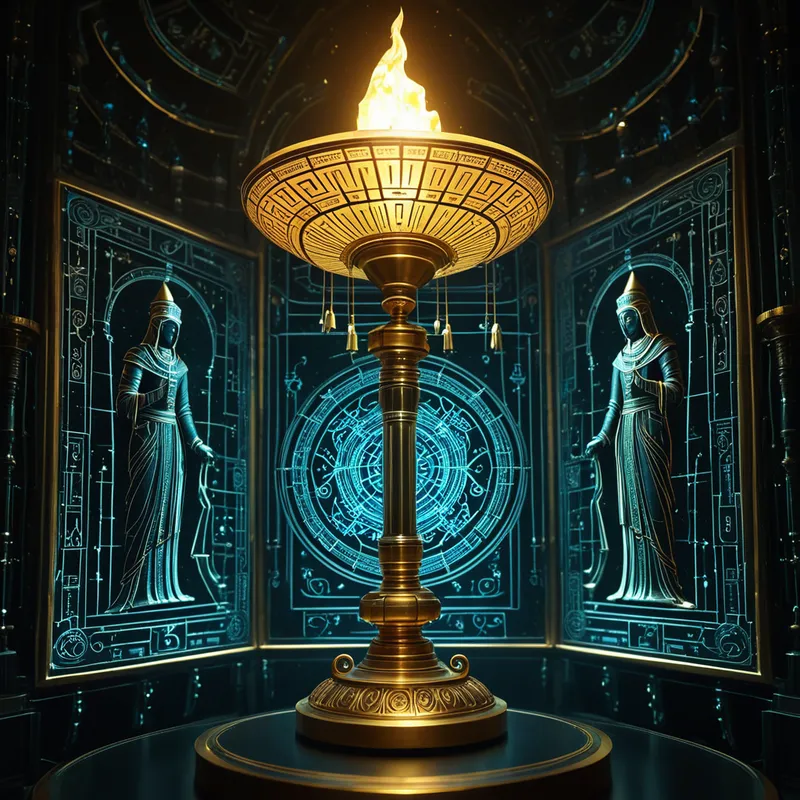
Next, the god fashioned a screen from the whitest cotton, stretched taut upon a frame of bamboo. Behind it, he placed a lamp—the blencong. Its flame was no ordinary fire; it was the light of divine consciousness itself. Then, in the gathering darkness of a village evening, Sang Hyang Tunggal sat behind the screen. He raised the puppet of Semar. And he began to speak.
The voice that emerged was not one, but many. It was the thunder of gods, the whisper of sages, the cunning of kings, and the lament of warriors. The flat, cut-out figure of Semar cast a magnificent, living shadow upon the screen. The villagers, drawn by the light and the voice, gathered. They saw the shadow—larger than life, dynamic, filled with spirit. They heard the stories of the Mahabharata and the Ramayana: the righteous struggle of the Pandawa, the tragic pride of the Kurawa, the eternal battle between dharma and adharma.
They watched, and as they watched, their own grief was mirrored and transformed. They saw their inner conflicts played out in the epic struggles. They laughed at the clown’s wisdom, wept for the hero’s fate, and understood, in their bones, the consequences of choice. The screen was the world; the puppets were the actors of fate; the light behind it all was the unseen divine source. And the dalang, the unseen manipulator and narrator, was the voice of the gods, guiding them back to remembrance. The silence was broken, not by a law, but by a story. Humanity was consoled, not by an answer, but by a profound, beautiful question made of light and shadow.

Cultural Origins & Context
This origin myth is not merely a story about the invention of an art form; it is the foundational narrative that sacralizes Wayang Kulit, embedding it at the very heart of Javanese spiritual and social life. Historically, Wayang likely evolved over centuries, influenced by Hindu-Buddhist narratives arriving in the Indonesian archipelago, blended with indigenous animist beliefs and ancestor veneration. The myth of divine origin, however, elevates it from entertainment to a ritual.
The myth was and is passed down orally, from master dalang to apprentice, within the context of rigorous training that is as much spiritual discipline as artistic apprenticeship. The dalang is not just a performer but a modern-day shaman, a cultural priest who mediates between realms. The myth justifies his sacred role. Societally, a Wayang performance (lakon) functioned (and in many places, still functions) as a communal ritual for events like births, weddings, or village cleansings. It was a tool for moral education, a means of conflict resolution through allegory, and a powerful mechanism for cultural cohesion, reinforcing shared values and cosmological understanding.
Symbolic Architecture
The myth presents a complete metaphysical model of reality. Every element is a potent symbol.
The Screen (kelir) is the phenomenal world—the field of manifested reality that we perceive with our senses. It is the stage of life, ever-present but ultimately a surface.
The Puppets (wayang) are the archetypal forms that inhabit this world: the Hero, the Trickster, the Servant-Clown, the King, the Goddess. They are the eternal patterns of behavior and personality that play out in human lives.
The light is the unseen consciousness; the shadow is the life we live. To know oneself is to turn and face the light, even though one can only ever see the shadow it casts.
The Lamp (blencong) is the divine source, the light of ultimate consciousness or cosmic truth. It is the singular origin (Sang Hyang Tunggal) from which all manifestations arise.
The Shadow is our individual and collective experience—the drama of life as we perceive it. It is real in its effects, but derivative in its nature, entirely dependent on the light and the form that intercepts it.
Finally, the Dalang is the unifying intelligence—the psyche itself, or the divine will. He manipulates the archetypes, speaks all voices, and orchestrates the narrative from a place that is both within and behind the spectacle.
The Dreamer’s Resonance
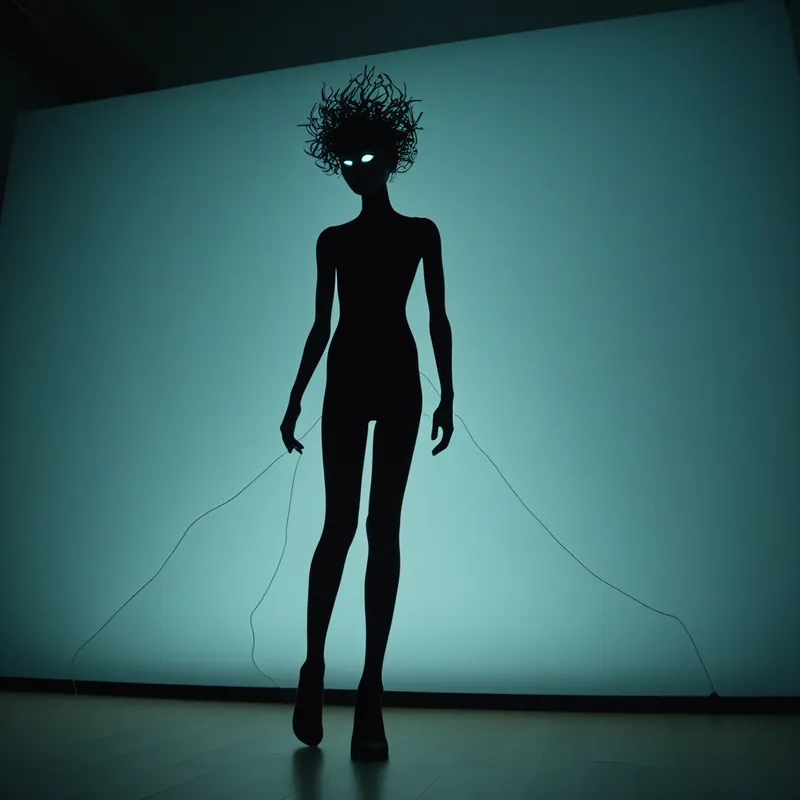
When the pattern of this myth stirs in the modern dreamer, it signals a profound moment of self-reflection and the confrontation with illusion. To dream of being a puppet, moved by unseen strings, speaks to feelings of powerlessness, of being an actor in a script not of one’s own writing—perhaps dictated by family, society, or unconscious compulsions. Conversely, to dream of manipulating puppets may reflect a burgeoning awareness of one’s own ability to shape one’s persona and life narrative, or a shadowy control over others.
Dreaming of a luminous screen, with shapes moving upon it, often coincides with a somatic sense of watching one’s own life from a detached, observational state. This can be a psychological process of depersonalization, or more healthily, the beginning of ego-differentiation—the ability to see one’s own patterns (the puppets) as objects separate from the core self (the dalang). The dream invites the dreamer to ask: Who is holding the strings? What is the source of my light? Am I identified with the shadow, or can I sense the solid form that casts it?
Alchemical Translation
The myth models the entire journey of individuation—the psychic transmutation from identifying with the shadow-play to becoming the conscious dalang.
Initially, we are the audience, captivated by the spectacle of our own lives, believing the shadows to be the only reality. Our emotions are tossed by the epic battles between inner forces (the Pandawa and Kurawa within). The first alchemical step is the nigar—the Javanese term for the dalang’s act of looking at the puppet to know its shadow. This is self-observation without judgment, studying the archetypal patterns (pride, victimhood, courage, deceit) that play out in our behavior.
The goal is not to destroy the puppets, but to learn their names, their stories, and their proper place in the repertoire. Integration, not eradication.
The next stage is to turn toward the light. Psychologically, this is the difficult work of confronting the source of one’s consciousness and values. It asks: What is the fundamental, illuminating principle behind my actions? Is it fear? Love? A borrowed dogma? This is akin to the dalang tending the blencong, ensuring the flame is clear and bright.
Finally, the alchemical triumph is to take one’s seat behind the screen. This is not a position of omnipotent control, but of responsible authorship and mediation. The integrated individual becomes the dalang of their own psyche: they can give voice to their inner clown (the embodied, humble self), marshal their inner hero, acknowledge their inner trickster, and orchestrate these elements into a coherent life narrative (lakon). They understand they are both the creator and a character in the story, both the light and the shadow, achieving a transcendent unity that the myth attributes to the divine itself.
Associated Symbols
Explore related symbols from the CaleaDream lexicon:
- Shadow — The projected life of the ego and the phenomenal world, the visible drama entirely dependent on the interplay of light (consciousness) and form (archetype).
- Light — The divine source of consciousness and truth, the illuminating principle (blencong) that makes perception and understanding possible.
- Mask — The articulated puppet, representing the persona or the archetypal form worn by the psyche, a fixed identity that performs on the stage of life.
- Order — The principle of dharma that the myth seeks to restore, the cosmic and moral structure that gives the shadow-play meaning and direction.
- Ritual — The sacred performance of the lakon itself, the enacted myth that serves as a container for communal and individual transformation.
- Dream — The entire spectacle on the screen, mirroring the dream-like quality of maya (illusion) in which we are immersed, and the nightly dreams where our personal puppets perform.
- Origin — Sang Hyang Tunggal as the singular source, the primal cause from which the art, the story, and the model of reality all emanate.
- God — The supreme manipulator and narrator in the myth, representing the transcendent unity and intelligence behind the cosmos, later embodied in the role of the dalang.
- Vision — The act of witnessing the shadow-play, which grants insight and moral clarity, transforming the audience from passive spectators into awakened participants in the cosmic drama.
- Illusion — The fundamental nature of the shadow reality, the captivating show that is real in experience but not ultimate in substance, inviting discernment.