Water Myth Meaning & Symbolism
The myth of the Great Flood, tamed by Yu's sacrifice, reveals water as the primal force of chaos, creation, and the soul's necessary ordeal.
The Tale of Water
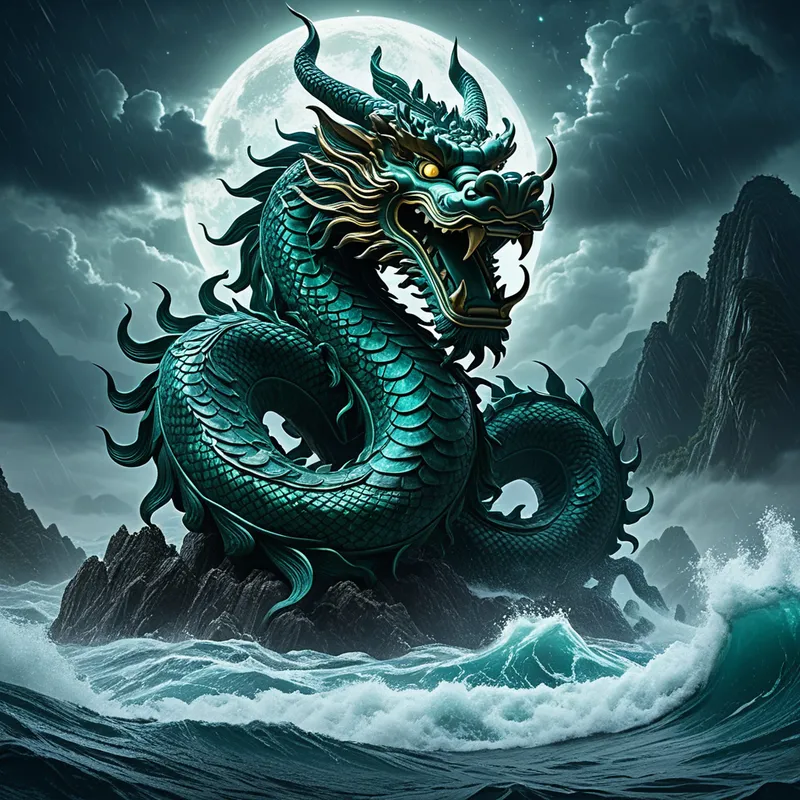
In the time before time, when [the world](/myths/the-world “Myth from Tarot culture.”/) was young and the pillars of heaven still shook, the waters did not know their place. They rose not from rain or spring, but from a rage that shook the very bones of [the earth](/myths/the-earth “Myth from Hindu culture.”/). It was the wrath of Gong Gong, the spirit of the wild waters. In his arrogance, he battled Zhuanxu for the throne of heaven. Defeated, in a fury of shame, he flung his horned head against the great pillar that held up the northwest sky—Mount Buzhou.
[The sky](/myths/the-sky “Myth from Persian culture.”/) cracked. A terrible groan echoed through the eight directions. The pillar shattered, and heaven itself tilted. The celestial river, the Silver River, poured through the rupture. On earth, the orderly veins of rivers burst. The gentle waters of lake and marsh turned to torrents. The four seas overflowed their basins, swallowing plains and hills. A universal deluge drowned the world. Fire could not burn, earth could not be tilled. Creatures fled to the highest peaks, and the people wailed as their world dissolved back into the primal, formless swamp from which it was born.
The [Yellow Emperor](/myths/yellow-emperor “Myth from Chinese culture.”/) and his descendants saw the suffering. First, Gun was sent. For nine years, he labored, building dikes and barriers with magic soil stolen from heaven. But water cannot be commanded by wall alone; it seeped, it pressed, it broke through. Gun failed, and paid with his life.
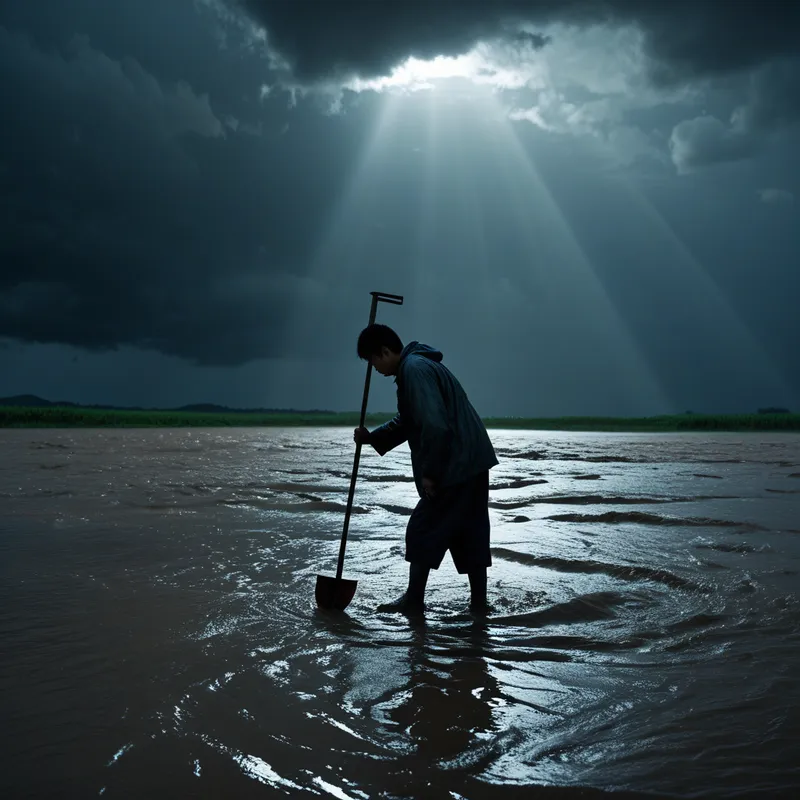
From his body, or from his undying will, emerged his son, Yu. Yu bore his father’s mission but not his method. He did not look up to heaven for magic, but down to earth. For thirteen years, he walked. His feet calloused, his body lean, he surveyed [the drowned](/myths/the-drowned “Myth from Norse culture.”/) world. He listened to the water’s desire. He saw that water does not wish to be trapped, but to flow.
So, he dug. With hands and tools, he channeled. He cut through mountains to guide the raging torrents eastward. He connected the wild floods to the thirsty beds of ancient rivers. He opened a path for the waters to return to [the sea](/myths/the-sea “Myth from Greek culture.”/). He labored so completely that he passed his own home three times, hearing the cries of his newborn son, but did not enter, for a moment’s pause might have meant a village lost. His body became like the earth—weathered, carved, purposeful.
Finally, the waters receded. They flowed now in the courses Yu had given them: the [Yellow River](/myths/yellow-river “Myth from Chinese culture.”/), the Yangtze, and all their countless children. The mud dried into fertile plains. The people descended from the mountains. Where there was chaos, Yu had revealed order—not by fighting the water, but by understanding its nature. The world was not merely saved; it was remade, and from this labor, the first dynasty was born.
Cultural Origins & Context
This is not one myth, but a foundational stratum of Chinese consciousness. The story of [the Great Flood](/myths/the-great-flood “Myth from Biblical culture.”/) and Yu’s taming of the waters is recorded in ancient texts like the Shangshu and the Shanhaijing. It predates philosophy, existing in the realm of primordial memory. It was a story told not just to explain geography, but to define civilization itself. The societal function was profound: it explained why the world was structured as it was (with rivers flowing east), it legitimized rulership (the right to rule stemmed from the ability to maintain cosmic and social order, or Li), and it encoded the fundamental Chinese relationship with nature—not one of domination, but of harmonious adaptation and immense, collective labor. Yu was the archetypal engineer-king, and his success established the model for all benevolent governance.
Symbolic Architecture
[Water](/symbols/water “Symbol: Water symbolizes the subconscious mind, emotions, and the flow of life, representing both cleansing and creation.”/) here is the ultimate [symbol](/symbols/symbol “Symbol: A symbol can represent an idea, concept, or belief, serving as a powerful tool for communication and understanding.”/) of the unformed, the potential, and the chaotic. It is the Wuji before the Taiji. It represents the raw, emotional, and instinctual forces of the [psyche](/myths/psyche “Myth from Greek culture.”/)—the unconscious in its untamed state.
The flood is the psyche overwhelmed, where emotion has breached its banks and identity dissolves.
Gun represents [the ego](/myths/the-ego “Myth from Jungian culture.”/)’s first, heroic attempt at control: building walls, repression, using “magic” (intellectualization) to stem the tide. It is a necessary but ultimately failed [strategy](/symbols/strategy “Symbol: A plan of action designed to achieve a long-term or overall aim, often involving competition, resource management, and foresight.”/), leading to psychic stagnation and [death](/symbols/death “Symbol: Symbolizes transformation, endings, and new beginnings; often associated with fear of the unknown.”/). Yu represents a higher [consciousness](/symbols/consciousness “Symbol: Consciousness represents the state of awareness and perception, encompassing thoughts, feelings, and experiences.”/). His labor is the work of individuation. He does not oppose the water; he guides it. He sacrifices personal [life](/symbols/life “Symbol: The symbol of ‘Life’ represents a journey of growth, interconnectedness, and existential meaning, encompassing both the joys and challenges that define human experience.”/) (passing his home) for the sake of a greater [structure](/symbols/structure “Symbol: Structure in dreams often symbolizes stability, organization, and the framework of one’s life, reflecting how one perceives their environment and personal life.”/). The channels he digs are the structures of [consciousness](/symbols/consciousness “Symbol: Consciousness represents the state of awareness and perception, encompassing thoughts, feelings, and experiences.”/)—healthy coping mechanisms, artistic [expression](/symbols/expression “Symbol: Expression represents the act of conveying thoughts, emotions, and individuality, emphasizing personal communication and creativity.”/), mindful practice—that give form and [direction](/symbols/direction “Symbol: Direction in dreams often relates to life choices, guidance, and the path one is following, emphasizing the importance of navigation in personal journeys.”/) to inner [chaos](/symbols/chaos “Symbol: In Arts & Music, chaos represents raw creative potential, uncontrolled expression, and the breakdown of order to forge new artistic forms.”/). The resulting rivers are not the elimination of water, but its cultivation into a [life](/symbols/life “Symbol: The symbol of ‘Life’ represents a journey of growth, interconnectedness, and existential meaning, encompassing both the joys and challenges that define human experience.”/)-giving, nourishing [system](/symbols/system “Symbol: A system represents structure, organization, and interrelated components functioning together, often reflecting personal or social order.”/). Order (Li) is not imposed from outside, but revealed from within the [nature](/symbols/nature “Symbol: Nature symbolizes growth, connectivity, and the primal forces of existence.”/) of the substance itself.
The Dreamer’s Resonance
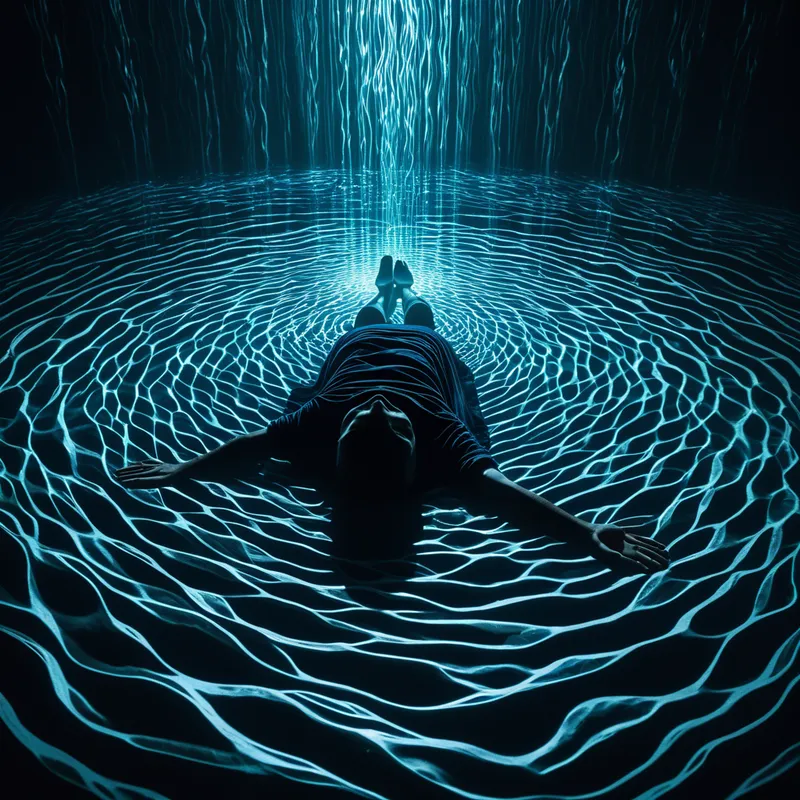
When this myth stirs in modern dreams, the dreamer is often in a state of emotional inundation. Dreaming of tsunamis, rising basement floods, or being lost at sea points to a psyche facing a surge of material from the unconscious—perhaps grief, rage, or a life transition that feels overwhelming. The somatic feeling is one of pressure, suffocation, and loss of footing.
The figure of Yu may appear as a calm guide, a therapist, or the dreamer’s own self engaged in a meticulous, patient task like digging or mapping. This signals the psyche’s innate movement toward integration. The dream is not merely showing the chaos; it is initiating the process of channeling. The labor feels endless (the thirteen years), but the focus is on the next shovel of earth, the next step. The dreamer is undergoing the slow, often lonely, work of finding form for formless feeling, of creating internal riverbeds so their emotional life can flow without destroying them.
Alchemical Translation
The alchemical process modeled here is the transformation of the [prima materia](/myths/prima-materia “Myth from Alchemical culture.”/)—the flooded, chaotic psyche—into the [lapis philosophorum](/myths/lapis-philosophorum “Myth from Alchemical culture.”/)—the ordered, fertile self. [The first stage](/myths/the-first-stage “Myth from Alchemical culture.”/), led by Gun, is calcinatio: the fiery, willful attempt to control, which fails and leads to mortificatio, the death of the old egoic strategy. From this ashes rises Yu, embodying [solutio](/myths/solutio “Myth from Alchemical culture.”/) (dissolution in the water itself, understanding it) and coagulatio (the slow, earthly work of re-solidifying into a new form).
The triumph is not over the water, but with it. The Self is not the king on dry land, but the sculptor of the river’s course.
For the modern individual, this myth instructs us that healing or growth is not about eradicating our “floods” of anxiety, passion, or depression. It is about the long, unglamorous labor of self-knowledge—surveying our inner landscape, recognizing the natural contours of our being, and patiently, sacrificially, digging the channels through which these powerful forces can move, contribute, and create. We become, like Yu, a caregiver to our own inner world, not by stopping the flow, but by directing it toward the sea of wholeness. The dynasty that is founded afterward is the stable, authentic life built upon this mastered, yet ever-flowing, foundation.
Associated Symbols
Explore related symbols from the CaleaDream lexicon: