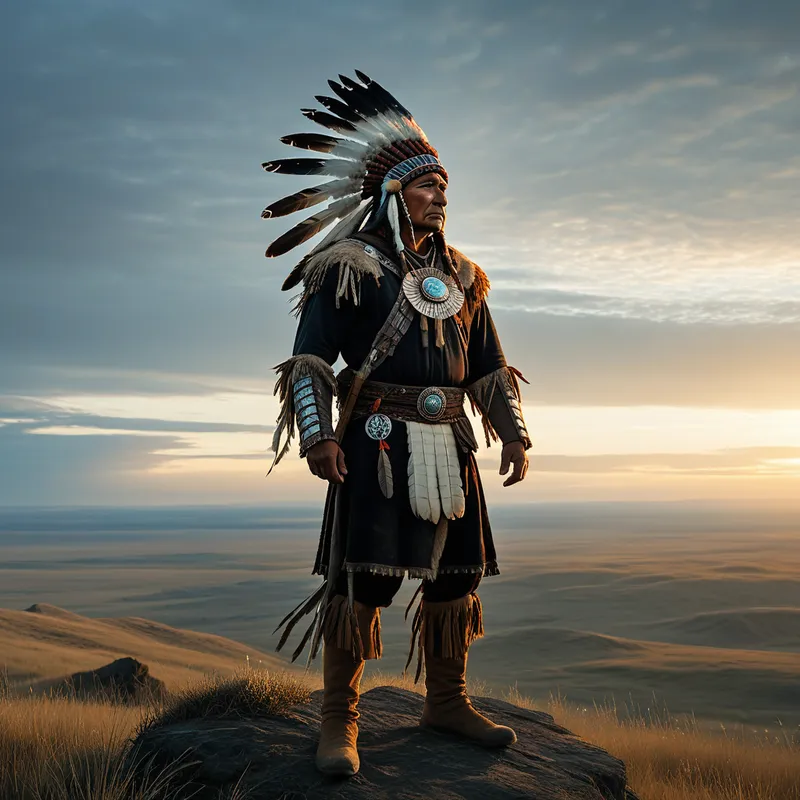
War Bonnet Feathers Myth Meaning & Symbolism
A warrior's sacrifice transforms into a sacred headdress, teaching that true honor is earned through humility and spiritual connection, not taken by force.
The Tale of War Bonnet Feathers
Listen. [The wind](/myths/the-wind “Myth from Various culture.”/) does not sing on the empty prairie. It needs the grass to bend, the cottonwood leaves to tremble, the feathers to whisper their stories. This is the story the feathers tell.
Once, in the time when animals still spoke in the tongues of men, there was a young warrior named Tasunke Witko. His heart burned with a fire for glory, and his arm was strong. He counted many coups, took many horses from enemy camps under [the moon](/myths/the-moon “Myth from Tarot culture.”/)’s cold eye. Yet, for all the scalps at his belt and the stories told of his raids, a hollow wind blew through his spirit. The people praised his deeds, but the Wakan Tanka, the Great Mystery, remained silent. No vision came to him in the sweat lodge. No animal spirit called his name.
His pride grew like a thorn thicket around his heart. “I will make the spirits see me,” he declared. “I will take the ultimate prize.” He set his sight on the eagle, the [Wakinyan](/myths/wakinyan “Myth from Lakota culture.”/), whose feathers were the very breath of [the sky](/myths/the-sky “Myth from Persian culture.”/), the conduit between earth and heaven. No man could simply take them; they had to be given, earned in a way beyond battle.
He climbed the sacred mountain, the place where [the world](/myths/the-world “Myth from Tarot culture.”/) is thin. For four days and nights he fasted, pierced his flesh, and cried out for a sign. He demanded the eagle’s feathers. He challenged the sky itself. On the fourth night, exhausted and embittered, a great shadow blotted out the stars. It was not an eagle, but the Spirit of the Mountain, an ancient presence of stone and storm.
“You shout at the silence,” the Spirit’s voice rumbled like grinding continents. “You grasp with empty hands. You seek honor as a possession. You must first lose everything you think makes you a warrior.”
A great wind, sent by the Tate Topa, swept Tasunke Witko from the peak. He tumbled down the mountainside, his lance snapping, his shield scattering, the trophies of his pride torn away. He awoke at dawn in a grassy valley, broken, weaponless, and utterly alone. All that remained was the aching void where his pride had been.
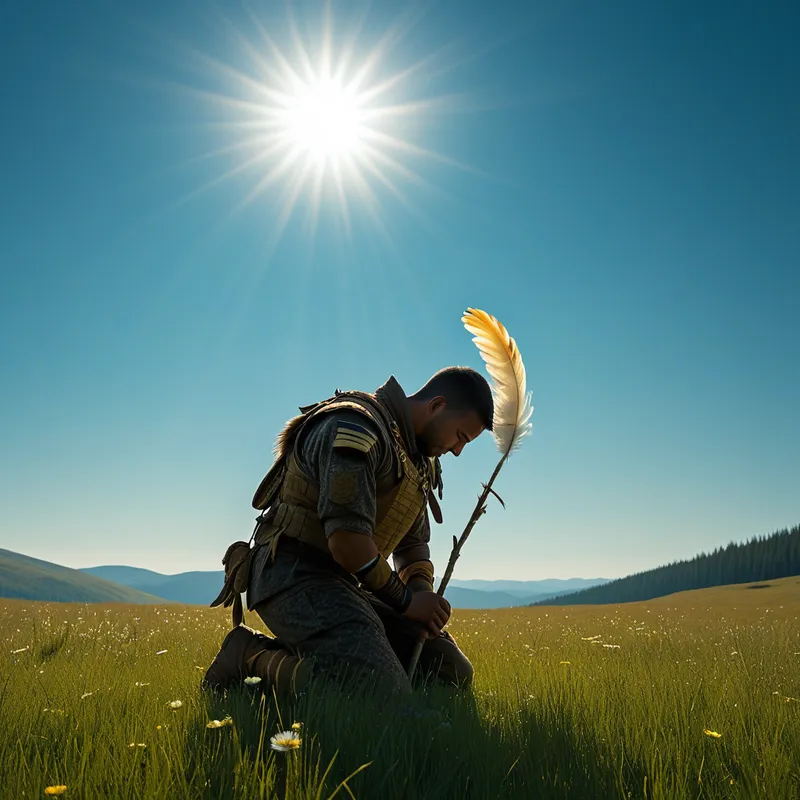
In that moment of absolute surrender, as his tears watered [the earth](/myths/the-earth “Myth from Hindu culture.”/), he heard a gentle rustling. Looking up, he saw a single, perfect golden eagle feather drifting down on a sunbeam. It landed softly before his knees. Then another. And another. Not from a bird he could see, but from the sky itself, from the heart of the Great Mystery. They fell until a pile lay before him. A voice, softer than the wind yet clearer than [water](/myths/water “Myth from Chinese culture.”/), spoke in his mind: “Now, build. Not a trophy, but a prayer. Each feather is a deed done not for your name, but for the People. Each is a sorrow transformed, a weakness made strength, a silent act of courage. This is the true Waphaha.”
With trembling, humble hands, using sinew from his own heart and wisdom he did not know he possessed, he began to bind the feathers into a circle. He was no longer taking; he was receiving. He was no longer building a monument to himself, but crafting a vessel for spirit. When he placed the finished bonnet upon his head, he did not feel taller, but more connected—to the earth beneath his feet, to the sky above, to the heartbeat of the People behind him. The feathers were not a crown of conquest, but a circle of responsibility, each one a story not of what he took, but of what he was given.
Cultural Origins & Context
The story of the [War Bonnet](/myths/war-bonnet “Myth from Plains Nations culture.”/) Feathers is not a single, fixed myth from one tribe, but a profound narrative pattern woven through the oral traditions of many Plains nations, including the Lakota, Cheyenne, Crow, and Blackfoot. It belongs to the rich tapestry of ethnogenetic narratives. Unlike European myths often centered on gods, these stories are deeply pedagogical, explaining the spiritual origins and proper protocols of sacred regalia.
The war bonnet, or Waphaha, was never merely a military decoration. It was, and is, a living document of spiritual status and responsibility, earned through specific, often non-martial, acts of valor, generosity, and wisdom. This myth was told by elders and Wicasa Wakan (Holy Men) not as entertainment, but as a necessary instruction. It served a critical societal function: to check the dangerous inflation of the warrior ego and to root the concept of honor in community service and spiritual humility. It taught that the highest authority—the spiritual world—cannot be commanded or conquered, only humbly petitioned and honored through right action.
Symbolic Architecture
At its core, the myth is an alchemical [blueprint](/symbols/blueprint “Symbol: A blueprint represents the foundational plan or design for something, often symbolizing potential, structure, and the mapping of one’s inner self or future.”/) for the transformation of raw, egoic [energy](/symbols/energy “Symbol: Energy symbolizes vitality, motivation, and the drive that fuels actions and ambitions.”/) (the [warrior](/symbols/warrior “Symbol: A spiritual archetype representing inner strength, discipline, and the struggle for higher purpose or self-mastery.”/)’s pride) into a structured, spiritual [vessel](/symbols/vessel “Symbol: A container or structure that holds, transports, or protects something essential, representing the self, emotions, or life journey.”/) (the bonnet). The young warrior represents the undeveloped [psyche](/myths/psyche “Myth from Greek culture.”/), identifying entirely with the [Persona](/symbols/persona “Symbol: The social mask or outward identity one presents to the world, often concealing the true self.”/) of the [hero](/symbols/hero “Symbol: A hero embodies strength, courage, and the ability to overcome significant challenges.”/), seeking validation externally through conquest.
The mountain is not an obstacle to be climbed, but the Self to be encountered. The summit is the inflation of the ego, where one believes they can command the gods. The fall is the necessary, humbling descent into the valley of the soul.
The stripping away of his weapons and trophies symbolizes the [dissolution](/symbols/dissolution “Symbol: The process of breaking down, dispersing, or losing form, often representing transformation, release, or the end of a state of being.”/) of the [persona](/myths/persona “Myth from Greek culture.”/). This is a critical [death](/symbols/death “Symbol: Symbolizes transformation, endings, and new beginnings; often associated with fear of the unknown.”/)—the death of the [identity](/symbols/identity “Symbol: Identity represents the sense of self, encompassing personal beliefs, cultural background, and social roles.”/) one clings to. The broken warrior in the [valley](/symbols/valley “Symbol: A valley often symbolizes a period of transition or a place of respite between two extremes.”/) represents [the ego](/myths/the-ego “Myth from Jungian culture.”/) brought to zero, a state of psychic [poverty](/symbols/poverty “Symbol: A state of lacking material resources or essential needs, often symbolizing feelings of inadequacy, vulnerability, or spiritual emptiness in dreams.”/) where transformation becomes possible. The [eagle](/symbols/eagle “Symbol: The eagle is a symbol of power, freedom, and transcendence, often representing a person’s aspirations and higher self.”/) feathers, arriving not from a hunt but as a gift from the sky, symbolize grace and the emergent symbols of the Self. They are not “thoughts” he generates, but “thoughts” that come to him from the deeper, transpersonal psyche.
The act of tying the feathers is crucial. It represents the conscious, patient work of [integration](/symbols/integration “Symbol: The process of unifying disparate parts of the self or experience into a cohesive whole, often representing psychological wholeness or resolution of internal conflict.”/). Each [feather](/symbols/feather “Symbol: A feather represents spiritual elevation, lightness, and the freedom of the spirit. It often symbolizes messages from the divine and connection to ancient wisdom.”/) tied is a discrete [insight](/symbols/insight “Symbol: A sudden, deep understanding of a complex situation or truth, often arriving unexpectedly and illuminating hidden connections.”/), a healed wound, an accepted limitation, woven into a new, circular totality. The completed bonnet is a [mandala](/symbols/mandala “Symbol: A sacred geometric circle representing wholeness, the cosmos, and the journey toward spiritual integration.”/) of the integrated psyche—no longer a [linear](/symbols/linear “Symbol: Represents order, predictability, and a direct, step-by-step progression. It symbolizes a clear path from cause to effect.”/) [quest](/symbols/quest “Symbol: A quest symbolizes a journey or search for purpose, fulfillment, or knowledge, often representing life’s challenges and adventures.”/) for glory, but a circular [responsibility](/symbols/responsibility “Symbol: Responsibility in dreams often signifies the weight of duties and the expectations placed upon the dreamer.”/) centered on [the Self](/myths/the-self “Myth from Jungian culture.”/).

The Dreamer’s Resonance
When this myth pattern stirs in the modern dreamer, it often signals a profound crisis of identity and a call to spiritual maturation. One may dream of losing a job, a title, a relationship—all modern “feathers” in their persona-bonnet. The feeling is of being stripped, exposed, and humiliated.
Somatically, this can feel like a crushing weight on the chest (the burden of pride) giving way to a hollow, nauseating emptiness in the gut (the valley of surrender). The dreamer is being forced to relinquish an outdated version of themselves that has become too small, too arrogant, or too disconnected. The dream-ego’s frantic searching for external validation (the climb) has failed.
If the process is accepted, the dream may later present gifts: finding a single, beautiful feather; being given an object of surprising power; or simply feeling a profound, peaceful connection in a humble setting. These are the first “feathers” of the new Self, arriving not through force of will, but through the grace of the unconscious, acknowledging the dreamer’s surrender.

Alchemical Translation
For the individual on the path of individuation, this myth models the entire arc from ego-inflation to ego-relativization. The modern “warrior” may be the executive, the artist, the parent, or anyone identified with a role of control and achievement.
The alchemical stages are clear:
- Calcinatio (The Burning Desire): The ego’s fiery ambition for recognition, status, and self-aggrandizement.
- Sublimatio (The Arrogant Ascent): The inflation of climbing the “mountain” of career or persona, believing one’s will is supreme.
- Mortificatio (The Shattering Fall): The inevitable crisis—failure, burnout, depression—that humbles and “kills” the inflated identity. This is the most painful but essential phase.
- [Solutio](/myths/solutio “Myth from Alchemical culture.”/) (The Tears in the Valley): The dissolution into a state of not-knowing, vulnerability, and receptivity. The hard edges of the ego are washed away.
- Coagulatio (The Tying of the Feathers): The slow, mindful work of rebuilding. Not a return to the old form, but the creation of a new one based on inner values, service, and integrated wisdom. Each act of integrity, each faced shadow, each moment of true compassion is a “feather” tied.
The final headdress is not worn to be seen, but to see. It is an organ of perception, aligning one’s sight with the vertical axis between spirit and matter.
The [triumph](/myths/triumph “Myth from Roman culture.”/) is not a victory over others, but a sacred covenant with the Self. The modern individual learns that their true authority and honor do not come from dominating their outer world, but from faithfully listening to and embodying the whispers of the inner one, building their circle of responsibility feather by sacred feather. The power is no longer over, but through and for. This is the alchemy of the War Bonnet: leaden pride transmuted into golden, feathered responsibility.
Associated Symbols
Explore related symbols from the CaleaDream lexicon: