Walls of Jericho Myth Meaning & Symbolism
A story of divine command, ritual silence, and the shattering collapse of an ancient city's walls, revealing a profound psychological pattern of liberation.
The Tale of the Walls of Jericho
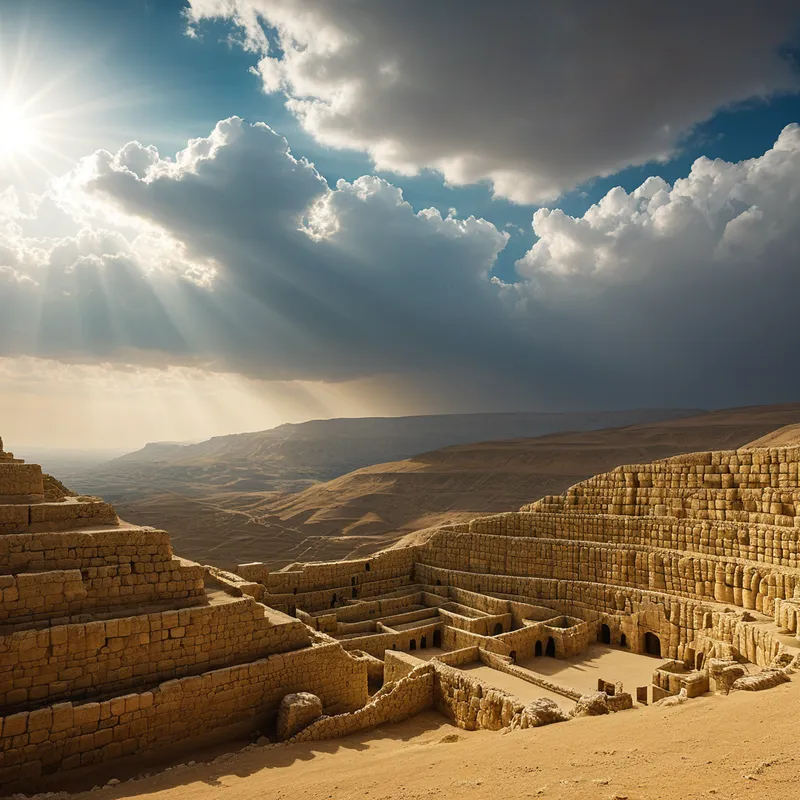
Hear now the tale of the wall, the shout, and [the fall](/myths/the-fall “Myth from Biblical culture.”/). In the land of Canaan, baked by a pitiless sun, there stood a city older than memory. [Jericho](/myths/jericho “Myth from Biblical culture.”/) was its name, a fortress of fear, its heart sealed behind walls of stone so thick and high they seemed a part of the very earth, a defiance against [the sky](/myths/the-sky “Myth from Persian culture.”/) and all who approached. The air above it shimmered with the heat of dread, for within, a people waited, breath held, for a threat they could not yet see.
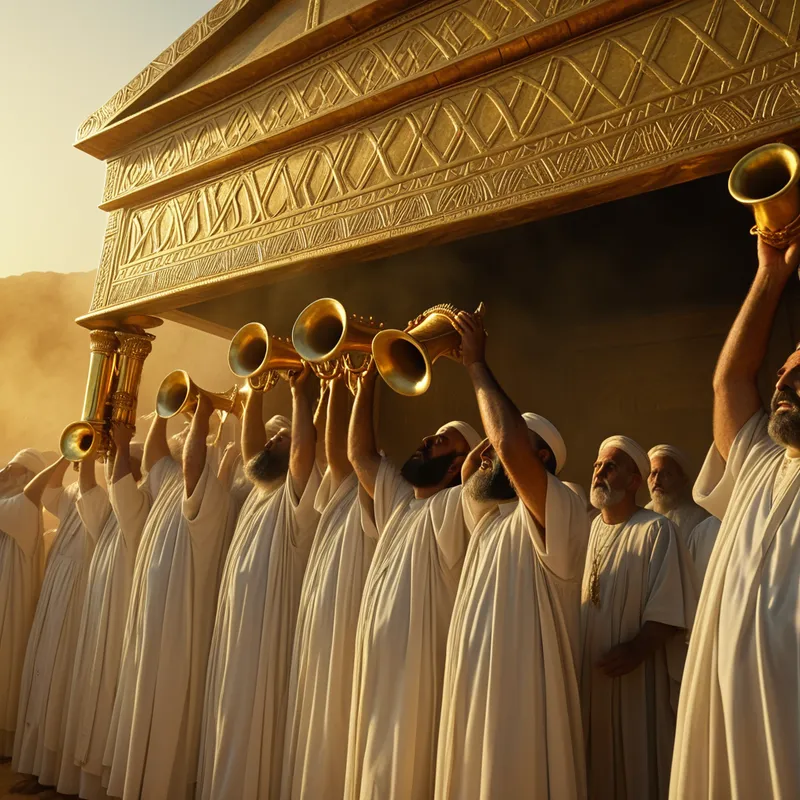
From [the wilderness](/myths/the-wilderness “Myth from Biblical culture.”/) they came, a people shaped by sand and covenant. Led by Joshua, son of Nun, they were the children of promise, bearing with them a sacred burden—the Ark of the Covenant. The command that came to Joshua was not of strategy, but of sacred pattern. The voice was clear, a whisper in the soul that brooked no argument: You shall march around the city, all you men of war. You shall go around it once. Thus you shall do for six days. And seven priests shall bear seven trumpets of rams’ horns before the Ark. But on the seventh day, you shall march around the city seven times, and the priests shall blow the trumpets.
And so the ritual began. A silent army, save for the tread of countless feet on the dust, the soft shuffle of robes, and the occasional bleat of a ram’s horn—a single, mournful note that hung in the air. They circled the immense, silent walls once each day, a living, breathing noose of faith tightening not by force, but by obedience. Inside, [the watchers](/myths/the-watchers “Myth from Christian culture.”/) on Jericho’s walls saw only madness, a silent procession that spoke of a power they could not comprehend. For six days, this was the only sound: the shuffle, the horn, the beating of their own hearts.
Then came the seventh day, as the dawn bled crimson over the eastern hills. The host rose not for one circuit, but for seven. The tension was a living [thing](/myths/thing “Myth from Norse culture.”/), a cord stretched to singing. Seven times they traced [the sacred circle](/myths/the-sacred-circle “Myth from Various culture.”/) in the dust. On the seventh circuit, as the city lay fully encircled by their faith, Joshua raised his hand. His voice cut the silence, not with a whisper, but with a cry that came from the depths of the covenant: “Shout! For the YHWH has given you the city!”
And they shouted. A roar torn from forty thousand throats, a sonic wave of released faith. The priests blew a long, shuddering blast on the trumpets of ram’s horn, a sound that seemed to tear the fabric of [the world](/myths/the-world “Myth from Tarot culture.”/).
And the walls answered.
Not with a crash, but with a deep, groaning sigh, as of a giant settling into final sleep. The stones did not topple outward; they fell inward, upon themselves, collapsing into rubble and dust, save for one portion where a thread of scarlet faith—the house of Rahab—remained standing. The impregnable was made passable. The defense became an entrance. The shout did not break the walls; it was the key for which the lock had been waiting for a thousand years.
Cultural Origins & Context
This story is embedded in the Book of Joshua, a text that sits at the fraught intersection of history, theology, and national identity formation for ancient Israel. It belongs to the Hexateuch narrative, detailing the transition from a nomadic, covenant-bound people to a nation claiming a territorial homeland. Scholars debate the historical veracity of the event—archaeology suggests Jericho was a modest settlement, not a grand walled city, at the likely time period. But this misses the mythic point entirely.
The story functioned as a foundational ethos for a culture defining itself against the established city-states of Canaan. It was not a military manual but a theological manifesto. It was told and retold to answer a profound psychological and communal question: By what right do we claim this land? The answer was not superior force, but divine mandate enacted through unwavering, ritualized faith. The walls represent not just a physical barrier, but the entrenched, “idolatrous” order of the old world. The story served to sacralize the conquest, transforming it from an act of violence into an act of cosmic, [ritual cleansing](/myths/ritual-cleansing “Myth from Multiple Traditions culture.”/), a necessary collapse for a new order to be born.
Symbolic Architecture
At its core, the myth is a masterclass in the [psychology](/symbols/psychology “Symbol: Psychology in dreams often represents the exploration of the self, the subconscious mind, and emotional conflicts.”/) of transformation through non-ordinary [action](/symbols/action “Symbol: Action in dreams represents the drive for agency, motivation, and the ability to take control of situations in waking life.”/). The [wall](/symbols/wall “Symbol: Walls in dreams often symbolize boundaries, protection, or obstacles in one’s life, reflecting the dreamer’s feelings of confinement or security.”/) is the ultimate [symbol](/symbols/symbol “Symbol: A symbol can represent an idea, concept, or belief, serving as a powerful tool for communication and understanding.”/) of the hardened complex, the rigid [defense](/symbols/defense “Symbol: A protective mechanism or barrier against perceived threats, representing boundaries, security, and resistance to external or internal challenges.”/), the seemingly immovable [obstacle](/symbols/obstacle “Symbol: Obstacles in dreams often represent challenges or hindrances in waking life that intercept personal progress and growth. They can symbolize fears, doubts, or external pressures.”/) in the [psyche](/myths/psyche “Myth from Greek culture.”/) or in [life](/symbols/life “Symbol: The symbol of ‘Life’ represents a journey of growth, interconnectedness, and existential meaning, encompassing both the joys and challenges that define human experience.”/). It is the [fortress](/symbols/fortress “Symbol: A fortress symbolizes security and protection, representing both physical and psychological safety from external threats.”/) of habit, [trauma](/symbols/trauma “Symbol: A deeply distressing or disturbing experience that overwhelms the psyche, often manifesting in dreams as unresolved emotional wounds or psychological injury.”/), dogma, or fear we build around our most vulnerable selves.
The most formidable walls are not made of stone, but of the stories we tell ourselves about what is possible and what is not.
The Israelite [host](/symbols/host “Symbol: The symbol of a ‘host’ often represents nurturing, hospitality, or the willingness to offer support and guidance to others.”/), guided by the Ark (the symbolic container of the divine law and [presence](/symbols/presence “Symbol: Presence in dreams often signifies awareness or acknowledgment of something significant in one’s life.”/)), represents the conscious ego aligning itself with a deeper, transpersonal directive—[the Self](/myths/the-self “Myth from Jungian culture.”/), in Jungian terms. The six days of silent circling signify the necessary [period](/symbols/period “Symbol: Periods in dreams can symbolize cyclical patterns, renewal, and the associated emotions of loss or change throughout life.”/) of preparation, containment, and focused [attention](/symbols/attention “Symbol: Attention in dreams signifies focus, awareness, and the priorities in one’s life, often indicating where the dreamer’s energy is invested.”/). It is the work done in the dark, without visible result, where [faith](/symbols/faith “Symbol: A profound trust or belief in something beyond empirical proof, often tied to spiritual conviction or deep-seated confidence in people, ideas, or outcomes.”/) is tested. The silence is critical; it is the antithesis of [the ego](/myths/the-ego “Myth from Jungian culture.”/)’s anxious planning and forceful striving. It is a listening, a gathering of [energy](/symbols/energy “Symbol: Energy symbolizes vitality, motivation, and the drive that fuels actions and ambitions.”/).
The seven circuits on the seventh day represent the completion of a sacred cycle, the full internalization of the [pattern](/symbols/pattern “Symbol: A ‘Pattern’ in dreams often signifies the underlying structure of experiences and thoughts, representing both order and the repetitiveness of life’s situations.”/). The shout and the blast of the ram’s [horn](/symbols/horn “Symbol: A horn symbolizes primal power, warning signals, and spiritual connection, often representing strength, alertness, or divine communication in dreams.”/)—the [shofar](/symbols/shofar “Symbol: A ram’s horn trumpet used in Jewish rituals, symbolizing divine calls, repentance, and spiritual awakening.”/)—are the catalytic release. The shofar is not a musical [instrument](/symbols/instrument “Symbol: An instrument symbolizes creativity, communication, and the means by which one expresses oneself or influences the world.”/) but a [ritual](/symbols/ritual “Symbol: Rituals signify structured, meaningful actions carried out regularly, reflecting cultural beliefs and emotional needs.”/) [noise](/symbols/noise “Symbol: Noise in dreams signifies distraction, confusion, and the need for clarity amidst chaos.”/), a blast from the [wilderness](/symbols/wilderness “Symbol: Wilderness often symbolizes the untamed aspects of the self and the unconscious mind, representing a space for personal exploration and discovery.”/), symbolizing the disruptive, awakening voice of the divine breaking into [human](/symbols/human “Symbol: The symbol of a human represents individuality, complexity of emotions, and social relationships.”/) time. The collective shout is the [moment](/symbols/moment “Symbol: The symbol of a ‘moment’ embodies the significance of transient experiences that encapsulate emotional depth or pivotal transformations in life.”/) when the gathered, focused [intention](/symbols/intention “Symbol: Intention represents the clarity of purpose and direction in one’s life and can symbolize motivation and commitment within a dream context.”/) of the entire psyche is released in a single, unified act of declaration. The collapse that follows is not an attack from without, but a [dissolution](/symbols/dissolution “Symbol: The process of breaking down, dispersing, or losing form, often representing transformation, release, or the end of a state of being.”/) from within. The obstacle yields not because it is beaten, but because its foundational myth of permanence is shattered by a louder, more resonant [truth](/symbols/truth “Symbol: Truth represents authenticity, honesty, and the quest for knowledge beyond mere appearances.”/).

The Dreamer’s Resonance
When this myth stirs in the modern dreamer, it often manifests as dreams of impenetrable barriers—endless walls, locked doors without keys, or vast fortresses. The dreamer may find themselves walking in circles around an object or a building, feeling a sense of ritual necessity mixed with frustration. There may be a profound silence in the dream, or conversely, the anticipation of a sound that must not be made until the precise moment.
Somatically, this pattern correlates with a psychological process of containment and gathering. It is the feeling of “circling” a problem or a deep-seated fear, knowing a direct assault is futile. The psyche is in a phase of incubation, marshaling resources from the unconscious. The emotional tone can be one of tense patience, a suspended animation. The moment of the “shout” in a dream might be a sudden, involuntary cry, the sounding of a strange horn, or even an earthquake that originates from within the dreamer. This signals the critical juncture where the accumulated pressure of conscious attention and unconscious support reaches a tipping point, forcing a structural collapse of the old defense system. It is often followed upon waking by a sense of relief, disorientation, or sudden, unexpected clarity regarding a previously intractable life situation.
Alchemical Translation
The alchemy of Jericho is the transmutation of rigid structure into liberated space through the application of opus contra naturam—a work against nature, or more precisely, against the ego’s natural inclination to force and willpower. The ego (Joshua and the army) must submit to a ritual prescribed by the Self (the divine command). The long, silent circling is the [nigredo](/myths/nigredo “Myth from Alchemical culture.”/), the blackening, the often-depressing and frustrating work of confronting [the shadow](/myths/the-shadow “Myth from Jungian culture.”/) material embodied by the wall—all our repressed fears and inherited fortifications.
Individuation often requires the courage to march in sacred circles while the world, and your own doubt, calls it madness.
The sounding of the horn and the shout are the albedo and [rubedo](/myths/rubedo “Myth from Alchemical culture.”/) combined—the whitening and reddening. It is the flash of illuminating insight and the passionate, total commitment that acts as the final solvent. The collapse of the wall is the mortificatio, the death of an old psychic structure, making way for the vivificatio, the new life. The preserved house of Rahab signifies that not all of the old is destroyed; that which was aligned with the new spirit (symbolized by the scarlet thread, a thread of consciousness and choice) is integrated.
For the modern individual, the myth models the process of breaking a complex. We identify the “wall”—perhaps a crippling self-doubt, a toxic relationship pattern, or a career prison. We then must cease our frontal assaults (which only reinforce it) and begin the ritual circling: therapy, journaling, meditation, any disciplined practice that brings conscious attention to the pattern without forcing it. We do this consistently, through the “six days” of little visible change. Then, at the appointed time—often when we least expect it—the gathered force of our conscious work and unconscious support culminates in an internal “shout,” a moment of decisive insight or emotional release that causes the entire edifice to crumble from within. We do not break the wall. We create the precise resonant frequency to which it must, by its own nature, succumb. [The promised land](/myths/the-promised-land “Myth from Biblical culture.”/) lies not beyond the wall, but in the space its absence reveals.
Associated Symbols
Explore related symbols from the CaleaDream lexicon: