Wakea Sky Father Myth Meaning & Symbolism
The story of Wakea, the limitless Sky Father, whose union with Papa, the Earth Mother, births the Hawaiian islands and the lineage of humanity.
The Tale of Wakea Sky Father
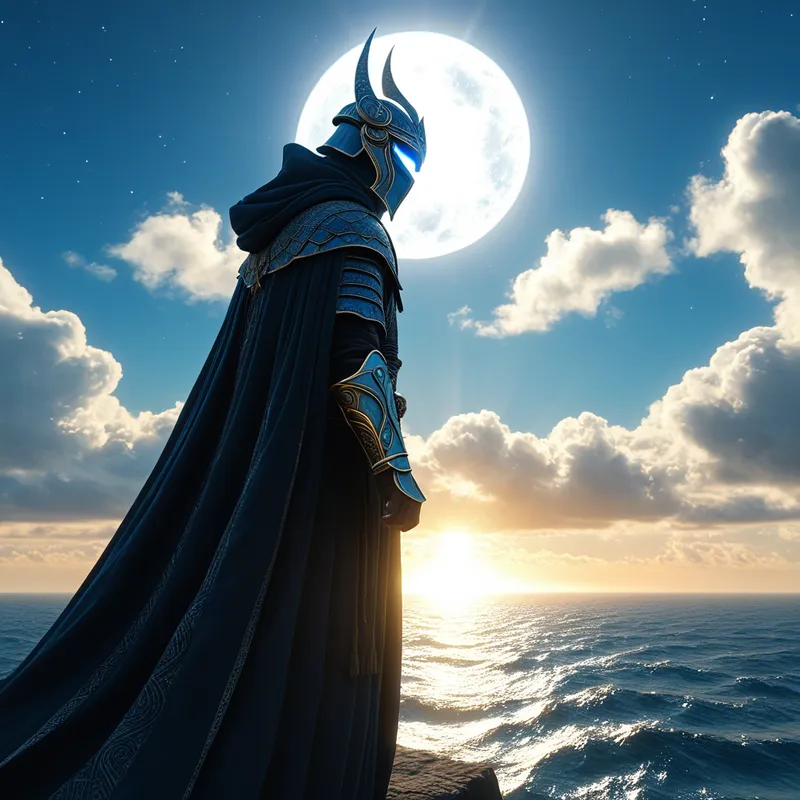
In the time before time, there was only Po. From this deep, generative night, the great forces stirred. Wakea emerged—the wide, arching, limitless sky. He was the bright expanse of day, the cool vault of night, the domain of the sun, the moon, and the ten thousand stars. His opposite, his necessary other, was Papa, the solid, enduring earth. She was the foundation of all things, the warm, dark soil from which life springs.
Their first union was a cosmic embrace, a perfect joining of heaven and earth. From this union came the islands. Not as rock and soil, but as living children: Hawaiʻi was born, followed by Maui, then Oʻahu, Kauaʻi, and others. The world was born from their love, a family of lands cradled in the sea.
But the sky, by its nature, is distant. Wakea’s gaze was ever upward, drawn to the celestial realms. A separation grew in his heart. He looked upon Papa, the constant, nurturing earth, and desired something… else. He turned his attention to Hoʻohokukalani, “She who placed the stars in the sky.” In this turning, a profound schism was wrought. Papa, in her grief and anger at this betrayal, withdrew. She receded, creating the space between land and sky that we know as the world. No longer were they pressed together in perpetual union; now, light and air flowed between them.
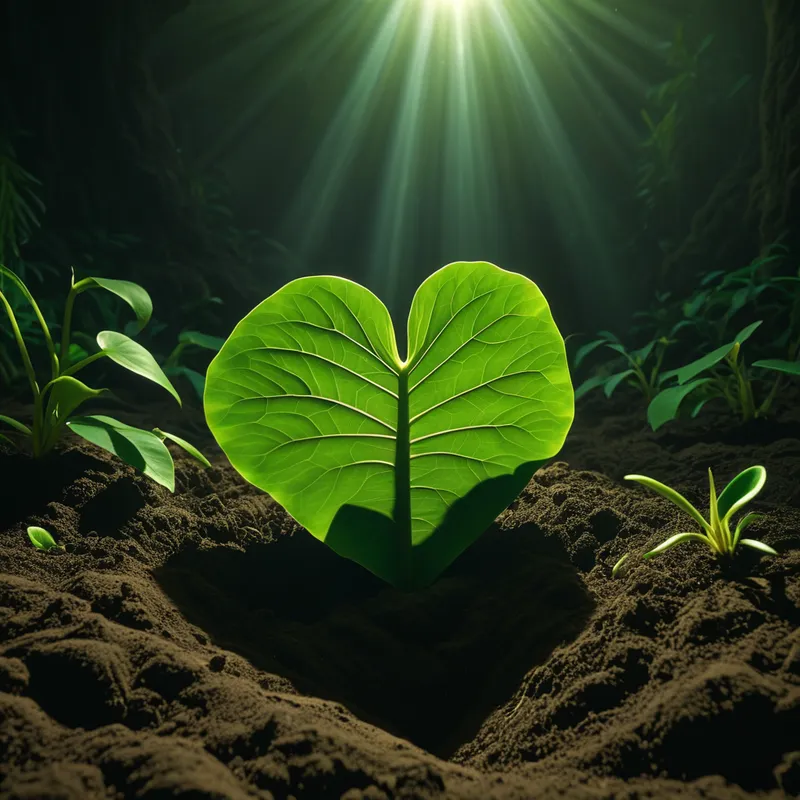
From Wakea’s new union with Hoʻohokukalani, a child was born. But this first child was formless, a lifeless, stillborn being. They named him Haloa-naka, “Long stalk, trembling.” With immense sorrow, they buried his body in the rich earth of Papa. From that sacred burial spot, the first kalo plant sprouted—its heart-shaped leaf reaching for the sky, its roots delving deep into the earth, a perfect child of both realms.
Their second child, born alive, was also named Haloa. He became the first aliʻi, the progenitor of the Hawaiian people. And so, the first human was the younger brother to the kalo plant. This established the sacred covenant: humans shall always care for and honor the kalo, their elder sibling, who sustains their body, just as the sky and the earth, in their separation and connection, sustain their world.
Cultural Origins & Context
This cosmogonic genealogy, known as the Kumulipo, was not mere story but the foundational framework of Hawaiian reality. It was the sacred history chanted by kāhuna and haku mele during the most important rituals, such as the birth of a high chief. Its recitation affirmed the divine right of the aliʻi, directly linking them to Wakea and Papa, and thus to the very fabric of the universe.
The myth served as a societal and ecological blueprint. It explained the natural order—why the sky is separated from the earth, why the islands exist, and the origin of the primary food source, kalo. More profoundly, it encoded the principles of pono (balance, righteousness). The separation of Wakea and Papa, while born of conflict, was necessary for life to flourish in the space created. It established a cosmology of dynamic, sometimes painful, relationships that require care, protocol, and respect to maintain harmony.
Symbolic Architecture
At its core, the myth of Wakea is an archetypal [drama](/symbols/drama “Symbol: Drama signifies narratives, emotional expression, and the exploration of human experiences.”/) of [differentiation](/symbols/differentiation “Symbol: The process of distinguishing or separating parts of the self, emotions, or identity from a whole, often marking a developmental or psychological milestone.”/). Wakea represents [the principle](/symbols/the-principle “Symbol: A fundamental truth, law, or doctrine that serves as a foundation for a system of belief, behavior, or reasoning, often representing moral or ethical standards.”/) of [consciousness](/symbols/consciousness “Symbol: Consciousness represents the state of awareness and perception, encompassing thoughts, feelings, and experiences.”/), [spirit](/symbols/spirit “Symbol: Spirit symbolizes the essence of life, vitality, and the spiritual journey of the individual.”/), and the upward-striving [impulse](/symbols/impulse “Symbol: A sudden, powerful urge or drive that arises without conscious deliberation, often linked to primal instincts or emotional surges.”/). Papa is the unconscious, the [body](/symbols/body “Symbol: The body in dreams often symbolizes the dreamer’s self-identity, personal health, and the relationship they have with their physical existence.”/), the grounded [reality](/symbols/reality “Symbol: Reality signifies the state of existence and perception, often reflecting one’s understanding of truth and life experiences.”/) of matter. Their initial union is a state of undifferentiated wholeness, a [paradise](/symbols/paradise “Symbol: A perfect, blissful place or state of being, often representing ultimate fulfillment, harmony, and transcendence beyond ordinary reality.”/) of potential but without form or the possibility of conscious experience.
The birth of the individual psyche requires a separation from the primal unity, a necessary “fall” into duality that creates the space for life and awareness.
Wakea’s “[betrayal](/symbols/betrayal “Symbol: A profound violation of trust in artistic or musical contexts, often representing broken creative partnerships or artistic integrity compromised.”/)” is not merely a moral failing but a symbolic depiction of the ego’s [emergence](/symbols/emergence “Symbol: A process of coming into being, rising from obscurity, or breaking through a barrier, often representing birth, transformation, or revelation.”/). Consciousness (Sky) must differentiate itself from the unconscious ([Earth](/symbols/earth “Symbol: The symbol of Earth often represents grounding, stability, and the physical realm, embodying a connection to nature and the innate support it provides.”/)) to know itself. This act is inherently traumatic—it wounds the original unity (Papa’s [grief](/symbols/grief “Symbol: A profound emotional response to loss, often manifesting as deep sorrow, yearning, and a sense of emptiness.”/)) and creates a sense of alienation (the [space](/symbols/space “Symbol: Dreaming of ‘Space’ often symbolizes the vastness of potential, personal freedom, or feelings of isolation and exploration in one’s life.”/) between). The stillborn first [child](/symbols/child “Symbol: The child symbolizes innocence, vulnerability, and potential growth, often representing the dreamer’s inner child or unresolved issues from childhood.”/), Haloa-naka, represents the first, failed attempt at creating a conscious [identity](/symbols/identity “Symbol: Identity represents the sense of self, encompassing personal beliefs, cultural background, and social roles.”/) from this new alignment; it is a psychic miscarriage. Only through integrating the [lesson](/symbols/lesson “Symbol: A lesson in a dream signifies a learning opportunity, often reflecting personal growth or unresolved issues requiring attention.”/) of that [loss](/symbols/loss “Symbol: Loss often symbolizes change, grief, and transformation in dreams, representing the emotional or psychological detachment from something or someone significant.”/)—burying it in the [earth](/symbols/earth “Symbol: The symbol of Earth often represents grounding, stability, and the physical realm, embodying a connection to nature and the innate support it provides.”/) (the unconscious)—does a viable new form emerge: the kalo (sustenance from the unconscious) and then the [human](/symbols/human “Symbol: The symbol of a human represents individuality, complexity of emotions, and social relationships.”/) Haloa (conscious [life](/symbols/life “Symbol: The symbol of ‘Life’ represents a journey of growth, interconnectedness, and existential meaning, encompassing both the joys and challenges that define human experience.”/) itself).

The Dreamer’s Resonance
When this mythic pattern stirs in the modern dreamer, it often manifests as profound somatic and psychological tensions. One may dream of a vast, beautiful sky that feels achingly distant from the solid ground beneath their feet, embodying a felt split between spiritual aspiration and earthly existence. Dreams of a stillborn idea, a failed project, or a buried grief often touch the Haloa-naka complex—the creative potential that could not come to life in its first form.
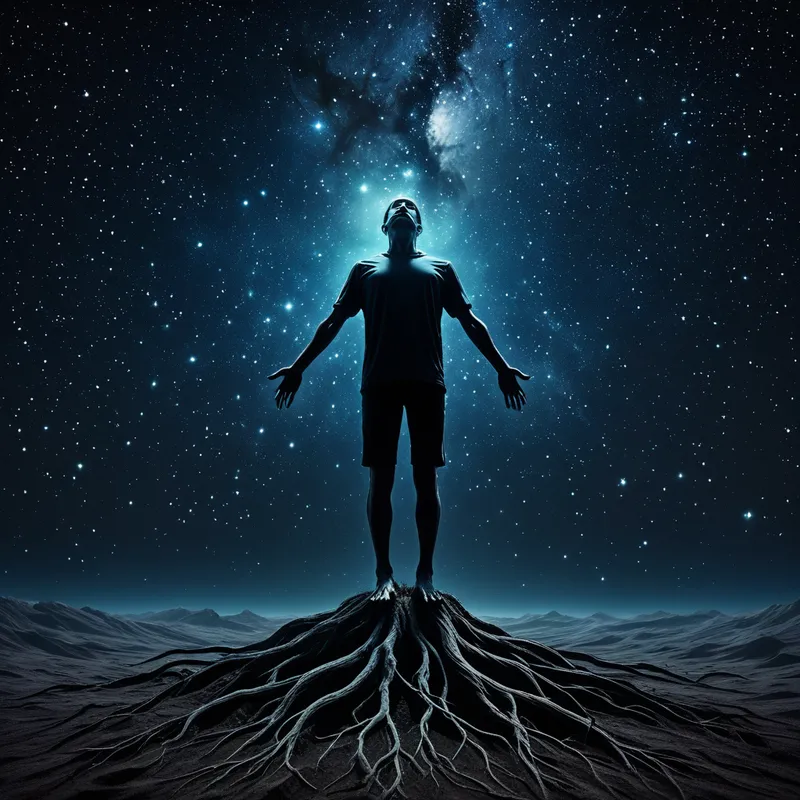
The dreamer might experience a powerful sense of betrayal, either as the betrayer or the betrayed, reflecting the painful but necessary differentiation from a parent, a partner, or an old identity (Papa). The somatic sensation is often one of being stretched—roots aching to hold fast to the familiar earth, while the head and heart are pulled upward by a compelling, lonely call to a higher or more conscious state. This is the birth pangs of a new psychological order, demanding a ritual burial of what did not work to nourish what will.
Alchemical Translation
The individuation process modeled by Wakea’s story is not one of returning to the initial, unconscious unity with Papa. That paradise is irrevocably lost. Instead, the alchemical work is to consciously re-relate to the “earth” from the new position of a separated “sky.”
The goal is not fusion, but conscious relationship across the sacred space that separation has created.
The modern individual must first acknowledge and honor the “betrayal”—the necessary act of self-differentiation that wounded the primal unity (the family system, the cultural expectations, the unconscious identifications). This involves grieving the loss of that undifferentiated state (Papa’s withdrawal). The buried “stillborn” aspects—failed potentials, shamed parts of the self—must be interred with respect in the soil of the psyche. From this act of sacred burial, one’s own “kalo” grows: the sustaining wisdom and nourishment that comes from the transformed unconscious.
Finally, one assumes the role of Haloa, the living child. This is the conscious ego, born from both sky and earth, tasked with stewardship. It means living in the created space, tending the relationship between your highest aspirations (Wakea) and your deepest grounded reality (Papa), and honoring the sibling covenant with all that sustains you. You become the chief of your own inner lands, ruling not through domination, but through the recognized kinship and pono between all the elements of your being.
Associated Symbols
Explore related symbols from the CaleaDream lexicon:
- Sky — The domain of Wakea, representing consciousness, spirit, the father principle, limitless potential, and the often-distant realm of ideals and thought.
- Earth — The body of Papa, representing the unconscious, the mother principle, foundation, fertility, grounded reality, and the nourishing darkness.
- Child — Represented by Haloa, the first human, symbolizing the new conscious identity born from the union and subsequent separation of sky and earth.
- Tree — Embodied by the sacred kalo plant, the elder sibling to humanity, symbolizing deep-rooted sustenance, ancestral wisdom, and life born from sacred burial.
- Separation — The crucial space created between Wakea and Papa, representing the necessary differentiation that allows for individual life, consciousness, and experience.
- Root — The part of the kalo plant buried in Papa, symbolizing connection to the unconscious, to ancestry, and to the foundational sources of nourishment and identity.
- Mountain — The islands born as children, representing the solid, manifested forms that arise from the union of cosmic principles, and the places where earth reaches for the sky.
- Order — The cosmic and social structure established by the myth, the principle of pono that governs the relationships between gods, humans, and nature.
- Ancestor — Wakea and Papa as primal ancestors, representing the deep, mythic lineage from which individual identity and cultural law descend.
- Sacrifice — The burial of the stillborn Haloa-naka, representing the necessary surrender of a first, failed form so that a viable and sustaining new form may grow.
- Union — The initial, perfect embrace of Wakea and Papa, symbolizing primal wholeness, undifferentiated being, and the state of potential before consciousness.
- Father Sky — The specific archetypal role of Wakea, the masculine celestial principle that both creates and separates, providing light, order, and the impulse for distinction.