Wairua Spirit Myth Meaning & Symbolism
A mythic journey into the spirit world to retrieve a lost essence, revealing the sacred bond between the living, the ancestors, and the land.
The Tale of Wairua Spirit
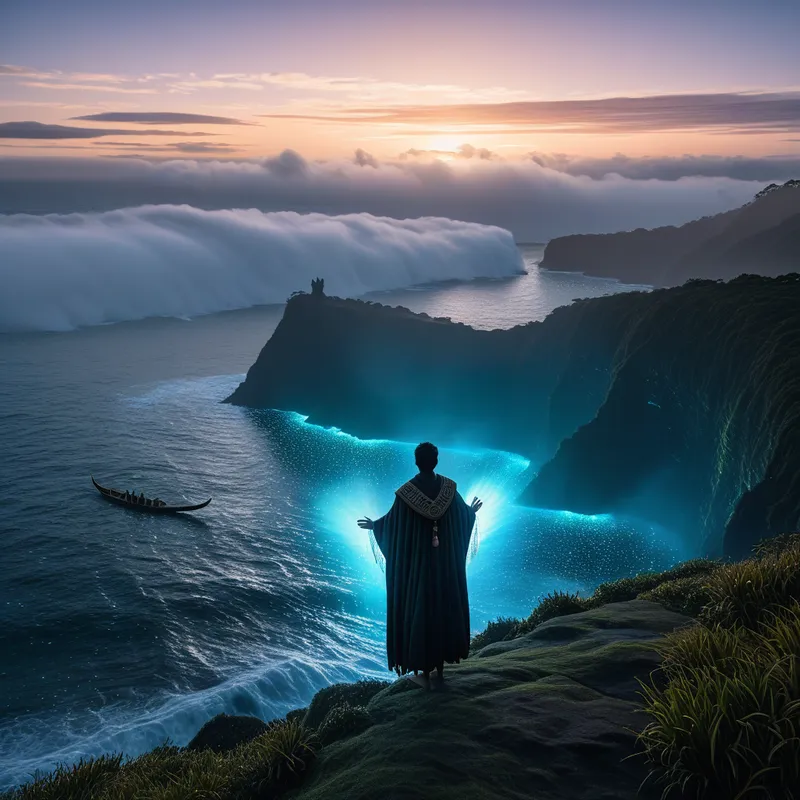
Listen. The wind does not just blow; it carries voices. The sea does not just crash; it whispers names. In the time when the world was thin, and the veil between Te Ao Mārama and Te Pō was but a breath, there lived a man named Tāne. He was strong, a provider, a man of the earth. But a silence grew in him, a cold hollow where his laughter once lived. His sleep was empty, his waking life a grey shell. The people said his wairua had wandered, lost in a grief he could not name.
One night, under a Marama so full it bled silver onto the black ocean, his grandmother, the Kuia, took his face in her weathered hands. Her eyes were deep pools reflecting the star-road. “Your spirit does not sleep, Tāne. It walks the paths of the dead, seeking a song it has forgotten. You must go and bring it home.”
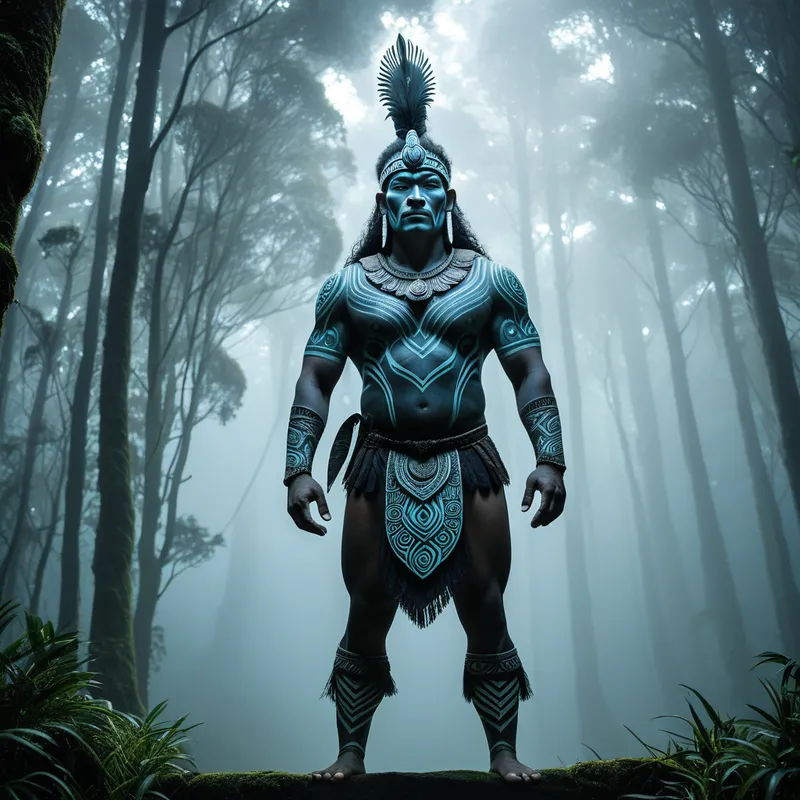
Guided by her karakia, Tāne prepared. He fasted. He bathed in the icy river. He smeared his body with sacred red ochre. At the deepest hour of the Pō, he stood at the tapu boundary of the village, where the great Tōtara grove began. The air grew thick and cold. The familiar sounds of crickets ceased. Before him, the forest was not dark, but luminous with a strange, phosphorescent glow. The ferns seemed to watch. This was no longer his forest; it was the throat of Te Pō.
He walked. Time unspooled. He passed shadows that were not his own, shapes that murmured in a language of rustling leaves and distant waves. A river of black water, singing with forgotten lullabies, blocked his path. From its depths, a [taniwha](/myths/taniwha “Myth from Maori culture.”/) arose, its scales like obsidian, its eyes like cold fire. “Turn back, flesh-walker,” it hissed. “This water drinks memory.” But Tāne remembered his grandmother’s words. He did not fight. He offered a waiata, his voice cracking but true, a song for the river itself. The [taniwha](/myths/taniwha “Myth from Maori culture.”/) listened, then sank, leaving a path of still water.
Deeper he went, until he stood in a silent clearing. In its center stood his own wairua. It was not a ghost, but a vibrant, younger version of himself, yet infinitely older, its form woven from starlight and the green of newborn ferns. It was kneeling, tending to a small, withered sapling—the very image of his own neglected joy. “I am tending what you left to die,” his wairua said, without turning. “Why have you come?”
“I am empty,” Tāne confessed, the truth tearing from him. “The world has no color without you.”
The spirit stood. It placed its hand, which felt like sunlight and cool mist, over Tāne’s heart. “I never left. You stopped listening. You built a wall of silence and called it strength.” In that touch, Tāne felt it all—the unwept grief for his father, the stifled love, the pride that isolated him. He wept, and his tears fell on the sapling. As they did, it straightened, budding with a single, perfect silver leaf.
“Remember this,” his wairua whispered, its form beginning to blur into his own. “I am the song you sing to the mountain. I am the connection to those who walk behind us. I am not in you; I am you, when you are whole.” With a rush like a sigh of the earth, the two beings merged. Tāne fell to the ground, not in weakness, but in completion.
He awoke at the village boundary, the dawn sun warming his face. The world was not just seen; it was felt. The song of the Korimako was a prayer. The breath of the wind was a greeting. He was not just Tāne. He was Tāne-of-the-retrieved-spirit, forever connected to the long line of those who had made the journey before him, a living bridge between the world of light and the deep, nourishing darkness.
Cultural Origins & Context
The concept of Wairua is not merely a single “myth” but a foundational pillar of the Māori worldview, intricately woven into tikanga (customary practices) and tapu. These understandings were not preserved in written texts but in the living oral traditions: in the rhythmic, metaphor-rich chants of whai kōrero, the genealogical recitals of whakapapa, and the powerful narratives of pūrākau. Stories of spiritual journeying were told by kaumātua and kuia to explain the nature of illness, both physical and social. A person acting without mauri (vital essence) or with a troubled wairua could bring imbalance to the entire whānau or hapū.
The societal function was profound. It taught that individual well-being was inseparable from collective and ancestral well-being. The journey to retrieve one’s wairua was a metaphor for the necessary processes of conflict resolution, grief work, and the restoration of mana. It framed psychological distress not as a personal failing, but as a dislocation from one’s source, a journey that required courage, ritual, and the guidance of tradition to mend.
Symbolic Architecture
At its core, the myth of the wandering Wairua is a masterful map of the psyche. The [hero](/symbols/hero “Symbol: A hero embodies strength, courage, and the ability to overcome significant challenges.”/)‘s initial state represents the ego-[consciousness](/symbols/consciousness “Symbol: Consciousness represents the state of awareness and perception, encompassing thoughts, feelings, and experiences.”/) that has become alienated from the Self—the deeper, total [personality](/symbols/personality “Symbol: Personality in dreams often symbolizes the traits and characteristics of the dreamer, reflecting how they perceive themselves and how they believe they are perceived by others.”/). The hollow man is one who lives only on the surface of his being, identified solely with his social [role](/symbols/role “Symbol: The concept of ‘role’ in dreams often reflects one’s identity or how individuals perceive their place within various social structures.”/) (provider, [warrior](/symbols/warrior “Symbol: A spiritual archetype representing inner strength, discipline, and the struggle for higher purpose or self-mastery.”/)) while neglecting the inner, spiritual [dimension](/symbols/dimension “Symbol: Represents the fundamental structure of reality, consciousness, or existence beyond ordinary perception.”/).
The journey into Te Pō is the descent into the unconscious, not as a place of monsters, but as the realm of soul. The taniwha is the classic guardian of the threshold, a personification of the resistance we meet when we first confront the depths of our own psyche. It does not respond to force, but to authenticity—the true song (waiata).
The encounter with the wairua-as-gardener is the critical [moment](/symbols/moment “Symbol: The symbol of a ‘moment’ embodies the significance of transient experiences that encapsulate emotional depth or pivotal transformations in life.”/) of recognition. The [spirit](/symbols/spirit “Symbol: Spirit symbolizes the essence of life, vitality, and the spiritual journey of the individual.”/) is not a foreign entity to be captured, but a disowned part of the self, engaged in the essential work the ego has abandoned: tending the fragile, growing potential (the sapling) of feeling, creativity, and [connection](/symbols/connection “Symbol: Connection symbolizes relationships, communication, and bonds among individuals.”/). The merger is not an annexation, but a reconciliation, a restoration of [psychic wholeness](/symbols/psychic-wholeness “Symbol: A state of complete integration between conscious and unconscious aspects of the psyche, representing spiritual unity and self-realization.”/) where the ego realigns itself as the servant of the larger Self.
The Dreamer’s Resonance
When this mythic pattern stirs in modern dreams, it often signals a profound somatic and psychological process of soul retrieval. The dreamer may experience dreams of being lost in vast, unfamiliar yet strangely significant landscapes—endless forests, labyrinthine caves, or misty shorelines. They may encounter a younger version of themselves, a radiant or sorrowful double, or a guiding ancestral figure who feels intimately familiar.
Somatically, this process can feel like a deep fatigue that sleep does not cure, a sense of being “spaced out” or disconnected from the body, or conversely, a sudden, acute sensitivity to environments and emotions. Psychologically, it is the psyche’s attempt to recover energy and identity that has been lost to trauma, repression, or a life lived too extrinsically. The dream is the unconscious initiating its own healing ritual, guiding the dreamer toward the parts of themselves they have been forced to leave behind in order to survive.
Alchemical Translation
The alchemical process mirrored in this myth is the unio mentalis, the union of mind and spirit, followed by its embodiment. The initial state is the nigredo—the blackening, the hollow depression and sense of meaninglessness. The journey into Te Pō is the solutio—dissolution in the waters of the unconscious, where rigid ego structures are softened.
The confrontation and negotiation with the taniwha represents the separatio, the careful distinguishing of what is truly one’s own soul-work from the defensive complexes that guard it. The tender meeting with the lost spirit is the coniunctio—the sacred marriage of conscious awareness and the lost soul-image.
Finally, the return to the village at dawn is the rubedo—the reddening, the return of color and vitality to life, now infused with a new level of consciousness. The individual is not simply “cured,” but transmuted. They carry the knowledge of the depths within them, becoming a vessel for a more complete humanity. Their life is no longer just a personal story, but a node in the great whakapapa of being, consciously participating in the flow of mauri between ancestors, community, and the living world. They have achieved a grounded spirituality, where the spirit is not an abstract concept, but the very texture of embodied, connected existence.
Associated Symbols
Explore related symbols from the CaleaDream lexicon:
- Spirit — The central entity of the myth, representing the essential, non-physical essence of a person that can become disconnected and must be consciously reclaimed.
- Journey — The fundamental structure of the narrative, a perilous voyage into the non-ordinary world of the unconscious to achieve healing and wholeness.
- Forest — The archetypal landscape of the descent into the unknown psyche, a place of transformation, danger, and encounter with the numinous.
- River — The threshold and barrier of the unconscious, often guarded, whose crossing requires offering one’s authentic self rather than force.
- Ancestral Spirit — The guiding force and ultimate source of the wandering wairua; reconnection with it signifies healing the rupture across time.
- Bridge — The role of the healed individual, who becomes a living connection between the everyday world and the spirit world, between past and present.
- Tree — Symbol of life, growth, and lineage; the withered sapling represents the neglected inner life that the wairua tends.
- Dream — The medium through which the need for this journey is often first communicated, and the modern analogue for the mythic landscape of Te Pō.
- Healing — The ultimate purpose and outcome of the mythic cycle, a restoration that is simultaneously personal, familial, and spiritual.
- Shadow — The initial, hollow state of the hero and the denizens of Te Pō represent aspects of the self that have been cast into darkness and must be integrated.
- Ritual — The prescribed process of preparation, karakia, and action that makes the dangerous journey possible, framing it within sacred tradition.
- Spirit World — The destination and psychological counterpart to conscious life, the realm of ancestors, soul, and the root of all meaning.