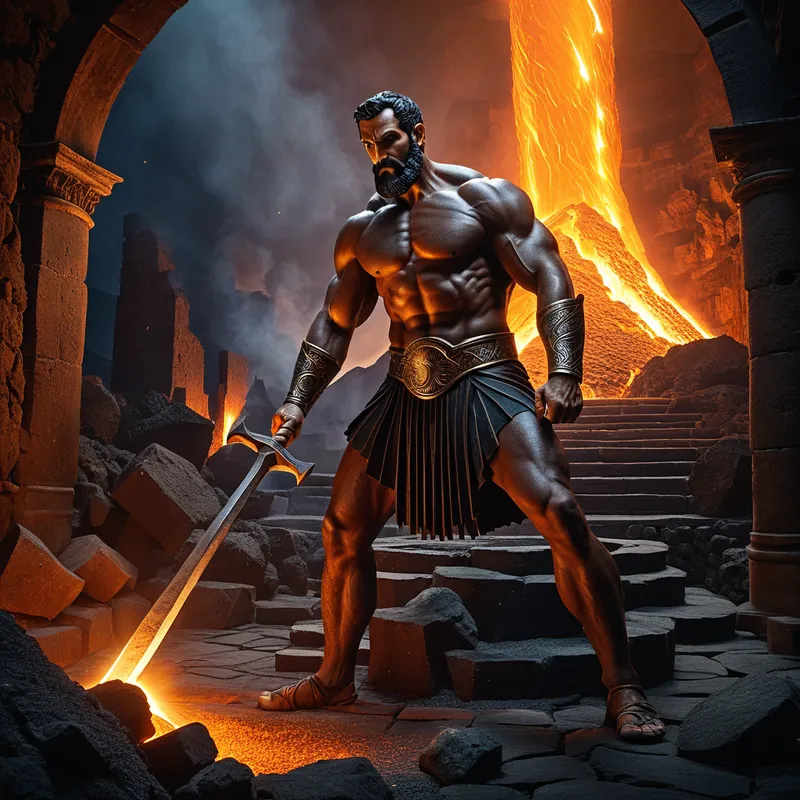
Vulcan Myth Meaning & Symbolism
The myth of Vulcan, the rejected and lame god who masters the primal fire, becoming the divine artisan whose sacred craft forges both weapons and destiny.
The Tale of Vulcan
Hear now the tale of the fire that was cast out, only to become the fire that forges fate.
In the gleaming, cloud-piercing courts of Jupiter, perfection was the law. Beauty was unmarred, form was flawless. So when Juno beheld her newborn son, her heart did not swell with love but seized with a cold, divine shame. For the babe was not as the other Olympians; his form was… imperfect. In a moment of cosmic cruelty, a mother’s rejection took physical form. She plucked the squalling infant from his cradle and with a strength born of disgust, hurled him from the sacred mountain’s peak.
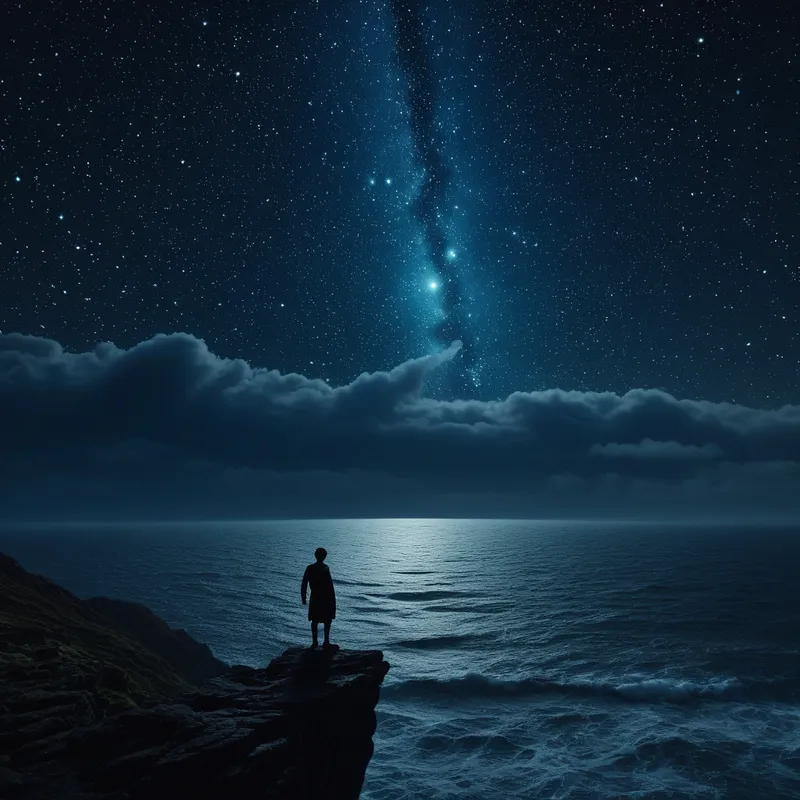
He fell for a day and a night, a tiny, tumbling star of flesh and fate, down through the vault of heaven, past the sighing winds, and into the churning, indifferent embrace of the sea. But destiny is not so easily drowned. The sea-nymph Thetis found him, this broken god-child, and in the sun-dappled quiet of her oceanic grotto, she raised him in secret. There, in the submarine gloom, a different fire was kindled—not the flash of lightning, but the patient, persistent glow of the inner flame.
The boy, named Vulcan, was lame, but his mind and hands were preternaturally swift. He began to craft. From shells and coral, he fashioned trinkets. Then, from hidden veins of ore he discovered, he built his first forge. The hammer’s ring became his voice, the anvil’s resistance his conversation. He learned the song of metal, the whisper of the flame, the secret of making substance obey vision.
Years flowed like molten bronze. News of the mysterious, incomparable smith reached even Olympus. When Juno, unaware of the artisan’s identity, requested a magnificent throne of gold and jewels, Vulcan delivered it. It was a masterpiece—and a perfect, invisible trap. The moment Juno sat upon it, cunning, unbreakable bonds sprang forth, fusing her to the seat of her own vanity. No god, not even mighty Jupiter, could pry her loose. The heavens were in uproar. Only the maker held the key.
They brought the wine-god Bacchus to the forge, deep within the fiery heart of Mount Etna. The air shimmered with heat, the floor trembled, and rivers of fire lit the soot-stained face of the master. Bacchus made Vulcan drink, and drink again, until the god of the forge, laughing and unsteady, was led back to Olympus—not as a rejected infant, but as a power to be bargained with. He released Juno, and in recompense, was given the most beautiful goddess, Venus, as his bride. He returned to his subterranean realm, the heart of the world, where his hammer falls eternally, crafting the thunderbolts of Jupiter, the weapons of heroes, and the very jewelry of the gods. The outcast had become the indispensable architect of divine power.
Cultural Origins & Context
The figure of Vulcan (Vulcanus) is a profound syncretic blend. His cult was ancient on Italian soil, likely originating from pre-Roman fire deities worshipped for their power over both destructive wildfire and the vital, domestic hearth. The Romans, ever practical, deeply venerated this dual aspect. His primary festival, the Volcanalia, held on August 23rd, was not a celebration of craft, but a propitiation. Small fish were thrown into ritual fires, a symbolic sacrifice to appease the god’s fiery nature and ward off devastating blazes that threatened the grain stores at the height of summer.
His formal mythology, however, was largely adopted and adapted from the Greek Hephaestus. Roman poets like Ovid and Virgil wove these Hellenic narratives into the Roman tapestry, giving Vulcan his dramatic backstory and his role as celestial armorer. This myth was not merely entertainment; it served a crucial societal function. It explained the presence of imperfection within a cosmos ruled by ideals, and it sanctified the labor of the artisan—the blacksmith, the carpenter, the mason—whose physically demanding, often disfiguring work was the literal foundation of civilization (its weapons, its tools, its temples). Vulcan legitimized the dignity of making.
Symbolic Architecture
At its core, the myth of Vulcan is an archetypal drama of the wounded creator. His lameness is not merely a physical trait but the primary symbol of his psychology: a profound sense of inadequacy, rejection, and fundamental “otherness” instilled at the moment of birth from a maternal source. He is cast out from the realm of perfect forms (Olympus) into the chaotic, fluid depths (the sea) and finally into the chthonic, transformative heat of the earth (the volcano).
The deepest creativity is often born not in the light of approval, but in the dark heat of rejection. The wound becomes the crucible.
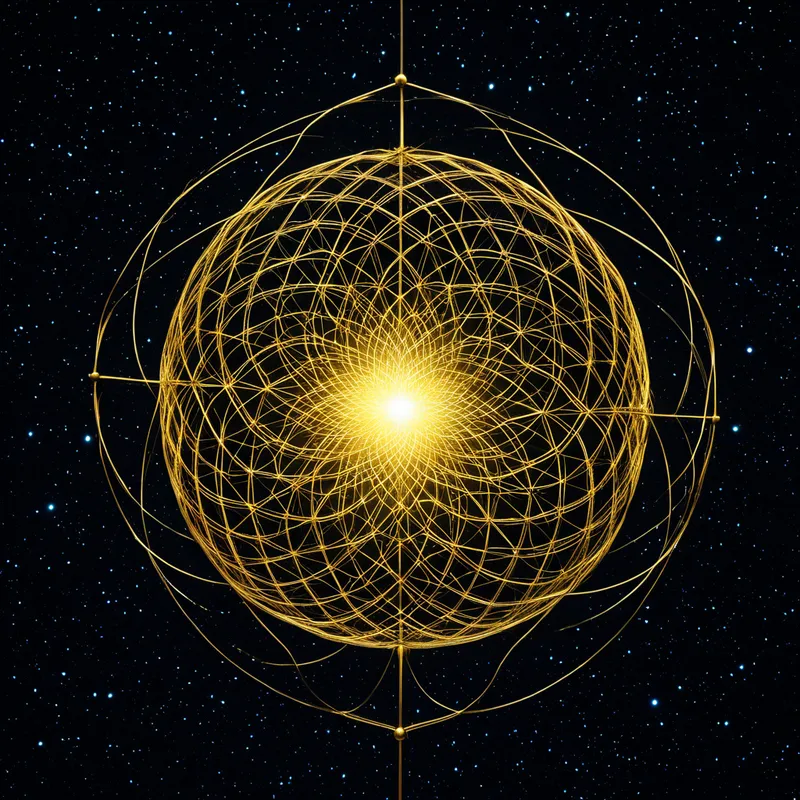
His forge, deep within Mount Etna, is the ultimate symbolic space. It is the subconscious, the workshop of the soul, where raw, primal elements (ore, fire) are subjected to intense pressure and skillful force to be transmuted into conscious, purposeful form (a sword, a crown). Vulcan does not command from on high; he works within the world’s fiery core. His power is immanent, not transcendent. The golden net he crafts to entrap Juno is the masterpiece of this symbolic architecture—it represents the intellect (the craft) turning the tables on the very source of rejection (the mother/animus), demonstrating that the “flawed” mind can create structures of perfect, inescapable logic and consequence.
The Dreamer’s Resonance
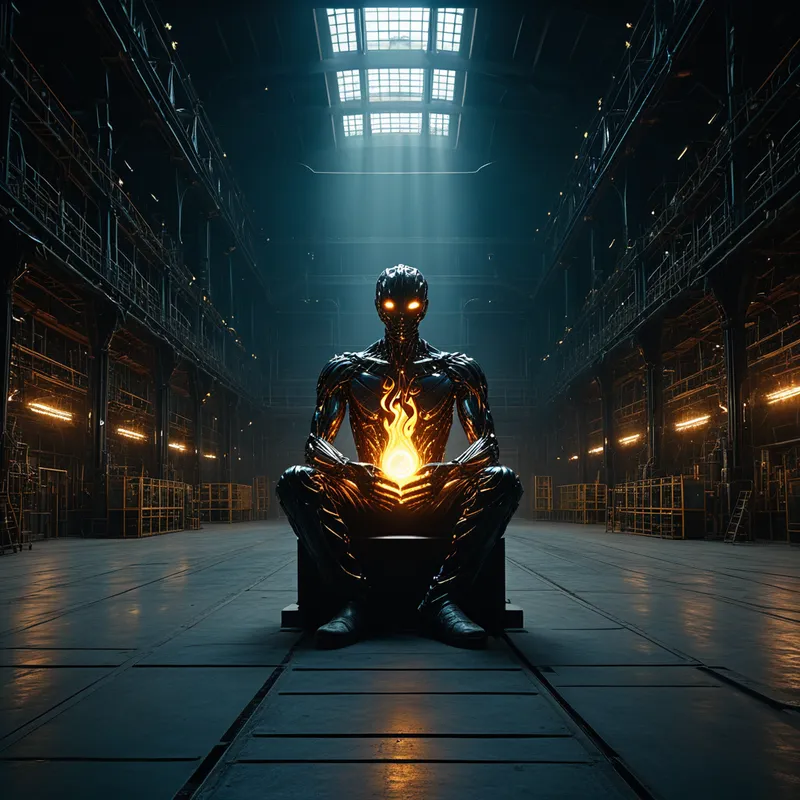
When the pattern of Vulcan arises in the modern psyche, it often manifests in dreams of isolation coupled with intense, focused productivity. The dreamer may find themselves in a basement, a garage workshop, a boiler room, or a cavern, engaged in a vital, solitary task. There is a somatic sense of being “lame” or restricted—perhaps dream limbs are heavy, or movement is labored—yet the hands are incredibly deft. The crafted object is paramount: a complex machine, a intricate piece of jewelry, a weapon. It is often glowing with inner heat.
Psychologically, this signals a process of conscious suffering. The dream ego is not passively enduring pain but actively engaging with it, using it as fuel. This is the stage where one withdraws from the demand for social perfection (“Olympus”) to attend to the foundational, often ugly, repair-work of the self. The dream forgespace is the psyche’s sanctuary for processing the raw ore of trauma, shame, or rejection. To dream of successfully forging something is to witness the nascent emergence of the Creator archetype from the ashes of the Orphan. The heat is uncomfortable, the labor is exhausting, but it is sacred work.
Alchemical Translation
The Vulcan myth is a precise map for the alchemical stage of calcinatio—the burning away of impurities in the fierce, dry heat of introspection and ordeal. The individual’s initial, naive identification with ideal perfection (the Olympian self-image) is thrown into the sea of the unconscious. There, it must be rescued not by a savior, but by a nurturing, accepting aspect of the psyche (Thetis, representing compassionate self-care). This begins the transformation.
Individuation is not about becoming perfect, but about becoming integral. The forge integrates the rejected fragment by making it the central tool of creation.
The long apprenticeship in the forge is the disciplined development of skill and consciousness. One learns to hold the tension of opposites: fire and water, force and precision, rejection and mastery. The return to “Olympus” is not a plea for re-admission, but a demonstration of earned power. The crafted object—be it a piece of art, a healed relationship, a professional mastery, or simply a stable sense of self-worth—is the “golden net.” It is the tangible proof that one’s unique perspective, born of suffering, can create something of objective value and power that even the “gods” (internalized critics, societal standards) must acknowledge.
Ultimately, Vulcan’s journey models the triumph of techne (craft, skillful making) over mere genesis (birthright). It argues that true authority and identity are not given but forged, hammer-stroke by hammer-stroke, in the solitary, fiery heart of one’s own experience. We do not heal our wounds to disappear them; we heal them to build our forge upon their sacred ground.
Associated Symbols
Explore related symbols from the CaleaDream lexicon: