Volkh Vseslavich Myth Meaning & Symbolism
A prince born of a serpent, a warrior who commands beasts, Volkh's epic saga explores the raw, untamed power of nature and destiny within the human soul.
The Tale of Volkh Vseslavich
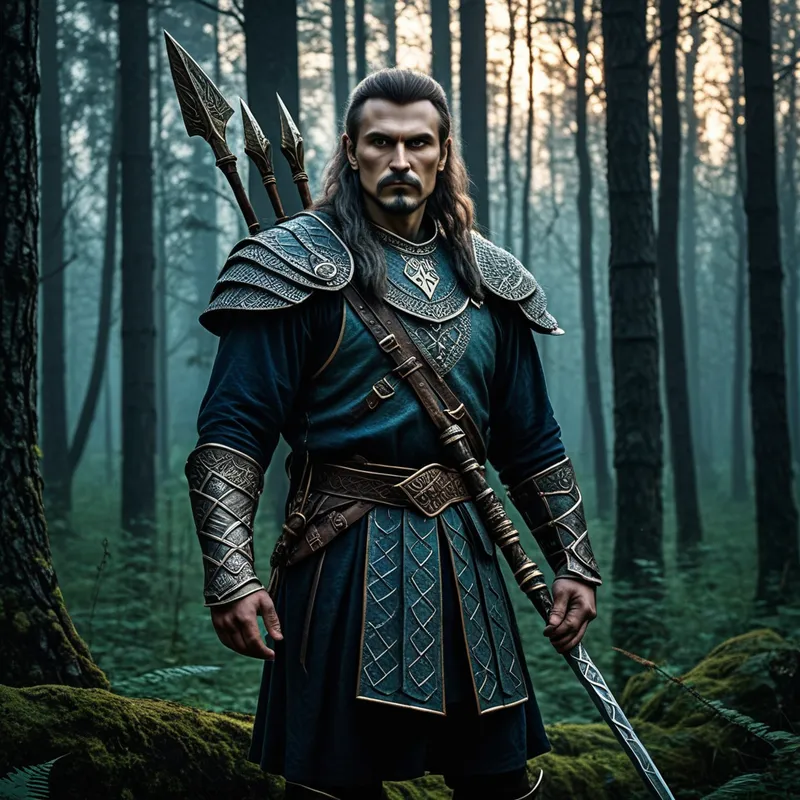
Listen, and hear the tale that the pines whisper and the wolves remember. In the ancient land of the Rus’, where the world was younger and magic clung to the earth like morning mist, a queen walked alone in her garden. A great serpent, a prince of the deep earth and hidden places, saw her and was stricken. In that moment of forbidden longing, destiny was woven. From their union, a child was born—not in nine months, but in a single, tempestuous year. His name was Volkh, son of Vseslav, and he entered the world not with a cry, but with a thunderclap that shook the palace walls.
He grew not by years, but by leaps of power. At one and a half winters old, he roared with a voice that made the warriors tremble. His mother, in fear and wonder, swaddled him in seven silks and bound him with seven bands of tempered steel. He strained, and the silks tore like spiderwebs, the steel snapped like dry twigs. “Mother,” he said, his voice already holding the gravel of the earth and the wind of the steppe, “you cannot bind what is destined to be free.”
His wisdom was as swift as his strength. He learned the secret tongues of the world: the chattering speech of birds, the growling language of beasts, the silent song of the grasses. He understood that to know a thing’s name is to hold its soul in your hand. When news came of a great foe, the Indian Tsar, threatening the land with a boundless, golden army, Volkh did not call for knights. He walked into the deep, primeval Forest. He breathed upon the moss, whispered to the stones, and sang to the shadows under the ancient oaks.
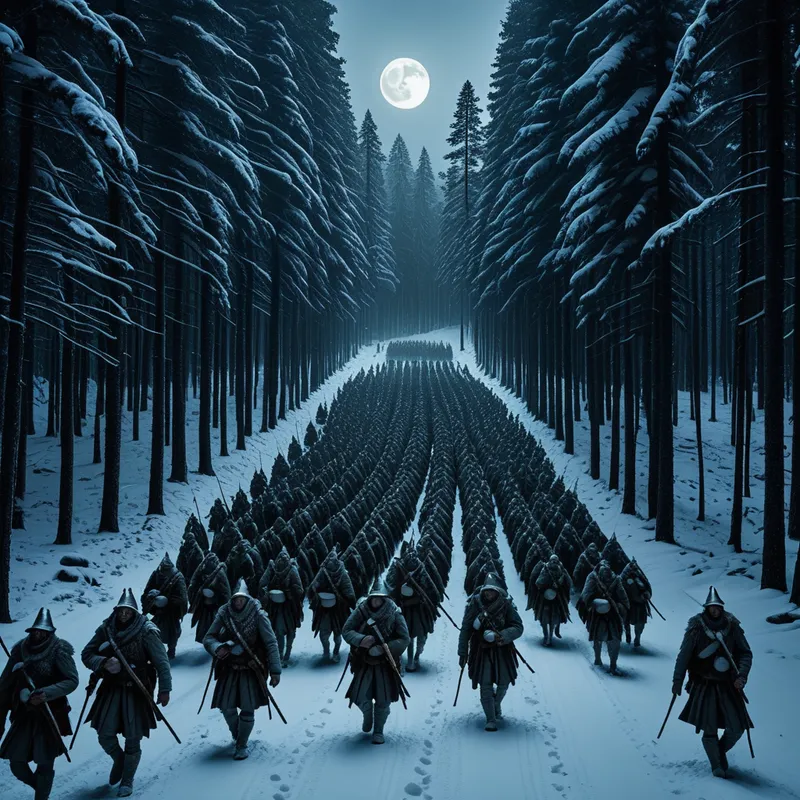
And the forest answered. From the thickets came wolves, their eyes like chips of amber. From the dens came bears, moving with the slow, terrible power of the earth itself. Lynxes, eagles, and every creature that runs, flies, or stalks gathered. With a thought, Volkh transformed them. Their fur and feather melted into polished mail, their claws became swords, their fangs became spearpoints. He did not command an army of men, but an army of the wild world given the shape of war. They marched, a silent, terrifying host, to the golden-domed city of the Indian Tsar.
There, Volkh used his greatest art. He shifted his own form, becoming a tiny, grey-feathered sparrow. He flew over the high walls, past the guards, and into the heart of the palace. Listening, he learned the Tsar’s plans from the very air. Then, in the royal stables, he transformed again—into a fierce ermine. He slipped through a crack, found the Tsar’s mighty war-horses, and severed the tendons in their legs with a single, precise bite. The next day, when the Tsar sought to ride out, his power was crippled at its source. Volkh’s beast-army swept in, not as a wave of chaos, but as the inevitable, focused wrath of nature itself. The conflict was not just a battle; it was the old, untamed world reclaiming its due from the arrogance of gilded order.
Cultural Origins & Context
The tale of Volkh Vseslavich is preserved in the byliny, the epic song-cycles of Kievan Rus’. These were not written in books but carried in the memories and voices of skilled performers, the skaziteli. Sung to the drone of the gusli, these stories were not mere entertainment; they were a living archive of cosmology, ethics, and collective identity. Volkh’s story belongs to the oldest stratum of these epics, often called the “mythological” or “heroic” byliny, predating the Christianization of the region.
His narrative functioned on multiple levels. For a society intimately tied to the vast forests and plains, Volkh embodied the ambiguous, potent spirit of the wilderness itself—a force that could protect or destroy, that was both foundational and terrifying. He represents the archaic, pre-state power of the volkhv (from which his name likely derives), the pagan sorcerer-priests who communed with these forces. His story is a memory of a time when the boundary between human, animal, and elemental was porous, when power derived from an accord with the world’s raw essence, not from political lineage alone. He is the ultimate outsider-hero, whose legitimacy comes not from the throne he was born to, but from the deeper, wilder kingdom he commands.
Symbolic Architecture
At its core, the myth of Volkh is a profound map of the psyche’s [relationship](/symbols/relationship “Symbol: A representation of connections we have with others in our lives, often reflecting our emotional state.”/) with its own innate, instinctual power—power that often feels [alien](/symbols/alien “Symbol: Represents the unknown, otherness, and the exploration of new ideas or experiences.”/), monstrous, and overwhelming.
The serpent-father is not a demon to be slain, but the chthonic source code of the self. To be born of it is to inherit the wisdom of the underground, the coiled potential in the dark soil of the unconscious.
Volkh’s [birth](/symbols/birth “Symbol: Birth symbolizes new beginnings, transformation, and the potential for growth and development.”/) from a [serpent](/symbols/serpent “Symbol: A powerful symbol of transformation, wisdom, and primal energy, often representing hidden knowledge, healing, or temptation.”/) and a [queen](/symbols/queen “Symbol: A queen represents authority, power, nurturing, and femininity, often embodying leadership and responsibility.”/) signifies the union of the primordial, instinctual world (the Chthonic) with conscious, [human](/symbols/human “Symbol: The symbol of a human represents individuality, complexity of emotions, and social relationships.”/) order. He is the living bridge. His bursting of the [steel](/symbols/steel “Symbol: Steel symbolizes strength, resilience, and endurance, suggesting a solid foundation or a formidable presence in one’s life.”/) swaddling bands is the first, inevitable [eruption](/symbols/eruption “Symbol: A sudden, violent release of pent-up energy or emotion from beneath the surface, often representing transformation or crisis.”/) of this innate [destiny](/symbols/destiny “Symbol: A predetermined course of events or ultimate purpose, often linked to spiritual forces or cosmic order, representing life’s inherent direction.”/) against all attempts at domesticating containment. His mastery of animal languages symbolizes the acquisition of a primal literacy—the [ability](/symbols/ability “Symbol: In dreams, ‘ability’ often denotes a recognition of skills or potential that one possesses, whether acknowledged or suppressed.”/) to decipher the instinctual drives ([hunger](/symbols/hunger “Symbol: A primal bodily sensation symbolizing unmet needs, desires, or emotional voids. It represents craving for fulfillment beyond physical nourishment.”/), territory, pack loyalty, predation) that underpin our own emotions and actions.
His army is perhaps the central [symbol](/symbols/symbol “Symbol: A symbol can represent an idea, concept, or belief, serving as a powerful tool for communication and understanding.”/): the untamed forces of the psyche, the raw emotions and drives (rage, cunning, [strength](/symbols/strength “Symbol: ‘Strength’ symbolizes resilience, courage, and the ability to overcome challenges.”/), fear), which, when left unconscious, can ravage the inner [landscape](/symbols/landscape “Symbol: Landscapes in dreams are powerful symbols representing the dreamer’s emotional state, personal journey, and the broader context of life situations.”/). Volkh does not suppress them. He recognizes them, gives them a conscious form and [direction](/symbols/direction “Symbol: Direction in dreams often relates to life choices, guidance, and the path one is following, emphasizing the importance of navigation in personal journeys.”/) (“transforms them into warriors”), and aligns them toward a purposeful goal. The defeat of the [Indian](/symbols/indian “Symbol: The term ‘Indian’ can symbolize cultural heritage, spirituality, and connection to ancestral roots, influenced by socio-political contexts.”/) Tsar represents the overthrow of a rigid, inflated, and purely materialistic [consciousness](/symbols/consciousness “Symbol: Consciousness represents the state of awareness and perception, encompassing thoughts, feelings, and experiences.”/) (the “golden” [kingdom](/symbols/kingdom “Symbol: A kingdom symbolizes authority, belonging, and a sense of identity within a larger context or community.”/)) by the integrated, instinct-informed self.

The Dreamer’s Resonance
When the pattern of Volkh stirs in modern dreams, it signals a profound somatic and psychological process: the awakening of the Self’s instinctual foundation. One may dream of speaking with animals, not in words, but in a direct knowing of intention. One might dream of shapeshifting—feeling one’s hands become paws, sensing a tail where none exists—which is the psyche’s somatic metaphor for accessing a different mode of being, a different set of innate competencies.
Dreams of leading or being part of a wild animal pack point to the reorganization of one’s instinctual life. The feeling is not of being devoured by chaos, but of a potent, coordinated force moving with a unified will. Conversely, dreaming of being pursued by such a host may indicate that these powerful, Volkh-like energies are still perceived as a threat to the conscious ego, a “beast army” of unintegrated passions or traumas storming the gates of one’s carefully maintained “city.” The critical task, as modeled by the myth, is not to build higher walls, but to learn the language of the beasts and discover what rightful king they await.
Alchemical Translation
The journey of Volkh Vseslavich is a perfect allegory for the alchemical and Jungian process of individuation—the psychic transmutation of base, unconscious material into the gold of a realized Self.
The first stage, nigredo, is embodied in his serpentine conception and tumultuous birth: the confrontation with the dark, messy, primal origins of one’s being. Accepting this “monstrous” lineage is the essential first step. The bursting of the bonds is the separatio, the necessary rupture from the confining identities (the “silken swaddling”) imposed by family or society.
Individuation is not a journey toward becoming only human, but toward becoming wholly creature—integrating the full spectrum of one’s animal, elemental, and spiritual inheritance.
His education in animal tongues is the albedo, the illuminating work of making the unconscious conscious. It is the patient study of one’s own inner fauna—naming the wolf of loyalty, the bear of solitary strength, the serpent of transformative wisdom, the bird of transcendent vision.
The mustering of the beast-army represents citrinitas, the harnessing and organizing of these now-conscious forces into a capable, purposeful entity. Finally, the directed campaign and victory symbolize rubedo, the culmination. The integrated self, now in command of its full native power, engages with the world’s challenges (the “Indian Tsar” of external oppression, internal tyranny, or sterile materialism) not from a place of civilized weakness, but from the sovereign authority of the wild, true nature. One does not become a beast; one becomes a sovereign who understands the beast, and in doing so, becomes fully, powerfully human.
Associated Symbols
Explore related symbols from the CaleaDream lexicon:
- Serpent — The chthonic father and source of Volkh’s power, representing primal wisdom, cyclical transformation, and the deep, instinctual roots of the self.
- Forest — The vast, untamed realm of the unconscious where Volkh learns his arts and musters his army, symbolizing the psyche’s wild, unexplored depths.
- Wolf — The primary animal of Volkh’s host, embodying loyalty to the pack, fierce intelligence, predatory instinct, and the untamed spirit of the wilderness.
- Transformation — The core action of the myth, as Volkh changes shape and transmutes beasts into warriors, representing the psyche’s fluid capacity for adaptation and integration.
- Destiny — The inescapable force that governs Volkh from birth, the thunderclap of a fate that cannot be bound, symbolizing the call of the authentic Self.
- Army — The organized totality of instinctual forces, showing that raw power becomes effective only when consciously directed toward a purpose.
- Bird — Volkh’s form as a sparrow for espionage, representing the elevated perspective, spirit, and ability to move between realms (earth and sky, conscious and unconscious).
- Horse — The target of Volkh’s sabotage, symbolizing domesticated power, mobility, and the means by which a rigid ego (the Tsar) maintains control.
- Key — Volkh’s knowledge of animal tongues, which unlocks the secrets of the natural world and the hidden chambers of the psyche.
- Shadow — The beast-army itself, representing the repressed, instinctual aspects of the self that Volkh does not fight but leads into the light of consciousness.
- Journey — The epic movement from princely birth to foreign conquest, mapping the internal voyage from latent potential to enacted, sovereign power.
- Power — The central theme, not as domination, but as innate, authentic force derived from alignment with one’s deepest, wildest nature.