Völva& Distaff Myth Meaning & Symbolism
A seeress, her spindle, and the cosmic thread she measures, cuts, and weaves into the tapestry of destiny for gods and mortals alike.
The Tale of Völva& Distaff
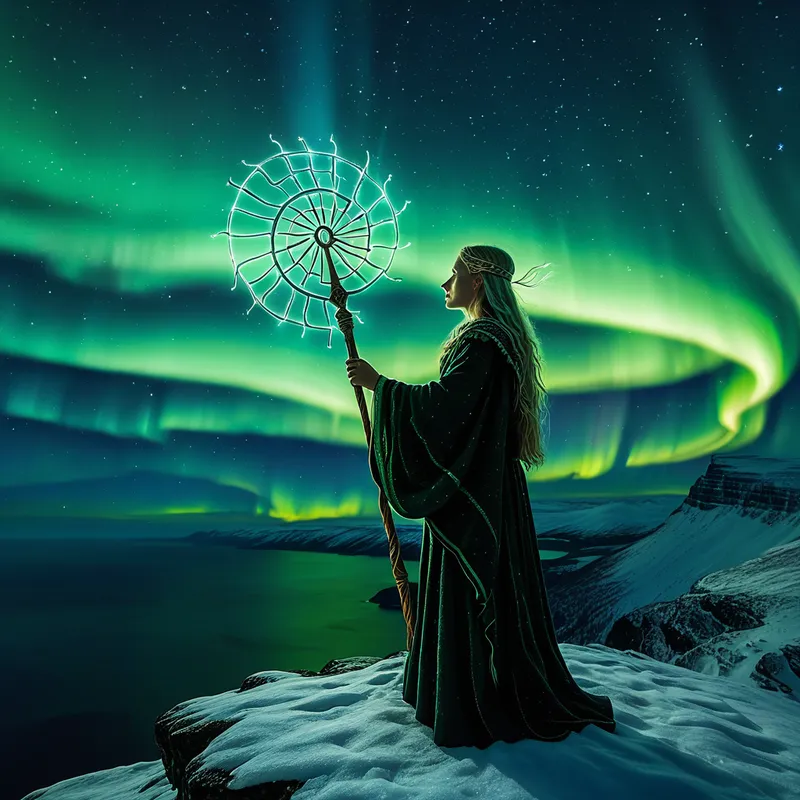
Listen. [The wind](/myths/the-wind “Myth from Various culture.”/) does not just blow; it carries whispers from the roots of the [Yggdrasil](/myths/yggdrasil “Myth from Global/Universal culture.”/). In the deep folds of time, before the [Ragnarök](/myths/ragnark “Myth from Norse culture.”/) was a prophecy carved in stone, there walked a figure cloaked not in shadow, but in the grey light between dusk and dawn. She was the [Völva](/myths/vlva “Myth from Norse culture.”/). Her feet knew the secret paths that run beneath the hills, and her eyes held the sheen of still, deep waters that reflect not [the sky](/myths/the-sky “Myth from Persian culture.”/), but the underbelly of [the world](/myths/the-world “Myth from Tarot culture.”/).
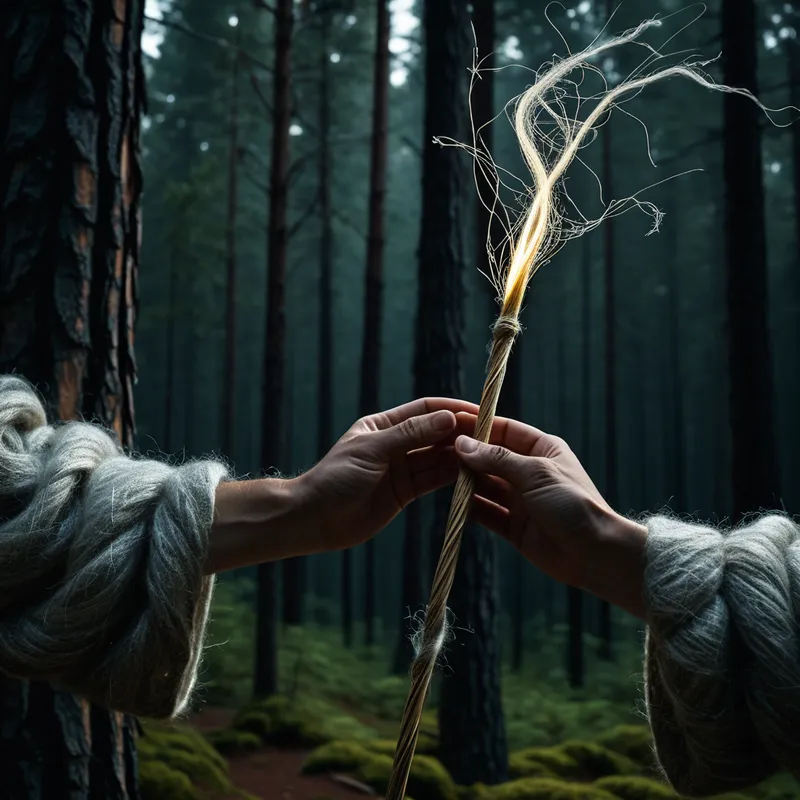
She carried her tools not in a sack, but in her soul: a simple staff of ashwood, worn smooth by a thousand journeys, and her Distaff. This was no mere tool for wool. From its bundled fibers, she drew the substance of reality itself. The air would grow thick and silent as she set her work. With a touch, the raw cloud of unspun fleece upon the distaff would shimmer with a light not of any fire. Her fingers, thin and strong as rootlets, would begin their dance.
She did not spin thread for cloaks. She spun the ørlög—the primal layers of fate. The thread that emerged from her spindle was luminous, a strand of moonbeam and memory. She would measure it out, her lips moving in a chant older than the names of the Æsir. For a newborn child in a smoky longhouse, she would spin a length, tying its end to a cradle-post. For a king dreaming of conquest, she would measure a longer, stronger cord, but her eyes would see the knot of betrayal woven halfway along its length.
The great conflict was not of clashing swords, but of seeing versus unknowing. The god Odin, in his ravenous hunger to stave off the doom he felt in his bones, sought her out. He found her at [the crossroads](/myths/the-crossroads “Myth from Celtic culture.”/) of nine worlds, her distaff a silent sentinel. He offered rings, he offered his own eye’s wisdom, but she demanded a price he had not considered: to be witnessed. To have her sacred, solitary work acknowledged by the one who hung from [the World Tree](/myths/the-world-tree “Myth from Celtic culture.”/) for [runes](/myths/runes “Myth from Norse culture.”/). He sat, the mighty Allfather, at the feet of the seeress, and she spun. She spun out the thread of his son Baldr’s life, showing its terrible, beautiful shortness. She spun the thick, twisted rope of the Fenrisúlfr’s binding, and the slender, fraying strand of its breaking. She showed him the great tapestry, woven from all her threads—a vast, interconnected web of glimmer and gloom, of love and venom, stretching from the roots of Yggdrasil to its highest, trembling leaf.
And then came the moment of resolution, the heart of her power. For some threads, she would let the spindle fall, and the thread would snap, its light vanishing—a life ended. For others, she would draw the thread to her lips and breathe upon it, and it would strengthen, its glow steadying—a fate affirmed. For Odin’s own thread, thick and complex as a mountain root, she did neither. She simply wove it into the greater pattern, showing him how it pulled against others, supported some, and strained against the doom-laden threads of Loki’s get. She offered no comfort, only the stark, sublime picture of the weave. The silence that followed was the resolution. It was the acceptance of the pattern. [The Völva](/myths/the-vlva “Myth from Norse culture.”/) gathered her unspun fleece, shouldered her distaff, and walked on, leaving Odin alone with the terrible, necessary beauty of the tapestry she had revealed.
Cultural Origins & Context
The figure of the Völva was not merely mythological but a historical reality in the Norse world. These were women of immense social and spiritual power who operated outside the conventional structures of family and tribe. They were itinerant seeresses, called upon in times of crisis, famine, or pivotal decision. Their practice, known as seidr, was a form of magic deeply intertwined with fate, destiny, and the manipulation of the invisible threads of reality.
The mythic motif of the distaff and spinning is one of the most ancient and pervasive in Indo-European culture. In the Norse context, it was concretely linked to the [Norns](/myths/norns “Myth from Nordic culture.”/)—Urðr, Verðandi, and [Skuld](/myths/skuld “Myth from Norse culture.”/)—who dwell by the Well of Urðr at the base of Yggdrasil and [water](/myths/water “Myth from Chinese culture.”/) the tree while shaping destinies. The human Völva was seen as an earthly embodiment of this principle, a mediator who could access [the Norns](/myths/the-norns “Myth from Norse culture.”/)’ domain. The myth was passed down not as a single, codified story, but as fragments in poetry (like the Völuspá, the Prophecy of the Seeress), sagas, and archaeological finds of ritual staffs often interpreted as ceremonial distaffs. Its societal function was dual: it was a tool for explaining the inscrutable mechanics of fate, and a narrative that validated the terrifying, necessary power of the feminine seer in a warrior society.
Symbolic Architecture
At its core, the myth presents a symbolic [architecture](/symbols/architecture “Symbol: Architecture in dreams often signifies structure, stability, and the framing of personal identity or life’s journey.”/) where the Völva represents [Consciousness](/symbols/consciousness “Symbol: Consciousness represents the state of awareness and perception, encompassing thoughts, feelings, and experiences.”/) in [relationship](/symbols/relationship “Symbol: A representation of connections we have with others in our lives, often reflecting our emotional state.”/) to the Unconscious. She is the part of the [psyche](/myths/psyche “Myth from Greek culture.”/) that can [journey](/symbols/journey “Symbol: A journey in dreams typically signifies adventure, growth, or a significant life transition.”/) into the chaotic, raw [material](/symbols/material “Symbol: Material signifies the tangible aspects of life, often representing physical resources, desires, and the physical world’s influence on our existence.”/) of potential (the unspun fleece) and through a disciplined, ritualized process (spinning), bring forth a coherent thread of [destiny](/symbols/destiny “Symbol: A predetermined course of events or ultimate purpose, often linked to spiritual forces or cosmic order, representing life’s inherent direction.”/).
The Distaff is the Axis Mundi of the personal psyche—the fixed center around which the chaos of potential is organized, the spine from which creative and fateful energy is drawn.
The fleece is the undifferentiated [prima materia](/myths/prima-materia “Myth from Alchemical culture.”/) of [life](/symbols/life “Symbol: The symbol of ‘Life’ represents a journey of growth, interconnectedness, and existential meaning, encompassing both the joys and challenges that define human experience.”/)—our instincts, inherited patterns (ørlög), and unprocessed experiences. The [spindle](/symbols/spindle “Symbol: A spindle is a tool used for spinning thread, symbolizing creativity, the act of weaving, and the intertwining of life’s stories.”/) is the active principle of [differentiation](/symbols/differentiation “Symbol: The process of distinguishing or separating parts of the self, emotions, or identity from a whole, often marking a developmental or psychological milestone.”/), the focused [attention](/symbols/attention “Symbol: Attention in dreams signifies focus, awareness, and the priorities in one’s life, often indicating where the dreamer’s energy is invested.”/) that draws out a single, continuous narrative from the swarm of possibilities. The thread itself is the individuated [life](/symbols/life “Symbol: The symbol of ‘Life’ represents a journey of growth, interconnectedness, and existential meaning, encompassing both the joys and challenges that define human experience.”/)-line, the unique [path](/symbols/path “Symbol: The ‘path’ symbolizes a journey, choices, and the direction one’s life is taking, often representing individual growth and exploration.”/) of a person or an [event](/symbols/event “Symbol: An event within dreams often signifies significant life changes, transitions, or emotional milestones.”/), connected to but distinct from the whole. The Völva’s act of measuring, cutting, or breathing on the thread symbolizes the moments of existential [choice](/symbols/choice “Symbol: The concept of choice often embodies decision-making, freedom, and the multitude of paths available in life.”/), [crisis](/symbols/crisis “Symbol: A crisis symbolizes turmoil, urgent challenges, and the need for immediate resolution or change.”/), and transformation that define a [life](/symbols/life “Symbol: The symbol of ‘Life’ represents a journey of growth, interconnectedness, and existential meaning, encompassing both the joys and challenges that define human experience.”/)’s [course](/symbols/course “Symbol: A course represents direction, journey, or progression in life, often choosing paths to follow.”/). She does not create [fate](/symbols/fate “Symbol: Fate represents the belief in predetermined outcomes, suggesting that some aspects of life are beyond human control.”/) from nothing; she reveals and works with the material already present in the cosmic [wool](/symbols/wool “Symbol: A natural fiber representing warmth, protection, and connection to tradition. Often symbolizes comfort, labor, or spiritual purity.”/).
The Dreamer’s Resonance
When this mythic pattern stirs in the modern dreamer, it often signals a profound engagement with personal destiny and life direction. Dreaming of spinning, of tangled or broken threads, or of an ancient, wise woman with a staff, points to a somatic and psychological process of re-evaluating one’s life narrative.
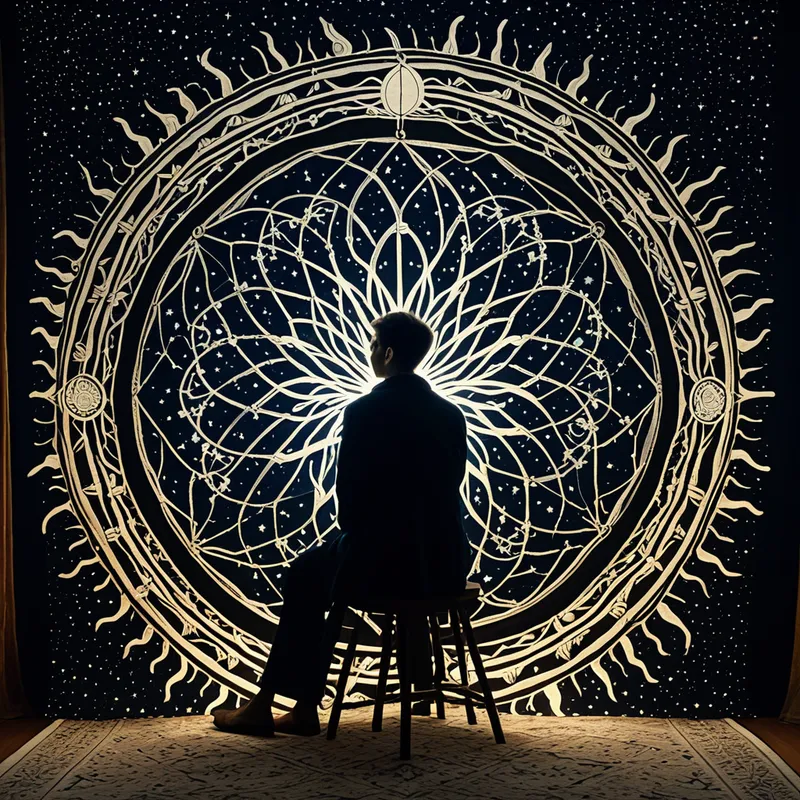
The body may feel the tension of being “on the spindle”—pulled taut, stretched in a new direction. Psychologically, it is [the ego](/myths/the-ego “Myth from Jungian culture.”/) sitting before the Völva of the deeper Self. Dreams of tangled yarn suggest a perceived loss of agency, a feeling that one’s fate is knotted and confused. Dreams of cutting a thread can feel terrifying, echoing a fear of death or abrupt ending, but in the myth’s logic, they may symbolize the necessary end of an outworn identity, relationship, or life phase to make way for a new weave. To dream of successfully spinning a strong, golden thread is to experience, somatically, the integration of purpose—the feeling of one’s actions and essence aligning into a coherent strand.
Alchemical Translation
The journey of the Völva models the alchemical process of psychic transmutation, or individuation, with stark clarity. The [nigredo](/myths/nigredo “Myth from Alchemical culture.”/), or blackening, is represented by the raw, chaotic fleece—the unexamined life, [the shadow](/myths/the-shadow “Myth from Jungian culture.”/) material, the inherited traumas and potentials we carry. The Völva does not flee this darkness; she gathers it onto her distaff, acknowledging it as her primary material.
Individuation is not the spinning of a new thread from nothing, but the courageous drawing out of the unique pattern already latent within the inherited wool.
The albedo, or whitening, is the spinning itself—the rigorous, patient work of self-reflection, therapy, and creative expression that draws a coherent sense of self from the chaos. The spindle’s turning is the cycle of analysis and synthesis. The [rubedo](/myths/rubedo “Myth from Alchemical culture.”/), or reddening, is the moment of conscious engagement with the thread: the “measuring” where one assesses one’s life, the “breathing upon it” where one invests it with conscious spirit and intention, and even the “cutting” where one actively lets go of what no longer serves the greater tapestry of [the Self](/myths/the-self “Myth from Jungian culture.”/).
For the modern individual, the myth instructs us to find our inner Völva—that faculty of inner vision and grounded craft. It asks us to identify our distaff: the central values, practices, or truths that provide a stable axis for our transformation. It then demands we engage in the sacred, mundane work of spinning: patiently drawing out the thread of our authentic life from the raw material of our experiences, not as passive victims of fate, but as active, conscious co-weavers at the loom of our own becoming. The ultimate goal is not to control the tapestry, but to understand our thread’s place within it, and to weave it with as much integrity, courage, and beauty as the material allows.
Associated Symbols
Explore related symbols from the CaleaDream lexicon: