Völva Myth Meaning & Symbolism
A seeress journeys beyond life's veil, confronting cosmic truths to weave destiny's pattern, embodying the terrifying grace of seeing what must be.
The Tale of Völva
Hear now a tale not of thunder, but of silence. Not of the clash of steel, but of the whisper in the dark between worlds. In a time when the breath of the giant Ymir still chilled the roots of the great Yggdrasil, there lived a woman apart. She was not called by the names of mothers or warriors. She was Völva.
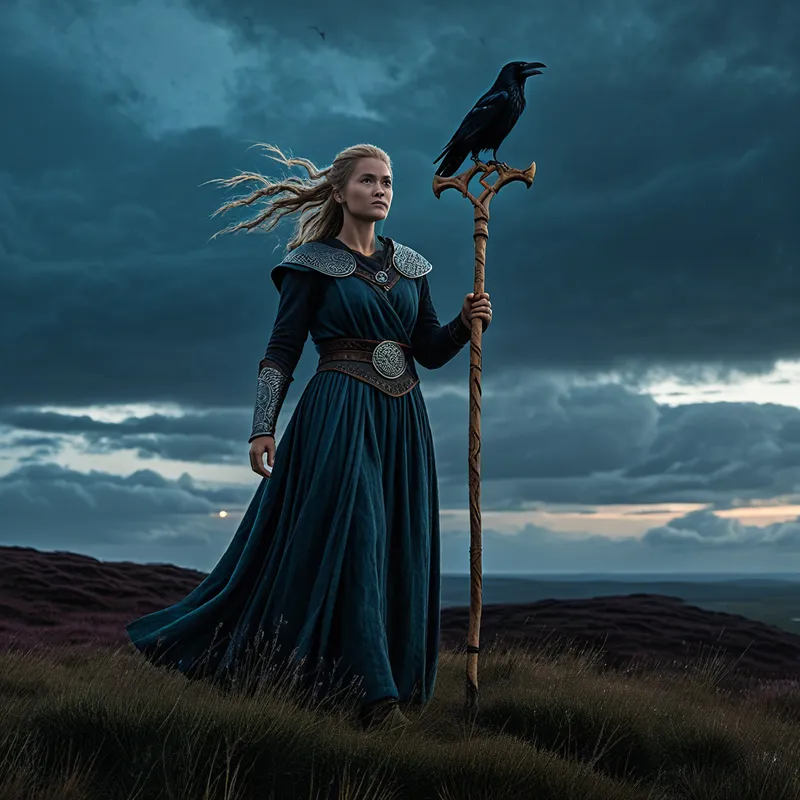
Her dwelling was not in the high halls, but at the edge of the settlement, where the cultivated land frayed into the wild heath. The air around her turf-roofed hut tasted of iron, damp earth, and the smoke of strange herbs. Men did not look upon her directly; they saw her staff first—a gnarled length of ash, carved with secrets that writhed under one’s gaze.
One evening, as the sun drowned in a sea of blood-red clouds, a chieftain, his heart heavy with portents of famine and feud, came to her threshold. He brought offerings: a silver arm-ring, a loaf of dark bread, a flagon of mead. He did not speak his fear. He did not need to. The Völva took the mead, her eyes like chips of flint in the firelight. She drew her cloak of black feathers close.
She did not peer into a pool or cast simple lots. She embarked. Seating herself upon the seiðhjallr, she entered a trance so profound the very air grew thick and still. Her spirit loosened its moorings. The fire dimmed. She chanted, a low, guttural song that seemed not to come from her throat but from the stones beneath the earth. She called to the fylgjur, to the shadows that cling to bloodlines. She journeyed down, past the roots of the great Tree, where the serpent Níðhöggr gnaws eternally.
In that sunless place, she saw the threads. Not of past or present, but of what is becoming. She saw the chieftain’s son, fallen on a foreign shore. She saw the alliance forged with a rival’s daughter, a fragile peace blooming from a field of old grief. She saw the long winter, and the seed saved that would break it. The visions were not kind; they were true. They were a tapestry woven with threads of joy and gutting loss, inseparable. Her voice, when it returned to the hut, was ragged, as if scraped from the gravel of the river of the dead, Gjöll. She spoke the pattern she had witnessed, a fatalistic poetry of doom and hope intertwined. The chieftain listened, his face ashen. He had asked for certainty and received the terrible, beautiful complexity of fate. He left the silver, the bread, the mead. He left a part of his simple hope there on the earthen floor. The Völva, spent and hollowed, stared into the embers, holding a truth too vast for any single life to bear.
Cultural Origins & Context
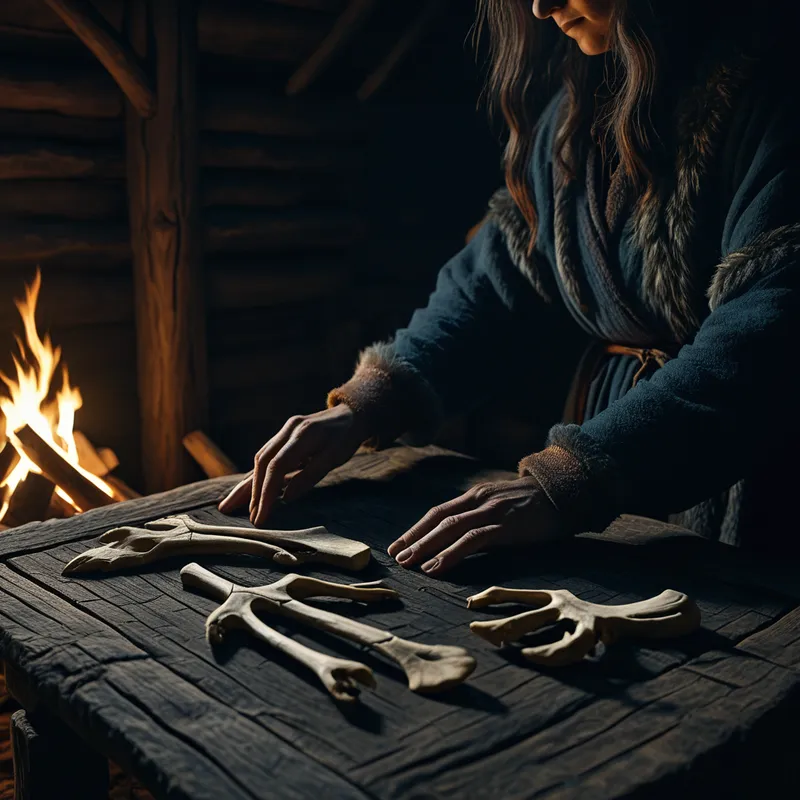
The figure of the Völva is not merely a character from myth, but a documented social and spiritual reality in the Norse world. Primarily attested in the Icelandic sagas (like the Eiríks saga rauða) and most spectacularly in the poem Völuspá, these women were itinerant seeresses who practiced seiðr. This was a complex form of sorcery that involved entering an ecstatic trance to perceive the web of ørlög (fate) and sometimes to reshape it.
Their role was paradoxical, embodying both reverence and fear. They were sought after by kings and commoners for prophecy and counsel, yet their power was considered somewhat ergi (unmanly, taboo), blurring rigid gender norms. A Völva traveled with an entourage, was hosted with high honor, and her pronouncements could dictate the actions of entire communities. Her power did not come from the pantheon of the Æsir alone, but from older, chthonic forces—from the land, the dead, and the Norns who water the roots of Yggdrasil. She was a living conduit between the ordered world of men and the chaotic, raw forces of creation and dissolution that surround it.
Symbolic Architecture
The Völva is the archetype of the Knower, the one who sees the pattern hidden within the chaos of events. Her journey is not a physical quest, but a descent into the underworld of the unconscious—the Hel within. Her staff is not a weapon but a tool of focus, a axis mundi connecting the personal psyche to the collective and cosmic layers of reality.
To seek the Völva’s truth is to willingly gaze into the abyss of complexity, where easy answers dissolve into the interwoven threads of cause, consequence, and paradox.
Her trance state symbolizes the suspension of the ego’s rational control, allowing the deeper, intuitive Self to speak. The visions she retrieves are rarely comforting; they are the unvarnished truth of a situation, containing both its inevitable sorrows and its hidden possibilities. She represents the psychological function of intuition in its most raw and terrifying form—not as a vague feeling, but as a direct perception of the underlying dynamics of life and relationship. She is shadow-work incarnate, for to consult her is to confront what one has avoided, the fate one has woven through unconscious action.
The Dreamer’s Resonance
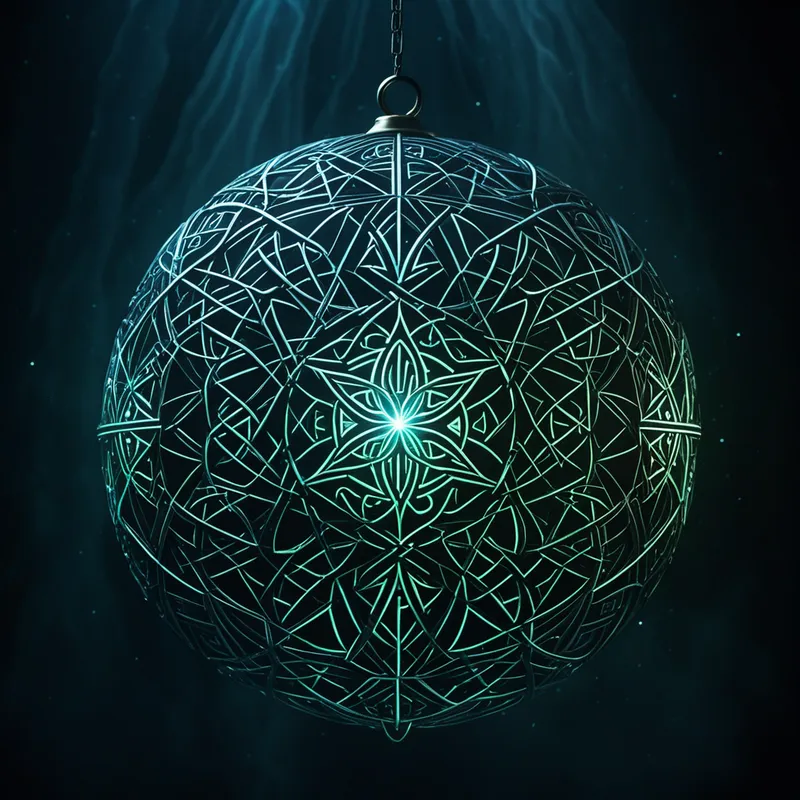
When the pattern of the Völva stirs in modern dreams, it signals a profound shift in the dreamer’s relationship to knowledge and personal destiny. One might dream of an ancient, knowing woman who offers a cryptic object (a stone, a key, a tangled cord). One might find oneself in a vast, dark library where the books are written in an unknown but intuitively understood language, or standing at a crossroads where every path is visible in its entirety—both its beauties and its tragedies.
Somatically, this process can feel like a draining of vitality, a “hollowing out,” as the old, ego-centric certainties are dissolved to make room for a more complex, systemic understanding. It is the psyche’s initiation into bearing the weight of awareness. The dreamer is not being given an answer, but being taught how to see. The anxiety or awe in such dreams points to the ego’s resistance to this deeper, often less controllable, form of knowing. The psychological process is one of surrendering the illusion of simple agency to understand one’s true position within a larger, living pattern.
Alchemical Translation
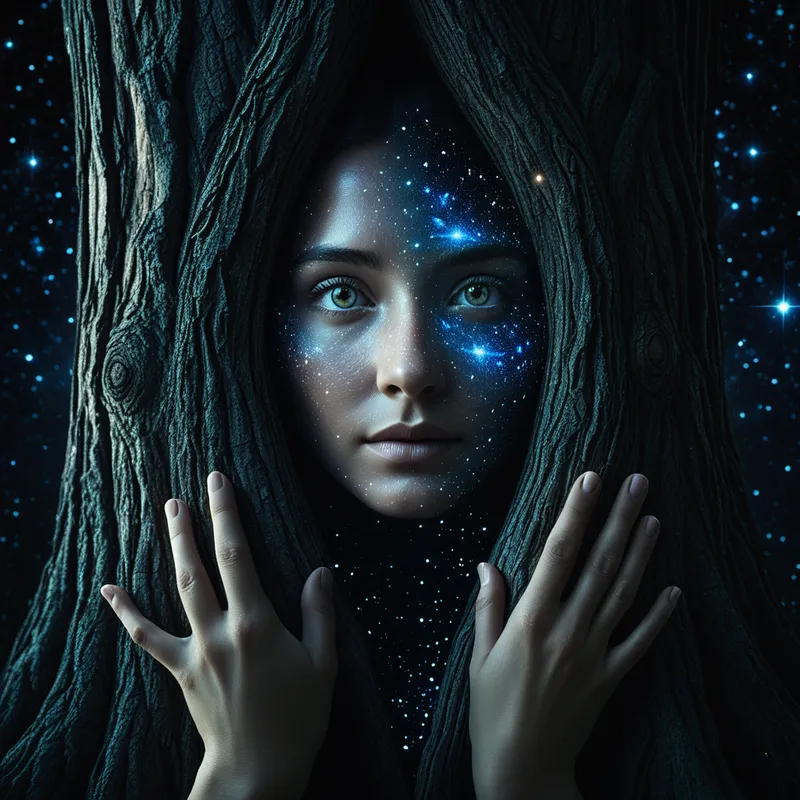
The alchemical journey modeled by the Völva is the opus of insight. It begins with the nigredo—the darkening, the descent into the trance, the confrontation with the shadowy roots of one’s own life and the collective unconscious. This is the dissolution of naive consciousness.
The core operation is separatio and coniunctio witnessed simultaneously. The Völva separates from her ordinary self to unite with the fabric of fate. She discerns the individual threads (the specific events, choices, personalities) while seeing their inseparable weaving into a whole. For the modern individual, this translates to the arduous work of withdrawing projections, seeing the hidden dynamics in one’s relationships and life path, and accepting the paradoxical unity of opposites—that joy and loss, creation and destruction, are part of a single process.
The ultimate transmutation is not the changing of fate, but the changing of one’s consciousness in relation to it. The leaden burden of fatalism is alchemized into the gold of conscious participation.
The Völva does not fight her vision; she becomes its vessel and its speaker. The individuation process here is the development of this capacity: to hold the tension of life’s contradictions without fleeing into simplification, to speak the difficult truth one sees, and to find a stance of grounded wisdom within the great, turning wheel of ørlög. One becomes, in a sense, the Völva of one’s own soul, able to consult the depths and return with a clarity that, while it may not ease the path, allows one to walk it with eyes wide open.
Associated Symbols
Explore related symbols from the CaleaDream lexicon: