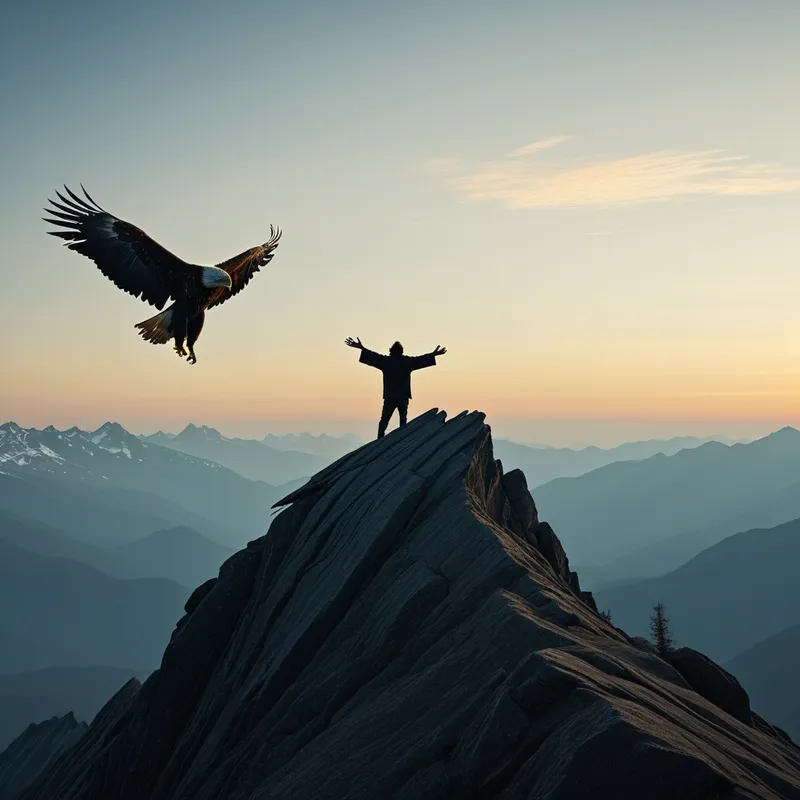
Vision Quest Myth Meaning & Symbolism
A sacred rite of passage where an individual seeks a guiding vision through fasting and solitude in the wilderness, forging a covenant with the spirit world.
The Tale of Vision Quest
Listen. [The world](/myths/the-world “Myth from Tarot culture.”/) is not as it seems. It is a shimmering hide stretched between the world of the seen and the world of the unseen. To know your place upon it, you must go to the edge, to the place where the stitching shows. You must go alone.
The time comes for the young one. The elders have spoken. The heart is restless, a bird beating against the ribs. The village, with its warm fires and familiar voices, becomes a cage. The call is not from the chief or [the shaman](/myths/the-shaman “Myth from Siberian culture.”/), but from the land itself—a whisper in [the wind](/myths/the-wind “Myth from Various culture.”/) through the pines, a pull from the distant, purple mountains. With prayers and purification in the sweat lodge, the body is stripped of the village’s smoke. The mind is scoured with song. They are given nothing but a blanket, perhaps a pipe.
They walk. They walk until the laughter of children is swallowed by the cry of the hawk. They walk until the paths made by men disappear, and only the trails of deer and the courses of streams remain. They find a place of power—a high butte, a deep canyon, a circle of ancient stones. Here, they make their prayer seat. They fast. They thirst.
The first night is fear. The wind has teeth. Every rustle in the brush is a monster. The stars are cold, indifferent eyes. The body wails for food, for [water](/myths/water “Myth from Chinese culture.”/), for home. This is the first death: the death of comfort. The second day is emptiness, a hollow gourd where the stomach was. The mind unravels like old rope. Memories flash—a mother’s face, a childhood mistake, a forgotten promise. The boundary between inside and outside begins to dissolve.
Then, in the profound silence of the third night, when weakness has made the soul porous, it happens. The world speaks. It may come as a visitation: Wanáǧi, the spirit of the grandfathers, standing solemn and radiant. It may be Nagila, the animal helper—the piercing gaze of the eagle, the patient strength of the bear, the cleverness of the coyote. It may be a song, heard on the wind, that the seeker must memorize and carry back, a song that did not exist before. It may be a symbol—a flashing shield, a winding river, a tree struck by lightning.
The vision is not a gentle dream. It is a storm that reshapes the landscape of the soul. It shows the seeker their true name, their path, their purpose. It forges a covenant. In return for this power, this knowing, there is a responsibility. A duty to the people, to the land, to the vision itself. As the first pink light of the fourth dawn touches the tears on their cheeks, the quest is complete. They are no longer who they were. They are hollowed out and filled with something vast. Stumbling, reborn, they turn their face toward home, carrying a gift that is not for them alone, but for the life of all.
Cultural Origins & Context
[The Vision Quest](/myths/the-vision-quest “Myth from Native American culture.”/), known by many names among the diverse Indigenous Nations—[Hanbleceya](/myths/hanbleceya “Myth from Lakota culture.”/) in Lakota, Taawhaki in some traditions—is not merely a story but a lived, foundational rite of passage. Its origins are as deep as the relationship between the people and the land. It was not a universal experience for all, but a solemn undertaking for those called to it: often young people on the cusp of adulthood, or individuals seeking guidance during a crisis, or those preparing for roles as healers or leaders.
The myth was not contained in a single text but was woven into the oral tradition, taught through preparation by elders and medicine people. Its societal function was vital. It served as a direct line of communication with the spiritual realm, ensuring the community’s actions were aligned with greater cosmic forces. The vision received would dictate the seeker’s role—it might reveal a talent for healing, instruct them in a new ceremony, or guide a hunting strategy. The quest validated individual experience while binding that individual more tightly to the collective whole; the vision was personal, but its fruits were communal. It was the process through which the abstract, timeless world of myth made direct, actionable contact with the immediate needs of the people.
Symbolic Architecture
At its core, the [Vision Quest](/symbols/vision-quest “Symbol: A spiritual journey of self-discovery, often involving fasting and solitude, to seek guidance, purpose, or a vision from the divine or unconscious.”/) is a master [symbol](/symbols/symbol “Symbol: A symbol can represent an idea, concept, or belief, serving as a powerful tool for communication and understanding.”/) of the [psyche](/myths/psyche “Myth from Greek culture.”/)’s [journey](/symbols/journey “Symbol: A journey in dreams typically signifies adventure, growth, or a significant life transition.”/) toward wholeness. The solitary [seeker](/symbols/seeker “Symbol: A person actively searching for meaning, truth, or a higher purpose, often representing the dreamer’s own quest for identity or fulfillment.”/) represents the conscious ego, venturing beyond the known world of the [persona](/symbols/persona “Symbol: The social mask or outward identity one presents to the world, often concealing the true self.”/) (the [village](/symbols/village “Symbol: Symbolizes community, connection, and a reflection of one’s roots or origins.”/)) into the untamed [wilderness](/symbols/wilderness “Symbol: Wilderness often symbolizes the untamed aspects of the self and the unconscious mind, representing a space for personal exploration and discovery.”/) of the unconscious.
The wilderness is not outside of us. It is the unmapped territory of the soul, where the raw archetypes dwell in their pure, non-human form.
The fasting and exposure are a deliberate dismantling of [the ego](/myths/the-ego “Myth from Jungian culture.”/)’s defenses. By stripping away physical and social sustenance, the seeker forces [consciousness](/symbols/consciousness “Symbol: Consciousness represents the state of awareness and perception, encompassing thoughts, feelings, and experiences.”/) to relinquish control, creating the necessary vacuum for contents of the unconscious to erupt. The Nagila or [spirit guide](/symbols/spirit-guide “Symbol: A spirit guide is an ethereal being believed to provide wisdom, guidance, and support along one’s life journey.”/) that appears is the embodiment of a powerful [archetype](/symbols/archetype “Symbol: A universal, primordial pattern or prototype in the collective unconscious that shapes human experience, behavior, and creative expression.”/)—[the Self](/myths/the-self “Myth from Jungian culture.”/), the guiding central principle of the psyche, often appearing in a form [the ego](/myths/the-ego “Myth from Jungian culture.”/) can relate to and comprehend. [The covenant](/symbols/the-covenant “Symbol: A sacred, binding agreement between parties, often with divine or societal significance, representing commitment, obligation, and mutual responsibility.”/) established is the crucial [agreement](/symbols/agreement “Symbol: A harmonious arrangement in artistic collaboration, symbolizing unity, shared vision, and creative consensus.”/) between [the ego](/myths/the-ego “Myth from Jungian culture.”/) and [the Self](/myths/the-self “Myth from Jungian culture.”/): the conscious mind agrees to serve the deeper, transpersonal [purpose](/symbols/purpose “Symbol: Purpose signifies direction, meaning, and intention in life, often reflecting personal ambitions and core values.”/) revealed, integrating this numinous [energy](/symbols/energy “Symbol: Energy symbolizes vitality, motivation, and the drive that fuels actions and ambitions.”/) into daily [life](/symbols/life “Symbol: The symbol of ‘Life’ represents a journey of growth, interconnectedness, and existential meaning, encompassing both the joys and challenges that define human experience.”/).

The Dreamer’s Resonance
When this mythic pattern stirs in the modern dreamer, it often manifests as dreams of profound isolation or searching in vast, symbolic landscapes. You may dream of being lost in an endless forest, climbing a mountain that has no summit, or waiting alone in an empty train station. These are not nightmares of helplessness, but somatic maps of a Vision Quest process already underway in the psyche.
The body in the dream often feels weak, thirsty, or exposed, mirroring the ego’s feeling of being “starved” of its old identities, relationships, or coping mechanisms. The appearance of a specific, potent animal—a wolf, an owl, a stag—that feels numinous and significant is the modern emergence of the Nagila. This dream signals a critical juncture: the conscious personality is being called to endure a period of confusion and deprivation because a deeper reorganization of the psyche is at hand. The ego is being asked to stand its holy watch in the darkness, to stop doing and start receiving.

Alchemical Translation
For the modern individual, the Vision Quest models the alchemical stage of [Nigredo](/myths/nigredo “Myth from Alchemical culture.”/), the necessary dark night of the soul that precedes illumination. Our “village” is the constellation of our social identities, careers, and routines. The call to quest is the creeping sense of meaninglessness within that structure, a spiritual hunger.
The fast is the voluntary abstinence from the psychic food that no longer nourishes us: the endless scroll of distractions, the validation of the crowd, the comfort of old narratives.
We must find our “place of power”—a symbolic inner space of silence created through meditation, journaling, or therapy—and hold the vigil. The conflict with fear and weakness is the resistance of the ego, which rightly senses its own dissolution. The breakthrough vision is the spontaneous insight, the symbolic image, or the affective wave that brings a new, cohesive understanding of one’s life direction. It is the discovery of personal myth.
The final, and most neglected, part of the alchemy is the return. The modern quest is not complete until the vision is “brought back to the village”—translated into a changed attitude, a creative act, a mended relationship, or a commitment to a new path. The power of [the wilderness](/myths/the-wilderness “Myth from Biblical culture.”/) must be woven into the fabric of ordinary life. In this translation, the individual undergoes individuation: no longer just a member of the collective, but a unique, self-aware vessel of a meaning that transcends them, yet through which they find their most profound and grounded purpose.
Associated Symbols
Explore related symbols from the CaleaDream lexicon: