Vishnu's Cosmic Ocean Myth Meaning & Symbolism
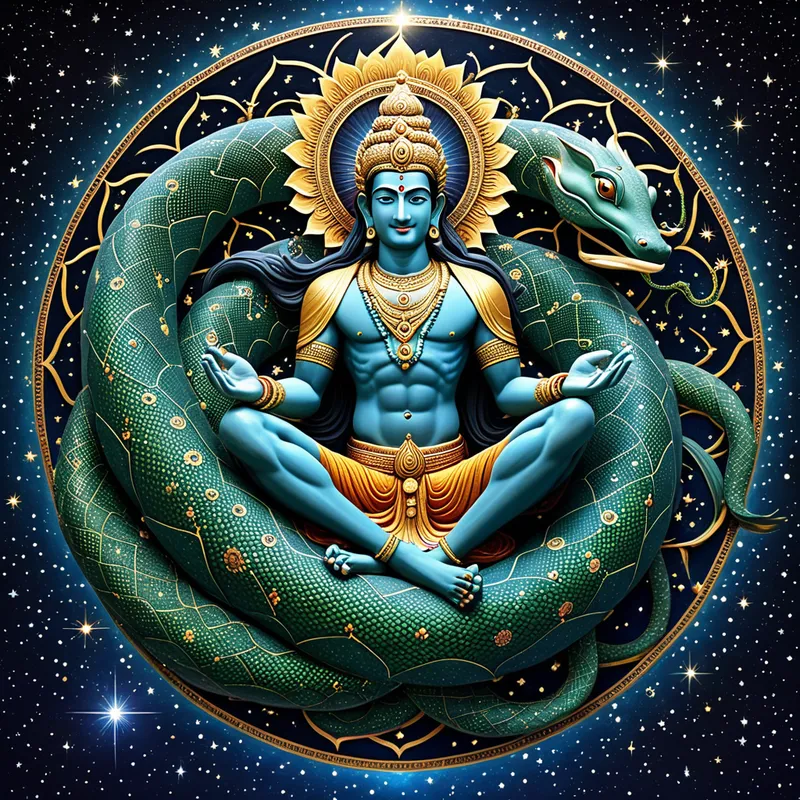
Vishnu sleeps on the serpent Ananta in the cosmic ocean, dreaming the universe into existence between cycles of creation and dissolution.
The Tale of Vishnu’s Cosmic Ocean
In the beginning, which is also the end, there is only the breath. A slow, tidal rhythm in the absolute dark. There is no up, no down, no here, no there. There is only the Cosmic Ocean, an expanse of potential so vast it holds both silence and the seed of every sound.
Upon this dark, placid infinity, a presence rests. It is Vishnu, the all-pervading. He reclines in yoga nidra, the sleep of conscious meditation. His bed is the great serpent Ananta Shesha, whose thousand hoods fan out like a celestial canopy, each hood holding a universe in its gaze. Ananta floats, a coil of infinite time, upon the waters. The only light is the soft, blue radiance emanating from Vishnu’s form, a twilight that defines the curve of his shoulder, the serenity of his sleeping face.
This is the night between the days of the cosmos. The last universe has been inhaled, dissolved back into the essence of the god. The next has not yet been exhaled. All that was, and all that will be, rests as a dream in the mind of the sleeper.
Then, a stirring. A vibration in the depths of that divine dream. From the navel of Vishnu, a light gathers, a concentration of creative will. It grows, pushing upward through the dark waters. A stem, radiant and pure, rises from his being. It breaks the surface of the cosmic ocean, and at its apex, it unfolds. A lotus blossom, resplendent, its petals layers of reality unfolding. Upon this lotus sits Brahma, the four-faced, born from the dream of Vishnu. He opens his eyes. He looks upon the void, the ocean, the sleeping god, and the lotus from which he came. His task is clear, yet it is a task given by the dreamer.
And so Brahma begins. From his mind, he spins the threads of the Maya. He populates the lotus with worlds, with skies, with mountains and rivers. He breathes life into forms, sets the wheel of Dharma in motion. The dream becomes substantial. The cosmic ocean now cradles not just the sleeper and his serpent, but a glittering, turning, breathing universe, singing with life and struggle and love.
For an acon, this creation flourishes. But the breath of the cosmos is cyclic. As the great cycle, the Kalpa, draws to its close, a change comes over the dream. Brahma’s work completes its arc. The lotus begins to gently close. Worlds fold in upon themselves. Stars dim. All the myriad forms, all the stories and sorrows and triumphs, are gently drawn back, like a story being read backward, into the stem of the lotus, then down, down into the navel of the sleeping Vishnu. The light is reabsorbed. The ocean grows dark once more, holding only the sleeper and the serpent. The exhalation is complete. The inhalation begins—a long, deep drawing-in of all that was manifested, back into the potential of the source. The dream ends, so that a new one may begin. The cosmic ocean is once again the womb of everything and nothing, waiting for the next turn of the breath.
Cultural Origins & Context
This profound cosmological vision is woven into the fabric of Puranic literature, particularly texts like the Vishnu Purana and the Bhagavata Purana. These texts are not dry histories but living tapestries of story, philosophy, and theology, composed and expanded over centuries, from the early centuries of the Common Era onward. They were transmitted orally by sages and storytellers, recited in temple courtyards and royal courts, making the cosmic scale of time and divinity accessible to the human imagination.
The myth served a crucial societal and psychological function. In a culture deeply attuned to cycles—the cycle of days and seasons, of life, death, and rebirth (Samsara)—this story provided the ultimate context. It placed human life within a drama of unimaginable grandeur, not to diminish it, but to frame it. It answered the existential dread of impermanence by showing dissolution not as an end, but as a necessary phase in an eternal rhythm of rest and creation, presided over by a conscious, benevolent presence. Vishnu is not absent; he is dreaming. The universe is his conscious artifact, and its dissolution is a return to his being for renewal.
Symbolic Architecture
The myth is a masterclass in symbolic thought, mapping the architecture of reality itself onto a resonant image.
The Cosmic Ocean is the unconscious, the unmanifest potential from which all forms arise. It is the dark, fertile chaos that precedes and follows order.
The ocean is not empty; it is full of everything in its potential, unarticulated state. It is the psyche before the ego dawns.
Vishnu in yoga nidra represents pure, undifferentiated consciousness. He is the Self (Atman) in its deepest state, the witness that is not entangled in its own dream, yet from which the dream emanates. His sleep is not ignorance, but a state of profound, creative receptivity.
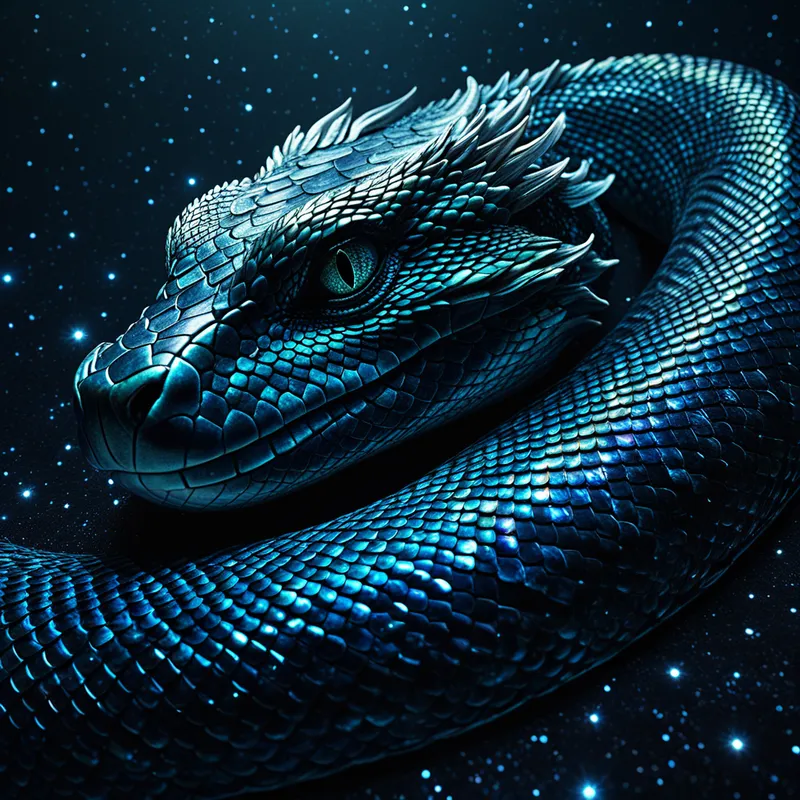
Ananta Shesha, the serpent, is a potent symbol of infinity, eternity, and the supportive ground of being. As the bed of Vishnu, it represents the foundation of time and space upon which consciousness rests. The serpent also symbolizes the latent, coiled energy (Kundalini) that, when awakened, rises to create and illuminate.
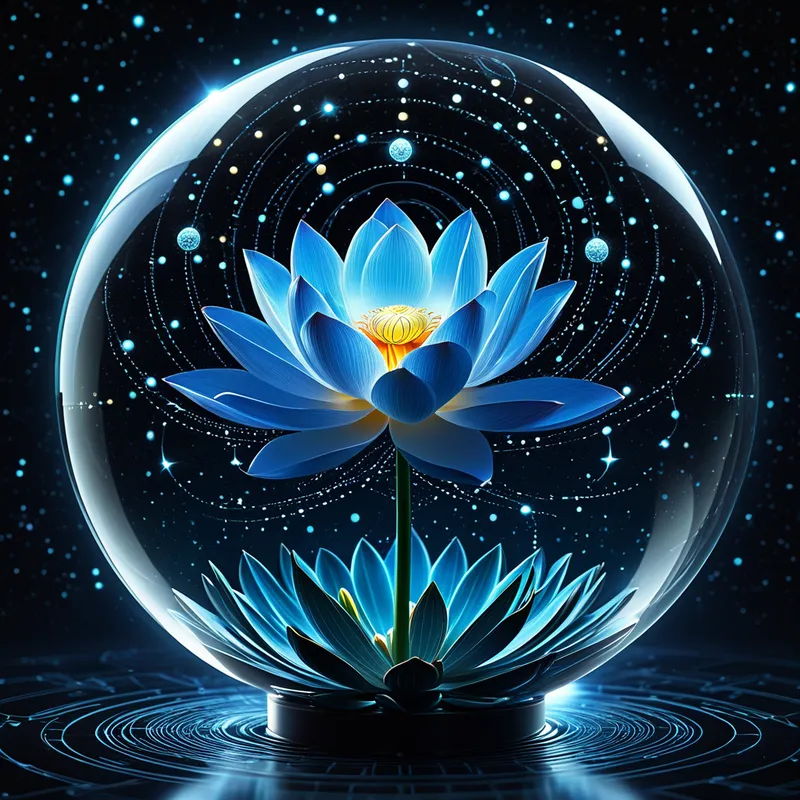
The Lotus rising from the navel is the birth of the manifest world from the center of being. The navel is the root, the source. The lotus, rooted in mud (the primordial waters), rising through water, and blooming in air, symbolizes the emergence of spirit from matter, of order from chaos, of the individual psyche (the created world) from the universal Self.
The Dreamer’s Resonance
When this mythic pattern stirs in the modern dreamer, it often signals a profound process of psychic reorganization. To dream of floating in a dark, starry ocean is to touch the Cosmic Ocean within—the feeling of being adrift in the potentials and anxieties of the unconscious before a new life phase.
Dreaming of a giant, benevolent serpent can point to an encounter with the deep, instinctual foundation of the psyche (the Ananta aspect), often offering support during a time of dissolution or transition. It is the psyche’s way of saying, “You are held by forces older and wiser than your conscious mind.”
A lotus blooming in a dream, especially from the body, is a classic symbol of individuation—the birth of a new, more authentic self from the murky waters of personal history and the unconscious. It signifies the emergence of clarity, beauty, and spiritual orientation from a period of inner turmoil or gestation. The somatic feeling is often one of deep, central unfolding—a release of tension followed by serene expansion.
Alchemical Translation
For the individual, the myth models the complete cycle of psychic transmutation, or individuation. Our personal “universes”—our identities, relationships, careers, belief systems—are not permanent. They are kalpas, cycles of creation that must eventually dissolve so that new growth can occur.
The phase of Vishnu sleeping on the ocean is the essential, often neglected stage of rest and incubation. Before a new creative act in our lives, we must often enter a period of withdrawal, of seeming inactivity. This is not depression or failure; it is the conscious return to the oceanic unconscious to gather potential. It is the artist staring at the blank page, the soul in meditation, the psyche after a great loss, gathering itself.
The dissolution of an old world is not annihilation; it is the alchemical solve—the breaking down of outworn forms so their essence can return to the source for reconstitution.
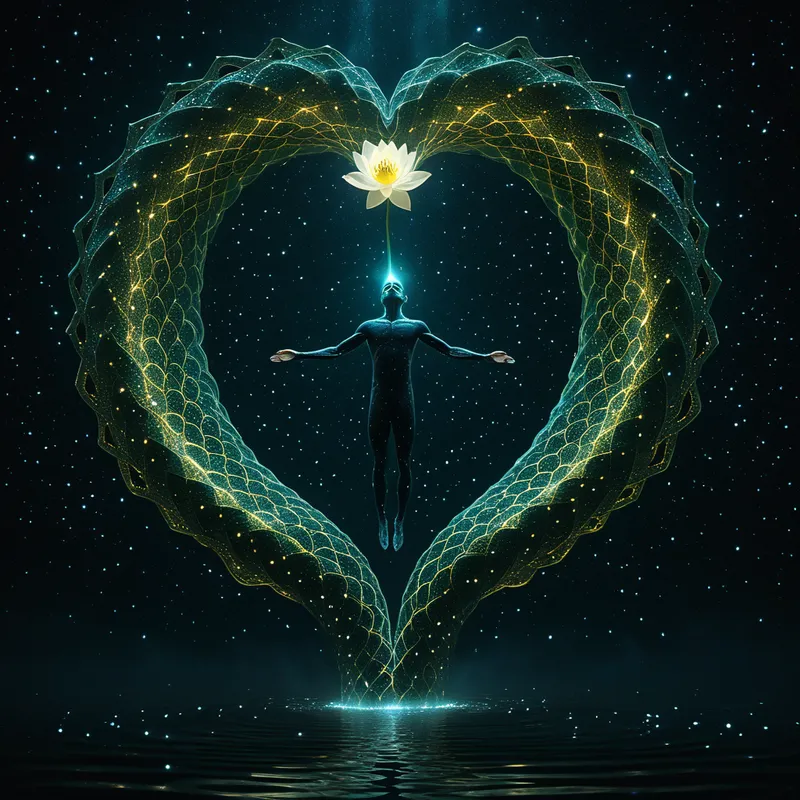
The rising of the Lotus is the coagula—the new form coalescing. This is the new idea, the healed perspective, the next chapter of life that emerges not from frantic effort alone, but from that deep, dream-like communion with the Self. Brahma, the creative mind, only gets to work once the lotus—the new possibility—has emerged from the depths.
Thus, the myth teaches that our deepest creativity and renewal are not acts of willful ego construction, but of ego surrender to the dreaming Self. We are both Brahma, the active creator of our personal world, and Vishnu, the deep, dreaming consciousness from which that world springs. To live this consciously is to participate in the cosmic dance, finding serenity in dissolution and sacred purpose in creation, forever cradled on the serpent of time in the ocean of all possibility.
Associated Symbols
Explore related symbols from the CaleaDream lexicon: