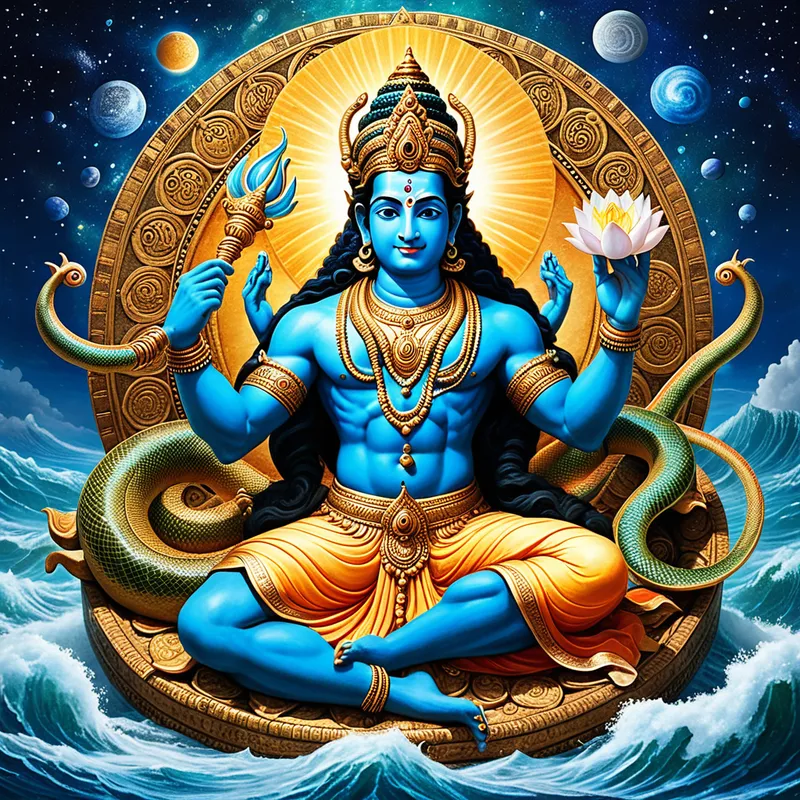
Vishnu's Avatars Myth Meaning & Symbolism
The story of the god Vishnu descending through ten forms to restore cosmic order, mapping humanity's spiritual and psychological evolution.
The Tale of Vishnu’s Avatars
Listen. Before time was counted, in the fathomless dark, the great serpent Ananta [Shesha](/myths/shesha “Myth from Hindu culture.”/) coils in the primordial waters. Upon his endless hoods rests [Vishnu](/myths/vishnu “Myth from Hindu culture.”/), the all-pervading essence, in yogic sleep. From his navel blooms a [lotus](/myths/lotus “Myth from Hindu culture.”/), and from [the lotus](/myths/the-lotus “Myth from Hindu culture.”/), creation stirs. But [the world](/myths/the-world “Myth from Tarot culture.”/) is a balance, a delicate dance between light and shadow, order and chaos. When [the shadow](/myths/the-shadow “Myth from Jungian culture.”/) grows too long, when the cosmic scales tip into tyranny or dissolution, the sleep of [Vishnu](/myths/vishnu “Myth from Hindu culture.”/) is broken. Not by a startle, but by a profound, compassionate resolve. He chooses to descend.
He descends not as a distant god, but into the very fabric of the struggle. First, as [Matsya](/myths/matsya “Myth from Hindu culture.”/), a gleaming fish in the rising flood, towing a boat carrying the seeds of all life and sacred wisdom to safety. Then as [Varaha](/myths/varaha “Myth from Hindu culture.”/), a colossal boar with tusks like crescent moons, roaring through [the abyss](/myths/the-abyss “Myth from Kabbalistic culture.”/) to lift the mud-smeared Earth goddess upon his snout, restoring her to her rightful place in the heavens.
When the demon Hiranyakashipu, armed with a boon of near-invincibility, declares himself god and tortures his own son for devotion to Vishnu, the descent takes a fierce form. From a pillar of the palace, Narasimha erupts—neither man nor beast, but both, a terrifying fusion of claw and fury. At twilight, neither day nor night, upon [the threshold](/myths/the-threshold “Myth from Folklore culture.”/), neither indoors nor out, he rends the tyrant, proving that divine law transcends all mortal loopholes.
The descent continues, each form a perfect response to a specific cosmic ailment. As the dwarf [Vamana](/myths/vamana “Myth from Hindu culture.”/), he humbles the generous yet overreaching demon-king Bali, measuring the heavens and [the earth](/myths/the-earth “Myth from Hindu culture.”/) in three strides. As Parashurama, the axe-wielding sage, his wrath is a purifying fire against the arrogance of power. Then, the archetype deepens: Rama, the righteous king, whose life is a epic poem of duty, love, and the battle against the dark lord Ravana. Followed by [Krishna](/myths/krishna “Myth from Hindu culture.”/), the divine diplomat and charioteer, who in the thunderous field of Kurukshetra whispers the eternal song of the soul to the warrior Arjuna.
And the tale whispers of a descent yet to come. When the age turns to iron and virtue sleeps, a final form shall arise: [Kalki](/myths/kalki “Myth from Hindu culture.”/), a warrior on a white horse, blazing with a sword that is both end and promise, to cleanse the world and begin the cycle anew. Each descent, a sigh of the cosmos; each avatar, a stitch in the torn fabric of Dharma.

Cultural Origins & Context
This grand narrative is not the work of a single author, but a living tapestry woven over millennia. Its threads are found in the ancient Vedas, but its full, vibrant pattern emerges in the Puranas, particularly the Bhagavata Purana. It was carried on the breath of traveling storytellers, the kathakars, and enacted in village plays and temple festivals. The function was never merely historical but deeply pedagogical and societal. It provided a divine template for kingship (Rama), for ethical action in impossible dilemmas (Krishna’s Gita), and for the understanding of time itself as cyclical, punctuated by divine interventions. It answered the perennial human question: “Where is the divine when evil prevails?” with a resounding, “Here, within the very struggle, in a form you can comprehend.”
Symbolic Architecture
The ten avatars are not a random [sequence](/symbols/sequence “Symbol: The symbol of ‘sequence’ often signifies the order of events and the progression towards a desired outcome or goal.”/) but a profound symbolic map of evolution, both cosmic and psychological. They [trace](/symbols/trace “Symbol: A faint remnant or subtle indication of something that was present, suggesting memory, evidence, or a path to follow.”/) a [path](/symbols/path “Symbol: The ‘path’ symbolizes a journey, choices, and the direction one’s life is taking, often representing individual growth and exploration.”/) from aquatic [life](/symbols/life “Symbol: The symbol of ‘Life’ represents a journey of growth, interconnectedness, and existential meaning, encompassing both the joys and challenges that define human experience.”/) (Matsya) to amphibious ([Kurma](/myths/kurma “Myth from Hindu culture.”/), the [tortoise](/symbols/tortoise “Symbol: Tortoises symbolize wisdom, longevity, and the importance of patience in achieving goals.”/)), to terrestrial mammal (Varaha), to the hybrid man-[beast](/symbols/beast “Symbol: The beast often represents primal instincts, fears, and the shadow self in dreams. It symbolizes the untamed aspects of one’s personality that may need acknowledgment or integration.”/) (Narasimha), to the full [human](/symbols/human “Symbol: The symbol of a human represents individuality, complexity of emotions, and social relationships.”/) form in its varied aspects: the cunning strategist (Vamana), the fierce purifier (Parashurama), the ethical ruler (Rama), the divine [lover](/symbols/lover “Symbol: A lover in dreams often represents intimacy, connection, and the emotional aspects of relationships.”/) and statesman (Krishna), the enlightened [teacher](/symbols/teacher “Symbol: The symbol of the teacher in dreams often represents guidance, wisdom, and the process of learning or self-discovery.”/) ([Buddha](/symbols/buddha “Symbol: The image of Buddha embodies spiritual enlightenment, peace, and a quest for inner truth.”/), considered an [avatar](/symbols/avatar “Symbol: The Avatar represents identity, self-expression, and the exploration of different aspects of the self.”/) in some traditions), and the future renewer (Kalki). This is the evolution of [consciousness](/symbols/consciousness “Symbol: Consciousness represents the state of awareness and perception, encompassing thoughts, feelings, and experiences.”/) itself.
The avatar is not a god playing dress-up; it is the divine principle fully incarnating into the limitations of a specific form to perform a necessary, redeeming function within those very limitations.
Vishnu, as the preserver, represents the sustaining consciousness of the [universe](/symbols/universe “Symbol: The universe symbolizes vastness, interconnectedness, and the mysteries of existence beyond the individual self.”/). His avatars symbolize that consciousness descending into the fragmented, conflicted realms of matter and [psyche](/myths/psyche “Myth from Greek culture.”/) to restore wholeness. Each [demon](/symbols/demon “Symbol: Demons often symbolize inner fears, repressed emotions, or negative aspects of oneself that the dreamer is struggling to confront.”/) represents a specific [imbalance](/symbols/imbalance “Symbol: A state of disharmony where opposing forces are unequal, often representing internal conflict or external instability.”/): Hiranyakashipu is the [inflation](/symbols/inflation “Symbol: A dream symbol representing feelings of diminishing value, loss of control, or expansion beyond sustainable limits in one’s life or psyche.”/) of [the ego](/myths/the-ego “Myth from Jungian culture.”/), Ravana is [the tyranny](/symbols/the-tyranny “Symbol: A symbol of oppressive control, unjust authority, and systemic domination that suppresses individual freedom and collective well-being.”/) of desire and intellect, the collective oppression faced by Parashurama is institutional corruption. The avatar is the precise “[medicine](/symbols/medicine “Symbol: Medicine symbolizes healing, transformation, and the pursuit of knowledge, addressing both physical and spiritual health.”/)” for that specific “[disease](/symbols/disease “Symbol: Disease represents turmoil, issues of control, or unresolved personal conflicts manifesting as physical or emotional suffering.”/)” of the [soul](/symbols/soul “Symbol: The soul represents the essence of a person, encompassing their spirit, identity, and connection to the universe.”/) or society.
The Dreamer’s Resonance
When this mythic pattern stirs in the modern dreamer, it often signals a profound process of “descent” for the sake of integration. You may dream of transforming to navigate a flood of emotion (Matsya), or of finding immense, grounded strength to lift a crushing burden (Varaha). A dream of a terrifying, hybrid figure (Narasimha) may point to the need to confront a “demon” of the psyche—a repressed rage or a rigid complex—in its own twilight realm, using its own rules against it.
The somatic experience can be one of immense pressure giving way to release, or of a fierce, protective energy mobilizing within. To dream of the avatars is to feel [the Self](/myths/the-self “Myth from Jungian culture.”/) (the inner Vishnu) orchestrating a rescue mission for parts of your own life or psyche that have been submerged, oppressed, or thrown into chaos. It is the unconscious affirming that healing requires us to meet the challenge in a form it understands, to become the hero, the teacher, or even the fierce protector that the situation demands.

Alchemical Translation
Psychic transmutation, or individuation, is the process of becoming whole by integrating the unconscious with the conscious mind. The myth of the avatars is a master blueprint for this alchemy. It teaches that the Self does not rescue us from our struggles, but through them, by descending into their very heart.
First, we must recognize the “demonic” imbalance—the overgrown ego, the paralyzing doubt, the toxic pattern. This is the call. The alchemical response is not to reject it with disgust, but to engage it with a consciousness (Vishnu) that is willing to take on an appropriate form. This is the “avatar-making” process within: to cultivate the disciplined ruler (Rama) when chaos reigns in our life, to summon the wise, unattached guide (Krishna/Buddha) when we are lost in the battlefield of conflicting desires, or to embrace the fierce, boundary-setting protector (Narasimha) when our integrity is violated.
The ultimate alchemical secret of the avatars is that the divine is not external to the transformation; it is the very principle of intelligent adaptation and compassionate engagement that allows transformation to occur.
The final avatar, Kalki, represents the culmination of this inner work: not a violent end, but the necessary dissolution of outworn psychic structures so that a new, more conscious order can be born. The cycle of avatars assures us that this descent and return is the eternal rhythm of growth. To walk the path of individuation is to become, in our own small, human way, an avatar of our own deepest, most preserving Self.
Associated Symbols
Explore related symbols from the CaleaDream lexicon: