Vishnu's Ananta Shesha Myth Meaning & Symbolism
The endless serpent upon whom the universe rests, embodying the foundation of time, consciousness, and the supportive ground of all being.
The Tale of Vishnu’s Ananta Shesha
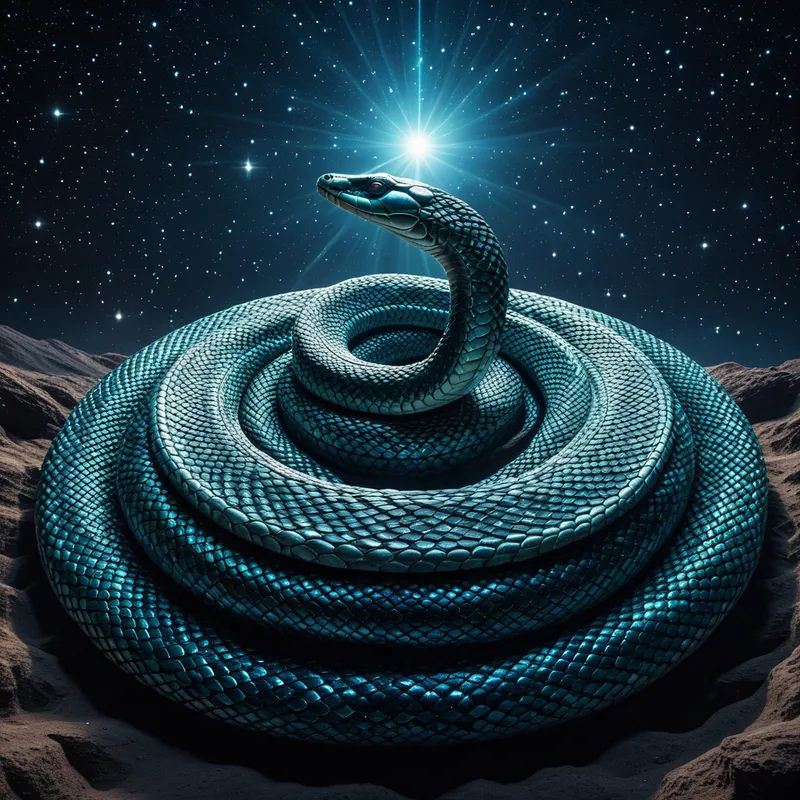
Before the first breath, before the first thought, there is the deep. Not a void, but a presence. A presence that coils in the fathomless, dark waters of Brahman. This is Ananta Shesha, whose name means “The Endless Remainder.” He is the first movement in the stillness, the first form in the formless.
Listen. Can you hear the susurrus of scales against the dark? He is unfathomably vast, his body a river of emerald and shadow, glimmering with the potential of all that is and ever will be. Upon his one thousand hoods rest the glittering dust of unborn worlds. He is alone, yet he is complete, for he is Time itself, coiled and waiting.
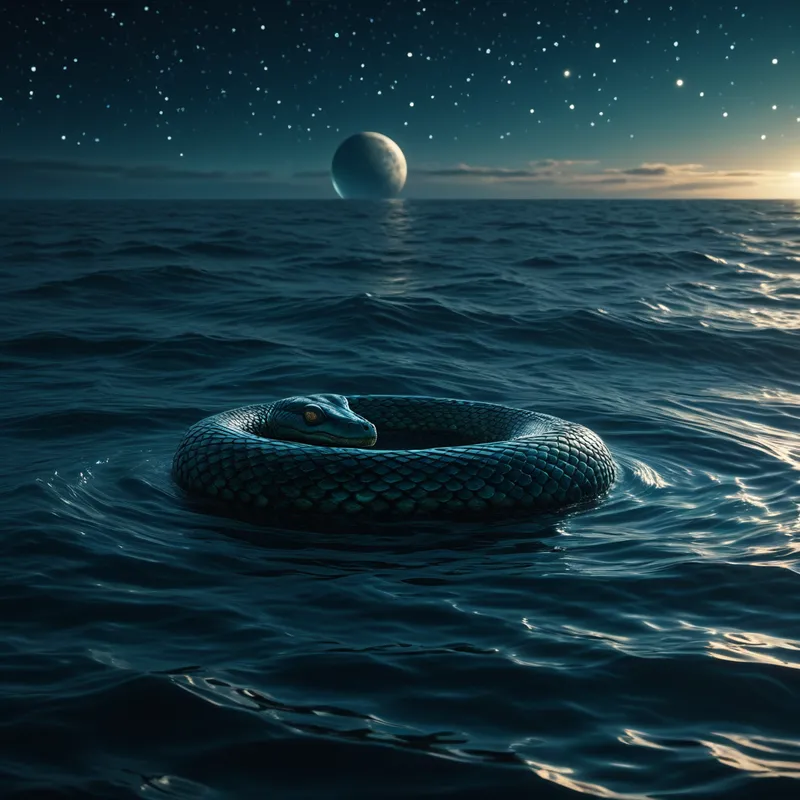
Then, a softening in the fabric of potential. A gentle luminescence descends upon the cosmic ocean, Kshirasagara. It is Vishnu, the all-pervading consciousness. He does not arrive; he simply is, as he always has been. He seeks not a throne, but a support. Not a chariot, but a resting place. His gaze finds the great serpent, and in that gaze is recognition, an eternal pact remembered.
Ananta Shesha, the endless one, stirs. With infinite care, he arranges his mighty coils into a bed—a floating island of living scales in the sea of causality. It is not a subjugation, but a sacred offering. Vishnu, the blue-hued god, reclines upon this living couch. He closes his eyes, and from his navel springs a lotus, and from that lotus, Brahma emerges to begin the work of manifestation. The universe blooms, a temporary dream in the god’s yogic sleep.
But the tale deepens. When the weight of a world becomes too great, when Bali claims dominion over all realms, or when the earth herself sinks into the waters of despair, it is Ananta Shesha who descends. He takes form as Kurma, the cosmic tortoise, his shell the unshakeable foundation for the churning of the ocean of milk. He becomes the mighty Lakshmana, the unwavering support to his brother in the epic Ramayana. He is the loyal Adishesha, fanning the lord with his hoods in eternal service.
And when the dream of the universe reaches its conclusion, when Brahma’s day ends and the great dissolution, Pralaya, begins, it is Ananta Shesha who remains. As fiery winds scald the heavens and the seas boil away, he opens his mouths. With a gentle, final breath, he consumes the flames of destruction itself. He is the remainder, the ground that survives the fire. He coils once more in the dark waters, supporting a sleeping Vishnu, waiting. Always waiting, for the next breath, the next dream, the next beginning. The cycle is eternal, and he is its silent, supportive spine.
Cultural Origins & Context
The myth of Ananta Shesha emerges from the vast, layered corpus of Vedic and Puranic literature. His earliest mentions can be traced to the Rigveda, where he is hinted at as the serpent of the deep, a symbol of the primordial waters. However, his full characterization as the supportive bed of Vishnu crystallizes in the Itihasas and the Puranas, particularly the Vishnu Purana and the Bhagavata Purana.
This myth was not merely a story for entertainment; it was a cosmological model and a theological anchor. Recited by traveling bards, kathakars, and temple priests, it served to explain the nature of reality itself. It answered profound questions: What does the universe rest upon? What exists before and after time? How can the divine be both active and at rest? Shesha provided the answer—the universe rests upon divine, conscious support. The myth reinforced a worldview where the cosmos is not a cold, mechanical void but a living, conscious entity sustained by a relationship between the preserver (Vishnu) and the foundation (Shesha). It taught devotees about the nature of seva (service) and adhara, illustrating that even the supreme divinity requires and honors a supportive base.
Symbolic Architecture
Ananta Shesha is not a monster but a matrix. He represents the fundamental, often unconscious, architecture upon which conscious experience is built.
He is the endless remainder, the ground of being that persists when all forms dissolve.
First, he is Time and Eternity. His name, “Endless,” and his thousand heads (a number denoting infinity) symbolize cyclical, unbounded time. He is not linear time but time as a coiled potential—past, present, and future existing simultaneously in a serpentine loop. He is the bed upon which the “dream” of temporal reality unfolds.
Second, he is the Supportive Unconscious. Vishnu, the conscious, preserving principle, can only enact his function because he rests upon Shesha. Psychologically, this mirrors how our conscious identity (the ego) is supported by the vast, archaic ground of the personal and collective unconscious. Our stability depends on a relationship with this deeper, often hidden, foundation.
Third, he is Devotion as Foundation. Shesha’s role is one of unwavering support. This symbolizes the truth that the highest form of strength is not dominance, but the capacity to hold, to sustain, to be the reliable ground. It is the archetype of the selfless caregiver on a cosmic scale, where service is not subservience but the essential activity that enables creation and preservation.
Finally, he is The Self-Regulating Whole. As the serpent who consumes the fires of destruction, Shesha represents the psyche’s or the cosmos’s innate homeostatic principle. The unconscious foundation has a self-regulating intelligence; it can absorb and neutralize the disintegrating forces (trauma, chaos, shadow) that threaten the conscious order.
The Dreamer’s Resonance
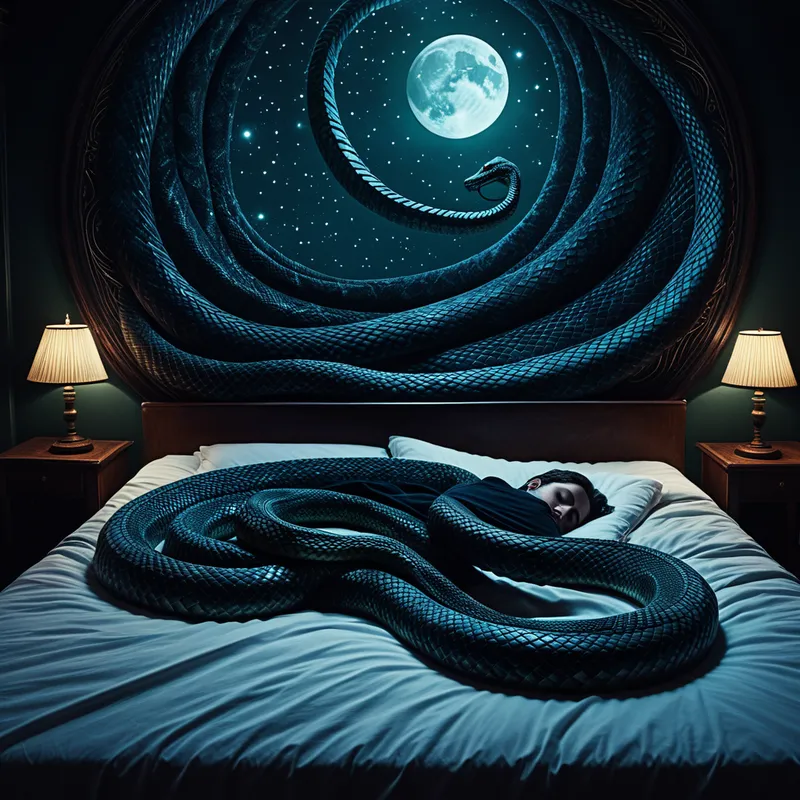
When the pattern of Ananta Shesha stirs in the modern psyche, it often manifests in dreams of profound support or its terrifying absence. One might dream of the earth being firm and reliable beneath their feet in a time of crisis, or conversely, of the ground liquefying, of beds dissolving into abysses. These are somatic communications from the foundational layer of the psyche.
A dream of a massive, benevolent serpent coiled peacefully in the basement of one’s childhood home speaks directly to encountering the supportive, ancient aspect of the personal unconscious. A dream of holding up a collapsing ceiling, feeling an immense strength rising from the spine, mirrors Shesha’s role as Kurma, the supportive base. This dream pattern indicates a process of psychic grounding. The individual is, often unconsciously, seeking or discovering the internal support system needed to bear the weight of their world—responsibilities, trauma, or transformation. It is the psyche building its own Mount Mandara upon the tortoise of inner resilience.
Alchemical Translation
The alchemical process modeled by Vishnu and Ananta Shesha is the transmutation of isolation into supported being, and chaos into grounded order. For the modern individual pursuing individuation—the conscious integration of the unconscious—the myth provides a master blueprint.
The first stage is Recognizing the Need for the Couch. The conscious ego (Vishnu) must acknowledge it cannot “preserve” or sustain itself alone. It must willingly seek repose, to “sleep” or surrender its hyper-vigilant control, and descend onto the support of the deeper self. This is an act of humility and trust, entering therapy, meditation, or creative practice—all ways of reclining upon the unconscious.
The act of creation does not begin with effort, but with receptive rest upon the infinite.
The second stage is Coiling the Serpent. This is the active engagement with the foundation. It is the dream work, the shadow work, the careful attention to the body’s wisdom and the archaic patterns (the coils) of one’s psyche. One must arrange this inner Shesha, understand its vastness and its rhythms, to create a stable base for the conscious personality.
The final, ongoing stage is Becoming the Supportive Remainder. As consciousness integrates more of the unconscious, the individual themselves begins to embody the Shesha principle. They become a source of grounded, enduring support—for themselves and, in a non-egoic way, for their community. They develop the capacity to “consume the fires” of personal and collective destruction—anger, anxiety, meaninglessness—transmuting them through the steadfastness of their being. They become the endless remainder, the part of the self that remains centered, conscious, and supportive through all cycles of personal growth and dissolution, forever in service to the greater consciousness unfolding within.
Associated Symbols
Explore related symbols from the CaleaDream lexicon: