
Virgin Mary's Beetle Myth Meaning & Symbolism
A folk tale where a humble beetle, blessed by the Virgin Mary, transforms into a sacred creature through an act of devoted, unseen service.
The Tale of Virgin Mary’s Beetle
Listen, and let the veil between our world and the old, whispering one grow thin. In a time when the earth still spoke in the language of miracles, and the sky bent low to hear the prayers of the small, there unfolded a night that would change a creature forever.
The air was cold, biting with the promise of frost. The Virgin Mary, weary from a journey that had taxed soul and body, sought shelter. The world, it seemed, had no room. Doors remained shut, hearts turned away from the stranger and her imminent joy. At last, a humble stable was offered, a cave of earth and hay where animals breathed steam into the chill. Here, amidst the scent of damp wool and dry grain, the sacred child was born. Mary laid him in a manger, a feeding trough, and her heart swelled with a love so vast it quieted the very stars.
But a mother’s work is never done. The stable, though a sanctuary, was soiled. The animals, innocent in their being, had left their waste upon the earth floor. For the new mother, who wished for a clean, holy space for her infant son, this was a profound distress. She had no strength left to clean, and no one to ask. A tear, clear as a diamond, traced a path down her cheek and fell onto the straw.
In the dark corner, where the earth was soft and rich, a small creature watched. It was a beetle, lowly and ignored, its world the soil and the detritus of life. It saw the radiant mother, it saw her tear, and it understood a sorrow deeper than instinct. Without a sound, without seeking praise or even notice, it set to work.
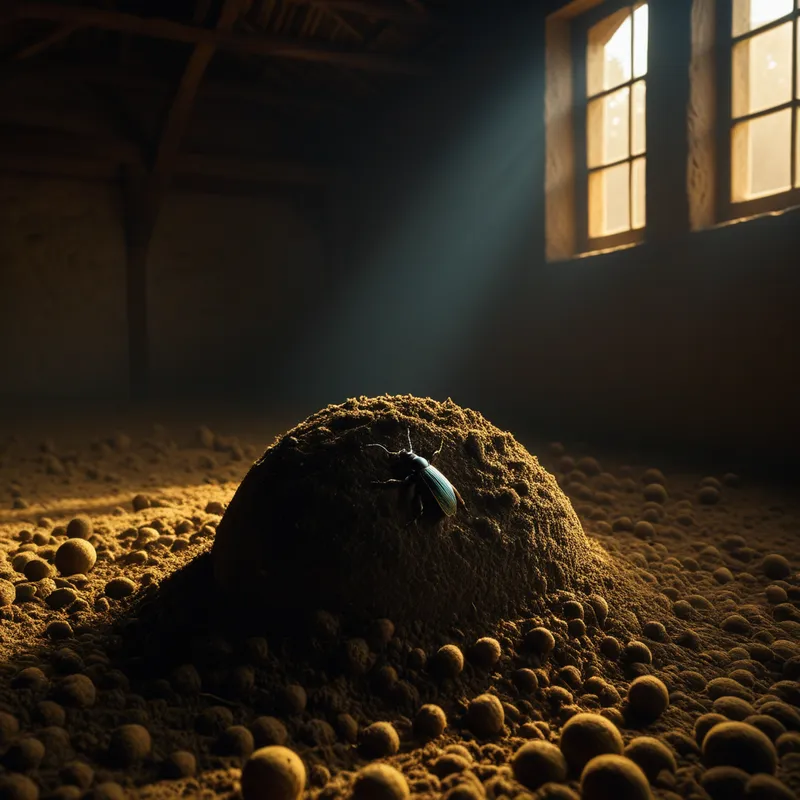
With a strength that belied its size, it began to roll. It gathered the offending matter, the waste of the stable, and shaped it into a ball. Pushing with its hind legs, head down, it labored. It rolled the ball away from the holy family, out of the stable, into the cool night. It returned, and rolled another. And another. All through the quiet hours, while shepherds watched their flocks and angels sang unheard hymns, the beetle toiled in silent devotion, cleansing the sacred ground.
As the first blush of dawn touched the horizon, the Virgin Mary saw what had been done. The floor was clean. She looked and saw the small, dark beetle resting by the entrance, its task complete. A wave of immense gratitude and blessing washed over her. She stretched out her hand, not to touch, but to bestow.
“Little servant,” she whispered, her voice the sound of a gentle spring. “For your selfless labor in the hour of my need, you shall be blessed. No longer shall you be seen as lowly. Your humble ball shall shine with the light of the heavens, and your back shall carry the stars themselves as a reminder of this night.”
And as the words left her lips, a transformation occurred. The beetle’s dull, black carapace began to shimmer. It gleamed with a metallic, sacred sheen—emerald, amethyst, and deepest gold, as if the night sky had been polished onto its back. And the ball it rolled, once a thing of earth, now held a celestial glow, a tiny, captured moon. From that night forth, it was known as Virgin Mary’s Beetle, a creature of grace, a living testament that no service done in love is ever unseen by the divine.
Cultural Origins & Context
This tale belongs to the vast, living tapestry of European peasant folklore, where Christian dogma intertwined seamlessly with older, animistic understandings of the natural world. It is not a church-sanctioned parable, but a folk belief, passed from grandmother to grandchild by the hearth, told to a child who finds a glittering beetle in the garden. Its roots likely stretch back to pre-Christian Europe, where beetles, especially the scarab, were often solar symbols of regeneration and life-from-decay. The story provided a Christian etiology—a “why” story—for the beautiful, iridescent dung beetles common in European fields, such as the Geotrupes species.
Societally, it functioned on multiple levels. For an agrarian culture, it offered a sacred justification and dignity to the most fundamental, unglamorous tasks of life: cleaning, waste removal, and cyclical renewal. It taught that holiness could be found in the stable, not just the cathedral. Furthermore, it served as a moral lesson in humility, silent service, and the idea that divine grace rewards not the proud and powerful, but the quietly devoted. The beetle became a natural-world saint, a bridge between the human realm of holy figures and the insect world, encouraging a sense of kinship and respect for all creatures.
Symbolic Architecture
At its heart, this myth is an allegory of the sacred hidden within the profane, and the transformation that occurs when menial labor is infused with conscious love.
The Beetle represents the humble, instinctual, and often despised aspects of the psyche—the parts of ourselves that handle life’s “waste”: our repressed emotions, our shame, our daily drudgery. It is the shadow worker, content in the dark soil of the unconscious.
The Ball of Dung is the primal material of transformation. It is the unformed, rejected, and “filthy” aspect of existence—be it physical waste, psychological trauma, or mundane obligation. In the beetle’s care, it is not discarded but gathered and shaped. This is the first act of consciousness: to take the raw material of our suffering or our lowly tasks and give it form, to engage with it rather than flee from it.
The Virgin Mary symbolizes the anima in her most nurturing, compassionate aspect. She is the receptive, witnessing consciousness that sees the value in the hidden labor. Her tear is the catalyst—it is human vulnerability and need, which calls forth service from the most unexpected quarters.
The miracle is not that the waste disappears, but that it is transformed into an object of sacred labor. The blessing is not an escape from one’s nature, but the revelation of the divine already latent within it.
The final Transformation—the iridescent shell—is the result of this sacred engagement. The beetle does not cease being a beetle; it becomes a glorified beetle. Its core function remains (rolling its ball), but it now does so with a recognized, radiant dignity. The psyche that willingly engages with its own “dirty work” is not burdened by it but is adorned by the process, gaining depth, beauty, and resilience.

The Dreamer’s Resonance
When this myth stirs in the modern dreamer, it often surfaces during periods of felt insignificance or burdensome responsibility. To dream of a small, determined insect performing a repetitive, Sisyphean task suggests the dreamer is engaged in a psychological process of integrating something they deem lowly, tedious, or shameful.
Somatically, one might feel a sense of pressure in the back, a slow, grinding determination, or a quiet fatigue that is not of despair but of deep, sustained effort. Psychologically, this is the process of “rolling one’s ball”—attending to the necessary, unglamorous maintenance of life or psyche: processing grief bit by bit, showing up for a demanding caregiving role, or diligently working through a creative project that feels overwhelming. The dream is an affirmation from the unconscious: this labor is not meaningless. The radiant beetle in a dream is a powerful symbol of emerging self-worth, a sign that the soul recognizes the sacredness of the current struggle, even if the waking ego feels only the burden.

Alchemical Translation
The myth of Virgin Mary’s Beetle is a perfect map for the individuation process, specifically the stage of nigredo turning into cauda pavonis—the blackening giving way to the peacock’s tail.
The initial state is the nigredo: the dark stable, the rejected waste, the beetle’s unseen world. This is the necessary confrontation with the shadow, with the material we would rather ignore. The beetle’s action—rolling the prima materia (the dung ball)—is the alchemical solve et coagula: it gathers (coagulates) the scattered, base elements of one’s experience and sets them in motion (dissolves static despair into dynamic engagement).
The Virgin’s witnessing and blessing represent the intervention of the transcendent function—the reconciling third that arises from the tension between the conscious need (the mother) and the unconscious resource (the beetle). Her grace is the moment of insight where the ego stops fighting its menial task and sees it as a vital part of a larger, sacred narrative.
The alchemical gold is not found by escaping one’s nature, but by fulfilling it with such devotion that its inherent divinity is revealed.
The final, iridescent beetle is the cauda pavonis, the glorious, multi-hued evidence of inner transformation. The psyche has integrated a lowly complex. What was once a source of shame or automatic, unconscious behavior (handling “waste”) becomes a conscious, valued skill. The individual realizes that their perseverance through difficulty, their daily commitments, have forged a character of subtle beauty and strength. They have not become someone else; they have become fully, radiantly themselves, their core purpose now illuminated from within. The ball they roll—their life’s work, their burden, their creative output—now carries its own inner light, a moon to guide them through the continuing night.
Associated Symbols
Explore related symbols from the CaleaDream lexicon: