Vidarr Myth Meaning & Symbolism
The silent son of Odin who survives Ragnarök by avenging his father, embodying the power of quiet strength, foresight, and the resilience of nature.
The Tale of Vidarr
Listen. The final winter has breathed its last, frigid gasp. The sun and moon are gone, swallowed by wolves of shadow. The stars have fallen from Yggdrasil’s branches like dead fruit. This is the twilight of the gods, Ragnarök. The air is thick with the iron scent of blood and the ozone crackle of dying magic. On the field of Vígríðr, the great ones fall.
Odin, the All-Father, rides forth on Sleipnir, his spear Gungnir shining with a desperate light. He faces the beast whose binding he once ordained: Fenrir, grown so vast his jaws scrape the sky and the earth. There is a roar that shatters mountains, a clash that breaks the spine of the world. And then, silence. The great wolf’s maw closes. The All-Father is gone.
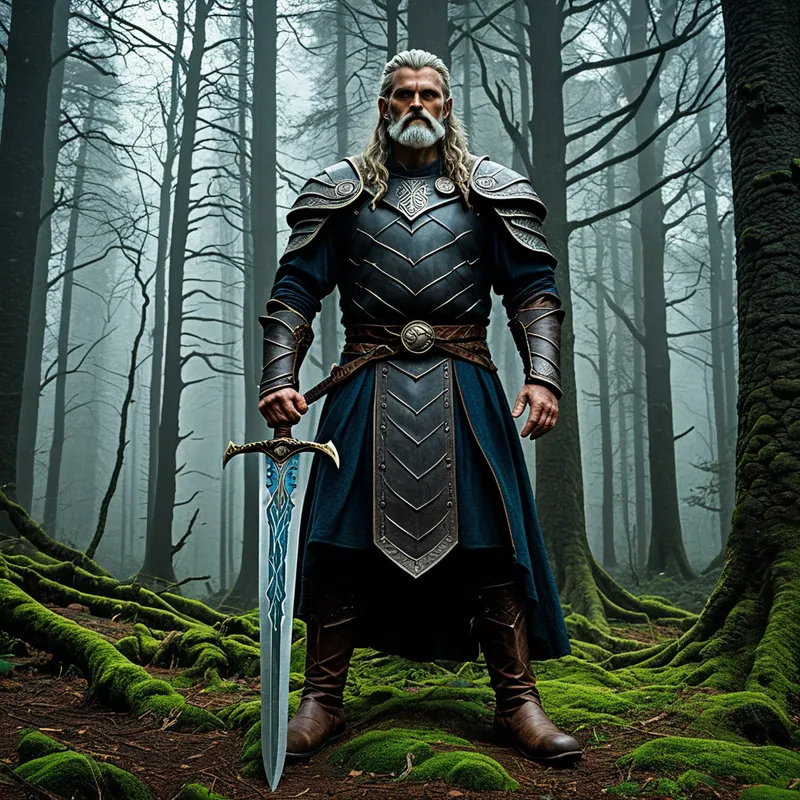
From the edge of the carnage, where the primal forest meets the scorched plain, a figure steps forward. He has been there all along, a quiet pillar in the chaos. This is Vidarr. He speaks no war cry. He has made no boast. His face, strong and solemn as weathered stone, shows no rage, only a deep, terrible resolve. He is known as the Silent God, the possessor of the iron shoe.
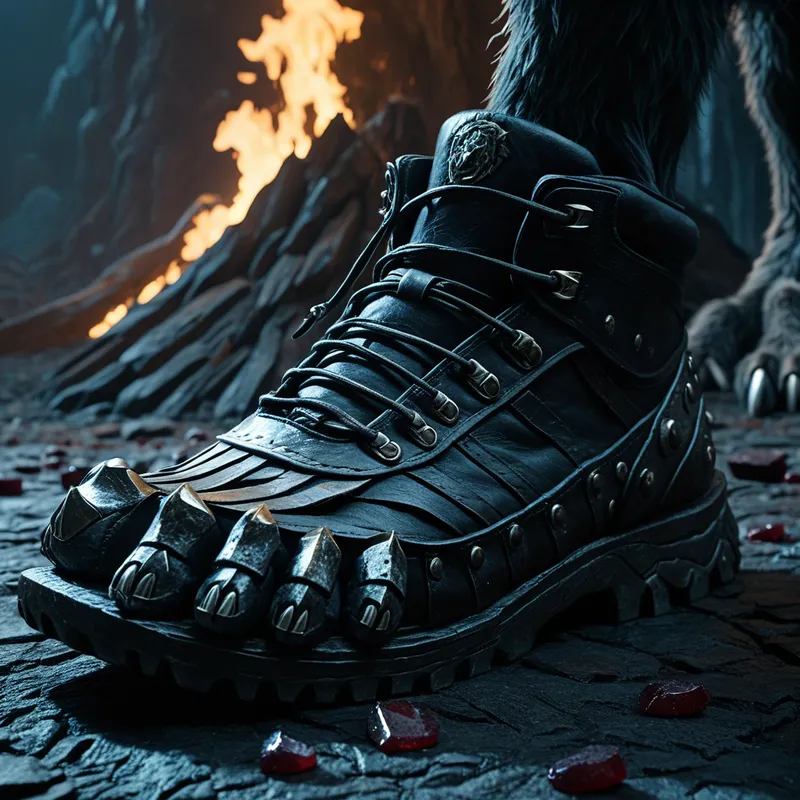
For ages untold, in the deep quiet of his halls, Vidarr has been at work. Every time a leather scrap was cut and discarded by the shoemakers of the gods, Vidarr collected it. Every leftover piece, every offcut from a saddle, a scabbard, a glove, was saved. With immense patience, he fashioned a shoe, a boot so thick and vast it is made of all the leavings, all the forgotten remnants. He wears it now.
He walks towards Fenrir. The wolf, glutted with the blood of the king of gods, turns its red eyes upon this new challenger. Vidarr does not flinch. He places his foot, clad in that shoe of countless fragments, upon the wolf’s lower jaw. The weight is the weight of all that preparation, all that silent gathering. It is the weight of inevitability. With one hand, he seizes the beast’s upper jaw. His grip is the grip of the deep earth, of roots that crack stone. There is no dramatic struggle, only a supreme, silent exertion. He tears. The monstrous wolf is rent asunder, its threat ended not with a brilliant spell, but with patient strength and a prepared tool.
The fires still burn, the seas still boil, but a space has been cleared. Vidarr, the silent son, has avenged his father. He will survive the conflagration. He will walk on the new earth that rises green from the sea, a god of the spaces between, a testament to what endures when the noise of glory has faded.
Cultural Origins & Context
The myth of Vidarr comes to us primarily through the Poetic Edda and the later Prose Edda of Snorri Sturluson. In a culture that celebrated the eloquent skalds and the boastful deeds of warriors in the hall, Vidarr presents a stark counter-archetype. He is the god who does not speak in the sagas; his power is not proclaimed but demonstrated.
His myth functioned as a crucial part of the Norse apocalyptic narrative. Ragnarök was not merely an end, but a necessary cleansing, a cycle of death and rebirth. For this cycle to be complete, agents of renewal were required. Vidarr, alongside his brother Váli and a few other deities, represented this principle of survival and continuity. He embodied a deep, cultural understanding that not all strength is loud, and not all victory is swift. In a society facing the harsh realities of winter, famine, and conflict, the virtue of quiet preparation, of resourcefulness (symbolized by the shoe of leather scraps), and of resilient endurance was paramount. Vidarr was the assurance that something—a principle of retributive justice and natural resilience—would outlast even the greatest catastrophe.
Symbolic Architecture
Vidarr is the archetype of the Silent Avenger and the Prepared Survivor. His symbolism is built not on flash, but on substance, depth, and latent potential.
He is the embodiment of the space left after a great sound, the resilience that exists not in the trunk of the tree, but in its deepest, most patient roots.
His silence is not emptiness, but a container. It represents focused intent, observation, and a strength that does not need to announce itself. In a pantheon of gods defined by their domains (thunder, poetry, love), Vidarr is the god of the space between things, the quiet places in the forest, the moment of decision before action. His vengeance is not hot-blooded but cold, deliberate, and inevitable—the natural consequence of a debt that must be paid.
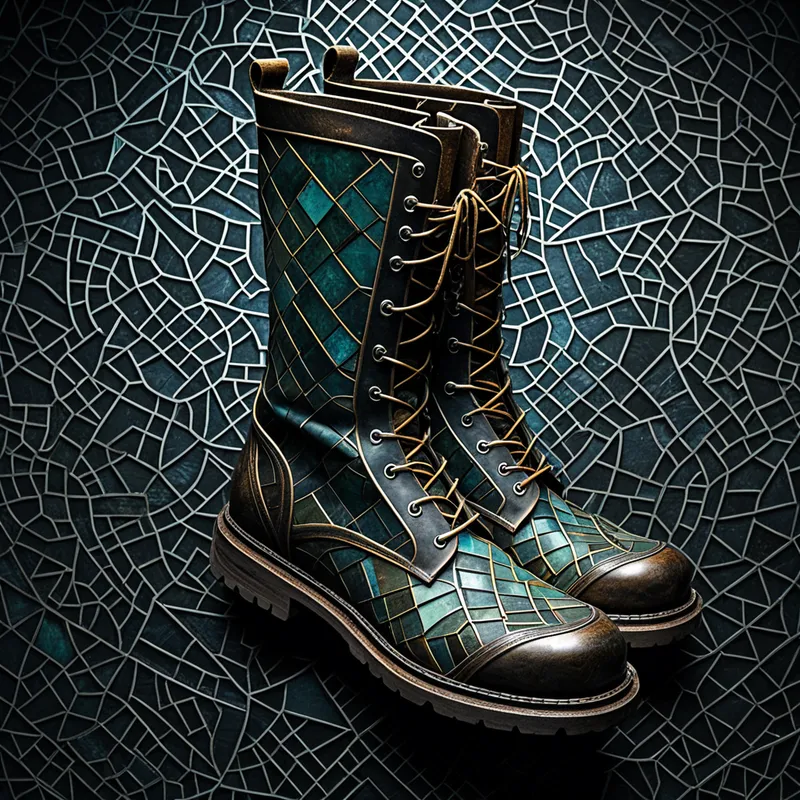
The shoe of leather scraps is his central symbol. It represents the alchemy of the mundane into the mythic. It is foresight, thrift, and the cumulative power of small, consistent actions. Each scrap is a moment of preparation, a choice to save rather than waste, to build for a future need that others cannot see. It transforms the discarded into the essential, the humble into the divine tool of survival. His victory over Fenrir is thus not a triumph of brute force alone, but a triumph of preparation over chaos, of the collected over the scattered.
The Dreamer’s Resonance
When the pattern of Vidarr stirs in the modern psyche, it often manifests in dreams of profound quiet amidst turmoil, or of meticulous, repetitive tasks. You may dream of being in a raging storm but standing in an immovable circle of calm. You may dream of collecting seemingly worthless objects—buttons, stones, pieces of paper—with a deep sense that they are vitally important.
These dreams signal a psychological process of integration and grounded preparation. The ego (Odin) may feel threatened or has been “devoured” by a overwhelming problem, a “wolf” of anxiety, loss, or chaos (Fenrir). The Vidarr archetype emerges as the somatic intelligence of the Self, urging a retreat from frantic action into deliberate, silent gathering of resources. It is the psyche building its “shoe”—assembling inner strength from forgotten experiences, practicing skills in solitude, or simply learning to hold space and wait. The dreamer is being called to cultivate their quiet center, to trust in the power that comes from depth and preparation, not from noise and reaction.

Alchemical Translation
The journey of Vidarr is a masterful map for the alchemical process of psychic transmutation, specifically the stage of mortificatio (death/dissolution) followed by a grounded, resilient coagulatio (rebirth into solid form).
The alchemist must first allow the old king, the ruling conscious attitude, to be devoured by its own shadow. Only then can the silent, patient son within rise to enact a necessary, transformative vengeance.
In individuation, the “Odin” within is our established conscious identity—our achievements, our wisdom, our persona. Fenrir is the neglected, ravenous shadow, the complex or trauma we have bound and tried to ignore, which eventually breaks free to destroy our old sense of self. This is a painful but necessary death.
Vidarr represents the latent psychic function that has been developing in the shadows of consciousness all along. This is not the brilliant insight (which belongs to Odin), but the capacity for endurance, for practical action, for holding a boundary. The “leather scraps” are all the small, overlooked experiences, the endured hardships, the minor disciplines, the quiet reflections we have accumulated. The alchemical work is to consciously gather these, to fashion them into a “shoe”—a new foundation, a grounded way of being.
The final act—tearing apart the wolf—is the integration of the shadow. It is not its destruction, but its resolution through the application of this hard-won, grounded strength. The new consciousness that walks on the “new earth” is not the same as the old. It is quieter, more resilient, less reliant on external glory, and intimately connected to the silent, enduring substance of the soul. It is the Self, having survived its own Ragnarök, ready to inhabit a renewed world.
Associated Symbols
Explore related symbols from the CaleaDream lexicon: