Via Dolorosa Myth Meaning & Symbolism
The sacred path of sorrows, a mythic journey of ultimate sacrifice and transformative suffering, leading from condemnation to transcendence.
The Tale of Via Dolorosa
Hear now the tale of the Sorrowful Way, the path walked but once, yet trodden in the soul of every age.
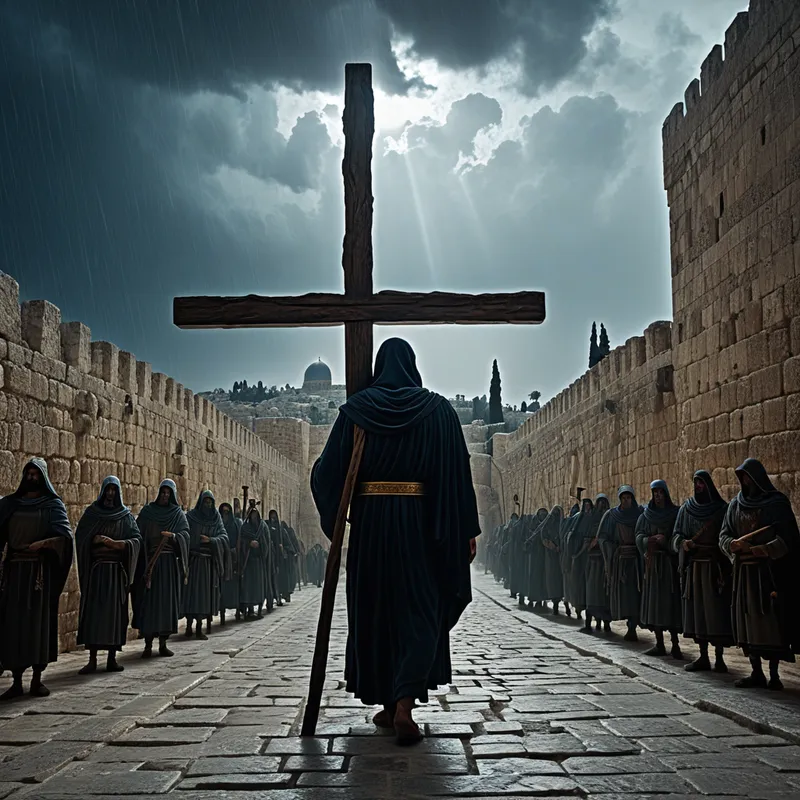
[The sky](/myths/the-sky “Myth from Persian culture.”/) over [Jerusalem](/myths/jerusalem “Myth from Biblical culture.”/) was the color of a fresh bruise, a pallid sun struggling behind veils of dust and dread. From the fortress of Antonia, a gate groaned open. Out stepped a procession not of [triumph](/myths/triumph “Myth from Roman culture.”/), but of a terrible, silent gravity. At its heart was a man, Yeshua, his shoulders raw from the lash, his brow crowned not with gold, but with a brutal wreath of thorns that drew rivulets of blood like dark tears down his face.
Upon his torn back lay the instrument of his execution: a massive, rough-hewn beam of cypress wood, the patibulum. Its weight drove his feet into the grit of the narrow street, [the Via Dolorosa](/myths/the-via-dolorosa “Myth from Christian culture.”/). The air was thick—a cacophony of shouted Latin commands, the wailing of women, the curious murmur of the crowd, and beneath it all, the labored, rhythmic scrape of wood on stone and the shuddering breath of the condemned.
This was no straight road to oblivion. It was a serpentine path through the very bowels of the city, a descent. The stones, worn smooth by millennia, were unforgiving. Three times the weight overcame him, and he fell—knees striking rock, the crossbeam crashing down, the crowd gasping as one. Each fall was a punctuation in the narrative of agony. And each time, hands reached out—not always in mercy. A foreigner, [Simon of Cyrene](/myths/simon-of-cyrene “Myth from Christian culture.”/), his face a mask of confusion and dread, was seized and forced to shoulder the timber. A woman, Veronica, pushed through the press of soldiers, her veil offered not to wipe sweat, but to meet his gaze and absorb the icon of his suffering, receiving an image forever sealed in cloth.
He moved as one already among the shades, yet his eyes held a focus that pierced the temporal. He spoke to the daughters of Jerusalem who mourned, not for himself, but for the cycles of violence yet to come. The journey was a brutal inversion of a king’s procession, each step a stripping away—of dignity, of strength, of hope as [the world](/myths/the-world “Myth from Tarot culture.”/) knows it. It culminated at the Place of the Skull, [Golgotha](/myths/golgotha “Myth from Christian culture.”/), where the vertical post awaited. There, the horizontal beam he carried would be lifted, joined, and raised against the weeping sky. The path ended where [the world](/myths/the-world “Myth from Tarot culture.”/) turned upside down.
Cultural Origins & Context
The myth of the Via Dolorosa is not a single, codified scripture, but a story woven from the threads of the Gospel narratives, early Christian meditation, and centuries of devotional practice. Its historical roots are in the Roman practice of exactus mortis—the forced march of a condemned criminal to the execution site, carrying the crossbeam, a public spectacle designed to instill terror and reinforce imperial power.
However, the early Christian community transformed this brutal procedure into a sacred geography. By the 4th century, with the pilgrimage of Helena, the path in Jerusalem began to be marked and venerated. The myth was passed down not merely by text, but by foot—by pilgrims who traveled across continents to physically retrace the steps, to kiss the stones, to feel the spatial reality of [the passion](/myths/the-passion “Myth from Christian culture.”/). The Stations of the Cross, formalized in the later medieval period, provided a liturgical and imaginative framework, allowing the myth to be internalized and performed anywhere in the world. Its societal function was dual: it served as a profound act of imitatio Christi (imitation of Christ) for the believer, and for the culture at large, it established a powerful archetype of meaningful suffering—a narrative where agony is not random, but a path with a purpose.
Symbolic Architecture
At its core, the Via Dolorosa is the archetypal map of conscious suffering. It is the [journey](/symbols/journey “Symbol: A journey in dreams typically signifies adventure, growth, or a significant life transition.”/) of [the ego](/myths/the-ego “Myth from Jungian culture.”/) bearing the [weight](/symbols/weight “Symbol: Weight symbolizes burdens, responsibilities, and emotional loads one carries in life.”/) of a [destiny](/symbols/destiny “Symbol: A predetermined course of events or ultimate purpose, often linked to spiritual forces or cosmic order, representing life’s inherent direction.”/) it both chose and resists.
The cross is not an accident that happens to the hero; it is the burden of consciousness he agrees to carry.
The [path](/symbols/path “Symbol: The ‘path’ symbolizes a journey, choices, and the direction one’s life is taking, often representing individual growth and exploration.”/) itself symbolizes the [labyrinth](/symbols/labyrinth “Symbol: The labyrinth represents a complex journey, symbolizing the intricate path toward self-discovery and understanding one’s life’s direction.”/) of [life](/symbols/life “Symbol: The symbol of ‘Life’ represents a journey of growth, interconnectedness, and existential meaning, encompassing both the joys and challenges that define human experience.”/), specifically those moments when life contracts into a narrow, painful, and inescapable channel. The falls are not failures, but necessary ruptures in the illusion of self-sufficiency. Simon represents the unexpected aid that comes from the “other,” the part of [life](/symbols/life “Symbol: The symbol of ‘Life’ represents a journey of growth, interconnectedness, and existential meaning, encompassing both the joys and challenges that define human experience.”/) or the [psyche](/myths/psyche “Myth from Greek culture.”/) we did not choose but which is compelled to share our burden. Veronica embodies the [moment](/symbols/moment “Symbol: The symbol of a ‘moment’ embodies the significance of transient experiences that encapsulate emotional depth or pivotal transformations in life.”/) of witnessing and [reflection](/symbols/reflection “Symbol: Reflection signifies self-examination, awareness, and the search for truth within oneself.”/)—the [psyche](/myths/psyche “Myth from Greek culture.”/)’s [ability](/symbols/ability “Symbol: In dreams, ‘ability’ often denotes a recognition of skills or potential that one possesses, whether acknowledged or suppressed.”/) to stop and behold its own suffering, imprinting it, making an [image](/symbols/image “Symbol: An image represents perception, memories, and the visual narratives we create in our minds.”/) of it, which is the first step toward [transmutation](/symbols/transmutation “Symbol: A profound, alchemical process of fundamental change where one substance or state transforms into another, often representing spiritual evolution or personal metamorphosis.”/).
The Golgotha is the [temenos](/myths/temenos “Myth from Greek culture.”/), the sacred cutting-off point, where the old self must die. Psychologically, the [hero](/symbols/hero “Symbol: A hero embodies strength, courage, and the ability to overcome significant challenges.”/) here is the conscious [personality](/symbols/personality “Symbol: Personality in dreams often symbolizes the traits and characteristics of the dreamer, reflecting how they perceive themselves and how they believe they are perceived by others.”/) confronting the ultimate [shadow](/symbols/shadow “Symbol: The ‘shadow’ embodies the unconscious, repressed aspects of the self and often represents fears or hidden emotions.”/): the [reality](/symbols/reality “Symbol: Reality signifies the state of existence and perception, often reflecting one’s understanding of truth and life experiences.”/) of [mortality](/symbols/mortality “Symbol: The awareness of life’s finitude, often representing transitions, impermanence, or existential reflection in dreams.”/), limitation, and [betrayal](/symbols/betrayal “Symbol: A profound violation of trust in artistic or musical contexts, often representing broken creative partnerships or artistic integrity compromised.”/) by the world. He carries the patibulum—the horizontal, earthly burden of relationships, [trauma](/symbols/trauma “Symbol: A deeply distressing or disturbing experience that overwhelms the psyche, often manifesting in dreams as unresolved emotional wounds or psychological injury.”/), and [fate](/symbols/fate “Symbol: Fate represents the belief in predetermined outcomes, suggesting that some aspects of life are beyond human control.”/)—to meet the stipes—the vertical, unchanging pillar of [spirit](/symbols/spirit “Symbol: Spirit symbolizes the essence of life, vitality, and the spiritual journey of the individual.”/) or Self. Their union is the crucifixion of the old [identity](/symbols/identity “Symbol: Identity represents the sense of self, encompassing personal beliefs, cultural background, and social roles.”/), a terrifying necessity for [rebirth](/symbols/rebirth “Symbol: A profound transformation where old aspects of self or life die, making way for new beginnings, growth, and renewal.”/).
The Dreamer’s Resonance
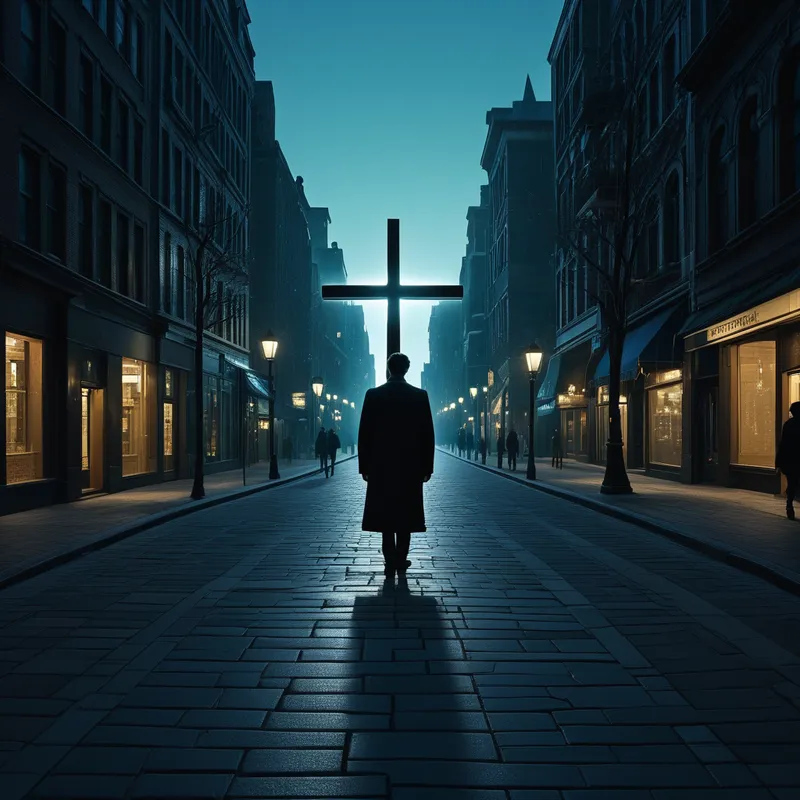
When this myth stirs in the modern dreamer, it rarely appears in biblical costume. Instead, the psyche presents its own Via Dolorosa. The dreamer may find themselves walking an endless, narrow corridor in a bureaucratic building, carrying a heavy, obscure object—a locked box, a dying animal, a pulsing, wounded light. The weight is somatic; they awaken with aching shoulders or a clenched jaw.
The figures along the path are key. The hostile crowd may manifest as a chorus of critical voices from one’s past or as faceless, blocking shapes. A “Simon” may appear as a stranger who wordlessly helps, or an overlooked friend in the dream narrative. A “Veronica” moment might be a mirror suddenly appearing in the path, where the dreamer is forced to see their own exhausted, determined face.
This dream pattern signals a profound psychological process: the ego’s reluctant engagement with its necessary suffering. It is not about masochism, but about the burden of integration. The dreamer is carrying something essential—a truth, a responsibility, a grief, a talent—that feels like it will crush them, yet they cannot put it down. The path has no exits because the process cannot be bypassed. The dream is a somatic map of the soul’s descent, preparing consciousness for a coming death-and-rebirth sequence in waking life.
Alchemical Translation
In the alchemy of the psyche, the Via Dolorosa is the [nigredo](/myths/nigredo “Myth from Alchemical culture.”/)—the blackening, the dissolution, the darkest part of the work. It is the stage where the base matter of the personality is broken down through the heat of suffering.
The path of sorrows is the furnace where the lead of the ego is cooked until its hidden gold begins to shimmer.
For the modern individual seeking individuation, this myth models the agonizing but sacred process of carrying one’s own cross. That “cross” is the unique and paradoxical burden of one’s own destiny: the marriage of one’s deepest wound (the horizontal beam of human trauma and relation) with one’s highest calling (the vertical beam of spirit and meaning). We are all compelle portare—compelled to carry.
The alchemical translation occurs in the falls. Each fall is a mortificatio, a little death of the ego’s pride and self-will. It is in the dust, in the moment of ultimate incapacity, that grace—in the form of a “Simon” (an insight, a therapy, a moment of compassion) or a “Veronica” (a moment of self-witnessing in journaling or art)—can intervene. The journey teaches that we do not transcend suffering by avoiding it, but by consenting to walk its precise, narrow way, allowing it to strip us of everything that is not essential.
The destination, Golgotha, translates as the crucifixio stage, where the conscious mind is fixed in its conflict, stretched between opposites. This is not the end, but the precondition for the [solutio](/myths/solutio “Myth from Alchemical culture.”/) (dissolution) and albedo (whitening) that follow—[the resurrection](/myths/the-resurrection “Myth from Christian culture.”/). Thus, the myth assures us that the most harrowing, forced march of the soul is, in truth, a sacred pilgrimage. Every step taken in conscious bearing of one’s truth, no matter how painful, is a step on the path of becoming whole. The Via Dolorosa, in the end, is revealed as the Via Lucis—[the Way](/myths/the-way “Myth from Taoist culture.”/) of Light.
Associated Symbols
Explore related symbols from the CaleaDream lexicon: