Vesta Myth Meaning & Symbolism
The myth of Vesta, guardian of the sacred hearth fire, embodies the inviolable center of home, state, and soul that must be tended in perpetual silence.
The Tale of Vesta
Listen. Before the clamor of legions, before the marble rose and the empire sprawled, there was a single point of light in the darkness. It was not the sun, nor the moon, but a flame born of a promise. It was the breath of Jupiter made manifest, a spark struck from the divine will to endure.
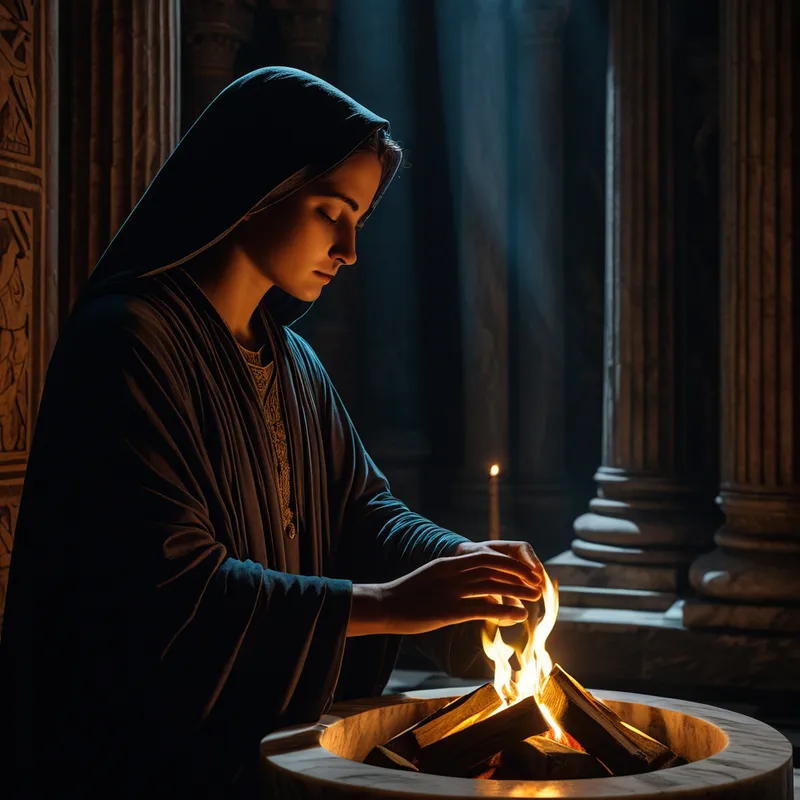
In the heart of the first village, on the muddy bank of the Tiber, a crude altar of stone held this flame. It was the household fire, the giver of warmth, the transformer of raw grain into sustaining bread, the beacon that kept the wild night at bay. But this was no ordinary fire. It was the living soul of the family, the genius of the place. To let it die was to invite the chill of dissolution, the return to formless chaos. So a daughter, chosen for her purity of heart and body, was given the solemn charge. She was to be the flame’s keeper. Her life was not her own; it was woven into the flickering light. She would feed it with sacred wood, shield it from errant winds, and watch over its dance through the long, silent watches of the night. Her vigilance was the price of continuity.
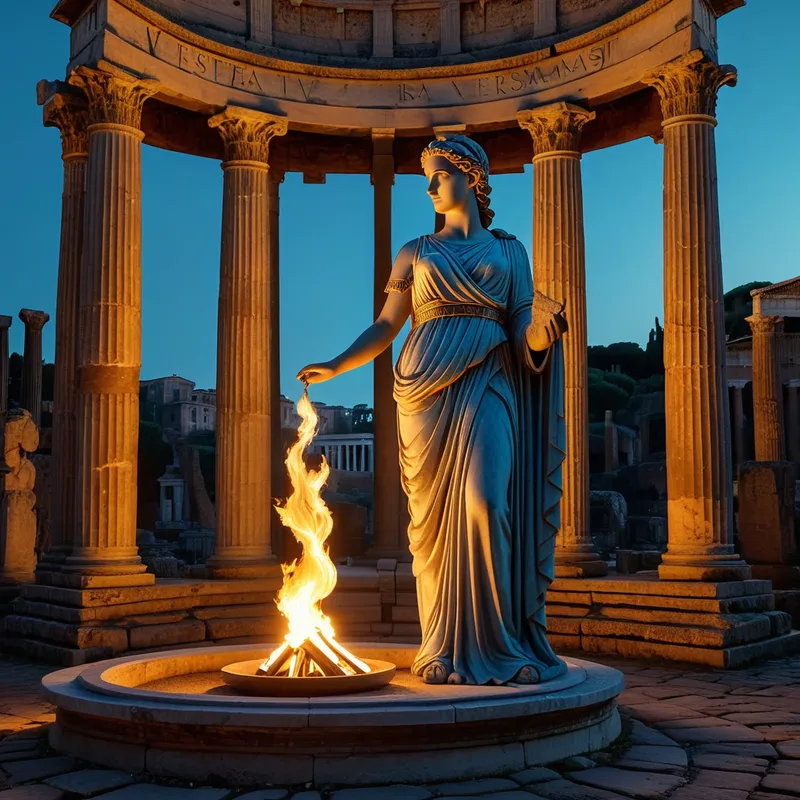
As the village became a city, and the city dreamed of destiny, the hearth grew in stature. It moved from the home to the very center of the world. In the Forum, a circular temple was built, its shape mirroring the ancient round hut of the founders, its door facing east to greet the sun. Here, the flame was no longer just for one family, but for the entire Res Publica. The daughters, now six Vestal Virgins, were taken as children, sworn to thirty years of absolute service. They moved like silent ghosts in white, their hair bound in the ancient style of brides, but they were brides only to Rome itself.
The conflict was never with monsters or titans. It was a war against entropy, against forgetfulness, against the creeping damp of neglect. The rising action was the daily, uncelebrated ritual: the fetching of water from a sacred spring, the preparation of the mola salsa, the careful tending. The drama was in a cough in the night, a sudden gust, a moment of human frailty. For if the flame guttered and died, it was a portent of catastrophic doom for the state. The resolution was not a battle won, but a fire re-kindled—not from common tinder, but by the agonizing, archaic method of focusing the sun’s rays onto purest wood. It was a rebirth wrested from the heavens themselves. And so it went, for centuries, a pulse of light in the stone heart of an empire, a breath held in perpetuity, a silent song of preservation sung by women who were both prisoners and the most powerful priestesses in the land.
Cultural Origins & Context
The cult of Vesta was not a myth of epic narrative, but one of embedded, ritual reality. It was arguably the oldest and most fundamental Roman religious institution. Vesta herself was rarely depicted in anthropomorphic form; she was the fire, a numinous presence rather than a personality with a story. This myth was passed down not through bardic tales of her exploits, but through the living, breathing practice of her priesthood and the visible, ever-burning hearth in her temple.
Her origins are pre-Roman, reaching back to the Indo-European reverence for the domestic hearth as the literal and spiritual center of community life. In Rome, this was elevated to a state cult. The Vestals were chosen from patrician families, and their role granted them extraordinary privileges and severe restrictions. They were free from paternal control (sine manu), could own property, and had the power to pardon condemned prisoners they met by chance. Yet, the penalty for breaking their vow of chastity was burial alive—a fate reflecting the crime: extinguishing the internal, generative fire of the state required being returned to the cold, sterile earth.
The societal function was profound. The Vestals embodied the pax deorum—the peace with the gods. Their intact, devoted state guaranteed Rome’s stability and continuity. They were the human anchors of the city’s sacred boundary (pomerium), their purity a shield against chaos. Their festival, the Vestalia in June, saw millstones and donkeys (vital for grinding grain) garlanded, connecting the sacred flame directly to the source of daily bread. This was a myth enacted, not recited, the ultimate expression of the Roman ideal: duty, piety, and the subordination of the individual to the eternal safety of the whole.
Symbolic Architecture
Vesta represents the inviolable center. She is not the fire of conquest (Vulcan) or the fire of passion and poetry. She is the fire of being. The hearth is the axis mundi of the home and the state, the still point around which the world turns.
The sacred flame is not about blazing transformation, but about faithful continuity. It is the light of consciousness that must be guarded against the winds of distraction and the floods of unconsciousness.
The circular temple, with no sharp corners for chaos to hide, symbolizes the perfected, contained self. The Vestal Virgin is the archetype of the devoted ego, the part of the psyche tasked with tending this central, sacred truth. Her virginity is not a mere physical state, but a symbol of psychological integrity—a wholeness unto herself, dedicated to a purpose higher than personal generation. She is sacer, set apart, belonging wholly to the numinous center. The ever-burning fire is the symbol of the immortal spark of the Self, the divine core within the individual that, if tended, provides warmth, nourishment, and unshakeable identity.

The Dreamer’s Resonance
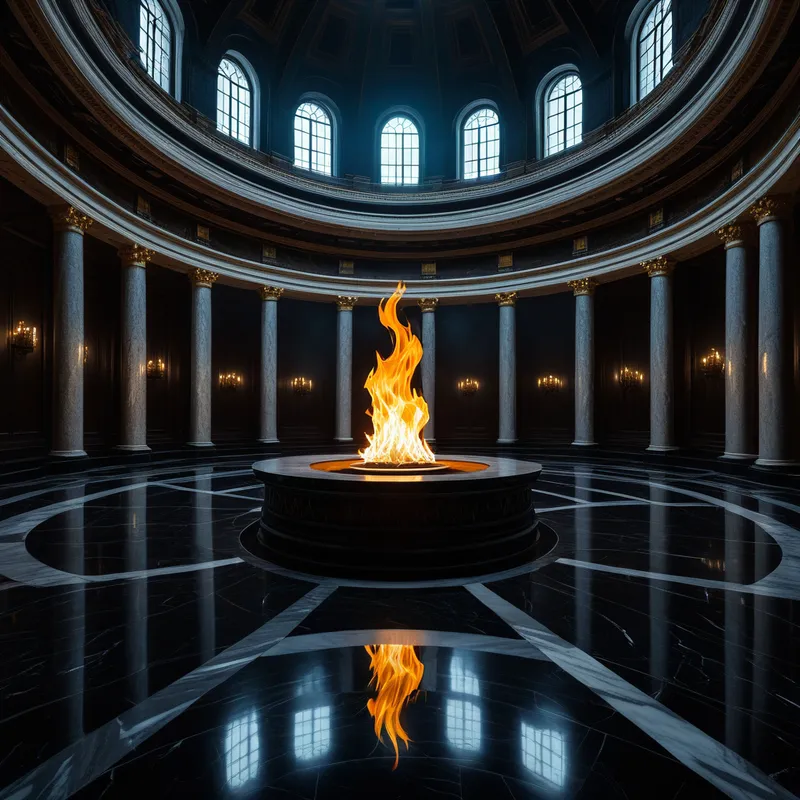
When the myth of Vesta stirs in the modern unconscious, it often manifests in dreams of a central, vital object that requires protection: a small flame in a vast, dark room; a precious, fragile heirloom in an empty house; a sealed, circular chamber within a chaotic labyrinth. The somatic feeling is one of quiet, anxious responsibility—a “holding” in the chest.
Psychologically, this signals a process of centering. The dreamer is being called to identify and protect what is truly sacred and essential in their life or psyche from being scattered, diluted, or extinguished. It may arise during periods of overwhelming external demand, moral compromise, or existential drift. The dream asks: What is your sacred hearth? What is the non-negotiable flame of your values, your spirit, your sanity? The Vestal in the dream is the dreamer’s own capacity for devoted, disciplined attention to this core. A dream of the flame dying speaks to a profound fear of losing one’s soul-purpose or inner integrity. A dream of successfully re-kindling it points to a hard-won recovery of personal truth.
Alchemical Translation
The alchemical process mirrored in Vesta’s myth is not the dramatic solve et coagula (dissolve and coagulate), but the sustained, essential operation of separatio and custodia—separation and guardianship. The first step in individuation is often not a grand quest, but the creation of a temenos, a sacred precinct within the psyche.
The work is one of distillation: separating the eternal flame of the Self from the flickering, consuming fires of persona, complex, and collective expectation.
The modern individual must become their own Vestal. This means withdrawing psychic energy (the “virgin” state) from outer, dispersing engagements to consecrate it to the inner center. It is the discipline of daily tending: through meditation, reflection, ethical action, or creative practice that feeds the core flame. The “thirty years of service” translates to the long, often silent, middle phase of life where one maintains commitment to an inner truth without immediate reward.
The ultimate alchemical triumph here is not the creation of something new, but the preservation and perfection of something eternally present. It is the realization that the Philosopher’s Stone—the symbol of wholeness—was not forged in a spectacular explosion, but was there all along, like a steady flame in the hearth, requiring only our devoted, vigilant recognition to illuminate our entire being. To integrate Vesta is to achieve an unshakeable inner sanctuary, a peace that is not passive, but actively, perpetually fueled.
Associated Symbols
Explore related symbols from the CaleaDream lexicon: