Vessantara Jataka Myth Meaning & Symbolism
A prince gives away everything—his kingdom, his children, his wife—to perfect the virtue of generosity, culminating in a profound restoration and spiritual kingship.
The Tale of Vessantara Jataka
Hear now the tale of the prince who gave the world away. In the kingdom of Sivi, under a sun that seemed to shine just for him, Prince Vessantara was born. His first cry was not a wail, but a promise; his tiny hand, clutching nothing, was an omen. From his birth, his heart beat to a singular rhythm: the pulse of boundless giving. As a youth, he did not merely offer alms; he poured the royal treasury into the hands of the poor until the coffers echoed with emptiness, and the court murmured with fear.
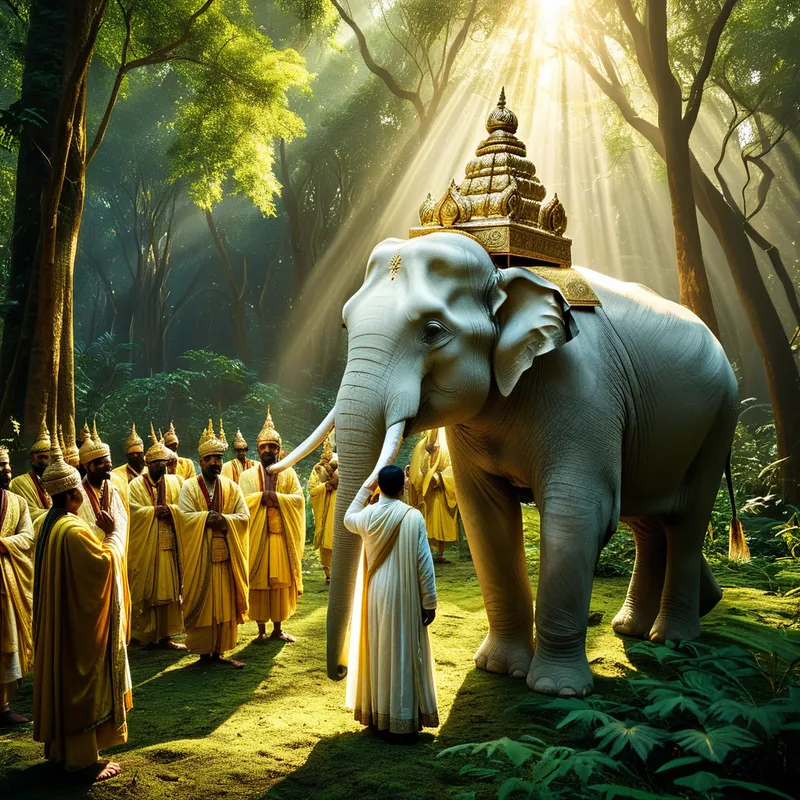
His virtue became his throne, and his generosity, a legend that traveled on the wind. It reached a neighboring kingdom parched by drought, where the earth cracked like a beggar’s lips. Their plea was specific: the rain-bringing, fortune-bestowing white elephant of Sivi, Vessantara’s own. Without a breath of hesitation, he gave it. The people of Sivi, fearing the loss of their prosperity, rose in a storm of ingratitude. The king, his own father, bowed to the tempest and exiled his son.
So Vessantara departed, with his unwavering wife Maddi and their two beloved children. They left the gilded cage of the palace for the vast, whispering cathedral of the forest. In the hermitage of Vamka, they built a life of simple rhythms. Yet, even in exile, his destiny pursued him. The gods, testing the very limits of his vow, sent petitioners into the green gloom.
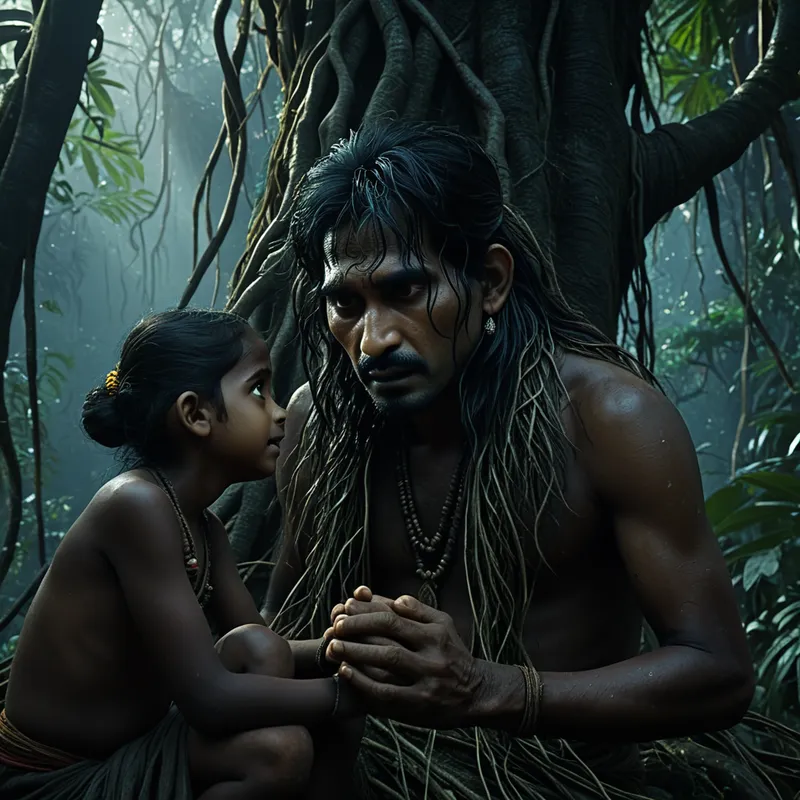
First came a group of Brahmins seeking the prince’s miraculous, wish-granting horses and chariot. He gave them. Then arrived the old, cunning Brahmin Jujaka, sent by his lazy wife to find servants. He asked for the children. The forest held its breath. Vessantara’s heart, a mountain of love, quaked and split. With a tenderness that was itself a kind of agony, he washed his children’s feet, spoke words of duty, and placed their small hands into the old man’s gnarled grasp. As Jujaka led them away, the trees wept sap, and the prince sat in the silent clearing, a king of utter emptiness.
The final test walked out of the woods at dusk. The god Sakka, disguised as another Brahmin, asked for Maddi. Vessantara, now a vessel hollowed by loss, consented. At this, the divine disguise fell away. Sakka restored Maddi, not as a possession returned, but as a companion acknowledged in her own sovereign right. The ordeal was complete.
News of these impossible gifts finally stirred the heavens and the human world. Vessantara’s father, his heart broken by regret, sent an army to bring his son home. The children, rescued from Jujaka, were restored. The white elephant returned. The prince, who had given away every fragment of his identity, returned to Sivi not as an heir, but as a true chakravartin. He was crowned not with gold, but with the invisible, unshakable crown of perfected virtue. The rains fell, the kingdom flourished, and the tale of the great giver was etched into the memory of the world.
Cultural Origins & Context
The Vessantara Jataka is not merely a story; it is a cultural heartbeat. It exists as the final and most elaborate of the 547 Jataka tales, the narrative treasury of the Buddha’s past lives. In the Theravada Buddhist traditions of Sri Lanka, Thailand, Laos, and Cambodia, it holds a place of unparalleled reverence. It is often called the “Great Birth Story.”
Its transmission was a sacred performance. For centuries, it was recited in marathon sessions by monastic bards during annual festivals, such as the Boun Pha Vet. These recitations were not passive listenings but communal rituals of merit-making. The audience, through the emotional journey of the tale, participated in the cultivation of dana (generosity). The myth functioned as a societal mirror and an ideal. It presented the ultimate model of the bodhisattva, challenging listeners to examine their own attachments while reinforcing the cultural pillars of charity, familial duty, and the belief in karmic restitution. It was a spiritual education wrapped in the most compelling of human dramas.
Symbolic Architecture
On the surface, this is a tale of extreme charity. At its depth, it is a meticulous map of deconstruction. Vessantara is not giving away objects; he is surrendering the very pillars of a conventional self.
The white elephant symbolizes sovereign power, prosperity, and social responsibility. To give it away is to relinquish the outer kingdom. His children represent the future—his lineage, his genetic and emotional continuity. To give them away is to sever attachment to the inner kingdom of the heart’s deepest hopes. Maddi symbolizes the ultimate companion, the “other” who completes the self in the world of relationship. Consent to give her is the dissolution of the final dualistic bond.
The perfection of generosity is not in the abundance of what is given, but in the totality of what is released. The self, stripped of all its attributes, stands revealed not as nothing, but as a capacity for everything.
The forest exile is the samadhi of loss, the necessary wilderness where attachment is burned away. The cruel Jujaka is not a villain, but the fierce, ugly face of grace—the uncompromising demand of the psyche for total honesty. The restoration that follows is critical: it is not a return to the old life. It is the reconstitution of the world around a transformed center. The returned family, elephant, and kingdom are no longer possessions, but manifestations of a reality that has been earned through utter non-clinging.
The Dreamer's Resonance
When this myth stirs in the modern unconscious, it announces a profound process of psychic divestment. To dream of willingly giving away one’s children, one’s home, or a cherished symbol of success is not a prophecy of literal loss. It is the soul’s theater, staging the painful, necessary release of identities we have outgrown.
The somatic experience may be one of tearing, of a heart cracking open. Psychologically, it is the ego’s confrontation with the Self’s greater imperative. The dreamer undergoing this Vessantara pattern is being asked: What have you made into an absolute? What role (parent, provider, partner, professional) have you mistaken for your entirety? The anguish in the dream is the resistance of the personal heart to the transpersonal command. The figure of the demanding, unlikable petitioner (the Jujaka in our lives) often appears in waking life as an inconvenient obligation, a crisis, or an illness that forces us to relinquish control. The dream prepares us to meet this demand not with resentment, but with the awe-ful recognition of its transformative purpose.

Alchemical Translation
The alchemy of the Vessantara Jataka is the transmutation of identity through radical kenosis—the sacred emptying. For the modern individual on the path of individuation, it models the ultimate in non-attachment, which is not indifference, but love so vast it cannot be contained by any single form.
The process begins with the giving of the White Elephant—the voluntary relinquishment of social persona and worldly status. This is the first, courageous step off the collective path. Next comes the exile to the forest—the introverted journey into the interior, where the noise of the world fades and the voices of one’s own deepest commitments become clear.
The giving of the children is the crucible. This represents surrendering the “inner children”—not just literal offspring, but our most cherished potentialities, our creative projects, our psychological investments in how the future must unfold. It is letting the future be free. The consent to give Maddi is the final stage: the release of the anima/animus, the beloved inner other, from the prison of our projections and needs. It is achieving relationship from a place of wholeness, not lack.
The king returns only when the prince is gone. The Self is crowned only when the ego has given away all its costumes.
The glorious restoration is the alchemical rubedo, the reddening. It is the world returned, but perceived with new eyes. What was once clung to as “mine” is now experienced as a fleeting, beautiful manifestation of a boundless, giving reality. The individual no longer possesses a life; they are in compassionate, generous dialogue with Life itself. They have become, in their own sphere, a chakravartin—a sovereign whose power lies in their capacity to give without impoverishment, because their true wealth is the infinite space of a heart that holds nothing back.
Associated Symbols
Explore related symbols from the CaleaDream lexicon: