Veronica's Veil Myth Meaning & Symbolism
A woman wipes the face of a condemned man with her veil, imprinting his sacred image upon it, creating an icon of compassion made permanent.
The Tale of Veronica’s Veil
The stones of Jerusalem were hot with the fever of a crowd. A tide of dust and desperation choked the narrow street, a river of humanity parting only for the grim procession at its heart. The air was thick with the smell of sweat, blood, and crushed herbs, pierced by the raw shouts of soldiers and the weeping of women.
He came, then. A figure bent double beneath the weight of a rough-hewn crossbeam, his steps a faltering drumbeat of exhaustion. The Christ was a map of suffering: skin torn by the Roman flagrum, a crown of thorns pressing cruel jewels into his brow, his eyes pools of a sorrow so deep it seemed to drink the very light from the sky. The dust of the Via Dolorosa clung to his wounds.
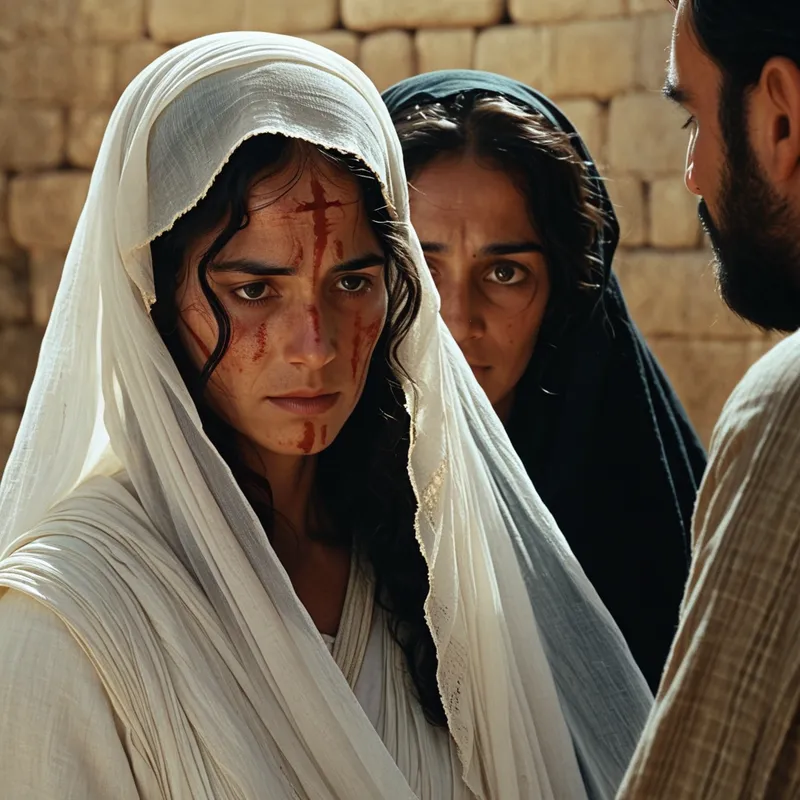
From the seething mass of onlookers, a woman moved. Not a queen or a prophetess, but Veronica. Her name meant “true image,” though in that moment, she was simply a heart breaking in silence. She saw not a criminal, not a theological proposition, but a man in the final, brutal extremity of his humanity. An impulse, pure and fierce as a lightning strike, moved her hands.
Pushing past the spears and scorn, she stepped into the sacred, terrible space around him. Without a word, she drew forth her veil—a simple square of linen, the personal cloth with which a woman might shield her face from sun or dust. It was an intimate object, a part of her. As he paused, his gaze meeting hers, she reached out. Gently, with a tenderness that defied the brutality of the hour, she pressed the cloth to his face. She wiped away the blood, the sweat, the grime of the fallen.
For a heartbeat, the world held its breath. The jeering ceased. The only sound was the shuddering inhale of a compassionate act in a vacuum of cruelty. Then, she drew the veil back.
And there, where her hands had offered solace, a miracle was woven. Not painted, not embroidered, but imprinted into the very threads was his face—his entire countenance, serene and sorrowful, bearing the marks of his passion yet radiating an unearthly peace. The Acheiropoieta was created in an instant of profound contact. The veil was no longer just cloth; it was a testament, a witness made permanent. Veronica, holding the image, became the keeper of the true icon, the proof that in the moment of deepest degradation, the divine face could be revealed through a simple, fearless act of care.

Cultural Origins & Context
The story of Veronica and her veil is not found within the canonical gospels. It emerges from the rich soil of early Christian devotional tradition, a pious legend that blossomed in the centuries following the crucifixion. Its first clear iterations appear in the medieval period, notably in texts like the Acts of Pilate, and it became a central, emotional station in the later development of the Stations of the Cross.
The myth served a powerful societal and theological function. In a faith centered on a God who became flesh and suffered, it provided a tangible, human bridge to that suffering. Veronica represented every believer’s desire to reach across time, to personally comfort and connect with the suffering Christ. Her act validated compassionate service as a path to encountering the sacred. The veil itself, as a acheiropoieton, became a primary relic, with several churches across Europe, most famously St. Peter’s in Rome, claiming to possess it. It answered a deep yearning for a direct, unmediated image of the divine face, one created not by an artist but by the sacred encounter itself.
Symbolic Architecture
At its core, the myth is an alchemy of encounter. The veil symbolizes the permeable boundary of the self—the personal “face” we present to the world, our identity, our capacity to receive and to shield.
The true image is not seen with the eye, but imprinted upon the soul through an act of courageous compassion.
Veronica’s movement toward suffering, not away from it, is the pivotal psychological turn. She does not look away from the brutal, the broken, the condemned. In the depth psychological sense, she approaches the shadow—the suffering, degraded, and rejected aspect of the Self—not with analysis, but with a cloth. Her action is not to fix, but to witness and to soothe. The contact is reciprocal: she offers solace, and in return, receives an indelible imprint.
The resulting image on the veil is the symbol of the transformed Self. It is the “true image” (vera icon) that emerges when the ego (Veronica) consciously engages with the profound, often suffering-laden contents of the deeper Self (the Christ figure). The face is both his and a new creation born of their meeting—a portrait of sorrow transmuted into serene acceptance through the catalyst of compassion.

The Dreamer’s Resonance
When this myth stirs in the modern dreamer, it often signals a profound moment of psychic integration. To dream of wiping a face, of a cloth that cleans or reveals, or of finding one’s own features changed on a reflective surface, points to an active process of soul-making.
The somatic experience might be one of a heavy, burdensome presence (the cross) or a feeling of being stained or soiled (the blood and sweat). The dream-ego’s impulse to step forward and offer the veil is the psyche’s innate movement toward healing. It is the moment we choose to tend to our own inner wounds, our shame, or our grief, not with harsh judgment, but with the gentle, wiping cloth of self-compassion. The imprint left behind—the mysterious face on the cloth—is the dream’s confirmation. It signifies that a lasting change has been registered in the fabric of identity. A previously hidden aspect of the Self has been seen, acknowledged, and in that acknowledgment, transformed from a source of pain into a source of sacred imagery.

Alchemical Translation
The journey of Veronica models the individuation process with stark elegance. The initial state is one of fragmentation: the divine image is broken, suffering, and paraded through the hostile crowd of our own internalized criticisms and fears.
The alchemical gold is not found by fleeing the leaden weight of suffering, but by imprinting our consciousness upon it with the sheer force of attention.
Veronica’s act is the opus—the work. She provides the prima materia (her veil, her conscious attention) and engages in the conjunctio (the sacred marriage) with the suffering other. This is not a passive meditation, but a risky, embodied engagement with what pains us most. The wiping is the rub, the friction necessary for transformation.
The miraculous imprint is the lapis philosophorum, the philosopher’s stone of this inner work. It represents the achieved symbol—the unified image that reconciles opposites: compassion and suffering, the human and the divine, the clean cloth and the bloody face. For the modern individual, the “Veil” becomes the newly integrated personality. It is the proof that by consciously facing and tending to our deepest wounds—our personal via dolorosa—we do not simply clean a stain. We allow our very substance to be rewoven. We become the bearer of our own true image, an image that now contains and transcends the suffering, holding it within a field of serene, witnessed compassion. The veil is no longer carried; it is what we are.
Associated Symbols
Explore related symbols from the CaleaDream lexicon: