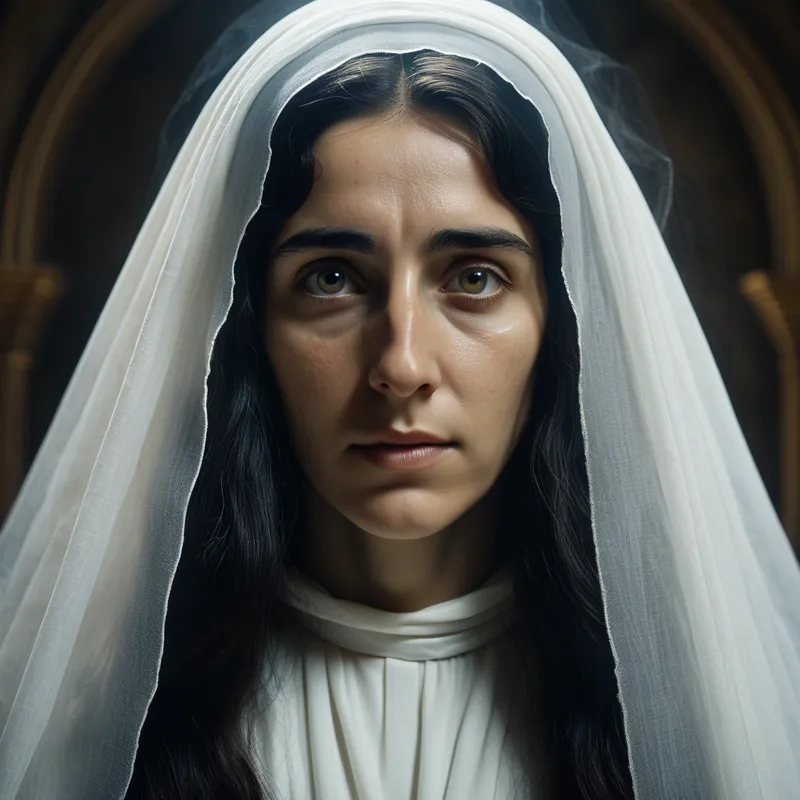
Veil of Veronica Myth Meaning & Symbolism
A woman's act of mercy during the Passion leaves the true image of Christ imprinted on her veil, a relic of compassion made eternal.
The Tale of the Veil of Veronica
The stones of Jerusalem were hot with the fever of a crowd. The air, thick with dust and the metallic scent of fear, carried the sound of labored breathing and the cruel crack of a lash. On the Via Dolorosa, a river of humanity parted around a singular, crushing spectacle: a man, broken by wood and weight, stumbling under the world’s scorn.
His name was whispered by some, cursed by others. To the soldiers, he was a task. To the authorities, a problem solved. But to a woman named Veronica, who watched from the shadow of a doorway, he was simply a man in the final extremity of suffering. She saw not the accused king, but the sweat and blood mingling with the grime of the street, the trembling muscles, the human face disappearing beneath a mask of agony.
A compulsion, fiercer than fear, moved her feet. She did not think of doctrine or consequence. She pushed through the press of bodies, her own heart hammering a counter-rhythm to the march of boots. The soldiers’ shouts were a distant roar. Her world narrowed to the few paces between her and that ravaged figure.
As he faltered, his cross threatening to crush him into the stone, she was there. In her hands was a simple square of linen, her veil. It was a practical thing, for dust and modesty. Now, it was an instrument of impossible grace. She stepped forward, and with a tenderness that silenced the very air around her, she lifted the cloth. She did not speak. Her action was her prayer. Gently, she wiped the sweat, the blood, the spittle from his face. For a fleeting moment, their eyes met—infinite sorrow gazing into boundless compassion.
Then, the moment broke. The soldiers shoved him forward, and the procession lurched on toward the hill of skulls. Veronica stood still, the veil clutched to her chest. The crowd flowed around her like water around a stone. It was only when she looked down, her tears beginning to fall, that she saw.
The linen was no longer plain. Upon it, as if woven by the light of that shared glance, was an image. Not a painting, not a stain, but a perfect, living imprint of his face. Every line of suffering, every shadow of acceptance, the profound peace beneath the agony—all were there, captured forever. In her hands, she held not a used cloth, but a testament. The divine had been met in the human act of mercy, and it had left its signature.
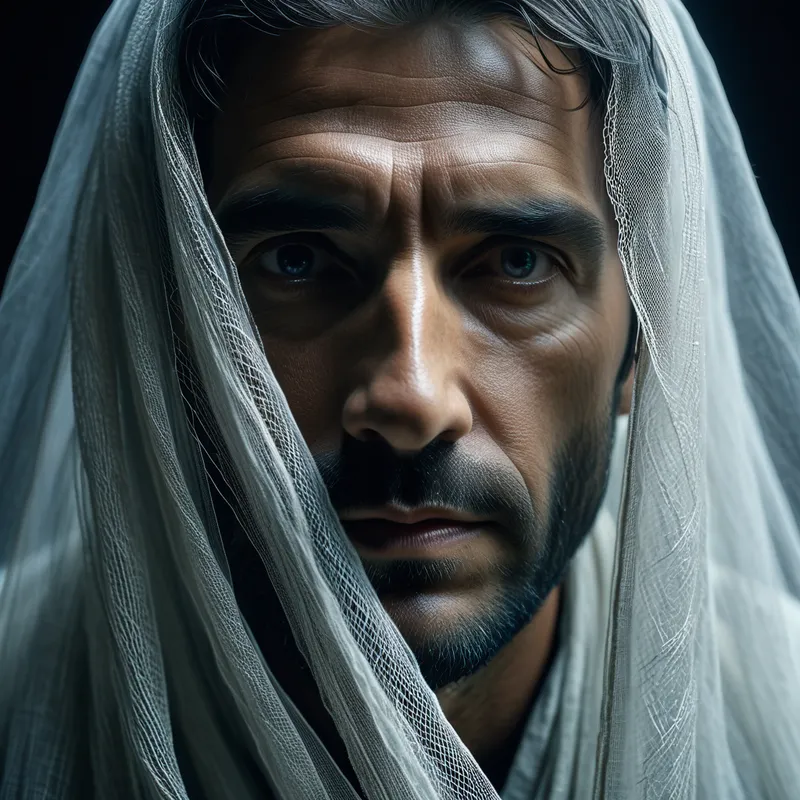
Cultural Origins & Context
The story of Veronica and her veil is not found in the canonical Gospels. It emerges from the rich soil of early Christian devotion and apocryphal tradition, crystallizing around the 4th century. It belongs to the genre of Acta Pilati and later medieval Passion narratives, where it served a vital devotional function.
Its primary vehicle was the Stations of the Cross, where it became the Sixth Station. Here, the myth moved from story to somatic ritual. Pilgrims in Jerusalem—and later, faithful in churches worldwide—would pause at this station, physically re-imagining Veronica’s act. The myth provided a tangible, human point of entry into the overwhelming mystery of the Passion. It answered a deep yearning: if one could not ease the Savior’s suffering, one could at least honor the memory of one who did. The veil itself, or its many claimed relics (most notably in St. Peter’s Basilica), became a sacramental focus, a proof that compassion leaves a permanent mark on reality.
Symbolic Architecture
At its core, the myth is an alchemy of encounter. The veil, a symbol of separation (between public and private, sacred and profane), becomes the very medium of connection and revelation.
The true image is not made by hands, but impressed by the meeting of suffering and compassion.
Veronica represents the archetypal witness who moves beyond passive seeing into active, risky engagement. Her act is not theological debate; it is instinctual, somatic care. The imprint on the veil symbolizes the irreversible transformation that occurs when consciousness (Veronica) fully encounters the Self (the Christ-image) in its most wounded, burdened state. The image is not a photograph of a man, but a cryptogram of a psychological truth: our deepest, most authentic face—our “true image”—is revealed not in triumph, but in the moment we are met with unconditional empathy.
The veil thus becomes a mandala of the Self. It holds the paradox: the face is of a man in extremis, yet the overall impression is one of sublime peace. It integrates agony and serenity, mortality and eternity, the human and the divine. It tells us that wholeness includes the shadow of suffering, and that this totality, when met with love, becomes sacred.

The Dreamer’s Resonance
When this myth stirs in the modern dreamscape, it often signals a profound moment of psychic impression. To dream of wiping a face, of seeing an image form on a cloth or mirror, or of discovering a hidden portrait, points to an ongoing process of seeing and being seen at the soul level.
Somatically, one might feel the weight of a burden (the cross) or the impulse to reach out (the veil). Psychologically, the dreamer is likely grappling with a “carried” suffering—either their own repressed pain or an empathetic identification with another’s trauma. The dream-veil represents the permeable boundary of the psyche where this encounter happens. The miraculous imprint is the dream’s assurance: this painful engagement is not for nothing. It is forging your “true face,” your authentic identity, which is always a composite of your experiences and the compassion you bring to them. The dream cautions against turning away from suffering (one’s own or another’s) and promises that courageous witnessing leaves an eternal, clarifying mark on the soul.

Alchemical Translation
The journey of the Veil of Veronica is a precise map for individuation. It begins with the nigredo, the blackening: the crushing weight of the cross, the brutal reality of suffering, both personal and collective (the Via Dolorosa). Consciousness (Veronica) initially observes from the shadows, in a state of sympathetic distress.
The alchemical leap is the solutio, the dissolution of boundaries. Veronica leaves her place of safety (the doorway) and offers her own substance (the veil). This is the ego surrendering its defensive distance to engage directly with the suffering contents of the unconscious (the burdened Self).
The transmutation occurs not in the avoidance of the burden, but in the intimate, caring contact with it.
The act of wiping is the coniunctio, the sacred marriage. It is the loving, attentive contact between conscious attitude and unconscious content. This is not an attempt to “fix” the suffering, but to acknowledge it with tenderness. The result is the albedo, the whitening: the creation of the luminous, permanent image on the veil. The suffering has not vanished, but it has been transfigured. It has become an integral part of a new, whole image—the Self.
For the modern individual, this myth instructs that our wholeness is forged in the street-level encounters with pain, not in the ivory towers of abstraction. Our “true image”—our authentic, indelible character—is the direct imprint of how we have met life’s most burdensome moments. Do we turn away? Or do we step forward, with whatever simple cloth of compassion we possess, and meet it? The myth assures us that in that meeting, something eternal is stamped upon the very fabric of our being. We become, like Veronica, both the witness and the revealed icon.
Associated Symbols
Explore related symbols from the CaleaDream lexicon: