Veil of the Temple Myth Meaning & Symbolism
The moment the sacred barrier is torn, revealing the ultimate mystery and ending the age of separation between humanity and the divine.
The Tale of the Veil of the Temple
Hear now of the moment the world’s axis shifted, not with a quake of land, but a tear in the fabric of heaven itself.
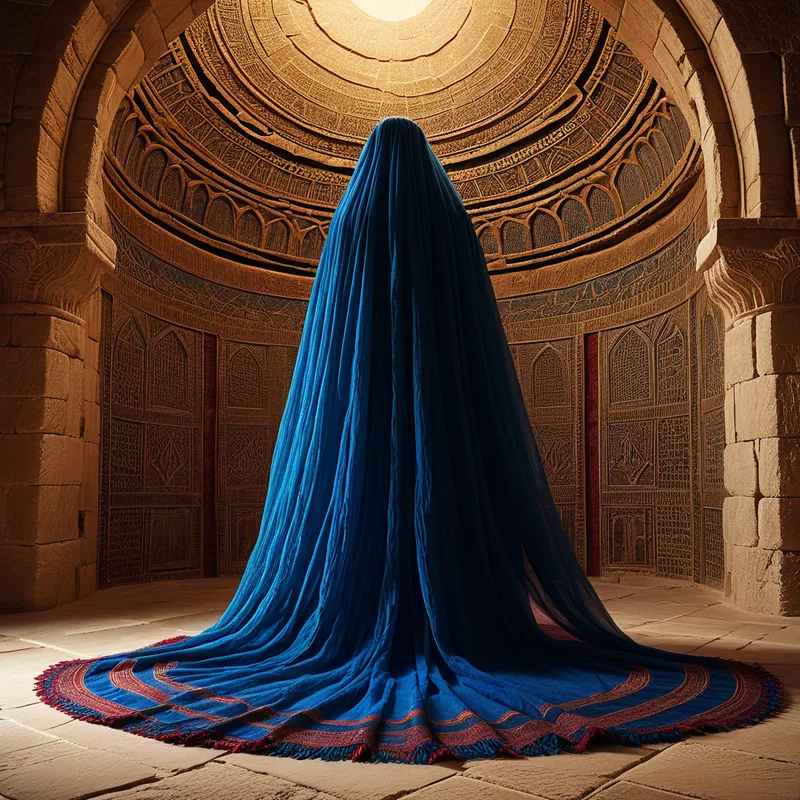
The air on the hill of the Skull was thick with the metallic scent of rain and blood. Darkness, deeper than any night, had swallowed the sun at midday—a darkness you could feel, a woolen blanket of dread pressed against the soul. Below, in the heart of the city, within the mountain of white stone that was the Temple, priests moved through their duties in the Outer Court. The rumble of distant thunder was mistaken for the groaning of the earth. The great Veil hung before them, a fortress of woven thread. Forty cubits high, a handbreadth thick, it was a tapestry of the cosmos—azure for the sky, scarlet for the fire of life, purple for the sea of mystery. It was the final door, the unbreachable boundary between the realm of men and the Holy of Holies, where the very breath of the Divine was said to rest. To pass it unbidden was to invite annihilation.
Then came the sound. Not a slow unravelling, but a violent, shrieking rip, like the sky being cloven in two. It came from the top, where the Veil met the ceiling of heaven’s proxy, and tore downward in one catastrophic gesture. The priests froze, their bowls of incense trembling. The sound echoed in the stone hall, followed by a profound silence, and then a gust of wind—not from the outside, but from within the now-exposed chamber. It was a wind that carried no scent of cedar or oil, but the chilling, electric scent of ozone and absolute presence. The darkness outside the Temple walls seemed to flood in, meeting the unveiled, unimaginable light from within. The barrier, maintained by centuries of sacred law and trembling reverence, was gone. The innermost secret stood exposed, not by human hands, but as if the heart of God itself had burst its seams in a moment of cosmic grief and triumph.
Cultural Origins & Context
This narrative is embedded within the Passion accounts of the Gospel texts (Matthew 27:51, Mark 15:38, Luke 23:45). Its tellers were early Christian communities, for whom the death of Jesus of Nazareth was not a tragic end, but the pivotal, transformative event of history. They wrote not as dispassionate historians, but as theologians interpreting a world-shattering moment through the lens of their Jewish heritage.
The function of this story was profoundly polemical and revelatory. For a culture steeped in the Torah and Temple ritual, where access to God was meticulously mediated by priesthood, sacrifice, and sacred boundary, the tearing of the Veil was a radical symbolic declaration. It announced the end of an era. The old system of separation—clean and unclean, holy and profane, priest and people—was rendered obsolete by a single, divine act. The story served to validate the early Christian claim that through the event of the cross, direct access to the divine was now available to all, a theme central to the Epistle to the Hebrews. It was a mythic image that dismantled the old religious architecture to make way for a new, interiorized understanding of the sacred.
Symbolic Architecture
The Veil is the ultimate symbol of the boundary. It represents every separation consciousness erects to manage the terrifying, overwhelming magnitude of the Self or the Divine. It is the line between the known and the unknown, the ego and the unconscious, the permissible and the taboo.
The tear is not an accident; it is a revelation. It signifies that the ultimate mystery cannot be contained by the structures built to honor it.
The direction of the tear—from top to bottom—is crucial. This is not a human achievement, an act of rebellion from below. It is a divine initiative, a grace that descends from the realm of the archetypal into the human world. It represents a rupture in the cosmic order initiated by the source of order itself. The exposed Holy of Holies is no longer a physical location, but a psychic reality: the innermost core of the individual, the imago Dei within, now accessible. The event transforms God from a distant, hidden monarch behind a curtain into an imminent presence unleashed into the common world.
The Dreamer’s Resonance
When this mythic pattern stirs in the modern dreamer, it often manifests as dreams of tearing fabric, crumbling walls, or doors that suddenly swing open to reveal a blinding or awe-inspiring light. There may be a sense of profound violation mixed with liberation, terror intertwined with ecstasy.
Somatically, the dreamer might experience this as a sudden release of tension in the chest or diaphragm—the feeling of a barrier giving way. Psychologically, this signals a critical point in a process of individuation. The conscious personality (the Outer Court) has maintained a rigid boundary against some profound content of the unconscious (the Holy of Holies)—perhaps a deep grief, a repressed talent, a spiritual longing, or a core aspect of identity deemed too powerful or taboo. The ego’s carefully constructed “temple” of persona and defense is being breached from within by a force it cannot control. The dream is an announcement: the period of separation is over. A direct, unmediated confrontation with what was hidden is now inevitable, and with it, the death of an old way of being.

Alchemical Translation
In the alchemy of the psyche, this myth models the nigredo and solutio—the blackening and dissolution—necessary for transformation. The hero’s journey here is not one of conquering a monster, but of enduring the catastrophic dissolution of the very container that defined reality.
The conscious ego is the priest, faithfully serving at the altar of its own identity, believing the ultimate mystery is safely and properly hidden behind a sacred protocol. The crucifixion event represents the ultimate sacrifice of the ego’s central organizing principle—its most cherished “son” or identity. At the moment of that sacrifice, when the ego surrenders its claim to ultimate control, the barrier falls.
The path to the gold of the Self is through the rending of the veil we wove to protect ourselves from its blinding light.
The alchemical triumph is not in repairing the tear, but in learning to stand in the unveiled space. It is the transmutation of a religion of external mediation into a spirituality of inner immediacy. For the modern individual, this means moving from a life governed by external authorities, inherited dogmas, and psychological projections (the intact Veil) to one grounded in direct, experiential encounter with the depths of one’s own being. It is the end of seeking God “out there” and the terrifying, glorious beginning of recognizing the divine spark within the shattered temple of the personal psyche. The rent remains; access is perpetual. The work is no longer to maintain the barrier, but to find the courage to enter.
Associated Symbols
Explore related symbols from the CaleaDream lexicon: