Vastu Purusha Myth Meaning & Symbolism
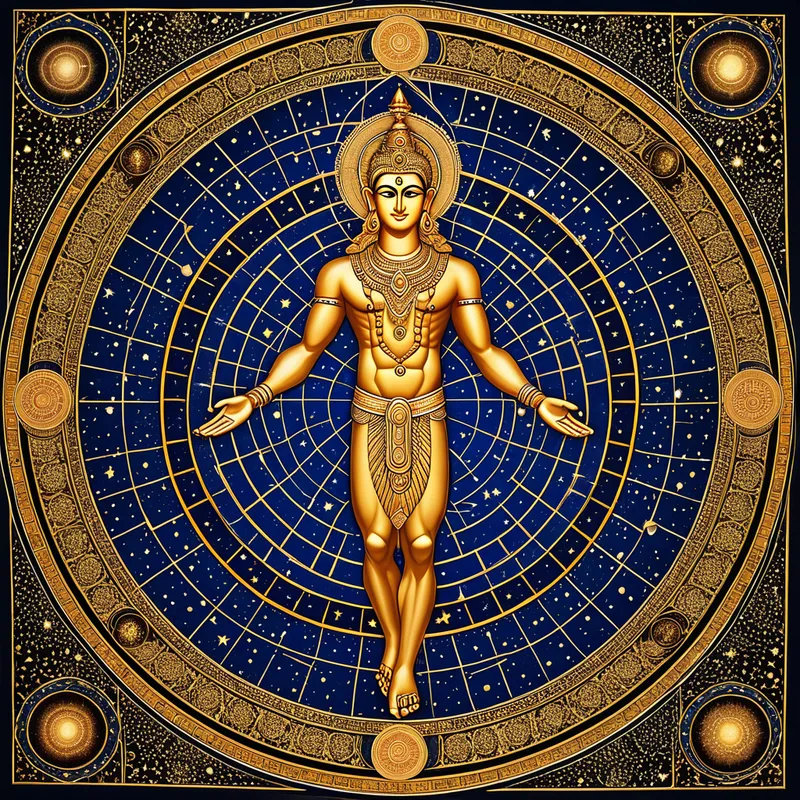
A cosmic giant is pinned beneath the world, his body becoming the sacred blueprint for all temples, homes, and cities, binding chaos into order.
The Tale of Vastu Purusha
In the time before time, when the worlds were still soft and unformed, a being of pure, hungry potential was born from the void. He was the Vastu Purusha, a giant of such terrifying appetite that his growth knew no bounds. He swelled, devouring light and space, his shadow swallowing the horizons. The heavens trembled, and the earth groaned beneath his weight. Chaos, his only companion, spread in his wake.
The pantheon of devas and asuras, locked in their own eternal churn, saw this new terror. Together, for once, they turned. A mighty host of forty-five—gods of sun and storm, of planets and directions, of fire and water—descended upon the writhing colossus. They did not seek to destroy him, for his energy was the very substance of creation. They sought to bind him.
A great battle, silent and cosmic, ensued. Not with weapons of metal, but with mantras of measure and gravity of purpose. They pressed him down, down onto the raw face of the earth. He fought, a tempest of limbs, but they were legion. Finally, the great god Brahma himself, the architect of universes, arrived. Seeing the giant pinned but still seething, Brahma understood the alchemy required. He did not slay. He consecrated.
With the weight of cosmic law, Brahma sat upon the giant’s heart, becoming the forty-sixth and supreme deity upon his form. The Vastu Purusha was pressed flat, his body stretched into a perfect square, his head to the northeast, his feet to the southwest. His rage cooled, his hunger transformed. His immense body did not become a corpse, but a living chart. His limbs, his joints, his organs became sacred sites, each governed by one of the deities who held him. The chaos was captured; the formless given form. From his still-living body sprang the first and eternal Vastu Purusha Mandala—the divine blueprint for all that is built, from a humble hearth to a celestial city.
Cultural Origins & Context
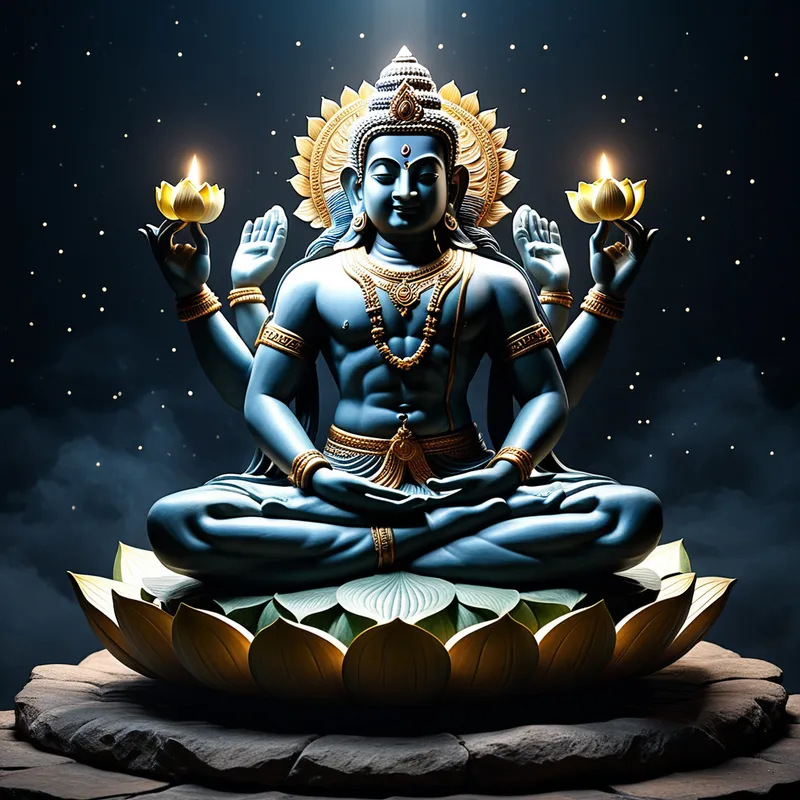
The myth of the Vastu Purusha is the foundational narrative of Vastu Shastra, a body of knowledge dating back to the Vedas. It is found primarily in later Puranic literature and technical Shastras. This was not merely a story for priests, but a practical cosmology for the artisan, the king, and the householder. It was passed down through guilds of architects (Sthapatis) and recited at the ground-breaking ceremony (Shilanyasa) for any significant structure.
Its societal function was profound: to sacralize the act of dwelling. By ritually re-enacting the pinning of the Vastu Purusha before construction, humans were not just building on land; they were participating in the primordial act of transforming chaotic space into ordered, living cosmos. The myth provided a spiritual and ethical justification for occupying space—it was a pact with the cosmic being whose body became the land itself. Every home, every temple, was thus a microcosm resting upon and honoring this divine sacrifice.
Symbolic Architecture
At its core, the Vastu Purusha represents the raw, unconscious, and potentially destructive energy of the material world—the tamasic ground of being. He is the unformed potential, the wildness that exists before culture, before the “house” of the self or society is built.
The foundation of all order is a negotiated peace with the chaos that precedes it.
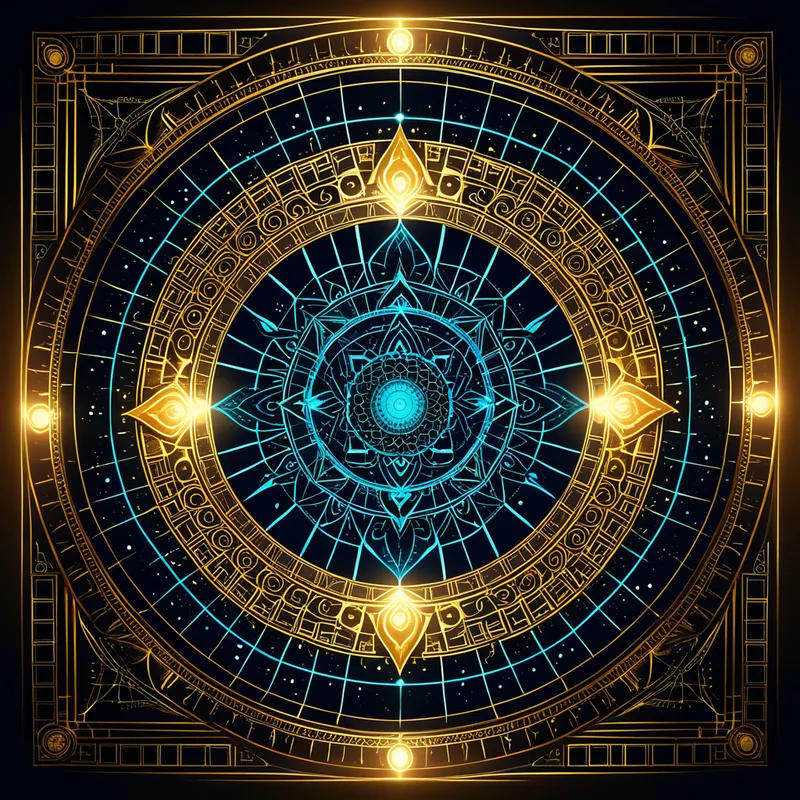
The act of pinning him is not a victory of good over evil, but of consciousness over unconsciousness, of rajas and sattva over untamed tamas. The forty-five (or forty-six) deities represent the organizing principles of the cosmos—directional energies, elemental forces, and planetary influences. They are the archetypal patterns that consciousness imposes to make reality intelligible and livable. The resulting mandala is a psychic map, a symbol of the integrated Self where every aspect of life—from wealth (Kubera in the north) to knowledge (Saraswati in the northeast)—has its proper place, held in a dynamic, sacred balance.
The Dreamer’s Resonance
When this myth stirs in the modern unconscious, it often manifests in dreams of foundational anxiety or profound reordering. One might dream of their house being built on unstable, shifting ground, or of discovering strange, ancient rooms or blueprints within their own home. Another may dream of a heavy, benevolent pressure on their chest—not suffocating, but stabilizing—as if being gently pinned into a new alignment.
These dreams signal a somatic and psychological process of creating a container. The dreamer is likely in a life phase where raw experience, emotional chaos, or unintegrated potential (the Vastu Purusha) is demanding structure. The psyche is attempting to “pin down” this energy, to map it onto a personal mandala—a new career path, a healed relationship, a stronger sense of identity. The discomfort of the pinning is the growing pains of giving form to the formless within oneself.
Alchemical Translation
For the individual, the myth models the essential process of individuation: the construction of a stable, sacred psyche from the raw materials of instinct and archetype. Our personal “Vastu Purusha” is the shadowy, overwhelming totality of our unconscious—our repressed desires, inherited traumas, and boundless potential. It can feel like a devouring chaos that threatens to overwhelm our conscious life.
The “deities” are the archetypal forces and conscious virtues we must invoke to negotiate with this inner giant. Discipline, compassion, wisdom, creativity—these are the divine agents that help us press down and map our inner chaos. Brahma, the conscious ego seated at the center (the heart), represents the integrating principle, the “I” that takes responsibility for this sacred architecture.
Individuation is not the eradication of the primal self, but its consecration into the living blueprint of a soul.
The alchemical goal is not to kill the giant, but to transform his energy. We do not eliminate our wildness, our passions, or our depths; we honor them by giving them a designated, sacred place in the structure of our being. The final “temple” or “home” that is built is the individuated Self—a resilient, harmonious psyche where every part, even the once-terrifying ones, is acknowledged, positioned, and integrated into a living, holy whole. We become both the site and the dweller, resting peacefully upon the transformed body of our own nature.
Associated Symbols
Explore related symbols from the CaleaDream lexicon: