Varna System Myth Meaning & Symbolism
A cosmic myth of primordial sacrifice, where the divine body becomes the blueprint for human society and the architecture of the soul.
The Tale of Varna System
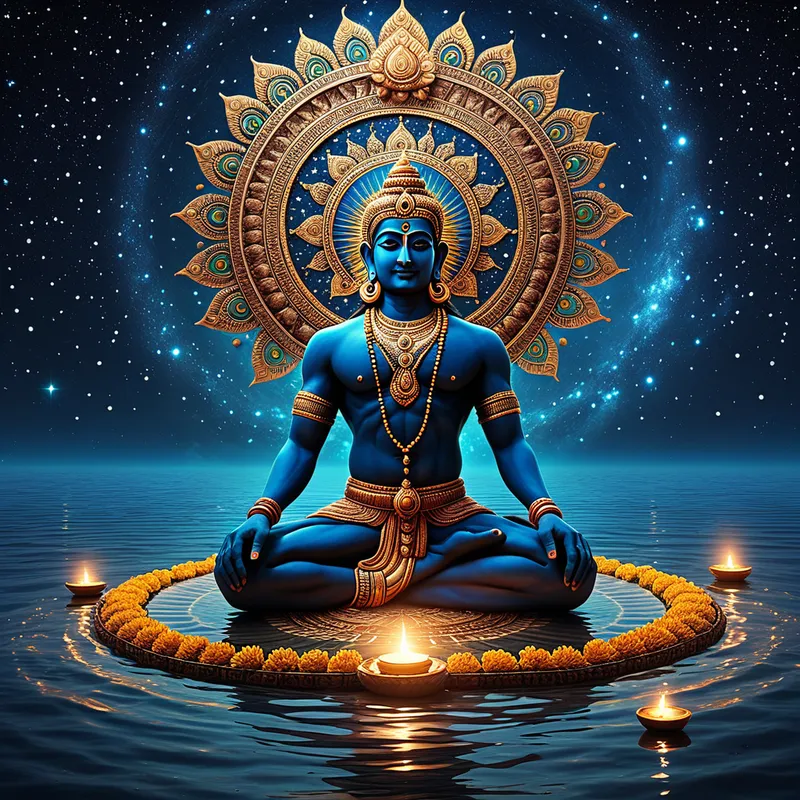
In the time before time, when the world was a single, unbroken ocean of potential, there lay a being. Not a man, not a god, but the Purusha. He was vast, a thousand-headed, thousand-eyed, thousand-footed giant of pure consciousness, filling all space, containing all worlds yet to be. He was the seed of everything, and he slept upon the waters of chaos, a silent, dreaming mountain of spirit.
From the formless dark, the first stirrings of desire arose—not a petty want, but the divine urge to become, to know itself through creation. The gods themselves, the shining Devas, were born from this yearning within the Purusha. They looked upon the sleeping giant, the totality of existence, and knew a sacred, terrifying truth: for the world to be born, the One must become Many. For life to flow, the still must be set in motion. This required the ultimate act: a sacrifice.
So they gathered, these first-born powers—Agni, the fire; Brihaspati, the word; and the others—and with solemn purpose, they bound the Purusha. Not with ropes of hemp, but with the cords of sacred intention. They laid the cosmic being upon the altar of the void, the grass of the ceremony scattered across the starless deep.
With the first chant, the atmosphere crackled. With the first offering of clarified butter into the mouth of Agni, the universe held its breath. Then, the knife of sacrifice, forged from divine will, descended. It was not a act of violence, but of profound, necessary severance. As the Purusha was offered, he did not cry out in pain, but sighed a sigh that became the wind in all worlds.
From his mouth, purified by speech and breath, came the people of clear thought and luminous word. From his arms, mighty and protective, sprang the people of strength and guardianship. From his thighs, the pillars of sustenance and support, emerged the people of nourishment and commerce. And from his feet, steadfast and grounded upon the earth, arose the people of foundation and service.
His mind became the moon. His eye became the sun. From his breath came the wind, and from his navel, the atmosphere. From his head, the sky unfurled; from his feet, the earth solidified. The Varnas were not merely born; they were extracted, like precious essences from the alchemy of the One. The sacrifice was complete. The single body was now a living universe, a society, a cosmos—all sprung from the same sacred source, each part essential to the life of the whole.
Cultural Origins & Context
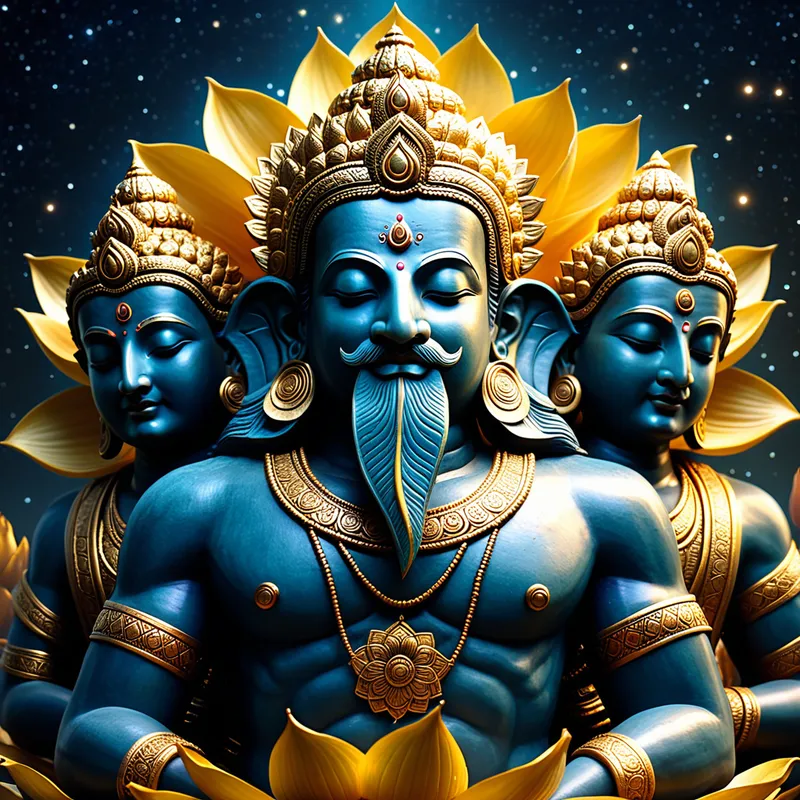
This foundational narrative is enshrined in the Rig Veda, specifically in the famed Purusha Sukta (Hymn of the Cosmic Person). It is among the oldest cosmological poems in human history, dating back over three millennia. It was not a political manifesto, but a cosmogonic hymn—a sacred explanation for the origin and structure of reality itself, chanted by priestly seers (Rishis) during elaborate fire sacrifices (yajna).
Its societal function was profound. It provided a divine, metaphysical blueprint for the organization of early Vedic society. By rooting social differentiation in the very body of the creator, it presented a vision of inherent, pre-ordained order (Dharma). It was a myth of integration, asserting that every function, from the priestly to the menial, was a vital organ of the social body, originating from the same sacred sacrifice. This was its primary cultural power: it offered a story of cosmic unity underlying apparent diversity, a narrative meant to foster interdependence and sanctify one's prescribed role within the cosmic whole.
Symbolic Architecture
At its heart, the myth of the Varna System is not a manual for social stratification, but a profound map of psychic wholeness. The Purusha represents the undifferentiated, complete Self—the totality of the human psyche before it is fragmented into roles, complexes, and conscious identities.
The sacrifice of the One is the necessary trauma of consciousness: to know itself, it must divide itself.
The four orders extracted from his body symbolize the four fundamental capacities or orientations within every individual:
- The Mouth (Priestly): The capacity for cognition, wisdom, and communication with the transcendent (the inner Rishi).
- The Arms (Protective): The capacity for action, willpower, protection, and the enforcement of order (the inner warrior or guardian).
- The Thighs (Sustaining): The capacity for production, exchange, sensuality, and nurturing the material world (the inner merchant or cultivator).
- The Feet (Foundational): The capacity for groundedness, support, practicality, and connection to the earth and the body (the inner servant who tends to basic needs).
The myth tells us that a whole person, a "cosmic person," must integrate these four aspects. To be only the head (all intellect, no action) or only the feet (all labor, no vision) is to live as a fragment, a dismembered piece of the original Self.
The Dreamer's Resonance
When this myth stirs in the modern unconscious, it rarely appears as ancient Indians. Instead, one might dream of being in a vast, bureaucratic building with four distinct departments, each with a locked door, trying to deliver a message but not knowing which office holds the right authority. Or one might dream of their own body feeling fragmented—a brilliant, talking head disconnected from weak arms, or strong, working feet that cannot feel the ground.
These are dreams of psychic dismemberment, reflecting the soul's distress at being identified with only one "varna" or function. The corporate executive (Arms) who dreams of losing their voice (Mouth) is experiencing this. The academic (Mouth) who dreams of their hands becoming useless (Thighs/Arms) is encountering this schism. The dream presents the conflict born from our cultural over-specialization, urging a re-membering of the sacrificed whole.

Alchemical Translation
The individuation process modeled here is the reconstitution of the Purusha. It is the alchemical work of gathering the scattered fragments of our being—the thinker, the doer, the feeler, and the keeper—and sacrificing our narrow identification with any single one to the fire of consciousness.
Individuation is not about becoming a perfect priest, warrior, merchant, or servant. It is about becoming the sacred ground upon which all four can perform their sacred function in harmony.
This begins with recognizing which aspect we are overly identified with (the inflated function) and which we have neglected or despised (the inferior function, our inner "shadow" varna). The intellectual must consciously engage the body (the Feet). The laborer must consciously honor their inner vision (the Mouth). The process is one of sacrificing the ego's claim to be only one part, allowing the other parts to be "born" from the larger Self.
The ultimate goal is to move from being a dismembered specialist to becoming an integrated vessel. One does not abolish the different functions but becomes the Purusha that contains them all—the silent, witnessing consciousness within which the priest can pray, the warrior can act, the merchant can trade, and the servant can clean, all as expressions of a single, sacred life. The myth, therefore, is an eternal invitation: to stop living as a scattered limb of the cosmos, and to start embodying the cosmos itself.
Associated Symbols
Explore related symbols from the CaleaDream lexicon: