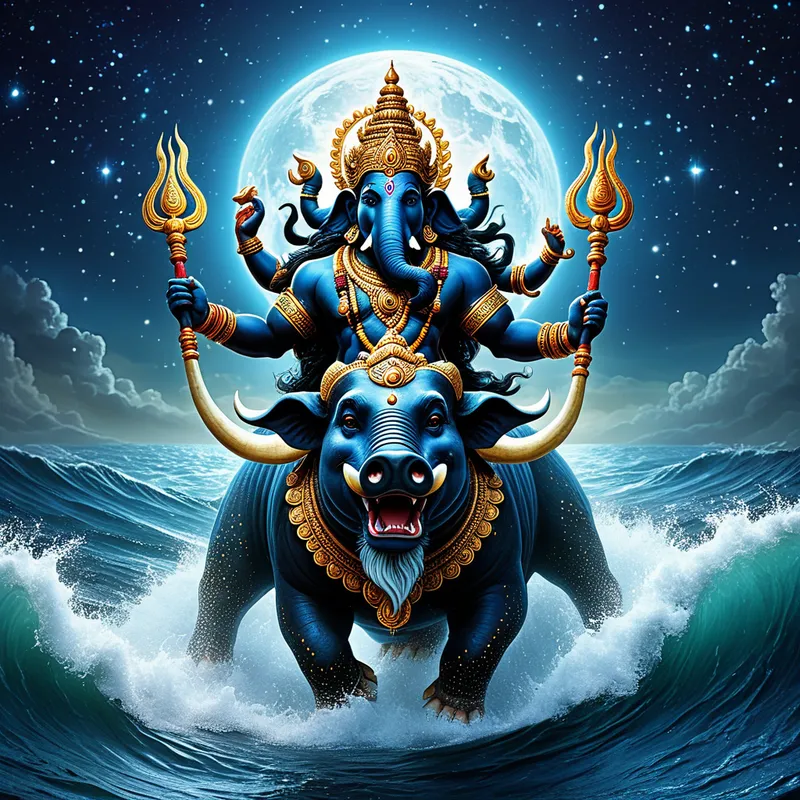
Varaha Myth Meaning & Symbolism
The story of the god Vishnu, incarnated as a cosmic boar, who dives into the primordial ocean to lift the submerged Earth back to order.
The Tale of Varaha
Listen. In the time before time, when the breath of creation was a whisper and the memory of order a fading dream, a great sigh echoed through the cosmos. It was the sigh of Bhudevi, the World-Mother. She had been pulled from her rightful place, dragged down into the abyssal waters of the Garbhodaka. There, in the crushing, formless dark, she lay submerged. The demon Hiranyaksha, whose name means “Golden-Eyed,” had struck her with his mace and cast her into the deep, a prize for his arrogance. The worlds above trembled, unmoored. Balance was lost. The axis of Dharma tilted perilously.
From the heart of this disturbance, a presence stirred. Not with a thunderclap, but with a low, resonant rumble that vibrated in the marrow of existence. It was the will of Vishnu, the all-pervading one. The crisis demanded not a distant god, but an embodied force, a principle made flesh—or rather, made fur, muscle, and tusk. From the nostril of Brahma, a form began to take shape. It grew, and grew, until it dwarfed mountains. It was Varaha, the Boar.
He was not a beast of the field, but the archetype of the beast, primordial and immense. His body was the color of a thundercloud at midnight, his bristles like forests of iron spears. His eyes held the patient fire of volcanoes, and from his jaw curved tusks—not of bone, but of luminous white diamond, capable of piercing dimensions. With a sound that was both a roar and a deep, grounding chant, he plunged. He dove into the chaotic ocean, parting waters that had known no division since the dawn of the cycle.
Down he went, into the absolute black. The pressure was the weight of forgotten epochs. Demonic shapes, spawn of Hiranyaksha’s chaos, swarmed and bit at his flanks, but his hide was the fabric of resilience itself. He did not fight them; he moved through them, a force of singular purpose. His snout, sensitive to the faintest vibration of matter, sought the scent of the lost one. And he found it—the subtle, mournful song of Bhudevi, buried under leagues of primal mud and the demon’s oppressive magic.
There, in the utter dark, he touched her. He did not grasp with hands, but offered the curve of his tusks, a cradle. He placed his mighty snout beneath her and began to rise. The ascent was the true battle. He lifted not just a sphere of mud, but the very principle of the solid, the tangible, the ground of being. The ocean fought to keep its prize; Hiranyaksha rose in fury, mace in hand, to challenge this upstart savior. Their battle shook the foundations of the deep. It was the clash of unbridled ego against selfless duty, of chaos against the imperative of order. Varaha fought with the earth itself at stake, and with a final, earth-rending blow from his tusk, he vanquished the demon.
And then, he emerged. Breaking the surface with a sound like a continent being born, he raised Bhudevi—now cleansed, radiant, and whole—upon his snout. He held her aloft, presenting her to the heavens. With a gentle, deliberate motion, he placed her back upon the back of the great serpent Shesha, in her ordained place in the celestial spheres. The worlds sighed in relief. The axis was righted. Order, rescued from the abyss, was restored.

Cultural Origins & Context
The myth of Varaha is woven into the earliest strata of Hindu thought, appearing in the Vedas and elaborated with profound narrative depth in the Itihasas and the Puranas, such as the Vishnu Purana and the Bhagavata Purana. It was not merely a story for entertainment, but a cosmological map and a social anchor. Recited by priests and storytellers, it served to explain the very nature of stability in a seemingly precarious universe. In a culture deeply connected to the land—where agriculture, settlement, and kingship were rooted in the earth—the image of the divine rescuing the terrestrial from chaos was a powerful reaffirmation of Dharma. It modeled the king’s duty (rajadharma) as the protector of the realm (the earth) from external and internal disorder. The myth also functions within the framework of the Dashavatara, establishing Varaha as the third descent, a crucial link between the aquatic and the terrestrial in the evolutionary symbolism of the avatar sequence.
Symbolic Architecture
At its core, Varaha is not a story of conquest, but of recovery. The boar is a profound and paradoxical symbol. It is an animal of the earth, a rooter, a creature that turns over the soil to find nourishment. In this divine context, it becomes the agent that turns over the chaos of the unconscious to recover the foundational Self.
The dive into the abyss is not an escape from reality, but the ultimate act of facing it. One must descend into the mud of one’s own origins to lift one’s essential nature into the light.
The submerged Bhudevi represents more than the planet; she is the anima mundi (the world soul), the grounded aspect of the psyche, our connection to the body, to nature, to instinct, and to stability. When this is “lost” to the demonic force of Hiranyaksha—symbolizing unchecked hubris, materialism, or sheer nihilistic chaos—the individual or the culture becomes dissociated, floating in anxiety without foundation. Varaha’s tusks are not weapons of destruction first, but tools of leverage and support. They represent the focused application of instinctual intelligence and sheer perseverance to lift what has been sunk. The act of placing Bhudevi on the serpent Shesha signifies the re-establishment of a dynamic, living support system—the psyche once again resting on the coils of deep, unconscious wisdom.
The Dreamer’s Resonance
When this myth stirs in the modern unconscious, it may manifest in dreams of profound sinking, flooding, or being trapped in mud or quicksand. The dreamer may feel a terrifying loss of solid ground, both literally and metaphorically—a career collapse, a relational rupture, a debilitating depression that feels like being pulled under. Alternatively, one might dream of a powerful, non-threatening animal—a boar, a bear, a bull—emerging from dark waters or woods to offer stability, to nudge or lift the dreamer to safety.
Somatically, this process correlates with a felt sense of collapse in the body—a heaviness in the limbs, a sinking feeling in the gut, shallow breath. The psyche is enacting the “Hiranyaksha moment,” where some aspect of life force or personal truth has been violently suppressed or stolen by an overpowering, demonic complex (often related to trauma, addiction, or a tyrannical inner critic). The appearance of the Varaha energy is the somatic counter-movement: a deep, grounding breath that feels like rising, a sudden solidity in the spine, the instinct to root down in order to rise up. It is the body’s wisdom initiating a rescue mission for the soul.

Alchemical Translation
The alchemical journey mirrored in the Varaha myth is the opus contra naturam—the work against nature, which here means against the natural pull of entropy and dissolution. For the individual, it is the process of salvaging the core Self from the engulfing waters of the personal and collective shadow.
Individuation often begins not with building a tower, but with diving into the swamp to recover the cornerstone that was thrown there long ago.
The first stage is the acknowledgment of the “sinking feeling,” the recognition that something essential is missing, submerged under layers of adaptation, trauma, or societal expectation (the mud of the Garbhodaka). The “Varaha” within is then invoked: it is that part of us willing to get its hands—or tusks—dirty. It is the stubborn, instinctual will to survive and thrive, the caregiver archetype expressed not as gentle nurturing, but as fierce, grounding intervention. This inner Varaha does not analyze the mud; it dives into it. It engages directly with the messy, chaotic, emotional, and instinctual material we have avoided.
The battle with Hiranyaksha is the inner conflict that arises when we try to reclaim this lost ground. The demon represents the psychic resistance—the voice that says we don’t deserve solidity, that chaos is our natural state, that the effort is futile. Overcoming it requires integrating the very “beastly” strength we initially feared. Finally, the act of lifting and repositioning Bhudevi is the moment of reintegration. The recovered “earth” is not the naive innocence of the past, but a matured, grounded Self, now consciously placed upon a new, more resilient foundation of self-knowledge and acceptance. We are not just rescued; we are re-founded. The myth thus offers a timeless blueprint: to save our world, we must first dare to dive into its darkest waters, trusting the primal, caring strength within to bring us back to solid ground.
Associated Symbols
Explore related symbols from the CaleaDream lexicon: