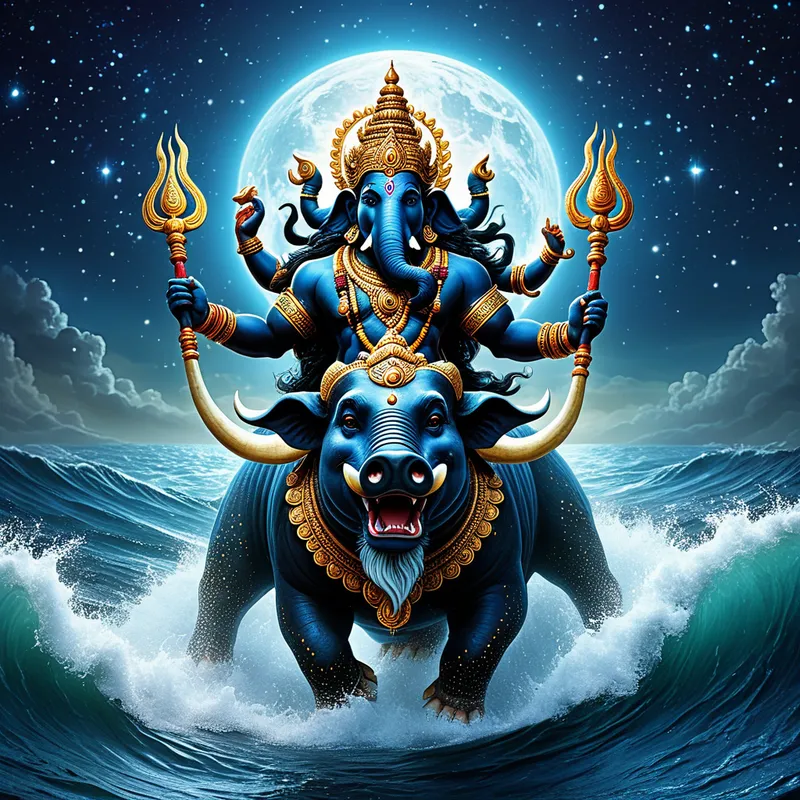
The Dream of Rescue: A Call from the Depths
The Somatic Echo
Before the narrative forms, before the figures appear, the dream of Rescue announces itself as a somatic gravity. It is a pull in the solar plexus, a hollow ache that feels less like emptiness and more like a magnetic yearning. The breath becomes shallow, held in anticipation of a demand you have not yet heard. There is a tension in the shoulders—the weight of an invisible burden, or perhaps the readiness to lift one. This is the body’s ancient language, speaking of a schism. Something vital has been cordoned off, sent into exile in the interior shadows, and its absence creates a low-grade psychic hum, a vibration of incompleteness. The dream is not a story about danger; it is the danger itself, made flesh in feeling. It is the psyche’s way of translating a structural fault into a visceral plea.
The Dreamer's Log
The dreamer finds themselves in a cavernous, derelict server farm, the air thick with the smell of ozone and damp concrete. On a flickering terminal, a single line of green text pulses: "Primary emotional protocol offline. Containment breach in Sector 7." From a dark pool at the room's center, a faint, rhythmic tapping echoes, like code against glass from the inside.
Alchemical Interpretation: The dreamer’s logical, operational self (the server) has failed to contain a vital, feeling-based intelligence (the trapped code), which now signals from the watery depths of the unconscious, demanding retrieval and reintegration.

The False Lead
The dream of Rescue is not a literal premonition of external catastrophe, nor is it a simplistic wish for a savior to solve your waking-life problems. To interpret it as such is to remain on the surface of a very deep ocean. It is not about the fortuitous arrival of help, but about the profound recognition of a need for it—a need that originates entirely within. The terror of the scenario is not the threat itself, but the dawning realization that the isolated, conscious ego cannot address it alone. This dream does not forecast bad luck; it diagnoses a forgotten dependency. The rescue required is not from a burning building, but from the architecture of a psyche that has walled off its own foundation.
Psychological Architecture
To dream of rescue is to encounter the shadow work of retrieval. Within the internal family of the psyche, certain parts—often those holding raw vulnerability, unmet childhood needs, creative fury, or primal grief—are deemed too intense, too messy, or too dangerous for the conscious self to manage. They are exiled. We construct internal server farms, logical containment units, to keep these "emotional protocols" offline. But an exiled part does not disappear; it amplifies. It becomes the child in the well, the code in the dark pool, the voice from the crumbling tower. The dream is the moment the containment field flickers. The Individuation process here is not one of adding new traits, but of courageously descending to reclaim what was always yours. It is the ego, the ruler of the daylight mind, being compelled to negotiate with its own forgotten citizens. The sovereignty gained is not dominance, but wholeness—a reintegration that heals the schism and ends the civil war within.
Mythic Resonance
This process echoes in the myth of Inanna’s Descent. The Queen of Heaven and Earth does not journey downward for conquest, but to witness the funeral of her shadow-sister, Ereshkigal, Queen of the Underworld. At each of the seven gates, she is stripped of her symbols of power—her crown, her lapis beads, her royal robe—until she stands naked and bowed before her own dark twin. She is killed and hung on a hook. Her rescue comes not from without, but from the careful, negotiated arrangements she made before her journey. It is a rescue by her foresight from her own necessary annihilation. Similarly, the Greek Orpheus descends not to fight Hades, but to sing. His rescue mission for Eurydice is a plea from the heart’s deep artistry to the realms of death and memory. His failure—the glance back—is the eternal reminder that the retrieved part must be integrated on faith, not clung to with the possessive gaze of the old consciousness. Both myths teach that the one who descends is both the rescuer and the one who must be fundamentally changed by the encounter.
Symbolic Nodes
- The Trapped Figure (Child, Animal, Older Self): The exiled part of the psyche, often appearing in a form that evokes instinctual care.
- Impossible Geography (High Tower, Deep Well, Submerged Room): The psychological distance and isolation of the exiled part.
- Failing Systems (Breaking Rope, Flickering Lights, Locked Doors): The conscious ego’s strategies and defenses proving inadequate.
- The Arriving Vehicle (Boat, Helicopter, Unlikely Animal): The emergent, often unconventional, psychic function capable of bridging conscious and unconscious.
- The Rescuer (Stranger, Known Person, Self in Different Form): The archetypal energy activating to facilitate the retrieval, often a aspect of the Self.
Archetypal Resonance
The core energy of the Rescue dream resonates most powerfully with The Orphan Archetype. Not its shadow aspect of Victim, but its essential, profound core: the Realist and the Survivor.
The Orphan’s essence is the profound understanding of exile and the hard-won knowledge that wholeness requires connection. Its somatic echo is that hollow pull, the deep knowing of being separated from one’s own source. The Rescue dream is the Orphan within signaling its location from the underworld of the psyche. This archetype does not wallow; it accurately assesses the terrain of abandonment and initiates the search for the authentic family—which, in alchemical terms, is the integrated Self. Its potential is to transmute the raw experience of loss into a relentless, grounded drive for genuine belonging, first and foremost within one’s own being. To answer this dream’s call is to activate the inner Orphan not as a wounded child, but as the most honest part of you, the one who knows exactly what is missing and is ready, at last, to go and find it.
The Alchemical Process
The alchemical transmutation here is Reunion. The prima materia is the felt-sense of fragmentation, the grief of the lost part. The heat and pressure are generated by the sustained tension between the conscious life—which functions, albeit with a silent hum of absence—and the unconscious plea, which grows louder in dreams. This is the nigredo, the blackening: the despair that no external solution exists. The fire is the courage to turn inward, to heed the call and descend without guarantee. The dissolution occurs as the old self-concept of independence or completeness is shattered by the encounter with the exiled one. Then, in the depths, the conjunctio: the meeting. It is not a merger, but a recognition. "You are mine. I am yours." The rescued and the rescuer behold each other, and in that gaze, a new compound is formed. The liberated element is brought up, not to dominate the psyche, but to take its rightful place within the internal council. The gold produced is sovereignty—not the rule of a monarch over subjects, but the harmonious governance of a complete realm.

The Integration Protocol
Question 1: In the dream, what specific quality did the trapped figure or entity possess (e.g., silent terror, fierce anger, pure joy, creative chaos) that you have difficulty allowing space for in your waking life?
Question 2: If the rescuer in the dream was not your waking-self, what power or capability did they embody that your current conscious identity feels it lacks?
Question 3: What in your life right now feels like the "failing system" or "impossible geography"—the structure or strategy that is straining to contain a truth that is asking to be free?
Action 1 (Somatic Reclamation): For one week, dedicate five minutes upon waking to lie still. Re-enter the dream's somatic echo—locate the pull, the ache, the tension in your body. Do not narrate it. Breathe into that specific area. Imagine your breath as a neutral, accepting presence, simply keeping company with that sensation, acknowledging its existence without demand.
Action 2 (Dialogic Retrieval): In a journal, write a letter from the trapped figure in your dream to your waking self. Let it speak. Then, write your response. Do not censor. This is not about fixing, but about establishing diplomatic relations with a long-lost internal citizen.
Action 3 (Ritual of Welcome): Create a simple, physical symbol for the rescued quality (a found stone, a drawn sigil, a specific piece of music). Perform a small, private ritual: light a candle, place the symbol before you, and verbally state, "You are welcome here. This psyche is your home." Then, carry or place the symbol where you will see it daily, as a token of the new internal alliance.
Final Validation
To have this dream is to feel the profound difficulty of being divided against yourself. It is exhausting. The longing for rescue is real, and the terror of the depths is valid. This dream does not come to those who are merely stressed; it comes to those who are ready, at a soul level, to end an inner exile. It is the map, drawn in the language of symbol and sensation, to a treasure you were forced to abandon. The journey is inward, and the sovereignty you seek is not over a kingdom, but in the reunification of one. You are not being called to find a savior. You are being called to become one—for the parts of you that have been waiting, in the dark, for your return.