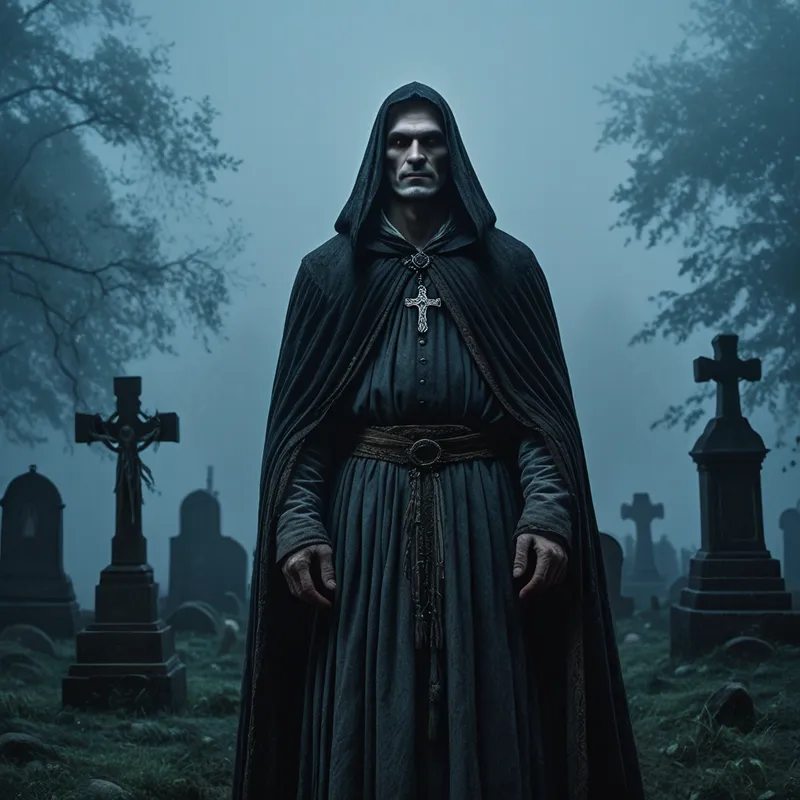
Vampires Myth Meaning & Symbolism
A restless soul, the Slavic vampire is born from a 'bad death,' haunting its kin, demanding ritual recognition to finally find its way to the otherworld.
The Tale of Vampires
Listen, and hear the tale that is told when the sun dies behind the forest and the long shadows eat the village paths. It begins not with a castle, but with a grave. A grave that is not quiet.
There was a man—a good man, perhaps, or a troubled one. But his end was not peaceful. He died by his own hand, tangled in despair. He died far from home, unshriven. He died with a curse hot on his lips. Or perhaps he was simply… different. A stranger in life, he became a stranger in death. They buried him with the rites, but [the earth](/myths/the-earth “Myth from Hindu culture.”/) itself seemed to reject him. The soil over his mound remained loose, disturbed. Animals would not go near.
Then, the first sign. A cow, sturdy and healthy, found dead at dawn, its milk turned to blood in the pail. Then a child, rosy-cheeked and laughing, fell into a wasting sickness, pale as moonlight, crying out in dreams of a heavy weight upon its chest. A slow dread seeped into the village like a fog. Whispers gathered in the dark corners of the banya.
“It is him,” the elders would murmur. “He walks.”
For he did walk. On nights when [the moon](/myths/the-moon “Myth from Tarot culture.”/) was a sliver, they would hear it—a slow, dragging step through the barley fields, a low, guttural moan at the window. He was not the elegant lord of later tales. He was upir, a swollen [thing](/myths/thing “Myth from Norse culture.”/), bloated with the stolen life of kin and beast, his skin darkening, his nails grown long like claws. He returned always to his own, a hungry shadow drawn to [the hearth](/myths/the-hearth “Myth from Norse culture.”/) he once knew.
The terror grew until the village could bear it no more. The znakharka was summoned. With grim resolve, the men took up spades and axes. At the stroke of noon, when the sun held its highest power, they went to the troubled grave. They dug. And there he lay, not decayed, but full and ruddy, fresh blood staining his lips and shirt. His eyes were open, staring at a sky he could no longer see.
This was the moment of truth, the terrible mercy. The znakharka would drive a stake of [hawthorn](/myths/hawthorn “Myth from Celtic culture.”/)—the pure wood—through his heart. A great sigh would escape the corpse, a release of trapped breath and malice. Sometimes, they would cut off the head, placing it between the feet. Then, they would burn the body, scattering the ashes at a crossroads, a place of no belonging. Only then would the sickness lift, the nightmares cease, and the grave grow still, the earth finally accepting its charge. The village, through this violent, sacred act, had healed its own wound.
Cultural Origins & Context
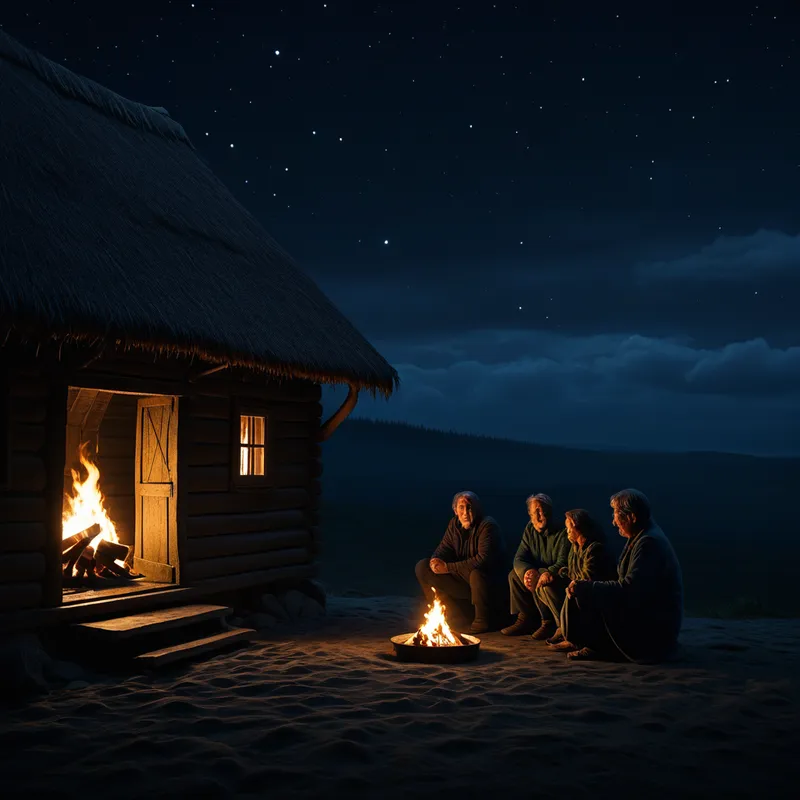
The Slavic vampire is a creature of the soil and the soul, born from a profound and intimate relationship with the cycles of life, death, and community. These beliefs are not the gothic fantasies of 19th-century novels, but deep-seated folk understandings that served a critical societal function. They were passed down orally, in the stories told by grandmothers by the fire and in the practical knowledge of the village wise-woman, the znakharka.
[The vampire](/myths/the-vampire “Myth from Global culture.”/) was a diagnosis for misfortune—a sudden plague, livestock death, or wasting illness. Its origin was always a “bad death”: suicide, murder, dying unbaptized, or being a witch or an outsider. The community’s greatest fear was the corruption of the natural order. A proper death required a proper transition, a guided journey to Nav. A “bad death” created a soul stuck in the liminal space between worlds, unable to move on. This trapped soul, festering with unresolved energy, would physically rise to prey on the living, starting with its own family.
The myth was a narrative container for managing collective anxiety about death, disease, and social discord. The ritual of staking and burning was not mere monster-slaying; it was a desperate, communal exorcism and a final funerary rite. It reaffirmed the boundaries of the village, both physical and spiritual, by violently expelling that which threatened its holistic health.
Symbolic Architecture
At its core, the Slavic [vampire](/symbols/vampire “Symbol: Vampires symbolize the darker aspects of desire, fear of intimacy, and the fear of being drained emotionally or physically by others.”/) is the embodied [Shadow](/symbols/shadow “Symbol: The ‘shadow’ embodies the unconscious, repressed aspects of the self and often represents fears or hidden emotions.”/) of the [community](/symbols/community “Symbol: Community in dreams symbolizes connection, support, and the need for belonging.”/) and the individual [psyche](/myths/psyche “Myth from Greek culture.”/). It represents what has been denied, betrayed, or improperly buried.
The vampire is the past that will not stay dead, the unspoken grievance that feeds on present vitality.
It is the consequence of a [life](/symbols/life “Symbol: The symbol of ‘Life’ represents a journey of growth, interconnectedness, and existential meaning, encompassing both the joys and challenges that define human experience.”/)—or a [truth](/symbols/truth “Symbol: Truth represents authenticity, honesty, and the quest for knowledge beyond mere appearances.”/)—not fully lived or honestly concluded. The “bad [death](/symbols/death “Symbol: Symbolizes transformation, endings, and new beginnings; often associated with fear of the unknown.”/)” symbolizes any traumatic, abrupt, or unresolved ending: a [betrayal](/symbols/betrayal “Symbol: A profound violation of trust in artistic or musical contexts, often representing broken creative partnerships or artistic integrity compromised.”/) left unaddressed, a [passion](/symbols/passion “Symbol: Intense emotional or physical desire, often linked to love, creativity, or purpose. Represents life force and deep engagement.”/) denied, a [grief](/symbols/grief “Symbol: A profound emotional response to loss, often manifesting as deep sorrow, yearning, and a sense of emptiness.”/) swallowed but not processed. This unresolved psychic [material](/symbols/material “Symbol: Material signifies the tangible aspects of life, often representing physical resources, desires, and the physical world’s influence on our existence.”/) does not decay; it preserves itself in the dark [cellar](/symbols/cellar “Symbol: A cellar represents the subconscious mind, hidden emotions, and unacknowledged aspects of the self; it is a place of storage, preservation, and sometimes decay.”/) of the unconscious, growing swollen and potent.
Its [hunger](/symbols/hunger “Symbol: A primal bodily sensation symbolizing unmet needs, desires, or emotional voids. It represents craving for fulfillment beyond physical nourishment.”/) for the [blood](/symbols/blood “Symbol: Blood often symbolizes life force, vitality, and deep emotional connections, but it can also evoke themes of sacrifice, trauma, and mortality.”/) of kin is profoundly symbolic. It does not seek strangers, but the life-force of its own [lineage](/symbols/lineage “Symbol: Represents ancestral heritage, family connections, and the transmission of traits, values, and responsibilities across generations.”/). Psychologically, this represents how our deepest, unintegrated wounds and patterns (our “[family](/symbols/family “Symbol: The symbol of ‘family’ represents foundational relationships and emotional connections that shape an individual’s identity and personal development.”/) curses”) drain [energy](/symbols/energy “Symbol: Energy symbolizes vitality, motivation, and the drive that fuels actions and ambitions.”/) from our present relationships and endeavors. The vampire is the ancestral [trauma](/symbols/trauma “Symbol: A deeply distressing or disturbing experience that overwhelms the psyche, often manifesting in dreams as unresolved emotional wounds or psychological injury.”/), the silent family secret, that continues to feed on the living generations until it is consciously confronted.
The Dreamer’s Resonance
When this mythic pattern stirs in modern dreams, it rarely appears as a Hollywood Dracula. The dreamer may encounter a figure that is familiar yet horrifying—a deceased relative who feels unnervingly “present,” or a version of themselves that is pale, insatiable, and trapped. The setting is often a childhood home that feels corrupted, or a landscape of dark, loose soil.
Somnatically, these dreams are accompanied by sensations of being weighed down, of suffocation (the classic “old hag” syndrome), or of a chilling, draining presence. Psychologically, this signals that some part of the dreamer’s history is actively “feeding” on their current life energy. It is a call from the psyche that a past event, relationship, or self-concept has not been given a proper psychic burial. The dream is the symptom of the soul’s “bad death”—an ending that was ignored, rushed, or dishonored, and which now demands ritual attention.
Alchemical Translation
The process of confronting the Slavic vampire is a brutal but precise map for psychic alchemy—the individuation journey. The myth does not offer a gentle meditation; it prescribes a direct, noon-day confrontation with the buried thing.
First, one must locate the grave. This is the act of honest self-inquiry: identifying the source of the “bad death.” What trauma, rejection, or failed potential have you buried without proper rites? Next comes the digging—the painful, conscious excavation of that memory or pattern, bringing it into the clear light of awareness (the “noon sun”). There, you will see it not as a distant memory, but as something preserved, alive, and still feeding.
The stake through the heart is the act of decisive, compassionate truth. It is the firm, final statement: “This ends here.”
This is not repression, but conscious severance. It is speaking the unspeakable truth, feeling the buried grief, or finally setting the boundary that should have been set long ago. The sigh of release is the liberation of energy bound in maintaining the repression. Finally, the burning and scattering at [the crossroads](/myths/the-crossroads “Myth from Celtic culture.”/) symbolizes the full release and transmutation of this material. You do not keep the ashes; you return them to the liminal space, allowing the energy to be recycled by the psyche in a new form. The crossroads represents choice—having faced the vampire, you are now at a point where new paths, free of that old hunger, become possible. The community—your integrated self—is healed.
Associated Symbols
Explore related symbols from the CaleaDream lexicon: