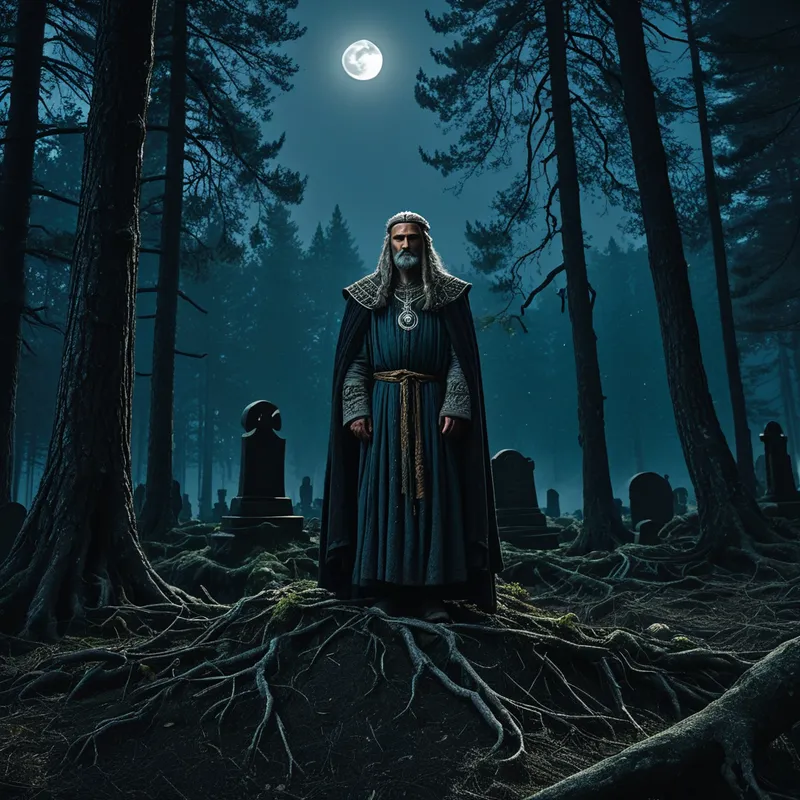
Vampire Lore Myth Meaning & Symbolism
A tale of the restless dead, the upír, who returns to drain the living, demanding ritual confrontation to restore the boundary between life and the unseen.
The Tale of Vampire Lore
Listen, and hear the rustle in the rye at twilight. Feel the chill that is not from the wind, but from the space between breaths. In the lands where the forest is a second skin and the earth remembers every footfall, there walks a truth older than churches, whispered from grandparent to child: the dead do not always rest.
He was once a man—a farmer, a father, perhaps a man of quick temper or one who died with a curse on his lips. His name is forgotten, for to speak it is to invite his attention. Now, he is an upír. He does not sleep in the good, dark earth. When the moon is a sliver, a nail-paring in the sky, he stirs. The soil over his grave grows loose, barren. Animals will not tread there.
He rises, not as a noble creature of the night, but as a swollen, ruddy-faced horror, clad in the linen of his burial. His nails are like talons, his mouth stained. He is hungry with a hunger that grain or meat cannot satisfy. He moves not with grace, but with a terrible purpose, back to the place he knew—his own home.
First, the livestock sicken. The best cow gives blood instead of milk. Then, the whispers begin in the house at night. A tapping at the window. Those who were closest to him in life are visited first. His widow grows pale, wasting away as if in a fever, dreaming of a heavy weight upon her chest, stealing her breath. His children cough blood into their rags. The hearth fire sputters and dies, though the wood is dry.
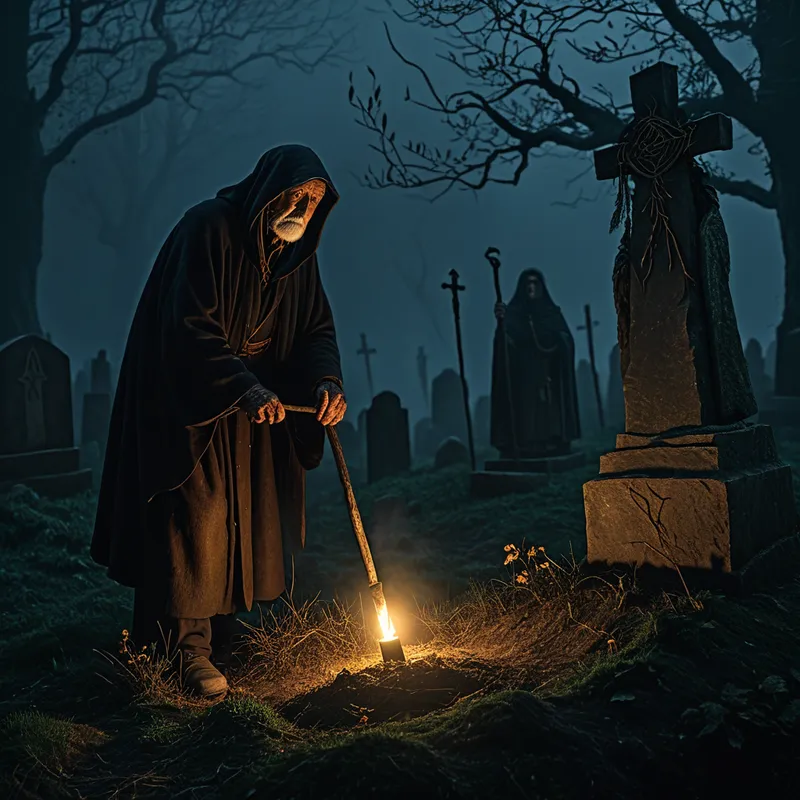
The village knows. The elder, the znakharka, is summoned. She reads the signs: the nightmares that are not dreams, the plague that walks from one house alone. The community must act. It is a grim, sacred duty. They go at noon, when the sun is highest, to the suspect grave. They exhume the coffin. And there he lies—not decayed, but full, lips parted, skin flushed as if in sleep. This is the proof.
There is no mercy in this ritual, only necessity. A stake of głóg or aspen is fashioned. It is not driven with rage, but with a solemn, dreadful precision, through the heart. Sometimes a scythe is laid across the throat. A stone is placed in the mouth. Then, the body is burned, and the ashes are scattered in running water. Only then does the widow draw a full breath. Only then does the child’s fever break. The boundary between the living and the dead, violently ruptured, is painfully, meticulously restored.
Cultural Origins & Context
The Slavic vampire was not a romantic figure, but a profound social and spiritual emergency. This lore thrived in the pre-Christian, animistic worldview of the Slavic peoples, where the cosmos was alive with spirits (domovoi, leshy) and the line between this world and the Nawia was thin. Death was a transition that required proper ritual—washing, dressing, vigil—to ensure the soul’s successful journey. A “bad death”—suicide, murder, dying unbaptized or under a curse—risked creating a soul that could not depart.
The upír or vrykolakas was the manifestation of this ritual failure. It was a communal problem, born from communal anxiety about order, purity, and the fear that the unresolved trauma of one could infect the many. The stories were passed down not for entertainment, but as a survival manual for the soul. They codified a procedure for diagnosing and excising a psychic parasite that threatened the very vitality of the family and village. The vampire was the ultimate outsider created from within, a walking testament to improper endings.
Symbolic Architecture
At its core, the Slavic vampire myth is a powerful drama of the unassimilated shadow and the violation of psychic boundaries.
The vampire is the part of the self that did not die when it should have—the old identity, the unresolved grief, the swallowed rage—that now returns, not as memory, but as a draining, autonomous complex.
The vampire’s traits are symbolic indictments. Its ruddy, full body signifies a life-force that is not circulating but is stuck, feeding on itself and others. Its hunger for blood represents the theft of vital essence (život), not literal blood. It preys first on kin because our unresolved psychic material affects those closest to us most intensely. The grave that remains barren is the psyche’s fertile ground gone fallow, occupied by a static, draining entity.
The ritual staking and burning are not mere violence. They are a profound alchemy of containment. The hawthorn stake pins the wandering complex. The scythe severs its connection. The stone in the mouth stops its poisonous narrative. Burning transforms its stuck, solid form into ash, and scattering it in water allows for dissolution and reintegration into the flow of life. The myth presents a complete, if brutal, protocol for dealing with a psychic entity that refuses to be laid to rest.
The Dreamer’s Resonance
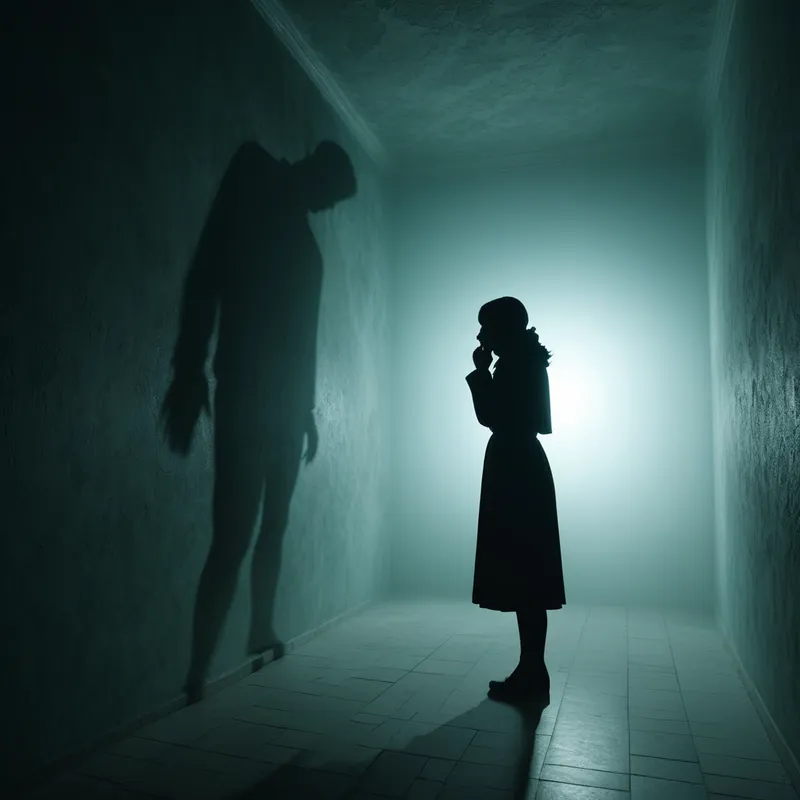
When this myth pattern stirs in the modern dreamer, it often signals a confrontation with a “psychic vampire”—an energy or complex that is draining one’s vitality. The dream may feature a familiar yet threatening figure, a presence in the bedroom causing sleep paralysis (echoing the old nočnica), or a sensation of being pursued or fed upon.
Somatically, this can correlate with chronic fatigue, a feeling of being “sucked dry” by a relationship or job, or depression that feels like a weight on the chest. Psychologically, the dream is the psyche’s diagnosis: an autonomous complex, often born from an unmetabolized trauma or a part of the personality that was never given a proper “burial” (e.g., a lost career, a past identity, a repressed talent), has become active. It is no longer dormant memory; it is an active, negative force drawing energy from the conscious ego to sustain its own half-life. The dream is the first tap on the window, the initial sickness in the livestock of the soul.
Alchemical Translation
The individuation process requires us to confront and integrate our shadows. The Slavic vampire myth provides a stark, potent model for this psychic transmutation. The modern “upír” is not a literal walking corpse, but the persistent, draining pattern—the chronic resentment, the entrenched victimhood, the addictive behavior that “lives on” long after its cause.
Individuation demands the courage of the village elder: to go, in the full light of consciousness (the noon sun), to the grave of this pattern, to exhume it, and to see it for what it is—not forgotten, but unnaturally preserved.
The alchemical work is in the ritual. Staking is the act of conscious insight: “I see you. I name you. Your movement ends here.” Placing the stone is the conscious refusal to let its story (“I was wronged,” “I cannot change”) be spoken anymore. Burning is the emotional catharsis and the application of transformative will—the fierce compassion required to dismantle a structure of the self. Scattering in water is the final release, allowing the energy bound up in the complex to be purified and returned to the psyche’s ecosystem.
The myth does not promise a pleasant task. It is gruesome, frightening, and communal—often requiring external support (therapy, community, spiritual direction). But its promise is the restoration of boundaries and the return of stolen vitality. By performing this psychic ritual, we do not become killers, but healers. We lay to rest the ghost that haunts us, not by fleeing, but by turning, facing the open grave, and completing the burial that life, in its chaos, left unfinished. In doing so, we reclaim our blood, our breath, and our right to stand firmly on this side of the earth.
Associated Symbols
Explore related symbols from the CaleaDream lexicon: