Valmiki's Ants Myth Meaning & Symbolism
The sage Valmiki, paralyzed by writer's block, is granted the gift of poetry by witnessing the perfect, selfless order of a colony of ants.
The Tale of Valmiki’s Ants
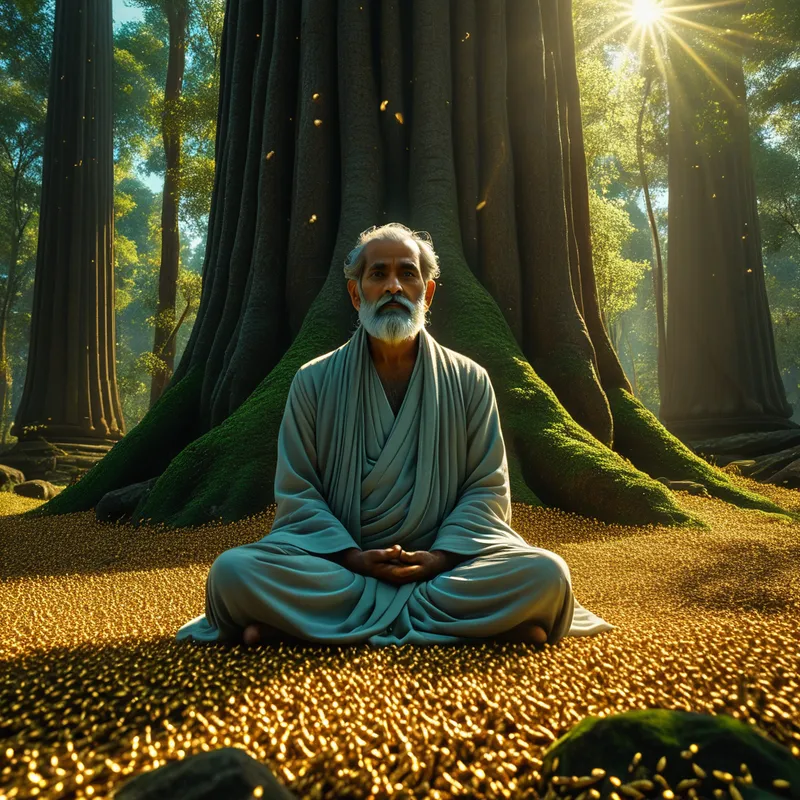
In the deep, green heart of [the world](/myths/the-world “Myth from Tarot culture.”/), where the air hums with the breath of [the earth](/myths/the-earth “Myth from Hindu culture.”/) and the silence is a living [thing](/myths/thing “Myth from Norse culture.”/), there lived a man whose soul was a tempest. His name was Valmiki, but in his heart, he was still a wilderness. He had turned from the ways of [the world](/myths/the-world “Myth from Tarot culture.”/), seeking the face of the divine in the solitude of the forest. He sat beneath a great, ancient tree, his body still as stone, his mind a roaring river of longing. He sought a vision, a word, a sign—anything to bridge the chasm between his human ache and the infinite silence of Brahman.
Days bled into nights, seasons turned, and the sage remained, a statue of devotion. Yet, a profound emptiness gnawed at him. He wished to praise, to articulate the ineffable beauty he sensed, but his tongue was heavy clay, his mind a locked chest. He was a vessel, but no song would pour forth. This was his tapasya—not of physical endurance, but of creative paralysis, a silence more deafening than any noise.
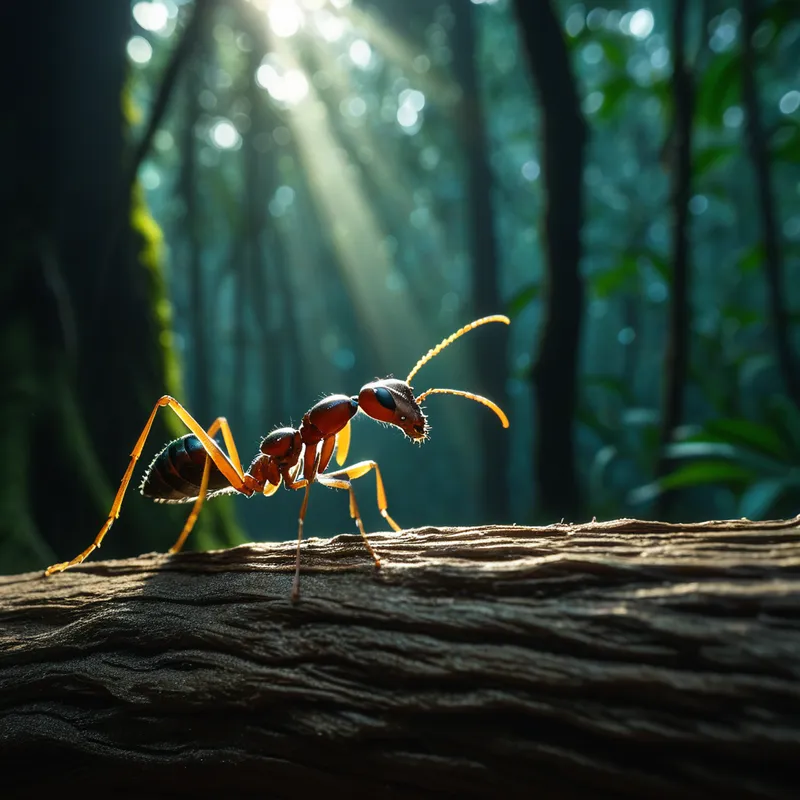
Then, one day, as the sun hung low and poured honeyed light through [the emerald](/myths/the-emerald “Myth from Medieval European culture.”/) leaves, his gaze—sharpened by years of inward looking—fell downward. There, at the base of his tree, was a universe in miniature. A column of ants, a river of tiny, determined life, flowed in an unbroken line. They moved not in chaos, but in a perfect, silent order. Each ant knew its place, its duty. One carried a leaf fragment ten times its size, another a precious droplet, another nothing but its own purpose. There was no hesitation, no conflict, only the seamless execution of a grand, invisible design.
Valmiki watched, his breath catching in his throat. He saw not insects, but a living hymn. Their procession was a verse, their tireless work a stanza, their collective will the epic poem of survival. In their selfless, ordered labor, he witnessed a purity of purpose he had been straining to find in the heavens. Here was divinity not in the distant, formless void, but in the humble, intricate dance of the earth.
A warmth flooded his chest, a loosening in his throat. The divine presence, Narayana himself, had not spoken in thunder or flame. He had whispered through the six-legged scribes of the soil. As Valmiki witnessed the perfect, rhythmic movement of the ants—valmika in Sanskrit—the first spontaneous shloka burst from his lips. It was a verse of compassion, born from this deep observation of life’s humble order. The dam of silence broke. [The river](/myths/the-river “Myth from Buddhist culture.”/) of poetry, which would become [the immortal](/myths/the-immortal “Myth from Taoist culture.”/) Ramayana, began to flow. The creator was born not in a blaze of ego, but in the humble awe of a disciple watching ants.
Cultural Origins & Context
This tale is nestled within the vast biographical lore surrounding Valmiki, the adi kavi or “first poet” of Sanskrit tradition. Unlike the central narratives of the Ramayana itself, this story belongs to the stratum of myth that surrounds the author—stories that explain his transformation from the bandit Ratnakara to the sublime sage and poet. It was passed down through oral tradition and later recorded in various Puranas and regional tellings.
Its societal function is multifaceted. Firstly, it democratizes inspiration. It suggests that divine wisdom and artistic genesis are not the sole province of grand rituals or received scripture, but can be accessed through mindful observation of the natural world. Secondly, it embeds a profound ecological and dharma-centric ethic. The ant colony is a microcosm of dharma—each part performing its role for the health of the whole. For a society deeply connected to agrarian and village life, this was a powerful metaphor for social harmony and duty. The myth taught that order (rita) and truth (satya) could be discerned in the smallest, most mundane processes of life.
Symbolic Architecture
The myth’s power lies in its stark symbolic contrasts and its [alchemy](/symbols/alchemy “Symbol: A transformative process of purification and creation, often symbolizing personal or spiritual evolution through difficult stages.”/) of the low into the high.
The Ants: They are the ultimate [symbol](/symbols/symbol “Symbol: A symbol can represent an idea, concept, or belief, serving as a powerful tool for communication and understanding.”/) of selfless duty, intricate order, and humble perseverance. They represent the unconscious, instinctual [pattern](/symbols/pattern “Symbol: A ‘Pattern’ in dreams often signifies the underlying structure of experiences and thoughts, representing both order and the repetitiveness of life’s situations.”/)—the [anima](/symbols/anima “Symbol: The feminine archetype within the male unconscious, representing soul, creativity, and connection to the inner world.”/) mundi or world [soul](/symbols/soul “Symbol: The soul represents the essence of a person, encompassing their spirit, identity, and connection to the universe.”/)—operating with flawless intelligence. They are [nature](/symbols/nature “Symbol: Nature symbolizes growth, connectivity, and the primal forces of existence.”/)’s innate poetry, a syntax of survival written in [dust](/symbols/dust “Symbol: Dust often symbolizes neglect, forgotten memories, or the passage of time and life’s impermanence.”/) and [effort](/symbols/effort “Symbol: Effort signifies the physical, mental, and emotional energy invested toward achieving goals and personal growth.”/).
Valmiki’s [Paralysis](/symbols/paralysis “Symbol: A state of being unable to move or act, often representing feelings of powerlessness, fear, or being trapped in waking life.”/): This is the egoic mind, the individual [consciousness](/symbols/consciousness “Symbol: Consciousness represents the state of awareness and perception, encompassing thoughts, feelings, and experiences.”/) straining to “create” from a place of will and [identity](/symbols/identity “Symbol: Identity represents the sense of self, encompassing personal beliefs, cultural background, and social roles.”/). It is the “I” that seeks to speak to the divine, and in its striving, finds only silence. It represents creative block, spiritual pride, and the disconnect from the instinctual, patterned flow of [life](/symbols/life “Symbol: The symbol of ‘Life’ represents a journey of growth, interconnectedness, and existential meaning, encompassing both the joys and challenges that define human experience.”/).
The [Revelation](/symbols/revelation “Symbol: A sudden, profound disclosure of truth or insight, often through artistic or musical means, that transforms understanding.”/): The [moment](/symbols/moment “Symbol: The symbol of a ‘moment’ embodies the significance of transient experiences that encapsulate emotional depth or pivotal transformations in life.”/) of [insight](/symbols/insight “Symbol: A sudden, deep understanding of a complex situation or truth, often arriving unexpectedly and illuminating hidden connections.”/) is not an acquisition of something new, but a re-membering. Valmiki [doesn](/symbols/doesn “Symbol: The word ‘doesn’ typically points to a lack or feeling of uncertainty regarding action or inactivity in one’s life.”/)‘t learn from the ants; he recognizes himself, and the [source](/symbols/source “Symbol: The origin point of something, often representing beginnings, nourishment, or the fundamental cause behind phenomena.”/) of all creation, within them.
The most profound poetry is not invented; it is overheard from the conversation the universe is having with itself.
The myth enacts a sacred inversion: the sage looking down to find what he sought by looking up. The “lowly” ant becomes the [guru](/symbols/guru “Symbol: A Guru represents a teacher or guide, often embodying wisdom, knowledge, and spiritual insight.”/). The earthly pattern becomes the divine [blueprint](/symbols/blueprint “Symbol: A blueprint represents the foundational plan or design for something, often symbolizing potential, structure, and the mapping of one’s inner self or future.”/). This dissolves the hierarchical split between [spirit](/symbols/spirit “Symbol: Spirit symbolizes the essence of life, vitality, and the spiritual journey of the individual.”/) and matter, sacred and profane. The first [verse](/symbols/verse “Symbol: A structured poetic line or stanza, often representing rhythm, order, and creative expression in dreams.”/) he composes is said to be one of spontaneous [compassion](/symbols/compassion “Symbol: A deep feeling of empathy and concern for others’ suffering, often involving a desire to help or alleviate their pain.”/) ([karuna](/myths/karuna “Myth from Hindu culture.”/)), indicating that true creativity is born from empathetic [connection](/symbols/connection “Symbol: Connection symbolizes relationships, communication, and bonds among individuals.”/)—from seeing the world, in all its parts, as a sacred, interconnected whole.
The Dreamer’s Resonance
When this mythic pattern stirs in the modern unconscious, it often manifests in dreams of small, intricate systems or overwhelming, repetitive tasks. One might dream of fixing a vast, complex clockwork; organizing a library with infinite, tiny books; or being part of a silent, purposeful procession.
Psychologically, this signals a process of psychic integration. The dreamer is likely struggling with a conscious goal—launching a creative project, solving a complex life problem, finding purpose—but feels blocked, overwhelmed by the “big picture” (Valmiki’s paralysis). The ants in the dream represent the unconscious offering a solution: break the monumental task into instinctual, manageable steps. Trust the innate, patterned intelligence of the [psyche](/myths/psyche “Myth from Greek culture.”/). The somatic feeling is often one of initial anxiety (the scale of the task) giving way to a calm, focused flow when attention is shifted to the immediate, small action.
It is a dream urging [the ego](/myths/the-ego “Myth from Jungian culture.”/) to surrender its need for grandiose control and to align with the deeper, organic patterning of [the Self](/myths/the-self “Myth from Jungian culture.”/). The frustration of “writer’s block” in any life domain is soothed by the dream’s message: “Look closer. The pattern for the whole is already here, operating in the humble parts. Align with the duty of the present moment.”

Alchemical Translation
The journey of Valmiki models the alchemical opus of individuation—the transformation of base consciousness into golden awareness—with stunning clarity.
[Nigredo](/myths/nigredo “Myth from Alchemical culture.”/) (The Blackening): Valmiki’s creative paralysis is the nigredo. It is [the dark night of the soul](/myths/the-dark-night-of-the-soul “Myth from Christian Mysticism culture.”/), the felt sense of barrenness and disconnection from the source. The ego’s resources are exhausted; its willpower has turned to ash.
Albedo (The Whitening): The observation of the ants is the albedo, the washing clean. It is not an active effort, but a receptive, mirror-like state. The pure, unadorned reality of the natural pattern reflects back to him. His perception is cleansed of preconception; he sees with “innocent eyes.” The ants are the lapis exilis, the seemingly worthless stone that contains the secret.
Citrinitas (The Yellowing): The dawning realization, the warmth in his chest, is the citrinitas—the first light of intellectual and spiritual understanding. The dichotomy between seeker and sought, poet and muse, begins to dissolve. He sees the universal law (dharma) in the particular.
[Rubedo](/myths/rubedo “Myth from Alchemical culture.”/) (The Reddening): The spontaneous eruption of the perfect shloka is the [rubedo](/myths/rubedo “Myth from Alchemical culture.”/), the culmination. It is the birth of the true Creator archetype, now redeemed and operational. The psychic energy that was locked in paralysis (the [prima materia](/myths/prima-materia “Myth from Alchemical culture.”/)) has been successfully transmuted into authentic, flowing creation. The individual Valmiki becomes a vessel for the transpersonal voice of the epic.
Individuation is not about becoming a giant, but about discovering the sacred geometry within your own ant-like diligence.
For the modern individual, the alchemy is this: our periods of stuckness, of feeling barren and uninspired, are not failures. They are the necessary nigredo that precedes revelation. The solution is never to strive harder from the same egoic place, but to change the level of observation. Look to the small, the routine, the seemingly insignificant patterns in your daily life—your own “ants.” In their faithful, repetitive order lies the hidden syntax of your soul’s purpose. By humbly aligning with that micro-dharma, the macro-poem of your life begins, effortlessly, to write itself.
Associated Symbols
Explore related symbols from the CaleaDream lexicon: