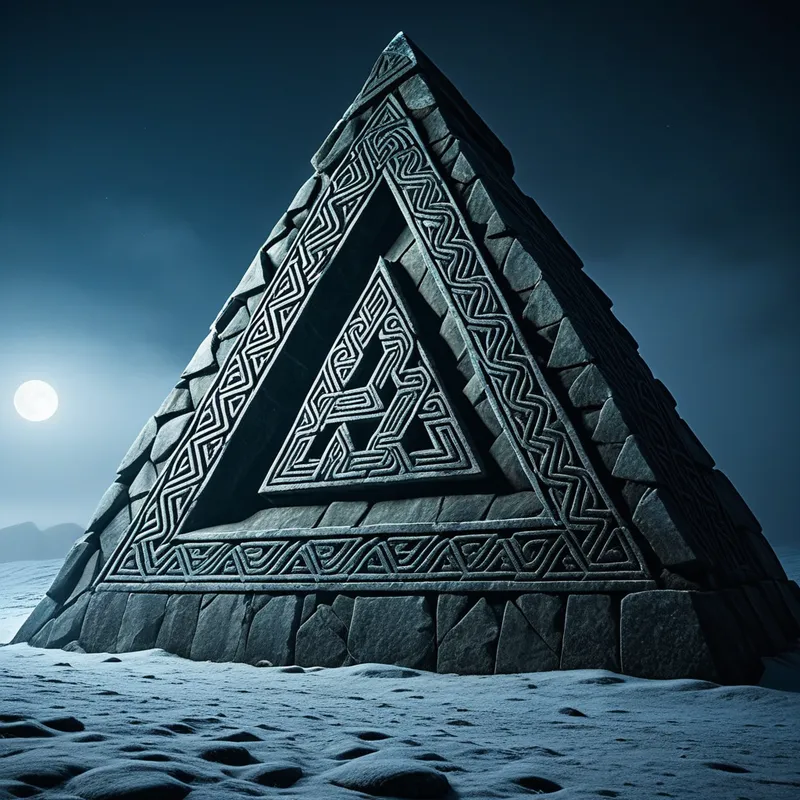
Valknut Myth Meaning & Symbolism
The mysterious knot of the slain, a symbol of Odin's binding power over fate and the sacred, terrifying journey between worlds.
The Tale of Valknut
Hear now, and listen well, by the crackling fire and under the cold eye of the stars. This is not a tale of a hero’s sword-song, but of the silence that follows it; not of the feast, but of the offering. It is the tale of the knot that cannot be untied, save by one.
In the high hall of Odin, the air is thick with the scent of mead and iron. Ravens whisper secrets into the Allfather’s ears, but his single eye is fixed elsewhere—on the tapestry of wyrd woven by the Norns at the foot of the Yggdrasil. He sees the threads of warriors, strong and bright, destined to be cut on distant, bloody fields. He needs them. Valhalla must be filled for the final battle.
So the Grey Wanderer cloaks himself in shadow and walks the Midgard roads. He arrives not with thunder, but as a chill on the neck of a chosen warrior on the eve of battle. The warrior feels it—a presence, ancient and hungry, watching from the edge of the wood. In his dreams, he sees three interlocked triangles, a knot of impossible geometry that spins in the void. He does not know its name, but he feels its pull: a sacred summons.
The battle dawns, cruel and bright. The chosen warrior fights with a fury not entirely his own, a ecstasy of steel and shout. And then, the spear finds him. As the world dims, the cacophony of clashing shields fades into a profound silence. He does not fall into darkness, but into a vortex.
He sees them then—the Valkyries, their armor gleaming like ice, their faces both terrible and beautiful. They do not carry him; they bind him. An unseen force, a psychic cord, wraps around his essence, a triple-looped knot securing his spirit from the dissolution of Hel. He is a prize, harvested. The last thing he perceives from the mortal realm is the symbol carved on a standing stone nearby, now glowing with a faint, ethereal light: the three interlocked triangles. The Valknut. The knot of the slain. It is the mark of the transaction, the seal of Odin’s claim.
In Valhalla, the warrior opens his eyes to endless feast and fray. But sometimes, in the quiet between battles, he touches the amulet at his chest—a replica of the knot that bound him. He understands now. It was never a trap, but a terrible, glorious passage. The knot did not imprison his soul; it selected it, pulled it from the stream of common fate into the service of a cosmic end. The price was his life. The reward was a purpose in the story of all things. The Valknut is the moment of that exchange, frozen in symbol forever.
Cultural Origins & Context
The Valknut, or “knot of the slain,” is an archaeological and artistic mystery. No surviving Old Norse text names it or explicitly narrates its myth. Its tale is told in silence—in the language of stone, metal, and image. We find it carved on ancient runestones, like the Stora Hammars stone, often in scenes depicting sacrifices, battles, and the god Odin. It is etched on funeral artifacts, placed within burial mounds as a companion to the dead.
This absence of a written story is itself profound. It suggests the Valknut belonged to an esoteric, perhaps even taboo, layer of understanding. It was not a tale for the uninitiated, but a symbol for those who knew—the seers, the warriors consecrated to Odin, those who trafficked in the mysteries of death and fate. Its story was passed not through sagas, but through the ritual context of its display. To see the Valknut on a memorial stone was to understand the depicted deceased was “Odin’s man,” chosen and claimed. Its societal function was dual: it was a protective charm for the journey to the afterlife and a public declaration of sacred allegiance, binding the community to the cosmological order overseen by the Allfather.
Symbolic Architecture
The Valknut is a symbol of radical interconnection and inescapable binding. Its three interlocked triangles speak a geometric language of profound complexity.
The Valknut is the psychic point where choice, action, and consequence fuse into a single, unbreakable knot called destiny.
First, it is the symbol of Odin’s power. He is the binder of minds in battle (the fetter-fetterer), the one who can loosen or tighten the threads of fate. The Valknut visually represents this binding magic—the capturing of the human spirit (hugr) at the moment of death and its direct translocation to his service.
Second, the number three is sacred and pervasive in Norse cosmology: three roots of Yggdrasil, three wells, three Norns, three phases of time (past, present, future). The Valknut binds these triplicities. It connects the worlds of the living (Midgard), the dead (Hel), and the divine (Asgard). It represents the interlocking of thought, word, and deed, or the three aspects of the soul. Psychologically, it symbolizes the point where conscious intention, unconscious drive, and external fate collide and become one irrevocable reality.
The Dreamer’s Resonance
When the Valknut appears in a modern dream, it rarely comes as a clear, historical symbol. More often, it manifests as a feeling of being inescapably bound—by a decision, a relationship, a career path, or an internal complex. The dreamer might see intricate, impossible knots, interlocking gears of fate, or feel trapped in a repeating triangular pattern of thought.
Somatically, this can feel like a tightening in the chest, a pressure at the temples, or a profound sense of being “selected” for a daunting task. This is not a nightmare of persecution, but the psyche’s registration of a critical juncture. The unconscious is signaling that a powerful archetypal force—the Magician or the All-Father—is active. A part of the old self, an old way of life, must die. The dream is the Valkyrie’s arrival, the binding of the ego to a larger, more demanding purpose. The anxiety is the terror of the spear-strike; the potential liberation is the promise of Valhalla—a place of greater meaning and struggle.
Alchemical Translation
The alchemical journey modeled by the Valknut is the Opus Contra Naturam—the work against nature, which in psychological terms is the work against the ego’s clinging to safety and smallness. It is the process of active, conscious sacrifice.
Individuation requires a Valknut moment: the willing binding of one’s personal will to the demands of the Self, the central archetype of wholeness.
The first triangle is the Sacrifice. This is Odin hanging on Yggdrasil, giving an eye for wisdom. For us, it is the conscious surrender of a cherished attitude, a comfortable illusion, or a petty grievance. It is the ego’s death.
The second triangle is the Binding. The sacrificed energy does not vanish; it is captured and redirected. The Valknut ensures it is not lost to the unconscious (Hel) but is secured for a higher purpose. Psychologically, this is the integration of a complex—taking a powerful, perhaps troubling, drive and dedicating it to the service of the personality’s total development.
The third triangle is the Translation. The bound essence is transported to a new plane of existence—from mortal life to mythic participation. In individuation, this is the emergence of a new, more capacious consciousness that can hold paradox (like life-in-death), serve a transpersonal purpose, and engage with the archetypal world without being consumed by it. The knot, once a symbol of fate’s prison, becomes the emblem of one’s chosen, meaningful place in the great work.
Associated Symbols
Explore related symbols from the CaleaDream lexicon: