Vaitarani Myth Meaning & Symbolism
The terrifying river of blood and filth that souls must cross after death, a mythic ordeal of purification, judgment, and the confrontation with one's own life.
The Tale of Vaitarani
Listen, and hear of the last journey, the one taken when the sun of life has set and the body is but cold ash. The soul, a flickering ember of consciousness called the Linga Sharira, finds itself not in light, but on a vast, grey plain under a sky the color of a bruise. The air is thick with sighs and the whispers of forgotten oaths.
This is the path to the realm of Yama. The soul is led by Yamadutas, their breath hot and smelling of iron. The path is long, a road of memory paved with the stones of every action, inaction, word, and silence. It leads to a sound—a deep, churning, liquid roar that grows with every step.
And then you see it.
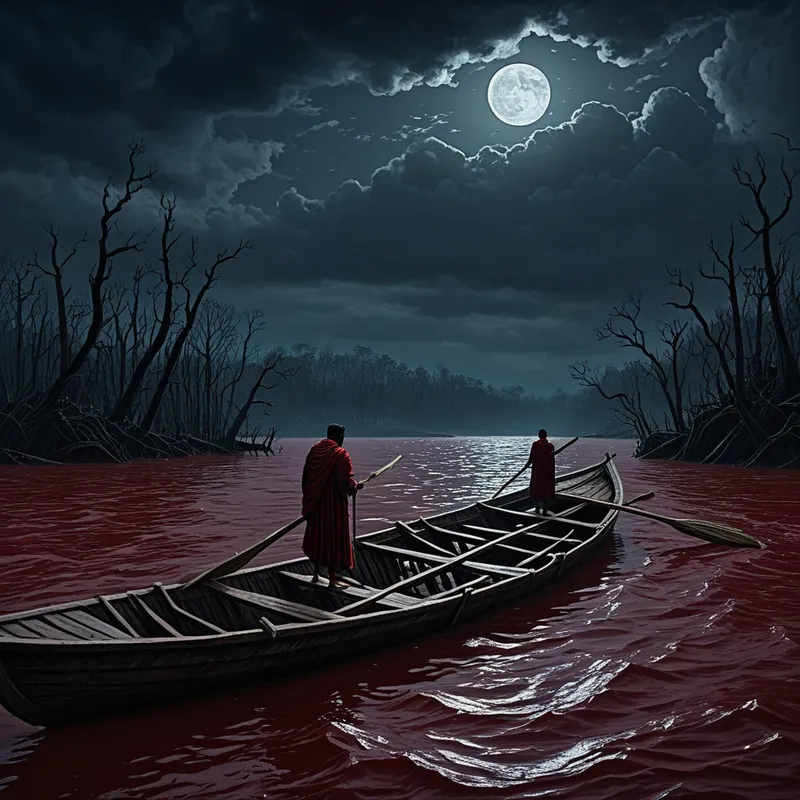
The Vaitarani. It is not [water](/myths/water “Myth from Chinese culture.”/). It is a torrent of clotting blood, pus, and offal. It churns with the bones of broken promises and the hair of severed relationships. Its surface screams with the echoes of every cry of pain the soul ever caused or ignored. The stench is a physical weight, a miasma of regret.
On the far shore, a distant, grim light—the court of Yama. On this shore, a teeming multitude of souls, naked in their essence, trembling. And in [the river](/myths/the-river “Myth from Buddhist culture.”/) itself, a sight to freeze the spirit: souls who failed the crossing, writhing, being bitten by ferocious aquatic creatures with iron teeth, drowning not in water but in the tangible substance of their own misdeeds.
But there is a boat. A single, rickety craft, and a boatman more skeleton than man. He does not speak. He only holds out a hand. His price is not coin, but the merit earned in life, the weight of your [Karma](/myths/karma “Myth from Hindu culture.”/). For the virtuous, the generous, the truthful, the crossing is swift. The boat glides, the horrific river calms, and the far shore welcomes them.
For others, there is no boat. The Yamadutas simply cast them into the current. They must swim through the blood, fighting the current of their own creation, assaulted by the manifestations of their cruelty and neglect. Their crossing is an agony of millennia, a purification by immersion in the very consequences they sought to avoid.
This is the tale. Not of a monster to be slain, but of a river to be crossed. The final, ultimate threshold where the soul meets the unvarnished ledger of itself.
Cultural Origins & Context
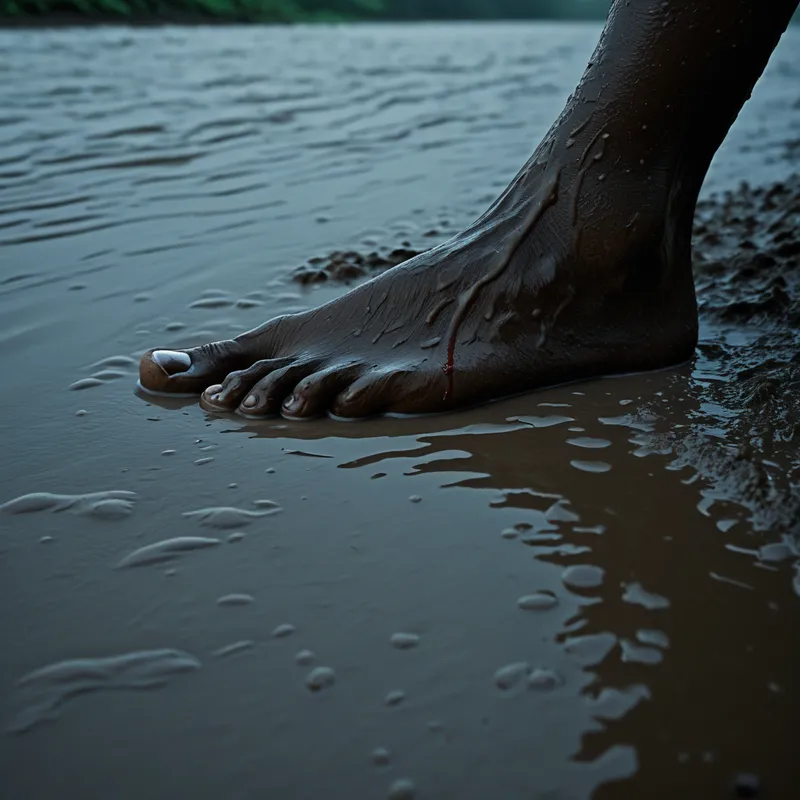
The myth of the Vaitarani flows from the deep tributaries of post-Vedic Hindu eschatology, most prominently detailed in the Puranas, like the [Garuda](/myths/garuda “Myth from Hindu culture.”/) Purana and the Agni Purana. These texts functioned as cosmological guidebooks, mapping the geography of the unseen. The myth was not merely a scary story, but a sophisticated societal and psychological tool.
It was recited during funeral rites (Antyeshti) and the mourning period. This served a dual function. For the living, it provided a vivid, moral cartography of the afterlife, reinforcing dharmic (righteous) behavior through powerful imagery. For the bereaved, it offered a narrative framework for the journey of the departed, transforming abstract grief into a specific, ritualized process they could participate in through offerings (Pindas) and charitable acts in the deceased’s name, which were believed to build the “merit” needed for an easier crossing. The myth was thus a bridge between the living and the dead, and a mirror held up to the conscience of the community.
Symbolic Architecture
The Vaitarani is the ultimate symbolic threshold. It is not a place, but a process made [landscape](/symbols/landscape “Symbol: Landscapes in dreams are powerful symbols representing the dreamer’s emotional state, personal journey, and the broader context of life situations.”/).
The river you must cross after death is the sum of all the rivers you refused to cross in life.
It represents the inescapable [moment](/symbols/moment “Symbol: The symbol of a ‘moment’ embodies the significance of transient experiences that encapsulate emotional depth or pivotal transformations in life.”/) of existential accountability. The [blood](/symbols/blood “Symbol: Blood often symbolizes life force, vitality, and deep emotional connections, but it can also evoke themes of sacrifice, trauma, and mortality.”/) and filth are not arbitrary punishments, but the symbolic externalization of internal corruption—the cruelty, greed, and violence that poison the individual and collective [psyche](/myths/psyche “Myth from Greek culture.”/). The boatman is the neutral arbiter of karma; he does not judge, he merely collects the fare your [life](/symbols/life “Symbol: The symbol of ‘Life’ represents a journey of growth, interconnectedness, and existential meaning, encompassing both the joys and challenges that define human experience.”/) has earned. The horrific aquatic beings are the “[teeth](/symbols/teeth “Symbol: Teeth in dreams often symbolize personal power, self-image, and the fear of losing control or aging.”/)” of neglected consequences, the autonomous, predatory [nature](/symbols/nature “Symbol: Nature symbolizes growth, connectivity, and the primal forces of existence.”/) of unintegrated [shadow](/symbols/shadow “Symbol: The ‘shadow’ embodies the unconscious, repressed aspects of the self and often represents fears or hidden emotions.”/) [material](/symbols/material “Symbol: Material signifies the tangible aspects of life, often representing physical resources, desires, and the physical world’s influence on our existence.”/).
The [river](/symbols/river “Symbol: A river often symbolizes the flow of emotions, the passage of time, and life’s journey, reflecting transitions and movement in one’s life.”/)‘s nature as both [barrier](/symbols/barrier “Symbol: A barrier symbolizes obstacles, limitations, and boundaries that prevent progression in various aspects of life.”/) and purgative is key. To be immersed in it is to be forcibly confronted with the [shadow self](/symbols/shadow-self “Symbol: The unconscious, repressed aspects of personality containing traits, desires, and impulses considered unacceptable or shameful.”/). The “swim” is the agonizing process of [assimilation](/symbols/assimilation “Symbol: The process of integrating new experiences, identities, or knowledge into one’s existing self, often involving adaptation and transformation.”/), of taking back the projected filth and recognizing it as one’s own. The easy crossing via the boat symbolizes a life lived with [awareness](/symbols/awareness “Symbol: Conscious perception of self, surroundings, or internal states. Often signifies awakening, insight, or heightened sensitivity.”/), where [the shadow](/myths/the-shadow “Myth from Jungian culture.”/) was acknowledged and integrated through conscious [action](/symbols/action “Symbol: Action in dreams represents the drive for agency, motivation, and the ability to take control of situations in waking life.”/) (dharma), leaving little toxic [residue](/symbols/residue “Symbol: What remains after a process or event; traces left behind that persist beyond the original occurrence.”/) to manifest as an externalized [river](/symbols/river “Symbol: A river often symbolizes the flow of emotions, the passage of time, and life’s journey, reflecting transitions and movement in one’s life.”/) of [torment](/symbols/torment “Symbol: A state of intense physical or mental suffering, often representing unresolved inner conflict, guilt, or psychological distress.”/).
The Dreamer’s Resonance
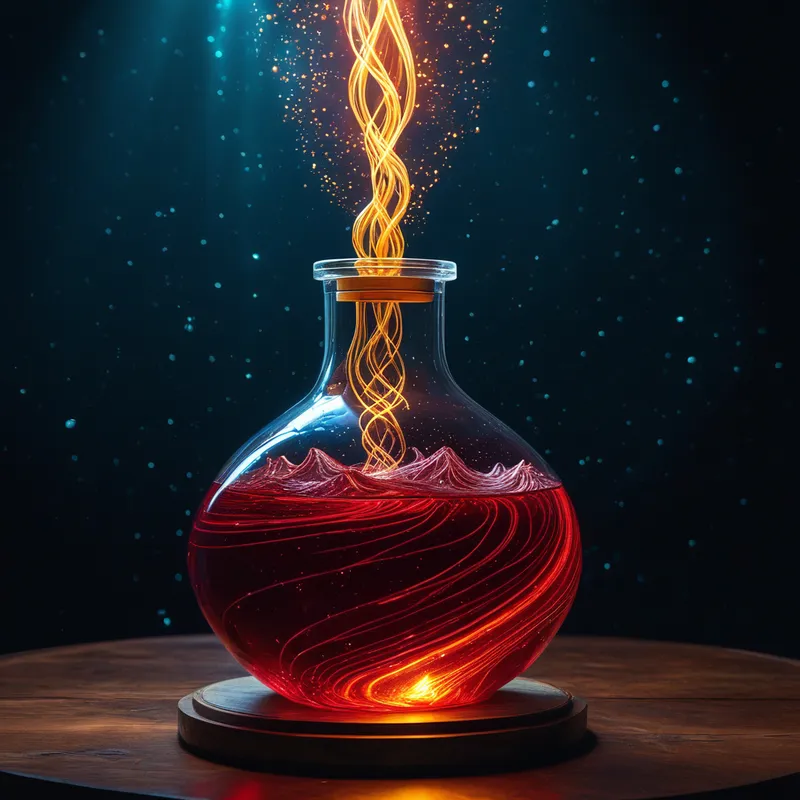
When this myth stirs in the modern unconscious, it rarely appears as a literal river of blood. Its pattern manifests in dreams of being trapped in viscous, polluted substances—quicksand of paperwork, rising floodwaters of black sludge in a basement, being stuck in traffic that is itself a river of molten plastic. The somatic feeling is one of dreadful, slow-motion suffocation and immobility.
Psychologically, this signals that the dreamer is at a profound inner threshold. A life structure—a job, a relationship, a self-concept—has reached its end, but the passage to what’s next is blocked by the accumulated “filth” of that phase: unresolved resentments, unspoken truths, ethical compromises, or simply the psychic waste of inauthenticity. The dreamer is on the bank of their own Vaitarani. The dream is the psyche’s announcement that a crossing is necessary, but it cannot happen until there is an honest accounting. The terrifying river in the dream is the unacknowledged cost of the current life path.
Alchemical Translation
The alchemical journey of individuation is a series of crossings. The Vaitarani models the most critical one: the [Nigredo](/myths/nigredo “Myth from Alchemical culture.”/), the blackening, the descent into the [prima materia](/myths/prima-materia “Myth from Alchemical culture.”/) of the soul’s own darkness.
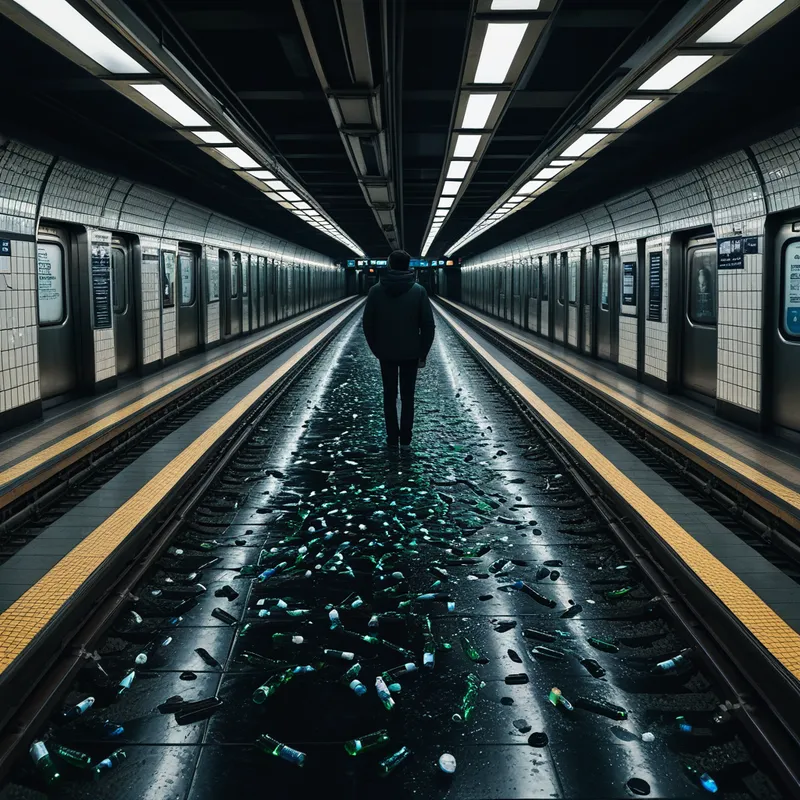
The alchemist does not avoid the rotten black matter at the bottom of the vessel; they heat it, stir it, and wait for it to transform. So too must we attend to the river within.
The modern individual’s “crossing” is the conscious descent into shadow work. It is the voluntary immersion into one’s own psychological Vaitarani—the repressed memories, the denied weaknesses, the hidden shames. We build our “merit” for this crossing not through ritual, but through ruthless self-honesty, making amends where possible, and bearing the uncomfortable weight of our own contradictions without fleeing into spiritual bypass or blame.
The triumphant outcome is not avoiding the river, but transmuting its substance. The blood of trauma becomes the water of compassion. The bones of old failures become the foundation of wisdom. The boat that carries us across is forged from the integrity we cultivate in facing our own darkness. When we cross our inner Vaitarani, we do not arrive at Yama’s court for judgment; we arrive at a more authentic self, having served as our own boatman, judge, and purifying current. The river, in the end, was always within, and the crossing is the act of becoming whole.
Associated Symbols
Explore related symbols from the CaleaDream lexicon: