Utnapishtim Myth Meaning & Symbolism
The immortal man who survived the gods' great flood, a story of divine warning, mortal obedience, and the price of eternal life.
The Tale of Utnapishtim
Hear now the tale whispered by the reeds of the Euphrates, carried on winds that have blown since [the world](/myths/the-world “Myth from Tarot culture.”/) was young. It begins not with a man, but with the council of the gods. Their clamor shook the vault of heaven. Humanity, they cried, had become a cacophony—their numbers vast, their noise insufferable. The divine sleep was shattered. In their fury, the assembly, led by the warrior Enlil, decreed a secret: a [great flood](/myths/great-flood “Myth from Mesopotamian culture.”/) to wipe the slate of earth clean, to return silence to [the world](/myths/the-world “Myth from Tarot culture.”/).
But one god’s heart was troubled. Ea, the clever, the compassionate, could not bear the utter annihilation. He could not break the divine oath, yet he could whisper through a wall. He came to the reed hut of Utnapishtim, a righteous king of Shuruppak, and spoke not to his ears, but to the reeds of his hut, and thus into his dreaming soul.
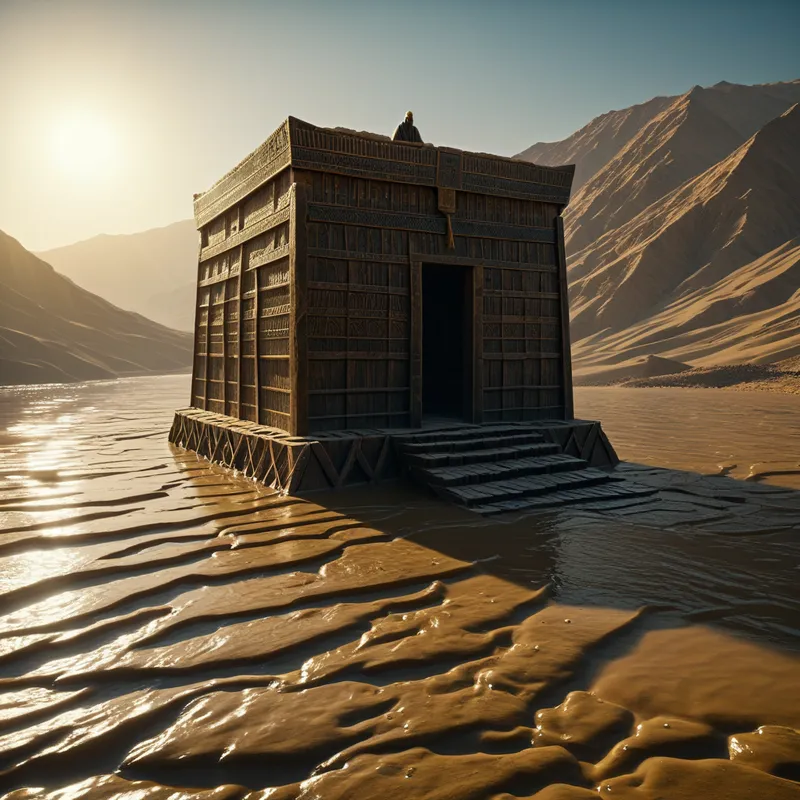
“Reed hut, reed hut! Wall, wall! Listen, reed hut! Pay heed, wall! O man of Shuruppak, son of Ubara-Tutu, tear down your house, abandon your wealth. Build a boat, a perfect cube, let its width equal its length. Seal it with bitumen, inside and out. Gather the seed of all living things.”
Utnapishtim awoke, his heart pounding with a sacred terror. He did not question the dream-voice. At dawn, he addressed his city with a ruse: “I have learned that Enlil has grown to hate me. I cannot dwell in your city, nor tread on Enlil’s ground. I will go down to the Apsu, to live with my lord Ea.” The people, pitying him, came to help. For seven days, the sound of the adze filled the air. A great, square ark took shape, a monstrous geometric puzzle on the land. Into it, Utnapishtim loaded his family, his craftsmen, and all the animals of the steppe.
Then the weather of the gods arrived. Adad bellowed in the clouds. The Anunnaki lifted their torches, setting the land ablaze with lightning. A black curtain fell upon the world. The storm raged for six days and seven nights, until all of humanity was returned to clay. The gods themselves, witnessing the devastation, cowered like dogs, weeping at what they had unleashed. Their own creation was gone, and with it, the sweet smoke of offerings.
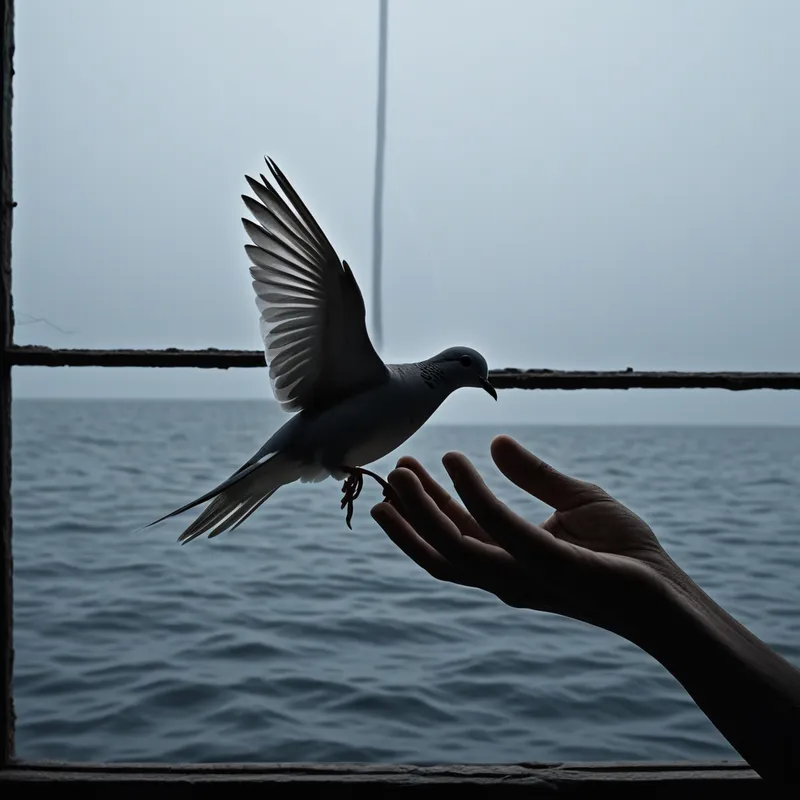
On the seventh day, [the sea](/myths/the-sea “Myth from Greek culture.”/) grew calm. Utnapishtim opened a window. Silence. A world of flat, grey [water](/myths/water “Myth from Chinese culture.”/). He wept. He released a dove. It flew off, circled, and returned, finding no perch. He released a swallow. It too returned. Finally, he released a [raven](/myths/raven “Myth from Haida culture.”/). The raven saw the waters receding, it ate, it scratched, it did not come back. Then Utnapishtim knew.
He made an offering upon the peak of Mount Nisir. The sweet smell of the sacrifice reached the gods. They swarmed like flies around the offering. Nintu cried out, lamenting her children. Enlil arrived, furious to find survivors. But Ea, the wise, spoke: “Punish the sinner for his sin, the wrongdoer for his wrongdoing. But be gentle, lest he be cut off. Instead of a flood, let loose a lion, a wolf, a famine, a plague upon humanity to thin their numbers.” Enlil saw the truth in it. He took Utnapishtim and his wife by the hand, blessed them, and placed them far away, at the Mouth of the Rivers, granting them the gift—and the burden—of life eternal.
Cultural Origins & Context
This story, the eleventh tablet of the Epic of [Gilgamesh](/myths/gilgamesh “Myth from Mesopotamian culture.”/), is not merely a tale. It is a cultural palimpsest, written and rewritten over millennia. Its earliest seeds are Sumerian, found in the Eridu Genesis, where [the flood](/myths/the-flood “Myth from Biblical culture.”/) survivor is named Ziusudra. By the Old Babylonian period, it was woven into the epic of the hero-king [Gilgamesh](/myths/gilgamesh “Myth from Mesopotamian culture.”/), who seeks out [the immortal](/myths/the-immortal “Myth from Taoist culture.”/) Utnapishtim to learn the secret of escaping death.
The myth was recited by court scribes and traveling bards, a foundational narrative explaining the capricious relationship between humanity and the divine. It served as a theodicy—a justification for the gods’ harshness—and a morality play about piety, wisdom, and the limits of human ambition. The flood was a historical memory, perhaps of catastrophic Tigris-Euphrates flooding, mythologized into a cosmic reset button. Utnapishtim’s story functioned as a warning and a promise: the gods are powerful and volatile, but a direct, obedient connection to divine wisdom (Ea) can provide a narrow path through absolute annihilation.
Symbolic Architecture
At its core, the myth of Utnapishtim is a profound [allegory](/symbols/allegory “Symbol: A narrative device where characters, events, or settings represent abstract ideas or moral qualities, conveying deeper meanings through symbolic storytelling.”/) of [consciousness](/symbols/consciousness “Symbol: Consciousness represents the state of awareness and perception, encompassing thoughts, feelings, and experiences.”/) surviving the unconscious. The “[noise](/symbols/noise “Symbol: Noise in dreams signifies distraction, confusion, and the need for clarity amidst chaos.”/)” of humanity is [the ego](/myths/the-ego “Myth from Jungian culture.”/)’s endless chatter, its unchecked [proliferation](/symbols/proliferation “Symbol: Rapid multiplication or spread of elements, often representing uncontrolled growth, expansion, or the overwhelming presence of something in one’s life.”/), which threatens the natural order (the gods’ [peace](/symbols/peace “Symbol: Peace represents a state of tranquility and harmony, both internally and externally, often reflecting a desire for resolution and serenity in one’s life.”/)). The flood is the overwhelming [deluge](/symbols/deluge “Symbol: A massive, overwhelming flood representing cleansing, destruction, or emotional inundation.”/) of the unconscious, sent to dissolve the differentiated ego back into the undifferentiated sea of primal [psyche](/myths/psyche “Myth from Greek culture.”/).
The ark is not a ship of escape, but a vessel of transformation—a sealed, cubed temenos (sacred space) where the old self must die so a new consciousness can be preserved.
Utnapishtim represents the nascent Self, guided by the [archetype](/symbols/archetype “Symbol: A universal, primordial pattern or prototype in the collective unconscious that shapes human experience, behavior, and creative expression.”/) of the wise old man (Ea). His obedience is not blind [faith](/symbols/faith “Symbol: A profound trust or belief in something beyond empirical proof, often tied to spiritual conviction or deep-seated confidence in people, ideas, or outcomes.”/), but an act of profound psychological intelligence: heeding the [inner voice](/symbols/inner-voice “Symbol: A spiritual or subconscious guide representing intuition, conscience, or higher self, often seen as a connection to divine wisdom or ancestral knowledge.”/) that speaks through dreams and [intuition](/symbols/intuition “Symbol: The immediate, non-rational understanding of truth or insight, often described as a ‘gut feeling’ or inner knowing that bypasses conscious reasoning.”/) (the whisper through the [wall](/symbols/wall “Symbol: Walls in dreams often symbolize boundaries, protection, or obstacles in one’s life, reflecting the dreamer’s feelings of confinement or security.”/)). The animals are the instinctual drives and psychic potentials that must be integrated, not left behind to drown. The releasing of the birds symbolizes the gradual testing of [reality](/symbols/reality “Symbol: Reality signifies the state of existence and perception, often reflecting one’s understanding of truth and life experiences.”/), sending out probes of consciousness (the dove, [the swallow](/myths/the-swallow “Myth from Greek culture.”/)) until one (the [raven](/symbols/raven “Symbol: The raven is often seen as a messenger of the divine and a symbol of transformation, wisdom, and the mysteries of life and death.”/), a [symbol](/symbols/symbol “Symbol: A symbol can represent an idea, concept, or belief, serving as a powerful tool for communication and understanding.”/) of cunning and adaptability) finds the solid ground of a new psychic [attitude](/symbols/attitude “Symbol: Attitude symbolizes one’s mental state, perception, and posture towards life, influencing emotions and actions significantly.”/).
The Dreamer’s Resonance
When this myth stirs in the modern dreamer, it often signals a profound inner crisis preceding a rebirth. You may dream of rising, murky waters engulfing your home, of frantically building a strange structure, or of receiving a cryptic, urgent message you cannot ignore but must act upon.
Somatically, this can feel like a pressure in the chest, a sense of impending dissolution, or a deep, wordless anxiety—the “weather of the gods” gathering in the body. Psychologically, you are in the “seven days of building.” The old structures of your identity, career, or relationships feel condemned, “hated by Enlil.” The ego is being commanded by a deeper authority to construct an ark—a temporary, sealed-off psychic container. This is the space for therapy, meditation, or solitary reflection where you gather your scattered “seeds” (potential, fragmented parts of yourself) to wait out the storm of emotional collapse, depression, or life-altering change. The dream is the whisper of Ea: a call to active preparation for a flood you sense is coming, but cannot yet see.

Alchemical Translation
The journey of Utnapishtim is a perfect map of the alchemical opus, the process of individuation. It begins with the [nigredo](/myths/nigredo “Myth from Alchemical culture.”/): the blackening, the divine wrath, the chaotic flood that reduces everything to a primal, uniform state (massa confusa). This is the necessary dissolution of outworn attitudes.
The building of the ark is the albedo: the whitening. It is the conscious, disciplined work of creating a vessel (the observing ego) strong enough to withstand the dissolution. The careful measurements—the perfect cube—symbolize the need for psychological order and containment as the unconscious rages.
Immortality, as Utnapishtim learns, is not the avoidance of death, but the achievement of a perspective that has witnessed the cycle of destruction and creation and now resides, somewhat sadly, outside of it.
His final state, at the Mouth of the Rivers, represents the [rubedo](/myths/rubedo “Myth from Alchemical culture.”/): the reddening, the culmination. He is not a god, but a human who has achieved a transcendent standpoint. He has internalized the flood. For the modern individual, this is the state of “immortality”—not literal, but symbolic. It is the hard-won wisdom that comes from having consciously navigated a total psychic catastrophe. You become the “distant sage,” the one who has been through the flood and now carries its memory not as trauma, but as the foundational truth of your being. Your life is no longer about avoiding the next flood, but about offering, like Utnapishtim to Gilgamesh, the sober, compassionate truth to those who come seeking an escape from mortality: life is found not in endless days, but in the depth with which you live the days you are given.
Associated Symbols
Explore related symbols from the CaleaDream lexicon: