Utgard Myth Meaning & Symbolism
The god Thor journeys to the fortress of Utgard-Loki, where his divine strength fails in a series of deceptive contests, revealing the power of illusion.
The Tale of Utgard
The road to the edge of the world is a road of whispers. It winds through forests where the pines remember the first frost, across rivers that sing with the voices of drowned giants, and into a silence so deep it feels like a held breath. Here, where the map of the known world frays into mist and rumor, the travelers came: Thor, red-bearded and mighty, his hammer Mjolnir at his side; his trickster companion Loki, eyes sharp as flint; and a mortal servant, whose heart beat a frantic drum against his ribs.
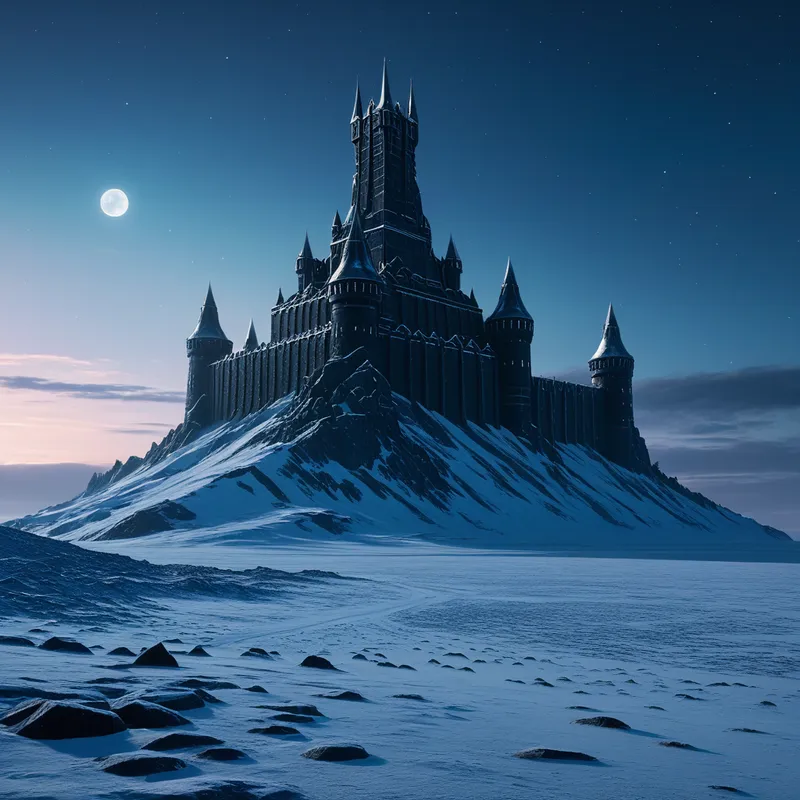
Their journey was born of a boast, a challenge muttered in the dark. They sought Utgard, the citadel that stood beyond the pale of gods and men, a fortress said to be built from the bones of forgotten mountains. When they found it at last, it was not what they expected, yet it was everything they feared. The gates were not merely tall; they were the horizon itself, carved from black ice and iron older than the sun. To look upon them was to feel oneself shrink into insignificance.
A giant named Skrymir had guided them, a being so vast his snores were mistaken for earthquakes. Now, before the gates, he vanished, and in his place stood the lord of this desolate place: Utgard-Loki. He was not a brute of mere muscle, but a figure of cold, calculating majesty, his smile a crack in a glacier. “Welcome, little ones,” his voice echoed, not loud, but from inside their own skulls. “We hear you are champions. Let us test this truth.”
He led them into a hall that defied reason, a cavern so immense its ceiling was lost in a haze of distant smoke and shadow. The fire pits roared like captive suns, and the giants who filled the benches were like moving cliffs. The contests were set, a cruel pageant of humiliation.
First, Loki, who boasted he could eat faster than any, was pitted against a creature named Logi. They faced a trencher piled high with meat. Loki devoured every scrap with savage speed, but Logi consumed not only the meat but the bones, the wood, and the very iron of the platter itself. Loki had lost.
Next, the servant boy, Thialfi, famed for his speed, raced against a slender giant named Hugi. Thialfi ran as he had never run before, his lungs burning, but Hugi was already at the finish line, turning back to meet him as if he had merely strolled.
Then came Thor. The god of thunder, his pride a white-hot coal in his chest. “Let us drink!” he roared, seizing a massive drinking horn. “This,” said Utgard-Loki, “is our modest cup. Most empty it in one draught. Some require two. Only the weakest fail to finish it in three.” Thor put the horn to his lips and drank, the ale flooding his throat. He drank until his vision swam, until his veins felt ready to burst. He lowered the horn. The level had barely fallen. A second, Herculean pull. A slight decrease. A third, desperate attempt. It was half-empty. The hall erupted in mocking laughter.
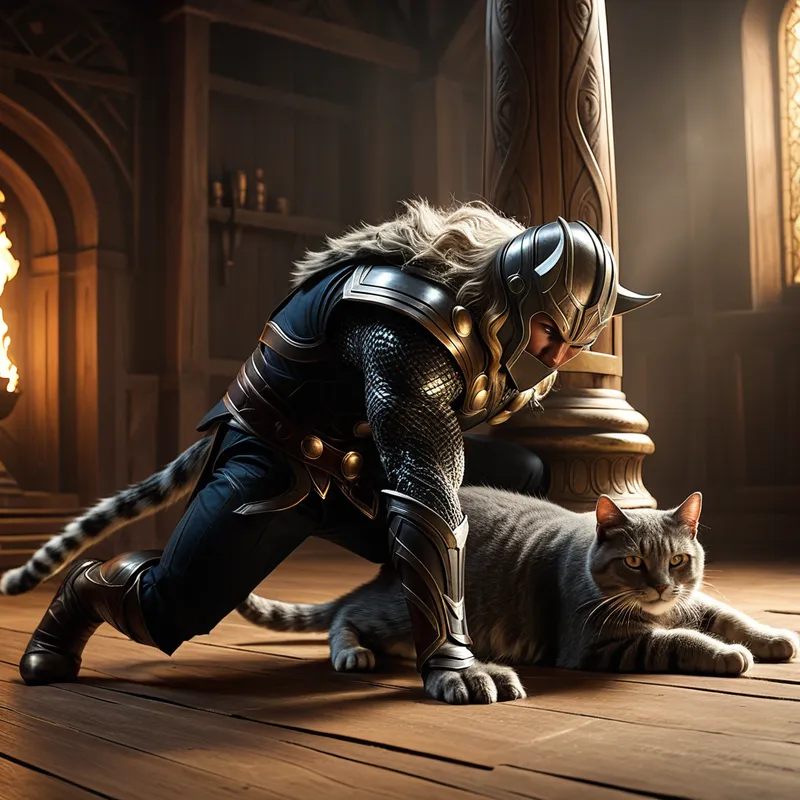
“Perhaps strength, then?” Utgard-Loki suggested, his voice dripping with false sympathy. He pointed to a grey cat that lounged on the straw-strewn floor. “Lift this little creature for us.” Thor strode over, slid his mighty hands under the beast, and heaved. The muscles in his back and arms corded like oak roots. He strained, grunting, the veins on his forehead threatening to split. The cat merely arched its back, indifferent. One paw left the floor. No more.
Enraged, humiliated, Thor demanded a wrestling match. “Against whom?” chuckled Utgard-Loki. “Our old nurse, Elli? She has felled stronger than you.” She was a withered, ancient crone. When Thor locked arms with her, he met not flesh, but the immutable force of entropy itself. He was driven to one knee, then forced down, his face pressed into the cold dirt of the hall floor.
The morning came, cold and grey. Utgard-Loki escorted the shattered party beyond his gates. His mocking smile was gone, replaced by a look of stark, sober warning. “You were never in a contest of strength,” he said. “You were in a theater of my will.” The drinking horn? Its tip was in the sea; to lower its level was to lower the ocean itself. The cat? It was Jormungandr, the Midgard Serpent, and lifting one paw had shaken the foundations of the world. The old nurse, Elli? She was Old Age, whom none can defeat. And Logi? He was Wildfire. Hugi? He was Thought, which outruns any man.
“You have not been weak,” said Utgard-Loki, “but you have been blind. Never seek me again.” And with a sound like a mountain sighing, the fortress of Utgard vanished, leaving only the empty, wind-scoured plain.
Cultural Origins & Context
This tale, known as the Þórsdrápa in later skaldic poetry and most fully recounted in the Prose Edda of Snorri Sturluson, is a cornerstone of the Norse mythological corpus. It was not a scripture, but a living story told in mead halls during the long, dark winters of Scandinavia and Iceland. The skalds who recited it served a vital societal function: they were the memory-keepers and philosophers of a culture deeply engaged with a harsh, capricious, and often deceptive world.
The myth operates on multiple levels. On one hand, it is a classic “otherworld journey” tale, where heroes venture into a realm of giants (jötnar) to test their mettle. For a warrior society, it validated the virtues of courage and persistence even in the face of certain, honorable defeat. Yet its deeper function was cautionary. It taught that raw power (ásmegin) has its limits. The world is not always as it seems; it is filled with illusions and scales of reality beyond human (or even divine) comprehension. The story humbles the archetype of the brute-force hero, suggesting that wisdom and perception are the ultimate, and often missing, tools for survival.
Symbolic Architecture
Utgard is not merely a place on a map; it is a psychic location. It represents the Shadow realm par excellence—the outer fortress of the unconscious where the rules of the familiar ego-world are suspended. Here, the ego’s most cherished attributes—strength, speed, cunning—are rendered meaningless by a deeper, more archaic order of reality.
Utgard-Loki is the master of projections, the psychic trickster who shows the ego not its true opponent, but a magnified, externalized image of its own limitations.
Thor represents the conscious will, the ego that believes its power is absolute. His journey to Utgard is the ego’s necessary, if traumatic, confrontation with the unconscious. Each contest is a symbolic dismantling: the eating contest (consumption/desire) is lost to the primal, all-consuming fire of instinct (Logi). The footrace (striving/action) is lost to the swift, intangible nature of thought itself (Hugi). Thor’s trials are even more profound. The drinking horn is the vast, oceanic depth of the unconscious; the ego cannot “drink it dry” or comprehend it. The cat is the totality of one’s own latent psychic power, the serpentine energy of the Self that feels immovable to the limited ego. The old nurse, Elli, is the ultimate limitation of the mortal condition—time and decay—against which all heroic posturing is futile.
The revelation at the story’s end is the core of its alchemy: the giants were not defeated because they were stronger, but because Thor was fighting phantoms of his own misunderstanding. The true battle was one of perception.

The Dreamer’s Resonance
When the architecture of Utgard appears in modern dreams, it signals a profound confrontation with the Shadow. The dreamer may find themselves in an endless, bureaucratic building (the modern Utgard-hall) where they must perform a meaningless, impossible task for a cold, judging authority figure (Utgard-Loki). They may dream of trying to lift a mundane object that has become impossibly heavy, or of running in agonizing slow-motion while being pursued.
Somatically, this dream-state often accompanies feelings of profound frustration, impotence, and humiliation—the very feelings Thor experiences. Psychologically, it indicates that the conscious mind is attempting to solve a deep, unconscious complex using its old, familiar tools of willpower, logic, or effort, and is failing spectacularly. The ego is being shown, in the visceral language of the dream, that its map of reality is incomplete. It is a crisis of orientation, where the foundational assumptions of “how things work” are being dismantled. The process, while painful, is a necessary prelude to growth; the ego must be humbled before it can be expanded.

Alchemical Translation
The journey to and from Utgard is a perfect model for the process of psychic transmutation, or individuation. The first stage is the call—the boast, the challenge, the restless sense that one’s current strength is insufficient. This propels the ego (Thor) into the unknown.
The contests represent the nigredo, the blackening, the stage of despair and dissolution. Every skill, every source of pride, is revealed to be inadequate. This is not a failure of character, but a necessary death of the inflated ego. The individual feels broken, foolish, and lost.
The triumph of the myth is not in winning, but in seeing. The gold is not in the victory, but in the revelation of the true nature of the contest.
Utgard-Loki’s final explanation is the albedo, the whitening, the illuminating insight. The complex is named. The projection is withdrawn. The “giants” one has been fighting—the insatiable appetite, the unreachable goal, the weight of the world, the inevitability of time—are seen for what they are: fundamental, impersonal forces of existence and the psyche, not enemies to be beaten, but realities to be understood and related to.
The return, with this hard-won knowledge, is the beginning of the rubedo, the reddening, the integration. Thor does not get a trophy, but he gains something far more valuable: self-knowledge and a corrected relationship with the world. For the modern individual, this translates to the cessation of a futile war. One stops trying to “drink the ocean” of anxiety and instead learns to sail upon it. One stops trying to “lift the world-serpent” of responsibility and learns to move with its rhythms. The fortress of Utgard vanishes because its power was always the power of illusion. The struggle ends when the nature of the struggle is seen clearly. The ego, humbled and informed, is no longer a brash god failing at giant’s games, but a wiser traveler in a vast and mysterious world.
Associated Symbols
Explore related symbols from the CaleaDream lexicon: