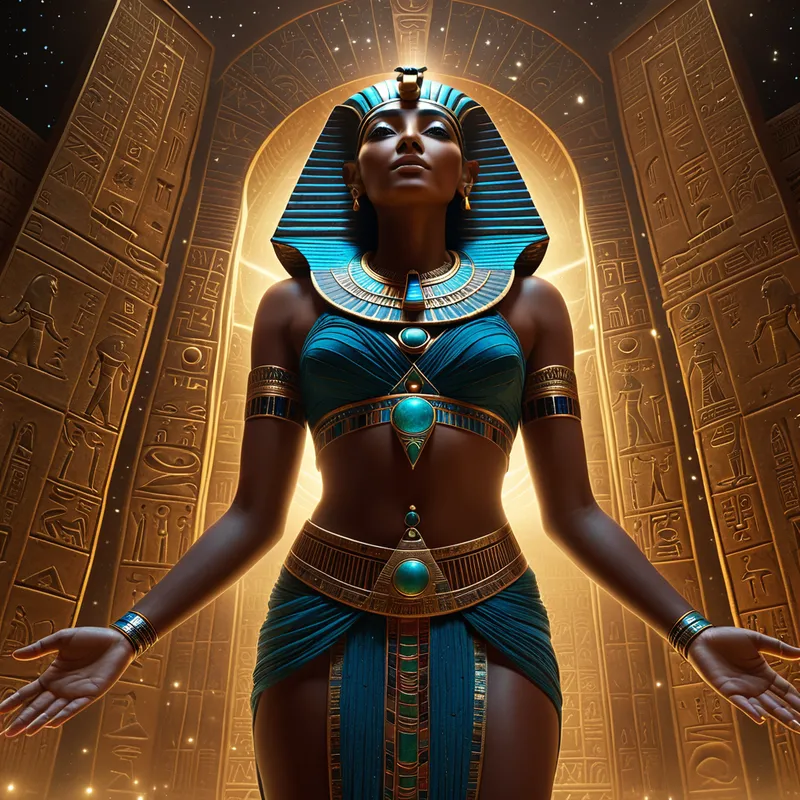
Usekh Collar Myth Meaning & Symbolism
A myth of divine order where a goddess's collar protects the cosmos from primordial chaos, weaving protection from the fabric of existence itself.
The Tale of Usekh Collar
Before the first sunrise etched its gold upon the Nun, there was a sound. Not a roar, but a hum—a vibration threading through the cold, starless dark. It was the sound of a goddess at her loom, but her threads were not flax or reed. They were the potential of all things: the gleam of future metals, the whisper of unspoken names, the cool promise of deep water, and the fierce heat of the sun’s heart.
She was Isis, the Great of Magic, and her work was born of terror. For in the formless deep, the serpent Apep stirred. Its coils were made of negation, its purpose to unravel the fledgling order of the cosmos, to swallow the sun-boat of Ra and return all to silent, hungry nothing.
Isis felt the tremor of his approach in her bones. She saw the fragile Maat—the delicate balance of truth and order—threatened. Protection could not be a wall, for walls can be broken. It could not be a shield, for shields can be bypassed. It had to be an embrace—a containing, affirming circle that would hold the essence of creation itself.
So, she began to weave. From the green of the Nile’s life-blood, she drew a thread. From the red fury of the desert storm, she spun another. She plaited in the deep blue of the night sky where the stars are fixed, and the bright yellow of the sun-disk at dawn. She sang the names of the gods as she worked: the stability of Geb, the sky-vault of Nut, the wisdom of Thoth. Each name became a bead of carnelian, lapis lazuli, feldspar, and gold. She wove in the eye of Horus, seeing all, and the knot of Serqet, binding poison.
The collar grew, wide and layered like the wings of a protective vulture. It was not light; it was dense with purpose. It hummed with the same foundational vibration that had begun her work.
When Apep rose from the abyss, a wave of anti-creation preceding him, Isis did not face him. Instead, she held aloft the finished Usekh. She spoke a single word that was all words: “I am.” The collar erupted not with light, but with presence. It became a microcosm—a perfect, complete circle containing the desert and the river, the sky and the earth, life and the respectful silence of death. It was a map of a functioning universe.
Apep’s chaos broke against this defined, beautiful truth like a wave against a cliff of crystal. The serpent could not comprehend it, could not digest such intricate, affirmed existence. The defined order repelled the formless void. The sun-boat sailed on. The world was held, not by force, but by a necklace of meaning.
Cultural Origins & Context
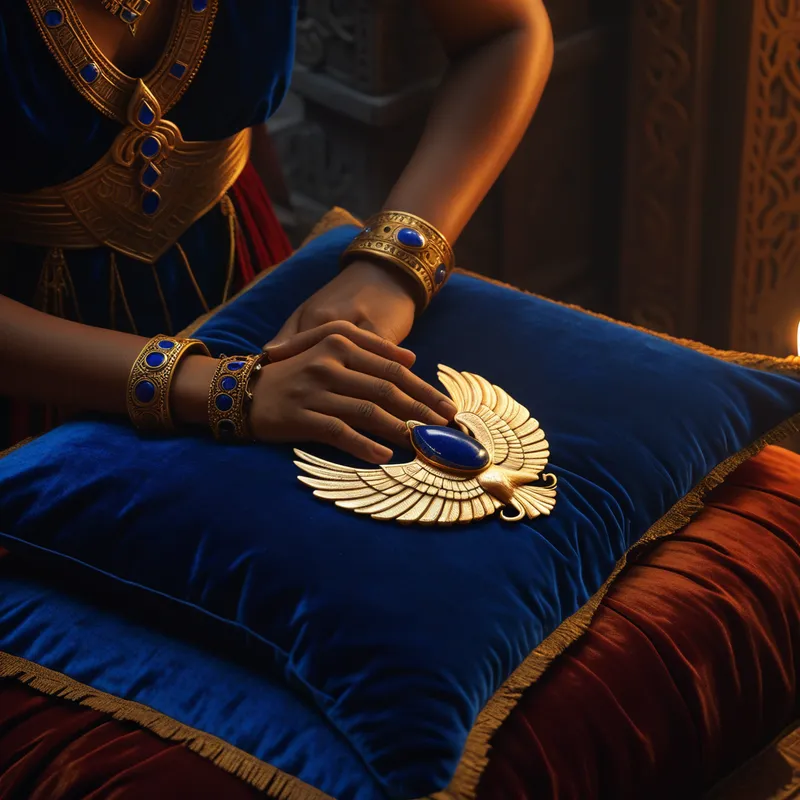
The Usekh collar was not merely jewelry in ancient Egypt; it was a portable cosmos and a shield. While no single, canonical “myth of its creation” exists like those for the Wedjat eye, its symbolic narrative is woven throughout the fabric of religious and royal practice. This “myth” was performed, not just told.
It was worn by gods in temple reliefs, their divine ka (life-force) protected by its layers. It was placed upon the neck of the pharaoh during coronation, transforming him into the living holder of cosmic order, the defender of Maat against the chaos his role obligated him to keep at bay. Most profoundly, it was an essential amulet placed on the mummy. In the perilous journey through the Duat, the deceased’s soul—vulnerable and judged—required this symbolic encapsulation of the whole world and all divine protection to survive the final, transformative ordeal and be reborn.
The myth was thus transmitted by goldsmiths and priests, in the funerary rites of the Book of the Dead, and in the very posture of kingship. Its societal function was foundational: to visually and ritually assert that civilization itself—with its laws, agriculture, and hierarchies—was a sacred, protective act of weaving order from the ever-present threat of disintegration.
Symbolic Architecture
At its core, the Usekh Collar is a symbol of psychic containment. It represents the necessary, beautiful structure the conscious self must build to interface with reality without being dissolved by it.
The circle that protects is not a prison, but a membrane—a definition that allows for exchange, a boundary that makes relationship possible.
Its multiple, ordered rows symbolize the layered complexity of a healthy psyche: the instincts, the emotions, the intellect, and the spirit, all arranged in harmony. Each colorful stone is a distinct aspect of experience—joy (carnelian), depth (lapis), vitality (turquoise)—integrated into a cohesive whole. The clasp, often in the form of twin falcon heads, represents the unifying principle, the conscious “I” that holds the totality together. The myth teaches that we do not face chaos naked. We are meant to be clad in the accumulated, woven wisdom of our experiences, our values, and our connections—our personal Maat.
Psychologically, the serpent Apep represents the unintegrated shadow, the formless anxiety, the depressive pull of meaninglessness, or the raw, unstructured power of the unconscious. The goddess’s act of weaving is the ego’s heroic, creative task: to gather these disparate, often chaotic inner elements (the colored threads) and fashion them into a functional identity that can withstand life’s inevitable crises.
The Dreamer’s Resonance
When the Usekh Collar appears in a modern dream, it rarely arrives whole. The dreamer may be fashioning one, struggling to string beads that keep slipping away. They may be wearing one that feels unbearably heavy, or conversely, so light it seems insubstantial. They may be searching for a lost clasp. These are somatic metaphors for the psyche’s work of integration and protection.
Dreaming of crafting the collar often coincides with a period of pulling one’s life together after a dissolution—a breakup, a career change, a loss. Each bead is a decision, a reclaimed memory, a new habit. The weight of a finished collar in a dream can mirror the weight of responsibility, of a role (caregiver, leader, parent) that feels constricting yet sacred. A broken or stolen collar signals a profound violation of personal boundaries or a crisis of identity, where the dreamer’s carefully constructed sense of self feels under attack from external chaos or internal doubt.
The dream is an image of the psyche’s own immune system. It shows the dreamer the current state of their psychic container—its strength, its ornamentation, its weaknesses—and invites them to participate consciously in its maintenance and repair.
Alchemical Translation
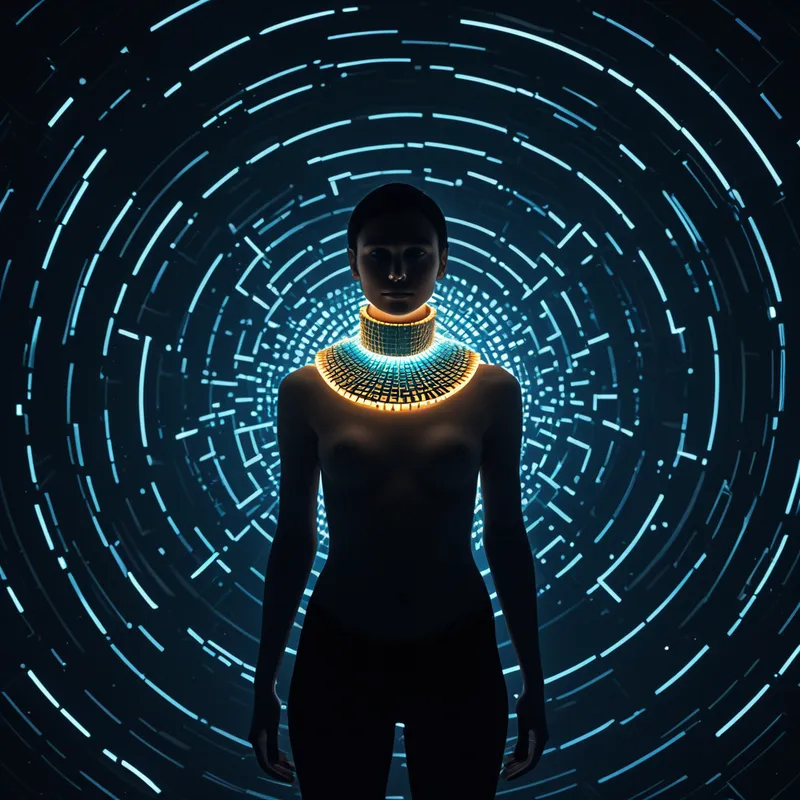
The alchemical process mirrored in this myth is not the dramatic death-and-rebirth of the phoenix, but the meticulous, patient labor of coagulatio—the bringing together of scattered elements to form a solid, lasting substance. The individuation journey is not only about discovering the gold of the Self; it is about fashioning the vessel that can hold it.
Individuation is the craft of becoming your own jeweler, weaving the threads of fate and choice into a collar of authentic being.
The “primordial chaos” is the undifferentiated state of childhood or any unexamined life. The first alchemical step is recognizing the need for a vessel—feeling the threat of overwhelm, anxiety, or meaninglessness (the approach of Apep). The long, often tedious work of therapy, self-reflection, journaling, and relationship-building is the weaving. Each insight is a bead. Each hard-won boundary is a row. Each act of self-forgiveness or integration of a shadow aspect is a protective amulet woven into the design.
The triumphant moment is not an explosion of light, but the quiet, solid realization of “I am.” It is the experience of facing a crisis not with fragmentation, but from within a defined, complex, and beautiful structure of selfhood. You have become both the weaver and the wearer. The finished “collar” is the cohesive personality—resilient, multi-faceted, and capable of containing the full spectrum of human experience without breaking. It allows you to engage with the world’s chaos not from a place of fragile defense, but from a center of composed, adorned, and unassailable order.
Associated Symbols
Explore related symbols from the CaleaDream lexicon: